The shape: what makes a commode "Louis XV"
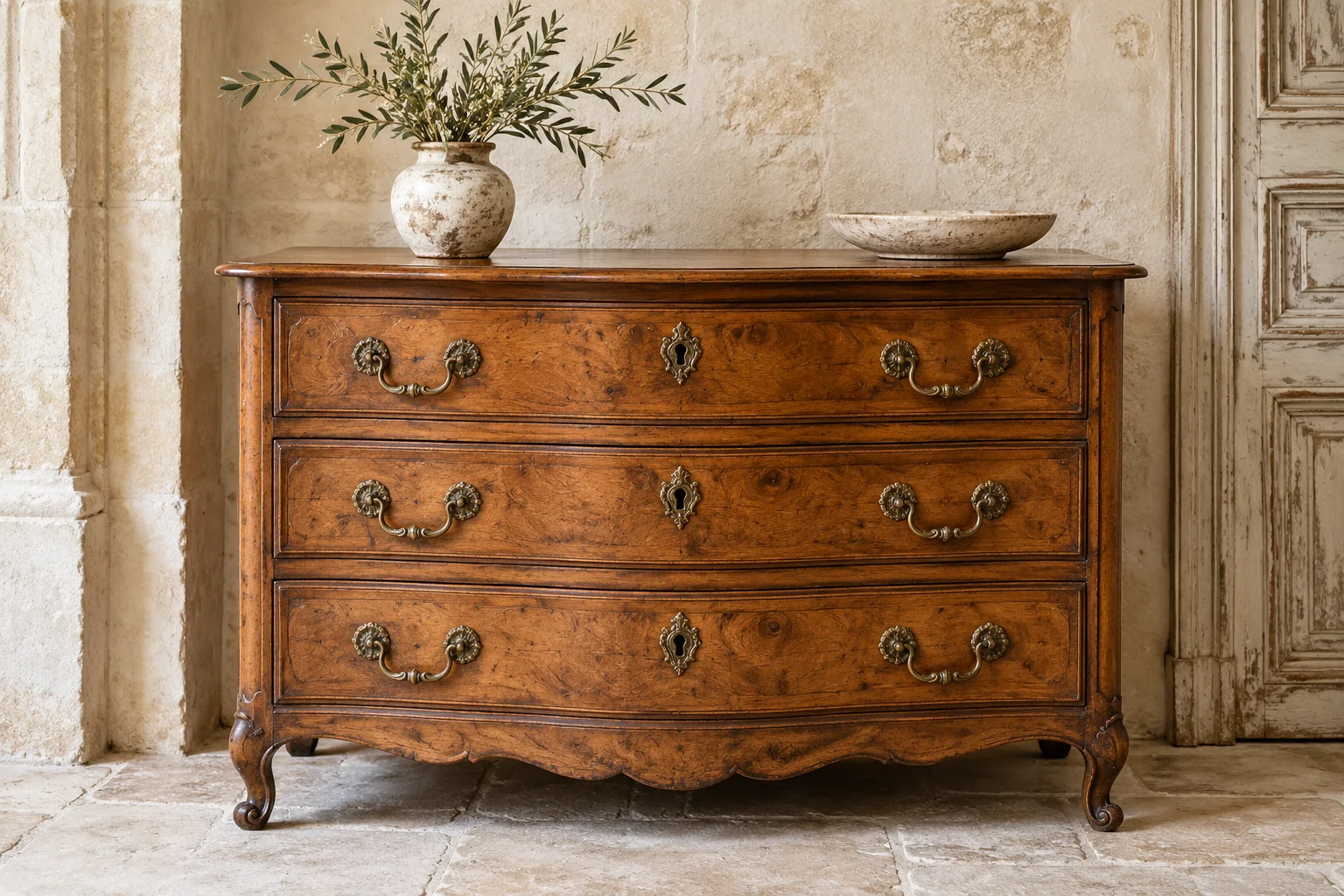
The Louis XV style, at its height between about 1730 and 1760, is the style of the curve. A Louis XV commode usually has:
- a front that bows outward (galbé), often also curved from side to side;
- short cabriole legs flowing out of the case, with no hard break between body and leg;
- a shaped apron below the drawers, often carved with a shell or foliage;
- two or three drawers; a two-drawer commode on taller legs is called a sauteuse;
- on Paris pieces, gilt-bronze mounts and a marble top; on provincial pieces, a solid wood top and iron or brass hardware.
Straight sides, fluted tapered legs and rectangular panels belong to the following Louis XVI style. Pieces that mix both are called Transition.
Period, style or provincial
Period Paris commodes were veneered in exotic woods or marquetry over an oak or pine carcass, mounted in gilt bronze and topped with marble. From the mid-eighteenth century, Paris guild rules required the master cabinetmaker to strike his name into the wood with an iron stamp, the estampille, usually on the top edge of the carcass under the marble or on a rear upright. The guild's own mark, the letters JME, sometimes accompanies it.
Louis XV style commodes were made throughout the nineteenth and twentieth centuries, notably under Napoleon III, by workshops large and small. Some are excellent furniture; a modern workshop name stamped on a style piece is a maker's mark, not an eighteenth-century estampille.
Provincial commodes, from Bordeaux, Provence, the Lyon region or the Southwest, were made in solid walnut, oak, cherry or fruitwood, with carved rather than gilt decoration. Their curves are often generous and their construction plain. For a French country interior these are usually the most natural choice.
Reading the construction
- Drawer joints. Hand-cut dovetails are few, uneven and spaced irregularly. Machine-cut dovetails, regular and numerous, point to the later nineteenth century or after.
- Drawer bottoms. Old bottoms are thick planks, chamfered at the edges and often shrunk away from the sides. Plywood is a later replacement or a later piece.
- Saw and plane marks. Hand tools leave irregular marks on backs and interiors; circular saw marks are regular arcs.
- Unseen wood. Old interior wood is darkened and dry, evenly across the surface. Fresh, pale wood in one area shows a repair or a replacement.
- Hardware. Look for old holes behind the handles and keyhole plates: changed hardware is very common and only a problem if it is undeclared.
- Marble. Check the underside for old repairs and that the marble fits the top exactly. Marble tops were often replaced.
Condition that matters in daily use
Drawers should run without forcing; worn runners can be restored. Lift-prone veneer, cracks across a curved side and woodworm need a cabinetmaker's opinion before purchase. A commode that rocks has usually lost height on one foot.
Living with a Louis XV commode
A curved walnut commode in a bedroom or entrance, with a mirror above and a lamp on one side, is one of the classic French country arrangements. Leave 30 in (75 cm) in front of it to open the drawers fully, keep it out of direct sun, and use felt pads under objects on a wood top. The contrast with a modern sofa works too, as we explain in pairing a modern sofa with an antique chest.
See also French dresser explained: commode, vaisselier or chest?, the dressers & chests of drawers category and reproductions vs antique and vintage.
Frequently asked questions
What is the difference between a Louis XV and a Louis XVI commode?
Louis XV commodes are curved: bowed fronts, cabriole legs, shaped aprons. Louis XVI commodes are straight, with rectangular panels and tapered, often fluted legs.
Does a stamp prove that a commode is eighteenth-century?
An estampille of a documented Paris master is strong evidence, but stamps were also added to later furniture. It must agree with the construction, the wood and the mounts.
Is a "Louis XV style" commode a fake?
No. "Style" means a later piece in that taste. It is honest if described as such, and many style commodes are well-made furniture.