Take an Inventory of the Contents
Gather representative examples: papers, pouches, thread spools, small tools or towels. Measure their footprint, then add the space needed to pick them up. A drawer that holds an object perfectly but requires everything to be removed to reach it is not necessarily practical. In a workshop, visible categories may matter more than maximum capacity; in an entryway, simple access becomes the priority.
Also compare frequency of use. Deep compartments suit sets of items stored together, while small drawers separate accessories. Closed furniture reduces visual clutter but may require labels or a precise organizational system. We recommend leaving a few spaces empty from the start: storage filled to its maximum capacity quickly becomes inflexible.
Inspect the Mechanisms and Interior
Ask for photographs with drawers open and removed, as well as views of bottoms and sides. Examine wear on runners, handles and visible repairs. A replacement drawer may be entirely usable; it simply needs to be described. A door that is difficult to close calls for an explanation before you plan its contents. Do not force an old lock to find out whether it works.
Check odors, internal marks and added linings. The furniture's original purpose, when known, may affect your project, but should not be invented from decorative labels. For a workshop cabinet, ask what is documented about its previous use. The strength of a thin bottom panel cannot be judged by the apparent weight of the front.
Bring the Cabinet into a Living Space
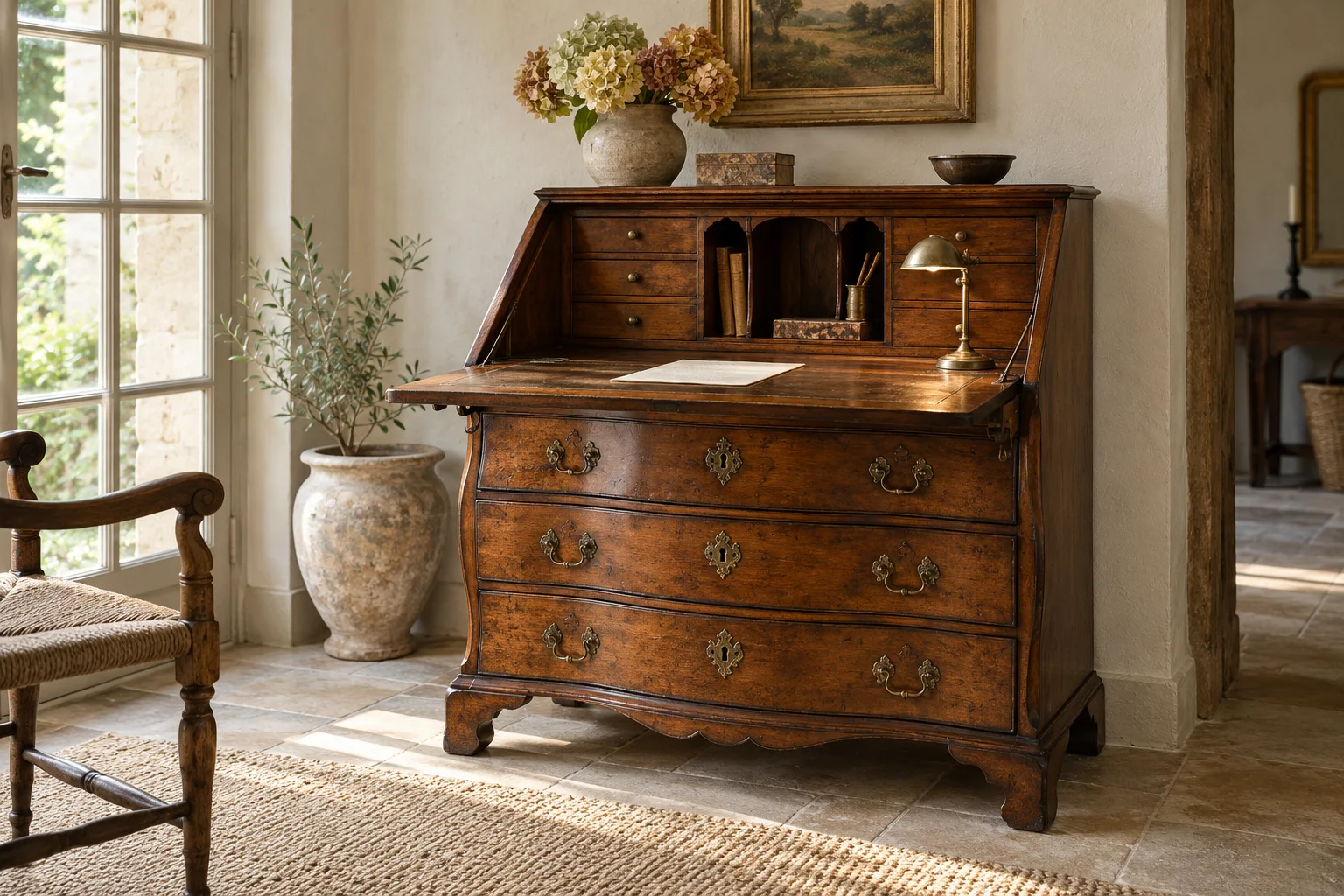
In a French country home, an antique storage piece can belong in a quiet study, a dry laundry room or a creative workshop. Pair it with simple containers and an uncluttered work surface. If its facade has a strong rhythm, avoid adding too many surrounding patterns: the repeated drawers already provide decoration. Give the top a clear purpose.
The Canadian Conservation Institute draws attention to the role of finishes in furniture preservation. Before stripping a surface, consider what can be kept and seek advice on fragile finishes. For interior organization, favor fitted, removable solutions without improvised gluing to the sides. Reversible organization allows a future change of use without unnecessarily altering the furniture.
What to compare
| Configuration | Suggested Use | Point to Consider |
|---|---|---|
| Small drawers | Separate supplies | Opening and usable dimensions |
| Open cubbies | Visible objects | Dust and depth |
| Closed cabinet | Discreet storage | Access and shelves |
Your buying checklist
Continue planning your room
Frequently asked questions
Can a workshop cabinet become kitchen storage?
You need to understand its condition and, as far as possible, its previous uses. For utensils or food, do not assume that simple cleaning answers every question. A decorative role or storage for nonfood objects may be more appropriate when the history or condition of the surfaces remains uncertain.
How do I organize a cabinet with many small drawers?
Group objects by activity rather than material alone: sewing, mail, drawing or minor repairs. Use reversible labels and reserve the easiest drawers to reach for everyday needs. Review whether the system still matches your habits instead of automatically filling every compartment simply because the furniture provides the space.
Must all the drawers slide perfectly?
They should work well enough for the intended use without being forced. Uneven movement can have several causes that deserve examination. Ask for a demonstration and a description of repairs; furniture intended for everyday use needs more reliable operation than a piece whose principal role is display.
Can shelves be added to a small cabinet?
Yes, if the solution respects the construction and planned load, but do not drill before examining existing supports. Removable fittings may be sufficient. For fragile or significant furniture, ask for a proposal that retains original components and allows a return to the previous configuration if your needs change.
Sources & further reading
- Canadian Conservation Institute — Care of Furniture Finishes — Identifying finishes and taking care before cleaning or altering them.