The main French chandelier forms and how to recognize them
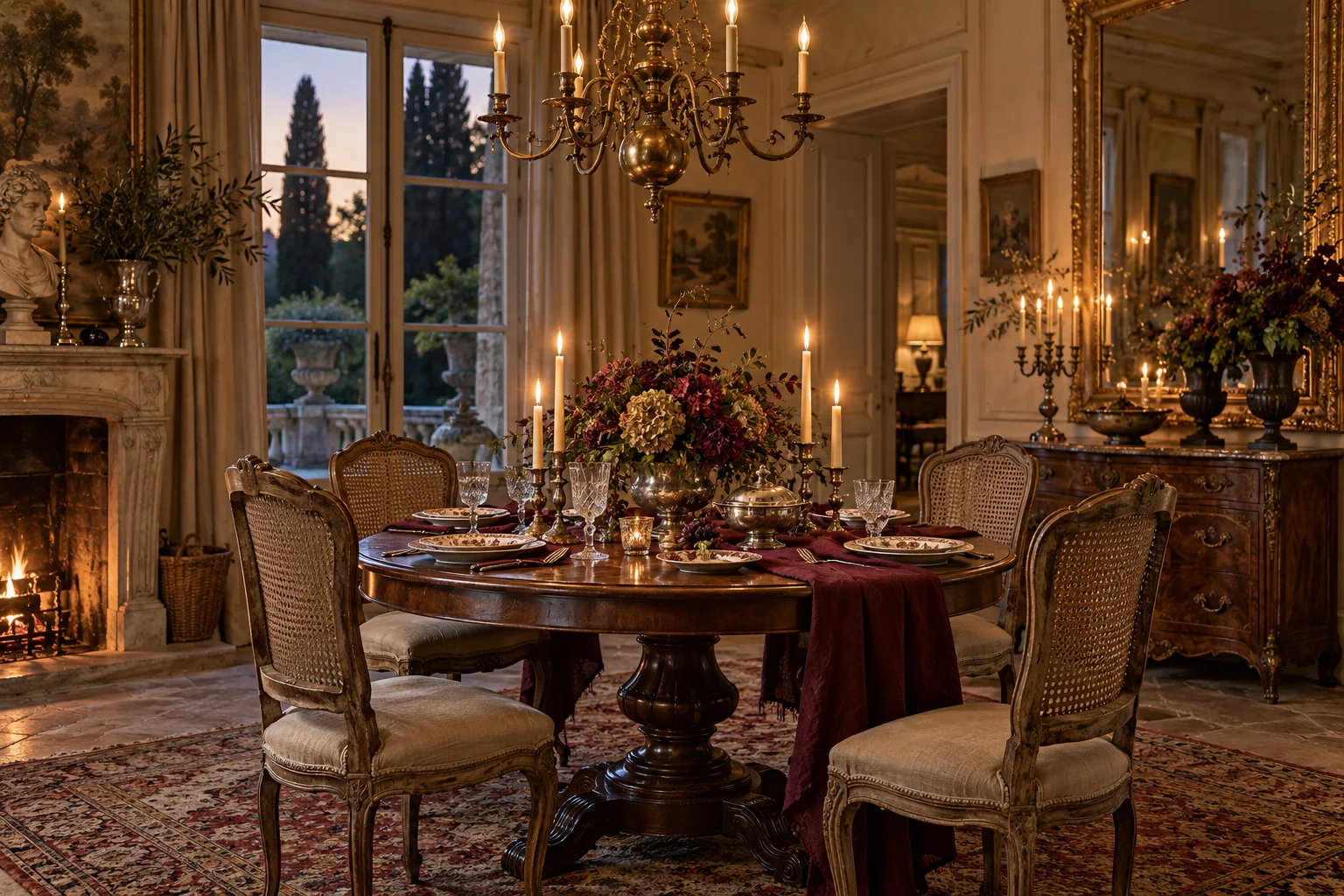
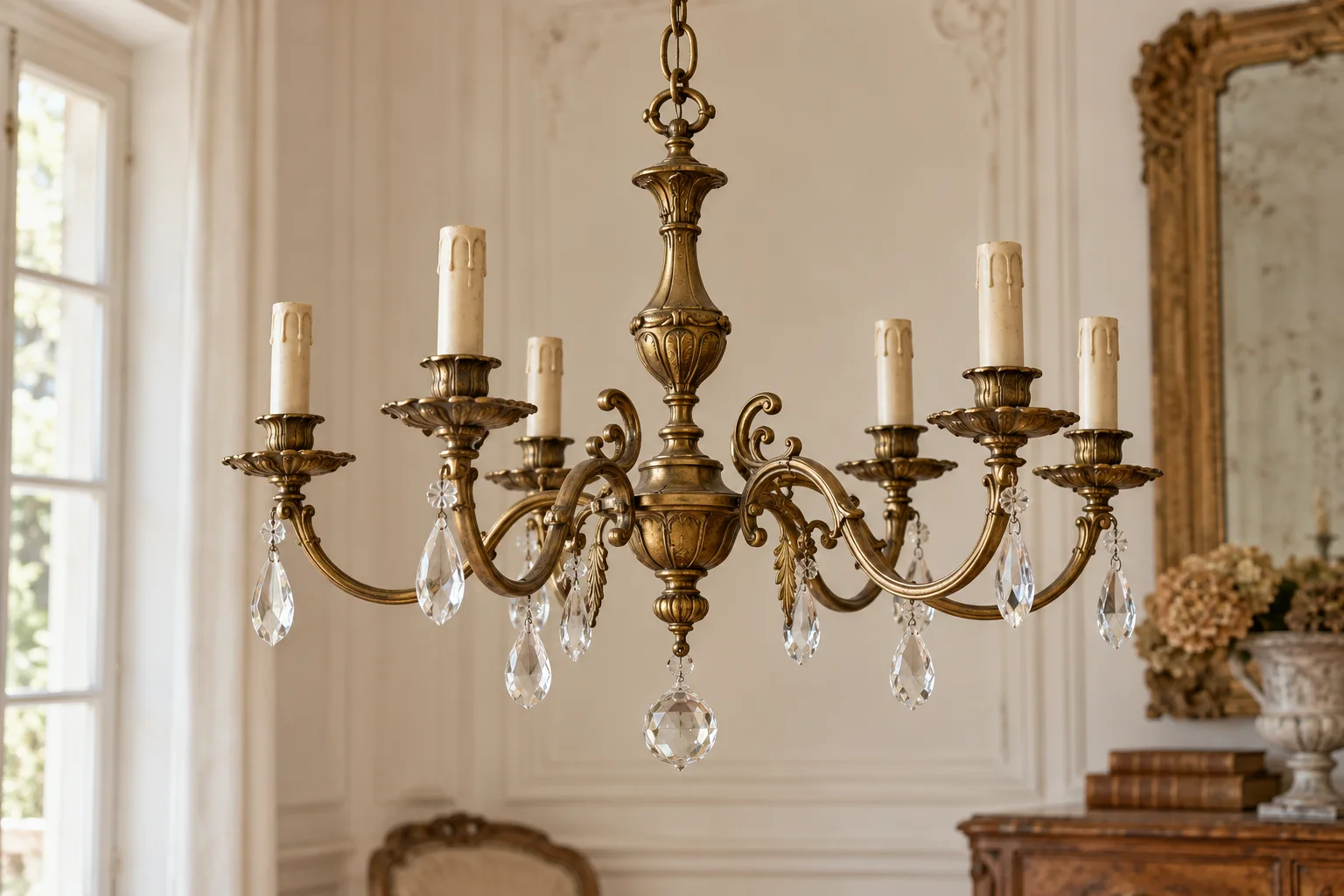
The lustre à cage is a gilt-iron frame dressed with cut drops, the eighteenth-century form that most people picture first. A Louis XV chandelier carries scrolling bronze arms, rocaille leaves and a deliberate asymmetry; a Louis XVI chandelier straightens the lines and adds swags, laurel and urns. The Empire chandelier hangs a ring or crown of gilt bronze from chains, with palmettes or eagles and a central bag of crystal strands. Painted sheet metal, called tole, gives the provincial forms: a basket of flowers, a hoop with leaves, a forged-iron frame with candle arms. Between 1920 and 1940 the Art Deco chandelier replaced crystal with pressed or frosted glass bowls and tulips on nickel or bronze frames.
Each of these names describes a form, not a date. Paris foundries revived the Louis styles throughout the nineteenth century, and workshops in France, Italy and Spain produced every form again after 1950. A period attribution rests on documents, foundry marks, old wiring channels and construction evidence such as hand-finished castings and wrought pins. Without those, describe a French chandelier by its style and its materials, and let the price follow the condition rather than a hoped-for century.
Size, height and placement over a table
Two rules settle the size. Over a dining table, the chandelier diameter should be between one half and two thirds of the table width: a 40 in (102 cm) table takes a 20 to 26 in (51 to 66 cm) chandelier. For a room without a table, add the length and width of the room in feet and read the total as a diameter in inches: a 12 by 14 ft room suggests about 26 in (66 cm). The lowest point should hang 30 to 36 in (76 to 91 cm) above the table top, and at least 7 ft (213 cm) above the floor anywhere people walk.
Weight decides the fixing. A six-arm brass and crystal chandelier weighs 20 to 40 lb (9 to 18 kg); a large cage or Empire bag can pass 60 lb (27 kg). Standard ceiling boxes are commonly rated for 50 lb, so a heavier piece needs a box and brace rated for its weight, installed by an electrician. Light output comes from five to eight candle bulbs; LED candles of 25 to 40 W equivalent at 2700 K on a dimmer give the warm, low light that the forms were designed for.
Wiring, crystal and the condition checks
Chandeliers from France arrive wired for 230 V with sockets that do not meet US listing. Rewiring to 120 V with UL-listed candelabra sockets, new wire threaded through each arm and new candle covers is routine work for a lighting restorer, and it should be done before the piece is hung. Ask whether the chains, hook and canopy are original or replaced, and whether the arms thread firmly into the body; an arm that turns freely has stripped threads.
Crystal is checked drop by drop. Cut lead crystal has sharp facets, weight in the hand and a clear ring when tapped; pressed glass shows soft edges and mould seams. Count the drops per arm, since every arm should carry the same number, and look for replacements that read brighter or clearer than their neighbours. Old crystal often carries a faint grey tone and small inclusions. A few missing prisms are normal and replaceable; bent arms, cracked bobeches and corroded steel pins are the faults to price. Gilt surfaces are dusted, never sprayed; the Canadian Conservation Institute describes safe handling of gilt and lacquered metal.
What to compare
| Form | Suggested Use | Decisive Check |
|---|---|---|
| Louis XV bronze and crystal | Formal dining room with a high ceiling | Arm castings, gilding and thread fit |
| Empire ring with crystal bag | Dining room or entrance hall | Strands complete, frame weight and fixing |
| Tole and iron country form | Kitchen or room with a low ceiling | Paint stability and rust at joints |
| Art Deco glass bowl | Hallway, bedroom or study | Glass chips and the fitter that holds the bowl |
Your buying checklist
Continue planning your room
Frequently asked questions
What is the difference between a French chandelier and a French-style chandelier?
A French chandelier was made in France; a French-style chandelier copies a French form and may come from Italy, Spain or a modern factory. The form alone does not settle the question. Documents, foundry marks, old wiring channels and hand-finished castings support an origin and a period. Without them, describe the piece by its style and materials.
How high should a French chandelier hang above a dining table?
Hang the lowest point 30 to 36 in (76 to 91 cm) above the table top. In a room with an 8 ft ceiling that usually means a short chain or a rod. Keep 7 ft (213 cm) of clearance in any area people walk through, and choose a diameter between one half and two thirds of the table width.
Can an antique French chandelier be used in the United States?
Yes, after rewiring. Chandeliers from France are wired for 230 V with sockets that are not listed for US use. A lighting restorer replaces the wire through each arm, fits UL-listed candelabra sockets and new candle covers, and checks the hook and chain. An electrician then confirms the ceiling box is rated for the weight.
How do I know if the crystal on a chandelier is real?
Cut lead crystal has sharp, precise facets, noticeable weight and a clear ring when tapped gently with a fingernail. Pressed glass shows softer edges and faint mould seams. Compare drops across the piece: replacements often look brighter than the older crystal, which carries a faint grey tone and small inclusions.
Sources & further reading
- Canadian Conservation Institute — Care of metal objects — Safe cleaning and handling of gilt, lacquered and bare metal on lighting frames.
- Canadian Conservation Institute — Caring for ceramic and glass objects — Handling and washing glass drops without scratching or thermal shock.