Structure first: gravel, hedges and the straight line
The first principle is an axis. Stand at the main door and draw a straight line into the garden: a gravel path, a mown strip, a row of pots. Everything else hangs off that line. The second is enclosure: low clipped hedges, walls or a trellis to frame the space. Box was the traditional hedge; where box blight and the box tree moth are present, yew, Japanese holly, euonymus or lavender give the same line.
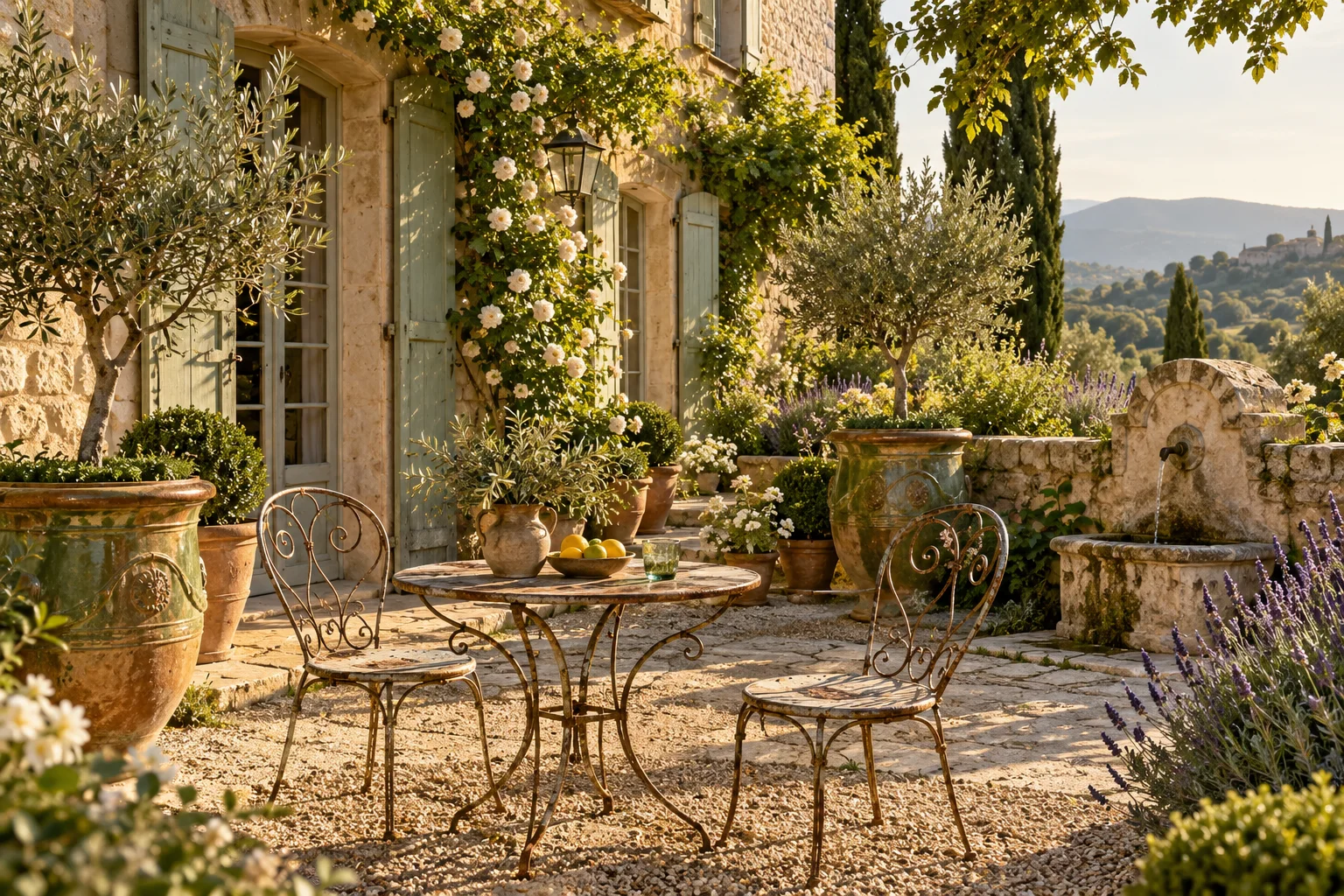
Gravel is the French floor. A court of 0.4 in (10 mm) gravel over a compacted base, edged in stone or steel, takes chairs, tables and pots without lawn edges to maintain. A simplified parterre is four squares of gravel or lawn around a central point, which is all most country gardens need.
The potager, the water and the shade
The third principle is the potager: a kitchen garden laid out in squares with paths between them, vegetables mixed with cut flowers and fruit trained flat against a wall or along wires. Beds of 4 ft (122 cm) width can be worked from both sides. The fourth is water, kept simple: a stone basin, a cast iron or zinc trough, a small fountain with a still surface that reflects the sky.
The fifth is shade. A lime, a plane tree or a vine on a pergola over the dining table makes the garden usable in July. Plant the tree first and the furniture under it later; a pergola of 8 ft (2.4 m) height clears a standing adult and a chandelier of lanterns.
Antiques outdoors: where iron, stone and terracotta belong
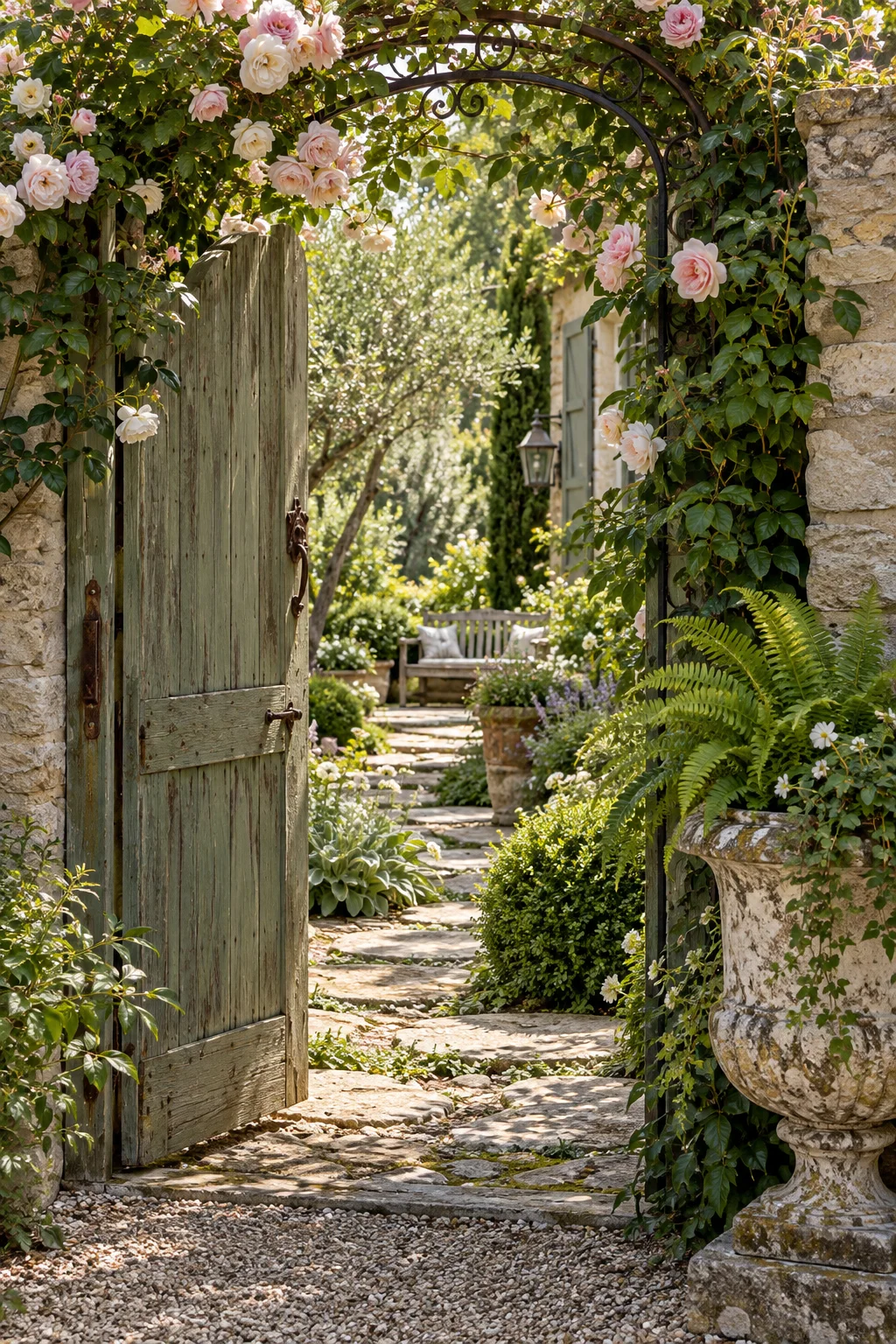
The sixth principle is restraint with objects. One bench on the axis, a pair of urns at the steps, pots in pairs by the door, a trellis on the blank wall: each piece has a job and a place. Iron furniture lives on gravel or stone, never on soil; the Canadian Conservation Institute guidance on metal objects supports keeping iron dry and coated to slow corrosion. Terracotta and glazed jars need feet and a liner, and shelter where winters freeze, as the guidance on ceramic objects also supports.
Stone and cast iron are heavy; set them on a level pad. Zinc planters and wooden caisses take the lighter spots: window ledges, steps, the terrace edge. Weathering is part of the look, but rot, frost flakes and rust through are not, so check each piece before winter rather than after.
What to compare
| Form | Suggested Use | Decisive Check |
|---|---|---|
| Gravel court with clipped edge | Dining and seating near the house | Compacted base, edging, drainage |
| Potager in four squares | Vegetables, cut flowers, fruit on wires | Bed width, path width, sun |
| Basin or trough with still water | A focal point on the axis | Leaks, frost, a drain |
Your buying checklist
Continue planning your room
Frequently asked questions
What makes a garden look French?
Structure before planting: a straight axis from the house, gravel instead of lawn near the door, low clipped hedges or walls that frame the space, and a few well-placed objects such as a pair of pots, a bench or a basin. Plants are kept in simple blocks and the palette is restrained. The effect comes from the lines, not from the number of flowers.
Do I need a formal parterre for a French country garden?
No. A parterre with scrolls and colored gravel needs constant clipping and a large flat site. A country garden gets the same character from four squares of gravel or lawn around a central point, edged with a low hedge or stone. The potager, laid out in squares with paths, is the working version of the same idea.
Which plants give a French country garden its look?
Clipped evergreens for the structure (yew, holly, euonymus, or box where it stays healthy), lavender and rosemary along gravel, roses on walls, lime or plane trees for shade, and fruit trees trained flat. In the potager, vegetables grow beside dahlias, cosmos and sweet peas for cutting. Choose plants suited to your climate rather than to Provence.
Can antiques be left outside in a French-style garden?
Iron benches, cast iron urns and stone pieces stay out all year on a hard, level base with sound paint or a dry position. Terracotta, glazed jars and zinc need feet, drainage and shelter from hard frost. Wooden benches last outside only in oak, chestnut or teak. Check every piece in autumn for water that can freeze inside it.
Sources & further reading
- Canadian Conservation Institute — Care of metal objects — Supports keeping iron garden pieces dry and coated to slow corrosion.
- Canadian Conservation Institute — Caring for ceramic and glass objects — Supports protecting terracotta and glazed earthenware from standing water and freezing.