What makes a Louis Philippe mirror recognisable
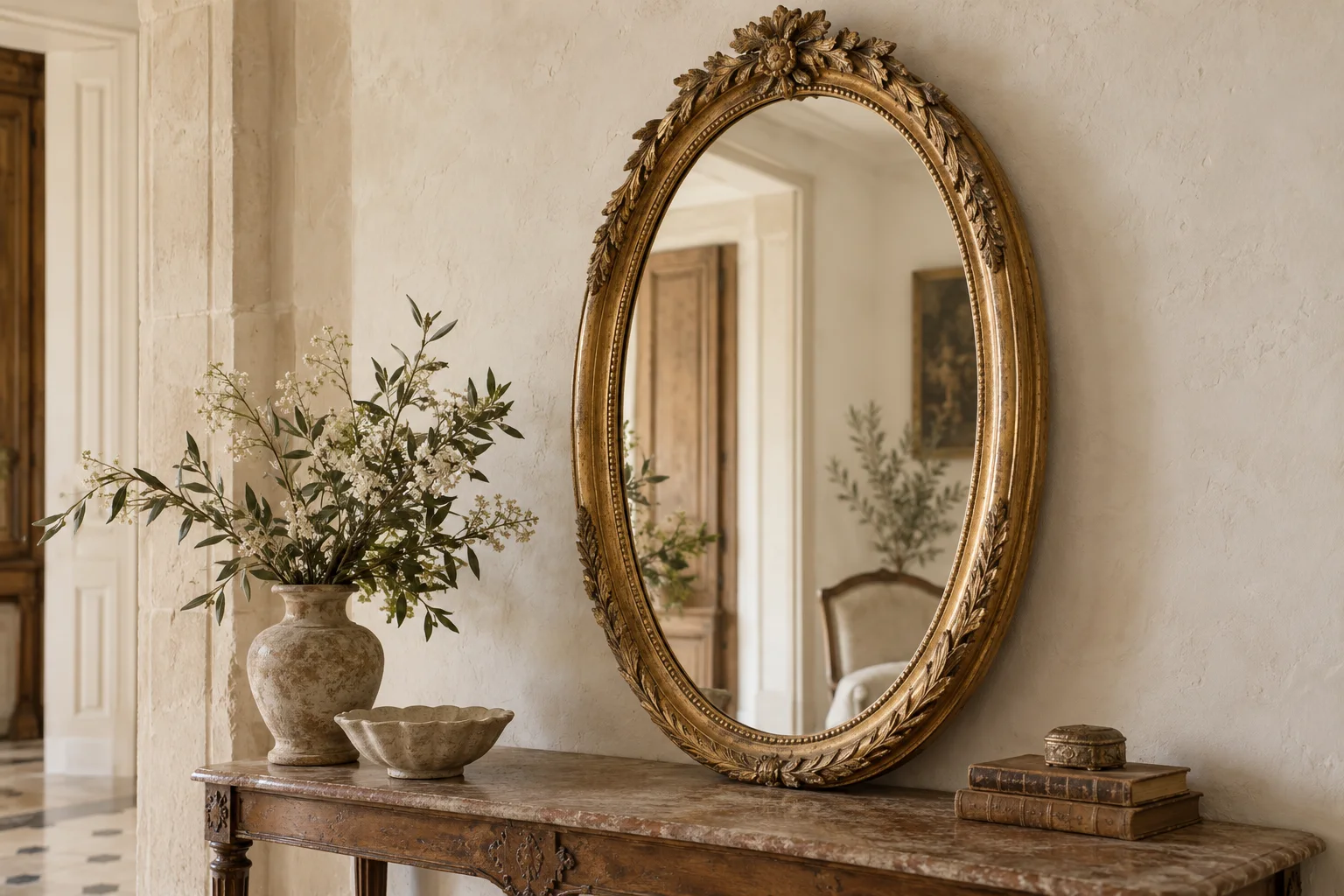
Four features define the form. The two upper corners are rounded, usually with a radius of 3 to 6 in (8 to 15 cm), while the lower corners stay square. The frame is a plain moulding, often with a stepped profile and a narrow inner slip, rather than carved ornament. The proportions are vertical, commonly 30 to 40 in wide by 40 to 60 in tall (76 to 102 cm by 102 to 152 cm). The surface is gilt, sometimes with a contrasting painted or ebonized inner band.
Many of these mirrors were made to stand on a mantel and lean against the wall, which is why the lower rail is often wider than the sides: it took the weight. A frame with a thicker lower rail and wear along its bottom edge has likely spent its life on a chimney piece. The plain surface is the point of the style; a Louis Philippe frame with applied flowers at the corners has usually been embellished later.
Period versus style: what a date claim should rest on
A seller who writes 'Louis Philippe mirror' describes a form. A seller who writes 'period Louis Philippe' claims a date between about 1830 and 1850, and that claim needs support: the construction of the frame, the gesso and gilding layers, the back boards and nails, and ideally a provenance. The form was produced through the Second Empire and the Third Republic, and reproduced in the 1950s to 1980s in composition and in plaster. None of those later mirrors is a fake; they are the same design made at a different time.
Look at the back for evidence rather than at the front. Hand-planed pine boards, oxidized to a dark brown, with cut or early wire nails, suggest a 19th-century frame. Plywood, hardboard or a single machine-sawn panel points to the 20th century. Mercury-silvered glass with soft gray reflection and edge foxing is consistent with older production, while a bright, perfectly flat plate is modern. Describe what you see; do not let the style name carry a date it cannot prove.
The glass, the gilding and what to accept
Original glass on a Louis Philippe mirror is often slightly wavy, with a gray cast and spots along the lower edge where condensation collected on a cold chimney breast. Many frames have been reglazed, and a reglazed frame is a sensible choice for daily use. Ask whether the glass is original, bevelled or flat, and whether the back board has been opened.
The gilding on plain mouldings is usually water gilding, burnished on the flat faces. Expect honest wear at the rounded corners and along the lower rail. Regilding is common and should be disclosed. A uniformly bright surface with no bole showing at the corners suggests metal leaf or gold paint; it will tarnish and is worth knowing about before you pay for 'original gilt'.
Hanging or leaning a mirror this size
A 36 by 54 in (91 by 137 cm) Louis Philippe mirror with its glass can weigh 50 to 80 lb (23 to 36 kg). Leaning it on a mantel is the historical solution, with two discreet mirror plates or a safety strap fixed to the wall so it cannot tip. Hung flat, it needs two fixings into studs or masonry anchors and D-rings with wire rated above the weight, or better, a French cleat along the top rail.
In a dining room, a large plain gilt rectangle doubles the light from a chandelier and sits well above a sideboard. In a bedroom, lean it on a chest of drawers for a dressing mirror. Keep it away from radiators and working fireplaces, which dry the gesso and open the corner joints.
What to compare
| Form | Suggested Use | Decisive Check |
|---|---|---|
| Mantel mirror with wide lower rail | Living room chimney piece, leaning with safety strap | Wear along the bottom edge; strap fixing to the wall |
| Hung vertical frame | Dining room above a sideboard, bedroom | Two fixings into studs; weight of frame and glass |
| 20th-century composition frame in the style | Everyday use, hallways, bathrooms | Hardboard back, modern glass; priced and described as 'style', not period |
Your buying checklist
Continue planning your room
Frequently asked questions
How can you tell a period Louis Philippe mirror from a later one in the same style?
Turn it round. Hand-planed, darkened pine boards with cut nails, old gesso cracks following the wood grain and gray, spotted mercury glass are consistent with 19th-century production. Plywood or hardboard backs, staples and a bright flat plate point to the 20th century. The front alone cannot settle the question, and a style name is not a date.
Are Louis Philippe mirrors always gilt?
Most are, but not all. Some frames were ebonized, painted or finished in a two-tone scheme with a gilt outer moulding and a dark inner band. Plain gilt remains the most common finish because it was the fashion for apartment chimney pieces. A painted frame is not a lesser mirror; describe the finish and its condition rather than assuming gilt is the original state.
Can a Louis Philippe mirror lean on a mantel safely?
Yes, this is how most were used. Place the wide lower rail on the mantel shelf, tilt the top slightly back and fix a safety strap or two mirror plates to the wall so the frame cannot slide forward. Keep the mantel clear of heat from a working fire, because heat dries the gesso and loosens the corner joints over time.
What size Louis Philippe mirror suits a sideboard?
Choose a frame roughly two thirds of the sideboard width and hang it with a gap of 6 to 10 in (15 to 25 cm) above the top. A 60 in (152 cm) sideboard carries a 36 to 40 in (91 to 102 cm) wide mirror well. Taller frames, 54 in (137 cm) and more, need ceiling height of at least 9 ft (2.7 m) to sit comfortably.
Sources & further reading
- Canadian Conservation Institute — Basic care: furniture and objects made of wood — Supports reading construction from the back of a wooden frame and keeping gilded wood away from heat sources.
- Canadian Conservation Institute — Caring for ceramic and glass objects — Supports the description of silvering deterioration and the handling of old glass plates.