Commode: the French chest of drawers
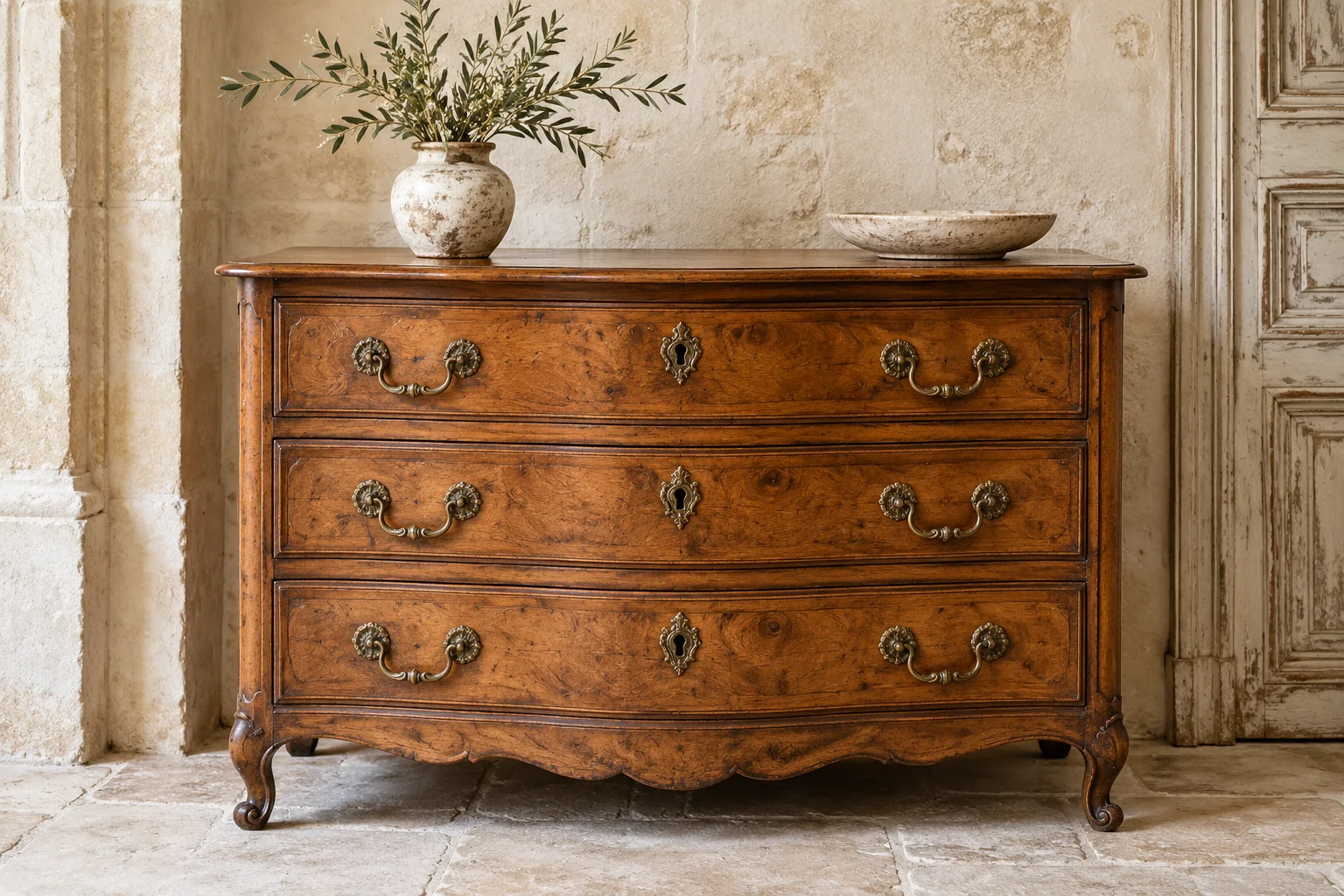
A commode carries two to four drawers in a case that stands 32 to 36 in (81 to 91 cm) high and 44 to 52 in (112 to 132 cm) wide. Louis XV commodes curve on every face; Louis XVI commodes straighten and fluting replaces the curves; Louis-Philippe commodes, the commonest in French houses, are plain, in walnut or mahogany, with a marble top. A tall, narrow case of six or seven drawers is a chiffonnier, covered in the guide to dressers and tall chests. The Metropolitan Museum describes the eighteenth-century case forms that these names come from.
Checks follow the drawers. Remove each one and look at the sides for hand-cut dovetails and at the bottom for the direction of the grain and the oxidation. A marble top is checked for cracks and old repairs, and the carcass under it for stains, since marble tops were fitted to many commodes in the nineteenth century. Locks are often present without keys. In a bedroom, a commode under a mirror takes the place of an American dresser exactly.
Vaisselier: the plate dresser
A vaisselier is a buffet base carrying an open rack with grooved shelves and guard rails for plates. Breton, Lorrain and Norman versions differ in carving and in the shape of the rails, but all stand 80 to 90 in (203 to 229 cm) high and come apart into two pieces for moving. In a kitchen or dining room the vaisselier does what a British dresser or an American hutch does: it stores dishes below and shows them above. The buffets and sideboards catalogue includes the form.
The main check is whether the rack belongs to the base. Compare the wood, the colour of the oxidation on the back, the wear at the points where the two meet and the joinery; a marriage of two pieces is common and should be priced as such. Look at the grooves in the shelves for wear from plates, and at the back boards of the rack, which were often thin and replaced. Plates of 10 to 11 in (26 to 28 cm) need about 11 in of shelf height between rails.
Buffet, bonnetière and the words in a French listing
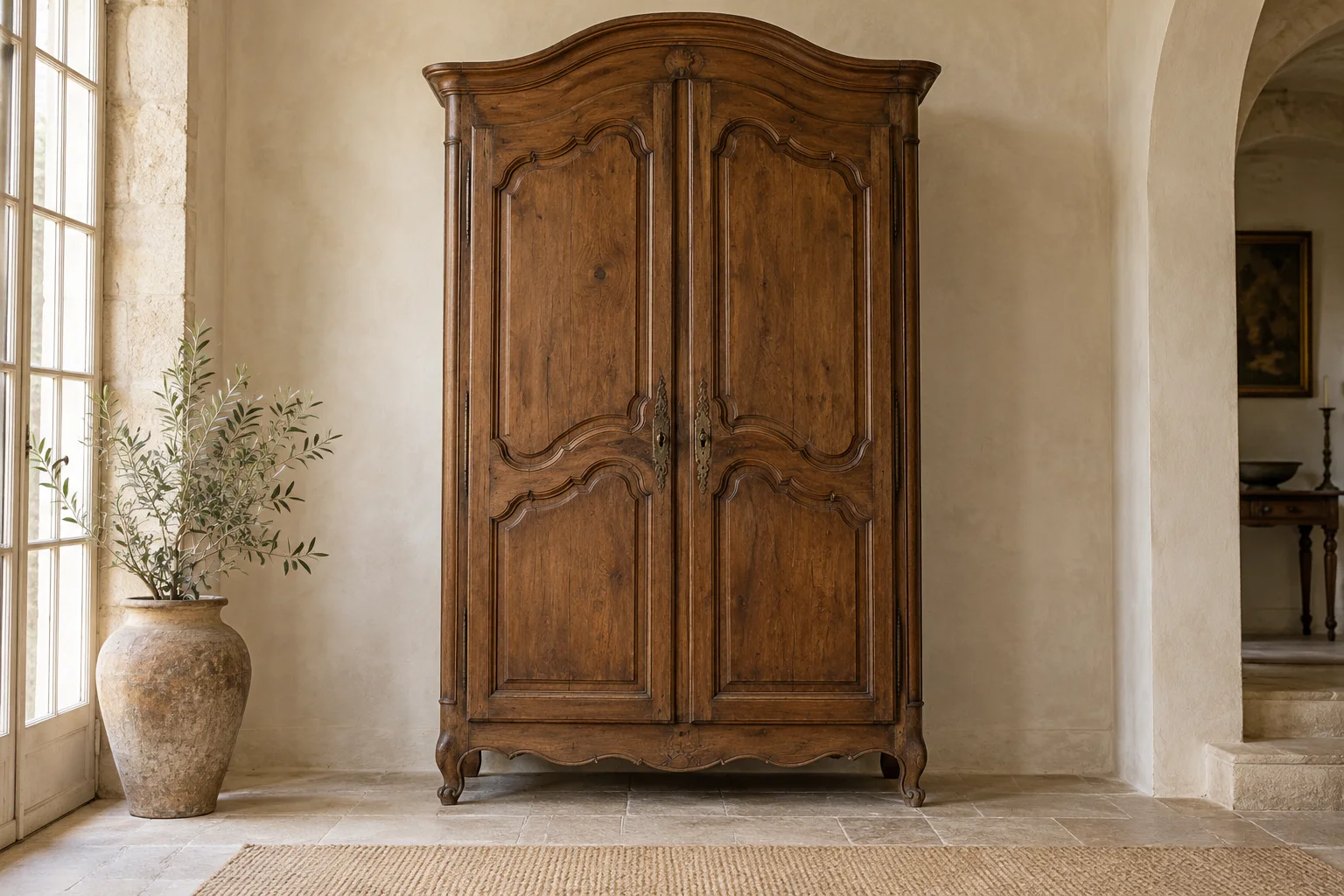
The buffet bas is the low two-door cabinet with drawers above the doors; the bonnetière is a narrow single-door cupboard; the armoire is the tall two-door wardrobe. French listings use a vocabulary worth learning: tiroirs are drawers, portes are doors, dessus de marbre is a marble top, noyer is walnut, chêne oak, merisier cherry. Dimensions appear as H x L x P, height, width and depth, in centimetres.
Two words decide what you are reading. Époque means the piece is claimed to date from the period named; style means it imitates that period and may be a century younger. A listing that says style Louis XV is honest about a later piece; a listing that says époque Louis XV is making a claim that needs documents or construction evidence to support it. Buy on the evidence, and let the vocabulary tell you which piece you are looking at.
What to compare
| Form | Suggested Use | Decisive Check |
|---|---|---|
| Commode with drawers | Bedroom or hallway, under a mirror | Dovetails, drawer bottoms and the top |
| Vaisselier with plate rack | Kitchen or dining room | Rack original to the base, shelf grooves |
| Buffet bas with doors | Dining room or entry | Hinges, door drop and backboards |
| Chiffonnier, tall and narrow | Small bedroom | Stability and the drawer runners |
Your buying checklist
Continue planning your room
Frequently asked questions
What do the French call a dresser?
It depends on which dresser you mean. A chest of drawers is a commode; a cabinet with a plate rack is a vaisselier; a low two-door cabinet is a buffet; a dressing table is a coiffeuse. French listings describe each by its parts, with tiroirs for drawers and portes for doors, so read the form before the name.
Is a vaisselier the same as a hutch?
Broadly, yes. Both are a cabinet base carrying an open rack for plates, used in a kitchen or dining room. A French vaisselier stands 80 to 90 in high, separates into two pieces for moving, and varies by region in its carving and rails. Check that the rack and base belong together.
What size is a French commode?
Most commodes stand 32 to 36 in (81 to 91 cm) high, 44 to 52 in (112 to 132 cm) wide and 20 to 24 in (51 to 61 cm) deep, with two to four drawers. That makes them the same height as an American dresser and a natural piece to set under a mirror in a bedroom or an entrance.
What does époque mean in a French furniture listing?
Époque means the seller claims the piece dates from the period named, for example époque Louis XV. Style means the piece imitates that period and may be much younger. Treat an époque claim as unproven until documents or construction evidence support it, and expect a style piece to be described honestly as later.
Sources & further reading
- The Metropolitan Museum of Art — French Furniture in the Eighteenth Century: Case Furniture — The eighteenth-century French case forms, commode included, that later styles imitate.
- Getty — Pair of commodes (documented example with replaced tops) — A documented pair of commodes recording veneers, carcass and replaced tops.