FRENCH ANTIQUES · FOUND OBJECTS, FRESH IDEAS, A HOME
In Gascony, the furniture most buyers call French provincial has a local name: "Louis XV and Louis XVI de campagne", the country versions of the Paris styles. The Gascon writer Joseph de Pesquidoux traced how they appeared: journeymen joiners walked the great road between Toulouse and Bordeaux, came home and built the curves of the court in a single local wood. This guide follows that history from the bare medieval farmhouse to the furnished house of 1900, then turns it into practical checks for buying an armoire, a table or a set of chairs.
From a single chest to a furnished house
Pesquidoux opens his account of the Gascon home with almost nothing in it. In the oldest farmhouses, the bedroom contained a bed on four posts and one piece of furniture, the clothes chest. People ate standing in the kitchen. Seats were stools or sections of tree trunk cut at knee height.
Furniture arrived in stages, and each stage left forms that survive in the antiques trade today:
The first additions: benches, and a plate rack or open dresser (vaisselier) standing on four feet.
Around 1400, when the timber-framed house with earth infill spread, chairs replaced stools and the chest was joined by a low armoire scarcely taller than the chest itself. A bread cupboard (the huchier) kept the cut loaf fresh. Pewter dishes and tureens appeared on the table.
In the seventeenth century, brick replaced earth in the frame of the better houses, and the furniture of a room began to match. Square straw-seated chairs surrounded a heavy table on X-shaped legs, with a drawer in front of each place, where the morning's leftovers waited for the evening. A two-part armoire with four doors held the household linen.
Two inventions of that period changed daily life, Pesquidoux says: the wall clock with a wooden movement, hung in its case, and the weight-driven roasting jack fixed to the fireplace jamb, so loud when wound that the neighbours heard it. The bedroom gained a bed as wide as it was long, set on a low platform, straw-seated armchairs and a bombé commode for linen.
The road that brought the Louis XV curve to Gascony
The decisive change, in Pesquidoux's telling, came with the great interprovincial road that joined Toulouse to Bordeaux by way of Auch and Mont-de-Marsan. Trade grew along it, money circulated, and Gascon families began to furnish their houses comfortably and prettily. Country mansions in brick or stone, the chartreuses, were completed with glazed windows and parquet laid beside the tiled floors.
Along the same road walked the compagnons, the journeymen of every trade, a gold or silver ring in one ear, making their tour of Languedoc or Guyenne before they could become masters. Each came home with what he had learned in the workshops of the towns, and everyone employed them. From their hands, Pesquidoux writes, came Gascon rustic art.
What "de campagne" means
The furniture they made kept the proportions, line and outline of the Paris model, but it was made of a single material, oak or chestnut, and its decoration was sober. Ornament was usually limited to a moulded frame around panels and drawers, sometimes picked out with a little gilding. Pesquidoux lists the forms:
chairs and armchairs with rounded or oval backs;
commodes;
small occasional tables, very light;
built-in cupboards (placards) and massive buffets;
armoires of two kinds: one with doors running from top to bottom in the same style as the cupboards, the other in two parts with a drawer in the middle, its doors carved with diamond-point panels;
beds with headboard and footboard of equal height, decorated with fluting, under a canopy carried on four iron rods.
The canopy rings jingled at the slightest movement, and the bed panels and canopy were covered with toile de Jouy or with red-and-blue or blue-and-white checked cloth nailed in place. Those textiles have their own article: Gascon bed hangings.
The end of a local style
By the middle of the nineteenth century, Pesquidoux notes, Gascon rustic art was disappearing. Furniture from distant factories and town shops filled the houses, and the Paris department stores, Le Bon Marché and the Louvre, sent clothes by mail order. A farmhouse furnished in 1900 might therefore hold eighteenth-century country pieces next to recent factory furniture, which is exactly what you find when such houses are cleared today.
What a furnished farmhouse looked like around 1900
A detailed account of a sharecropping family in the Orthe district, near the Adour, reproduced in Archives de Gascogne, shows how much this furniture mattered. Almost all of it was walnut, with some pieces in chestnut and oak. It was rubbed every week with vinegar. The peasant's luxury, the author writes, was to own a complete set of furniture of this quality, and families put their pride and their savings into it until they reached the standard expected by custom. We list that household's furniture, with the values recorded at the time, in What a Gascon farmhouse owned.
In the Lot-et-Garonne, the doctor and architectural historian Alfred Cayla found that the kitchen almost always held a plate dresser and a tall longcase clock. Our encyclopedia has entries on the hutch and vaisselier and the French longcase clock.
Dating country Louis XV: why the style is not the date
The most important point for buyers is that a country style does not give a precise date. Rural joiners went on making Louis XV curves long after Paris had moved on, and a Gascon armoire in the Louis XV manner may have been made in the late eighteenth century or well into the nineteenth. A wedding armoire ordered in 1840 could still have a shaped cornice and cabriole feet. Date a piece by its construction, its wood and its wear, not by its outline. Our article on antique, vintage or reproduction French country furniture covers the general method.
How to check a Gascon country piece
The wood
Oak shows a strong grain and, where the board was cut across the growth rings, the silvery flecks of the medullary rays.
Chestnut looks very like oak but lacks those ray flecks, and it is lighter in weight. It was widely used in the southwest.
Walnut, the preferred wood of the Orthe sharecroppers, has a finer, closer grain and a warm brown colour that deepens with polish.
One wood throughout, with secondary boards in the same or a cheaper local timber, is consistent with the "de campagne" tradition. Veneer on a country armoire is unusual and worth questioning.
The construction
Look for mortise-and-tenon joints held with wooden pegs, which often stand slightly proud of the surface after centuries of shrinkage.
Pull out a drawer: hand-cut dovetails are irregular and few; machine dovetails are even and numerous.
Check the hinges. Long iron hinge pins (fiches) and hand-forged ironwork are expected; modern screws in old holes suggest repair.
Look at the back and the underside. Hand-planed boards show shallow scallops; circular saw marks point to later work.
Look at the wear: feet worn by mopping, edges rounded by hands, a darker patina where people touched the doors.
The carving
Country carving is restrained and confident: a moulded frame, a shell or flower on the apron, fluting on bed posts, diamond-point panels on armoire doors. Very deep, crowded carving on a supposedly rustic Gascon piece is a reason to ask whether it was added later to raise the price.
Living with the furniture today
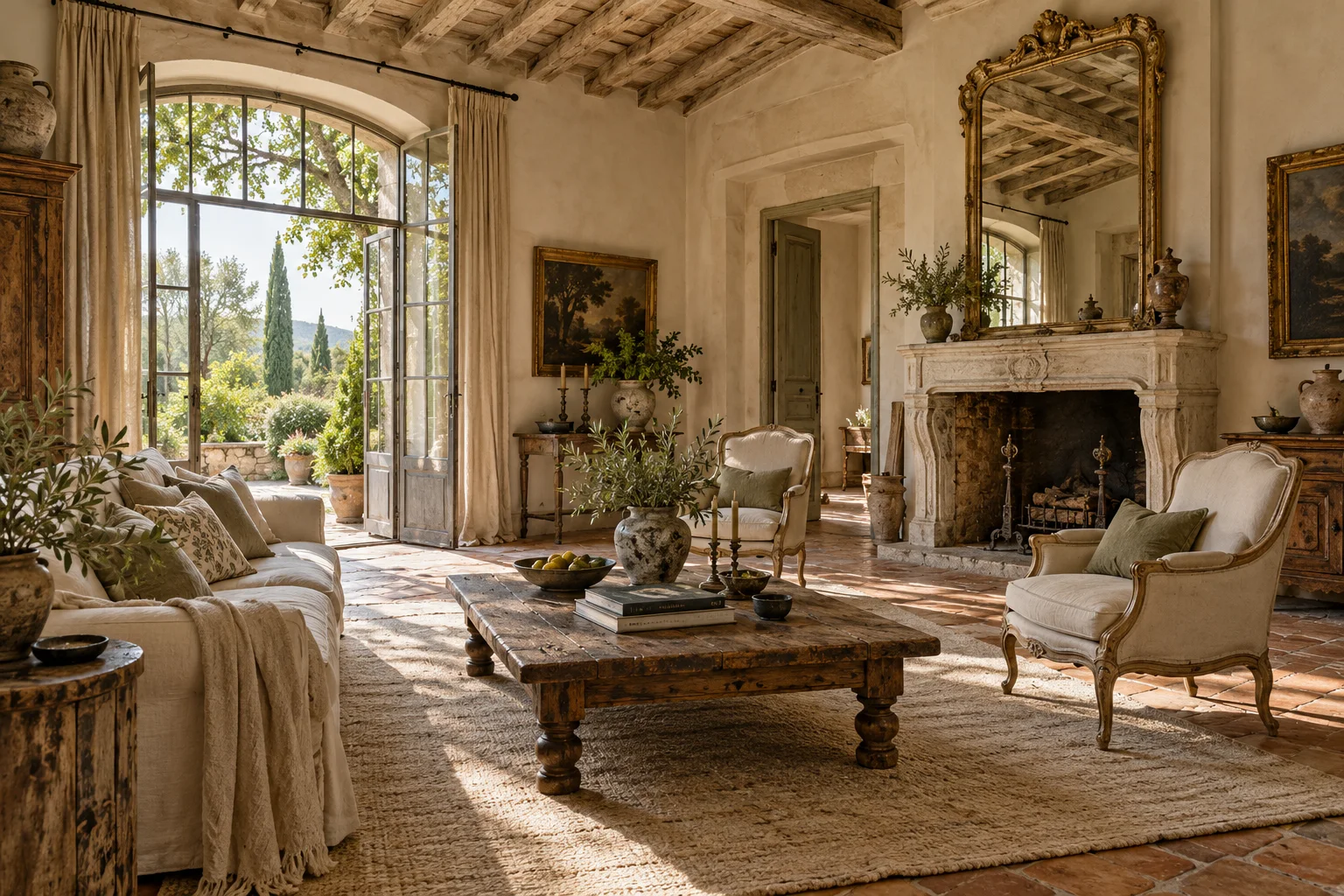
These pieces were built for houses with thick walls, tiled floors and cool rooms. Keep them away from radiators, avoid direct sun that bleaches walnut and chestnut, and maintain a stable humidity, roughly 45 to 60 percent. Clean with a barely damp cloth and feed the surface with a good wax once or twice a year. The vinegar rub of the Orthe households is not recommended on old finishes. A Gascon armoire looks most at home on terracotta, with plain limewashed walls around it; our Gascon farmhouse style page shows how to assemble the rest of the room.
What to compare
Wood
How to recognise it
What it suggests
Oak
Open grain, silvery ray flecks on quartered boards, heavy
Widely used; typical of country Louis XV
Chestnut
Oak-like grain without ray flecks, lighter
Very common in the southwest; often cheaper than oak today
Walnut
Fine close grain, warm brown, takes a deep polish
The preferred wood of well-off farm households around 1900
It is the country version of the Louis XV style: furniture that keeps the proportions and curves of the Paris model but is made by local joiners in a single solid wood, usually oak, chestnut or walnut, with sober carving limited to mouldings, shells, flowers or fluting.
Who made Gascon country furniture?
According to Joseph de Pesquidoux, it was made by local joiners who had travelled as journeymen along the Toulouse to Bordeaux road and learned the urban styles in town workshops before returning to their villages.
Is a Louis XV style country armoire from the eighteenth century?
Not necessarily. Rural joiners continued to use Louis XV forms well into the nineteenth century, so the date must come from the construction, the wood, the ironwork and the wear rather than from the style alone.
How can I tell oak from chestnut?
Both have a similar open grain, but oak shows silvery ray flecks where the board was cut across the growth rings, while chestnut does not. Chestnut is also lighter in weight.
Sources & further reading
Joseph de Pesquidoux, La Gascogne, Paris and Grenoble, B. Arthaud, 1951: the evolution of the Gascon home and the "Louis XV and Louis XVI de campagne".
Jacques Borgé and Nicolas Viasnoff, Archives de Gascogne, Éditions Michèle Trinckvel, 1993: monograph of a sharecropping family of the Orthe district by the baron d'Artigues.
Dr Alfred Cayla, Maisons de Guyenne et de Gascogne, Éditions Serg, 1977: interiors of the Lot-et-Garonne farmhouse.
By Fernand Lou Perriquet · Published November 7, 2026 · Illustrations are AI-created and do not show available stock. How we research and write our guides ↗
French country kitchen cabinets are often not cabinets in the fitted sense: a dresser with plates on its rack, a two-part buffet for glass and linen, open shelves…