Anduze jars: the glazed garden vase from the Cévennes
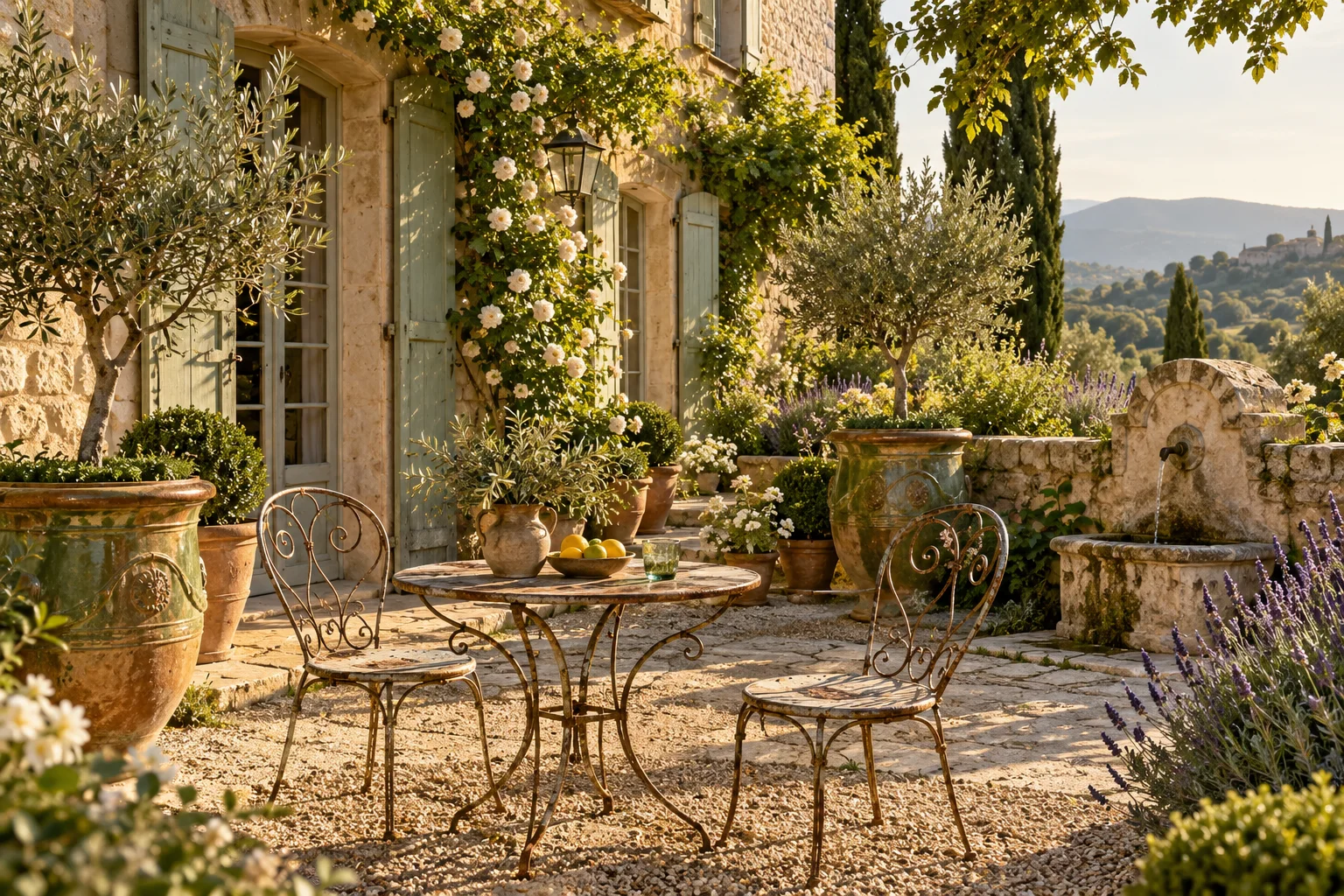
The Anduze jar (vase d’Anduze) is a tall, flaring terracotta vase with a flame glaze in green, honey and brown, decorated with garlands and medallions; the medallion often carries the maker’s name and sometimes a date. The form has been made in the town of Anduze, in the Gard, for centuries, and it is still made there today, so a jar is dated only by its stamp, its documents or its wear.
Sizes run from table-top jars of about 12 in (30 cm) to garden jars of 40 in (100 cm) and more; a pair of 24–28 in (61–71 cm) jars suits most doorways. The glaze protects the outside, but the body is porous earthenware: in hard frost, a planted jar can spall or crack. Plant into a liner, raise the jar on feet, and move it under cover where winters are severe. The Canadian Conservation Institute guidance on ceramic objects supports keeping glazed earthenware dry and away from freezing when it is wet.
Caisses de Versailles: the wooden box that opens
The caisse de Versailles is a square wooden box with four corner posts topped by finials, designed for the orange trees of the royal orangeries. Its defining feature is practical: in the original design the sides lift out, so the roots of a tree could be pruned and the soil renewed without unpotting. Reproductions often have fixed sides; the listing should say which.
Sizes go from 16 in (40 cm) for a clipped box ball to 36 in (90 cm) for a small tree, in oak, chestnut, iroko or painted softwood. Paint was traditionally green or white. Look for rot at the foot of the corner posts and at the base boards, and plan a plastic or zinc liner inside: wet soil against wood is what ends these boxes.
Zinc and tole: light planters for windows, tables and sunrooms
Zinc jardinières are galvanised sheet metal with soldered seams, often oval or rectangular, with handles; tole planters are painted sheet iron, sometimes with decorative edges. Both are light enough for a windowsill or a table and both develop a soft grey or chalky patina as the surface oxidises.
Neither likes standing water. Line a zinc or tole planter with a plastic tray or individual pots, keep a saucer underneath indoors, and empty it after rain outdoors. A pierced base is a sign of outdoor use and does not reduce the value of a working planter. Sizes to remember: a window box of 24–36 in (61–91 cm) holds three 6 in (15 cm) pots; a table jardinière of 12–16 in (30–40 cm) holds a single bulb pot or cut flowers in a jar.
What to compare
| Form | Suggested Use | Decisive Check |
|---|---|---|
| Anduze jar (glazed terracotta) | Doorways, axes, a pair on steps | Glaze losses, cracks, a liner and feet |
| Caisse de Versailles (wood) | Citrus, bay, clipped box | Rot at posts and base, removable sides |
| Zinc or tole jardinière | Windows, tables, sunroom | Seams, pin holes, a liner |
Your buying checklist
Continue planning your room
Frequently asked questions
What is an Anduze jar?
An Anduze jar is a tall, flaring glazed terracotta garden vase decorated with garlands and medallions, made in the town of Anduze in southern France, where the form is still produced. Old and new jars share the same shape and glaze colors, so a jar is dated by the maker’s stamp on its medallion, by documents, or by wear, not by its appearance alone.
Why do caisses de Versailles have removable sides?
The original design let gardeners lift out one side to prune the roots of an orange tree and renew the soil without removing the tree from its box. Many later and reproduction boxes have fixed sides and are purely decorative planters. If root care matters to you, check that the sides actually lift out and that the corner posts are sound.
Can zinc planters stay outside?
Yes, zinc tolerates weather well and develops a soft grey patina, but it must drain. Standing water inside the planter corrodes the seams from within. Pierce the base or line it with removable pots, raise it slightly off the ground, and empty it after heavy rain. Painted tole planters are more fragile and do better under cover.
What size French planter suits a pair by a door?
For a standard door of 36 inches (91 cm), a pair of jars or boxes 22 to 28 inches (56 to 71 cm) tall reads well without blocking the passage. Leave at least 6 inches (15 cm) between planter and door frame. On wide steps, step the pair up one size. Measure the clear width before buying, including the swing of the door.
Sources & further reading
- Canadian Conservation Institute — Caring for ceramic and glass objects — Supports keeping glazed earthenware dry and away from freezing when wet.
- Canadian Conservation Institute — Care of metal objects — Supports draining and drying zinc and painted sheet-metal objects to prevent corrosion.