What vintage means, and how it differs from antique
In customs and in honest listings, an antique is more than 100 years old and documented; a piece made in 1925 crossed that line in 2025, so the boundary moves every year. Vintage usually means a 20th-century piece of known decade, roughly 1920 to 1970 for French country decor, made in workshops or factories rather than by village joiners. Vintage pieces were often produced in series, so matching sets of chairs, glasses or canisters survive, and wear is expected. For the older layer of the style, see our page on French country antiques.
Describe a vintage piece by form, material and decade, and attribute a maker only by mark: a stamp under a chair seat, a label on a lamp base, an impressed mark under a pot. A shape that recalls a famous design describes an inspiration, not a maker. 'Vintage French' on its own says neither where nor when a piece was made; ask for the mark and a photograph of it.
The vintage French pieces to look for
Café seating comes first: bentwood chairs with a round cane or plywood seat, and steel chairs in the form Xavier Pauchard designed for Tolix in 1934, widely copied since; our notes on bentwood bistro chairs and vintage metal chairs explain labels and checks. Enamel kitchenware gives a kitchen color without paint: the blue, white or speckled coffee pot, the canister set marked Sucre, Café, Farine, the colander.
Glass and ceramics fill the shelves. French opaline glass, milky white, pale blue or celadon, appears as vases, boxes and lamp bases. Mid-century ceramics from Vallauris and other workshops bring thick glazes in green, ochre and brown; a signed piece carries an incised or painted mark under the base. Rattan and cane armchairs of the 1950s and 1960s lighten a sunroom or bedroom. Opaline globes, enamel pendant shades and plain brass wall lights are among our vintage lighting.
Where vintage pieces fit, and how to check their condition
Vintage suits rooms of hard daily use. Café chairs and an enamel pot belong in the kitchen; steel chairs and a marble bistro table on the terrace; opaline and ceramic vases on a mantel or a bedroom chest; rattan in a sunroom. Group like with like: five opaline pieces on one shelf read as a collection, scattered they read as clutter. Our vases and ceramics category shows groupings by color.
Checks depend on the material. On enamel, chips inside a pot expose iron that rusts; chips outside are cosmetic. On opaline, look for chips at the rim and interior clouding that will not wash out. On ceramics, run a fingernail along hairlines and tap gently: a dull sound suggests a crack. On bentwood, check that the hoop under the seat is tight; on steel chairs, probe rust at the feet and welds. Old wiring in a vintage lamp should be replaced to US standards before use.
Mixing vintage with older pieces
Vintage and antique pieces work together when they share a material or a color. A 1950s rattan chair sits well beside a 19th-century walnut armoire because both are warm and natural; steel café chairs around an old oak farmhouse table work because the metal echoes old ironwork. Keep one era dominant per room, let the other appear two or three times, and avoid reproductions dressed up as either. The wider style is mapped in French country decor, room by room.
What to compare
| Form | Suggested Use | Decisive Check |
|---|---|---|
| Bentwood or steel café chairs | Kitchen, dining nook, terrace | Tight seat hoop; sound feet and welds; maker stamp |
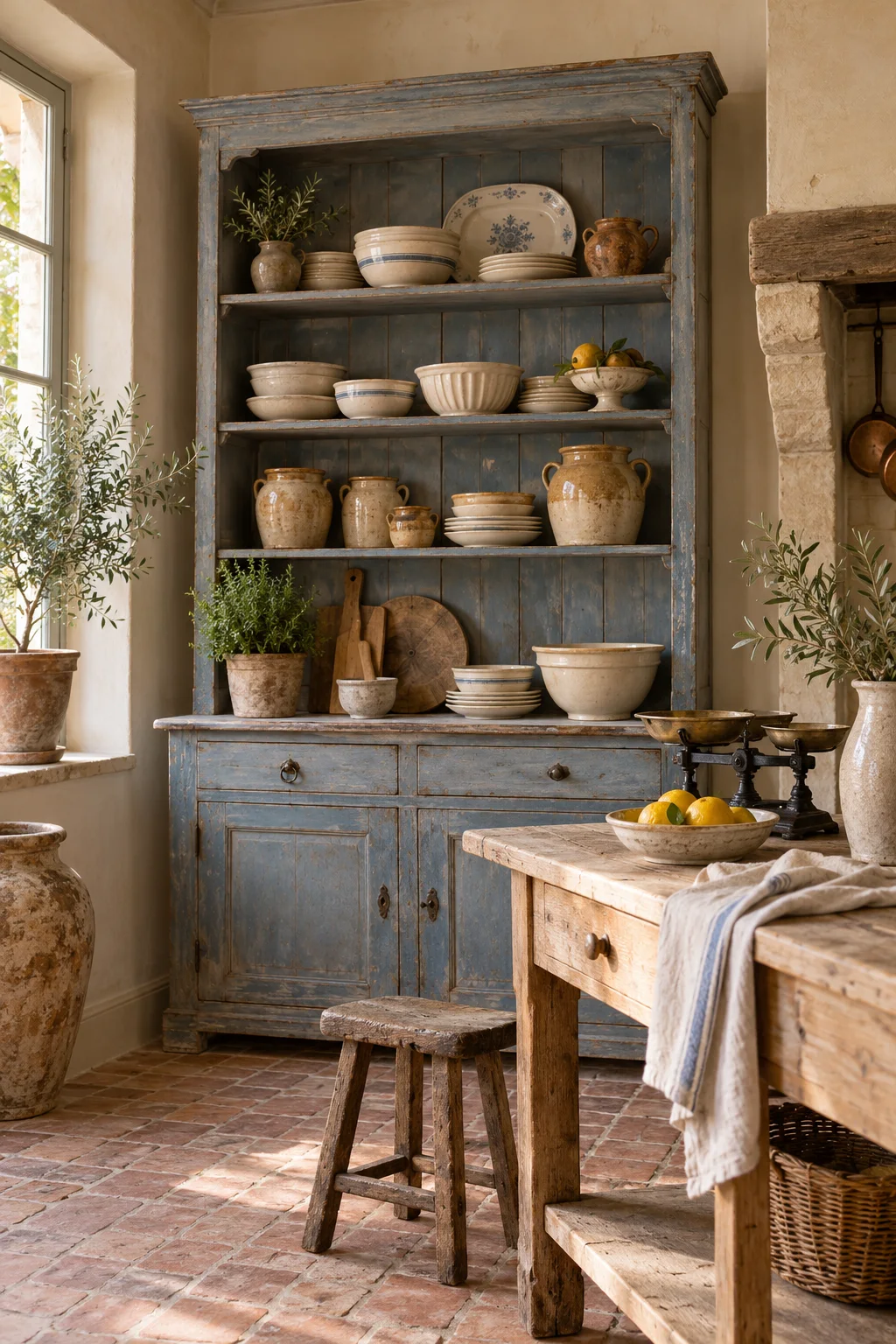
| Enamel coffee pot and canisters | Open kitchen shelves | Chips inside expose iron; lids fit |
| Opaline and 1950s ceramics | Mantel, bedroom chest, grouped shelf | Rim chips, hairlines, mark under the base |
Your buying checklist
Continue planning your room
Frequently asked questions
What is the difference between vintage and antique French decor?
An antique is more than 100 years old and, for customs, documented as such; vintage usually means a 20th-century piece of known decade, for French country decor roughly 1920 to 1970. Vintage pieces were often made in series and for daily use, so sets survive and wear is expected. The line between the two moves forward every year.
What are the key pieces of vintage French country decor?
Bentwood and steel bistro chairs, enamel coffee pots and canister sets, opaline glass vases and boxes, mid-century glazed ceramics, rattan armchairs and simple brass or enamel lighting. Each was made for daily use in a home, a café or a kitchen, which is why these pieces still work in the same rooms today.
How do you check vintage enamelware and opaline glass?
On enamel, look inside first: chips there expose iron that rusts, while chips outside are cosmetic. Lids should fit and handles should be firm. On opaline, run a finger around the rim for chips, hold the piece to the light to look for cracks, and check for interior clouding that will not wash out.
Where can I buy vintage French country decor?
Homeowners can browse the Lo Cantou listings for vintage French kitchen pieces and decor, each photographed with its condition described; check current availability before ordering. Interior designers sourcing for a client can send a brief to Antiques 360 for three documented pieces within 72 hours, with the landed cost known upfront.
Sources & further reading
- Canadian Conservation Institute — Caring for ceramic and glass objects — Handling and cleaning glass and ceramics, including opaline and glazed pottery.
- Canadian Conservation Institute — Care of metal objects — Keeping iron and steel dry to limit corrosion, relevant to chipped enamel and steel chairs.