Toile de Jouy: history, scale and placement
Toile de Jouy is a printed cotton showing pastoral or narrative scenes in a single color, red, blue, sepia, green or black, on a cream ground. The name comes from the manufactory Christophe-Philippe Oberkampf founded at Jouy-en-Josas, near Versailles, in 1760, which printed from wood blocks and later from engraved copper plates and rollers. The pattern has been reprinted ever since, so 'toile de Jouy' today names a type of printed scene, not the factory.
Scale decides placement. A large toile, with a vertical repeat of 25 in (64 cm) or more, needs a wide surface to read: curtains, a bed canopy, wallpaper or a headboard. On a small cushion the scene is cut into fragments. Use one toile per room and let its print color set the accent: a red toile with red gingham or a red ticking stripe, a blue toile with blue and white.
Gingham, ticking stripes and Provençal prints
Gingham, called vichy in France after the spa town, is a woven check of one color and white, from 1/8 in (3 mm) squares to 1 in (25 mm) and larger. Small checks suit kitchen curtains, tablecloths and seat pads; large ones suit cushions and slipcovers. Ticking, toile à matelas, is a tightly woven cotton or linen stripe made for mattress and pillow covers; narrow stripes in blue, red, black or brown on cream are hard-wearing on chairs, cushions and bench pads.
Provençal prints descend from the indiennes, printed cottons brought from India in the 17th century and so popular that France banned their import and manufacture from 1686 to 1759. After the ban, workshops in Provence and elsewhere printed small floral and paisley patterns in saturated yellow, red, blue and green, often with a border. These small repeats suit tablecloths, quilted boutis and cushions, and mix easily with stripes.
How to mix French country patterns
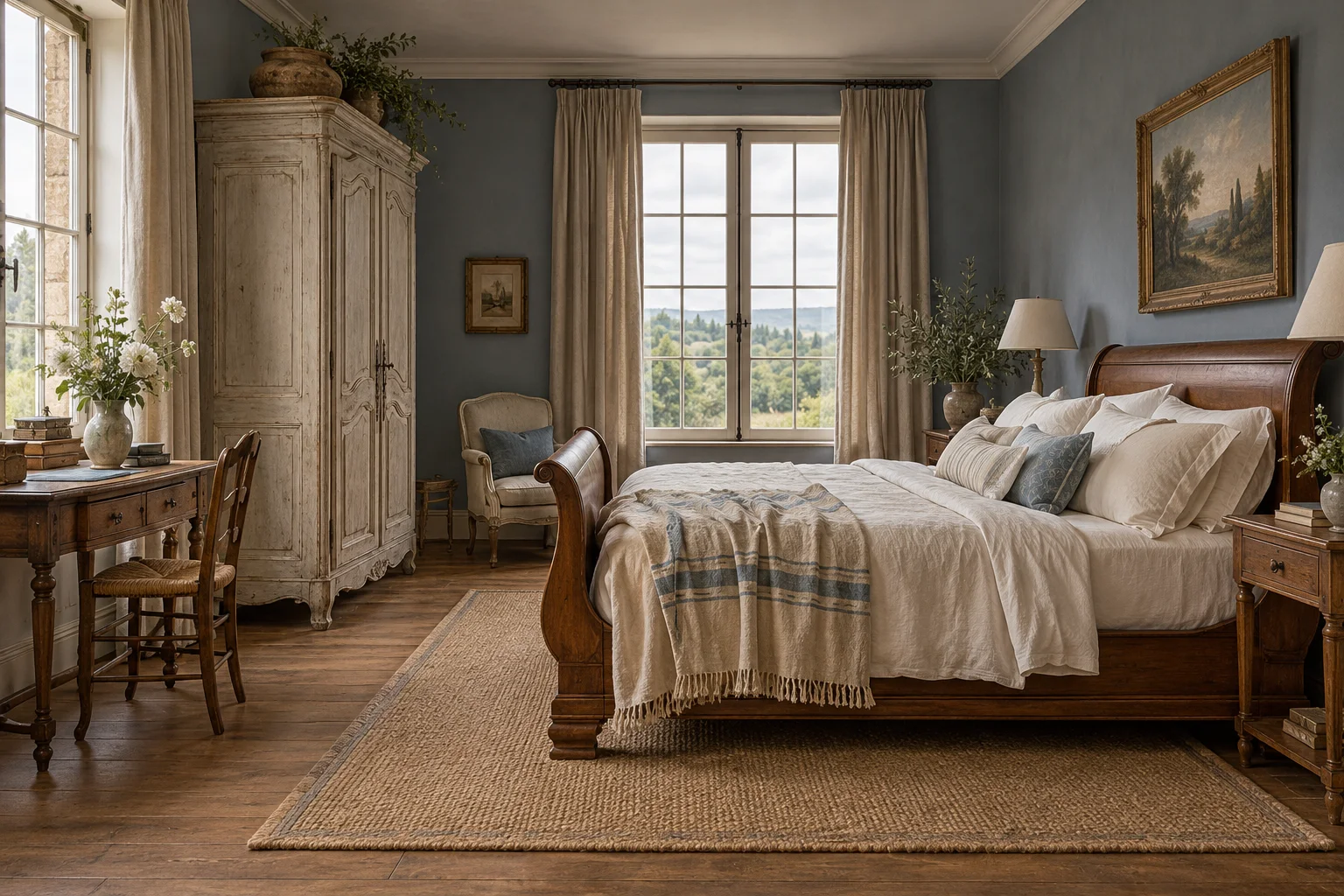
Combine three scales: one large pattern, such as a toile or a big floral; one medium, such as a ticking stripe or a 1/2 in (12 mm) check; and one small, such as a tiny Provençal print. Tie them with one shared color, and let plain linen in oatmeal, white or gray carry the larger surfaces. A useful proportion is about 60 percent plain, 30 percent medium pattern and 10 percent bold. In a French country bedroom, that can mean linen sheets, a ticking-striped headboard and toile curtains.
Antique linen and hemp add texture without pattern: monogrammed sheets, heavy grain sacks, kitchen towels with a red stripe. Our page on French linen and antique textiles explains weights and weaves, and old linens ready to use shows cushions and sheets. Floors can carry the bolder pattern instead: a worn rug or tapestry in faded red and ochre balances plain upholstery.
Antique or reproduction textiles, and how to care for them
Antique printed cottons show fading where light reached them, softened folds, hand-hemmed edges and, on block prints, slight misalignment between colors. Old linen and hemp sheets often have a center seam because village looms wove narrow cloth. Reproductions are crisp, evenly registered and usually 54 in (137 cm) wide. Both have a place: reproduction fabric for upholstery sat on daily, antique fabric for cushions, curtains and display. Date a textile only by a mark, a stamp or a document.
Wash antique linen and cotton by hand in cool water with a mild, neutral detergent and no bleach, and dry it flat out of direct sun. Store textiles rolled or loosely folded in acid-free tissue, refolding every few months so creases do not split. Strong daylight fades printed colors within a few seasons. Silk, wool embroidery and fragile pieces belong with a conservator; our note on crewel embroidery covers wool on linen.
What to compare
| Form | Suggested Use | Decisive Check |
|---|---|---|
| Toile de Jouy, large repeat | Curtains, canopy, headboard, wallpaper | Repeat size against the surface; one toile per room |
| Gingham and ticking stripe | Kitchen curtains, seat pads, upholstered chairs | Tight weave for seats; color tied to the toile |
| Antique linen or Provençal print | Cushions, tablecloths, bedding, quilts | Holes at folds, stains, light fading |
Your buying checklist
Continue planning your room
Frequently asked questions
What patterns and prints are typical of French country fabrics?
The typical French country patterns are toile de Jouy, with single-color scenes on a cream ground; gingham checks, called vichy in France; narrow ticking stripes; small Provençal floral prints descended from the indiennes; and plain or monogrammed linen. Most rooms use one large pattern, one or two smaller ones and plenty of plain linen.
Can you mix toile de Jouy and gingham in one room?
Yes, as long as they share a color and differ in scale. A red toile curtain works with a small red gingham on seat pads and a red ticking stripe on a cushion. Keep the toile as the only large pattern in the room and let plain linen fill the larger surfaces between them.
How can you tell antique French fabric from a reproduction?
Antique printed cotton shows light fading, soft folds, hand-hemmed edges and, on block prints, slightly misaligned colors; old linen sheets often have a center seam from narrow looms. Reproductions are crisp, evenly registered and usually 54 in (137 cm) wide. Date a textile only by a mark, a stamp or a document.
Where can I buy French country fabrics and antique textiles?
Homeowners can browse the Lo Cantou listings for antique linens and textiles, each photographed with its condition described; check measurements and availability before ordering. Interior designers sourcing for a client can send a brief to Antiques 360 and receive three documented pieces within 72 hours, with the landed cost known upfront.
Sources & further reading
- Canadian Conservation Institute — Caring for textiles and costumes — Washing, storing and protecting old textiles from light, folds and pests.