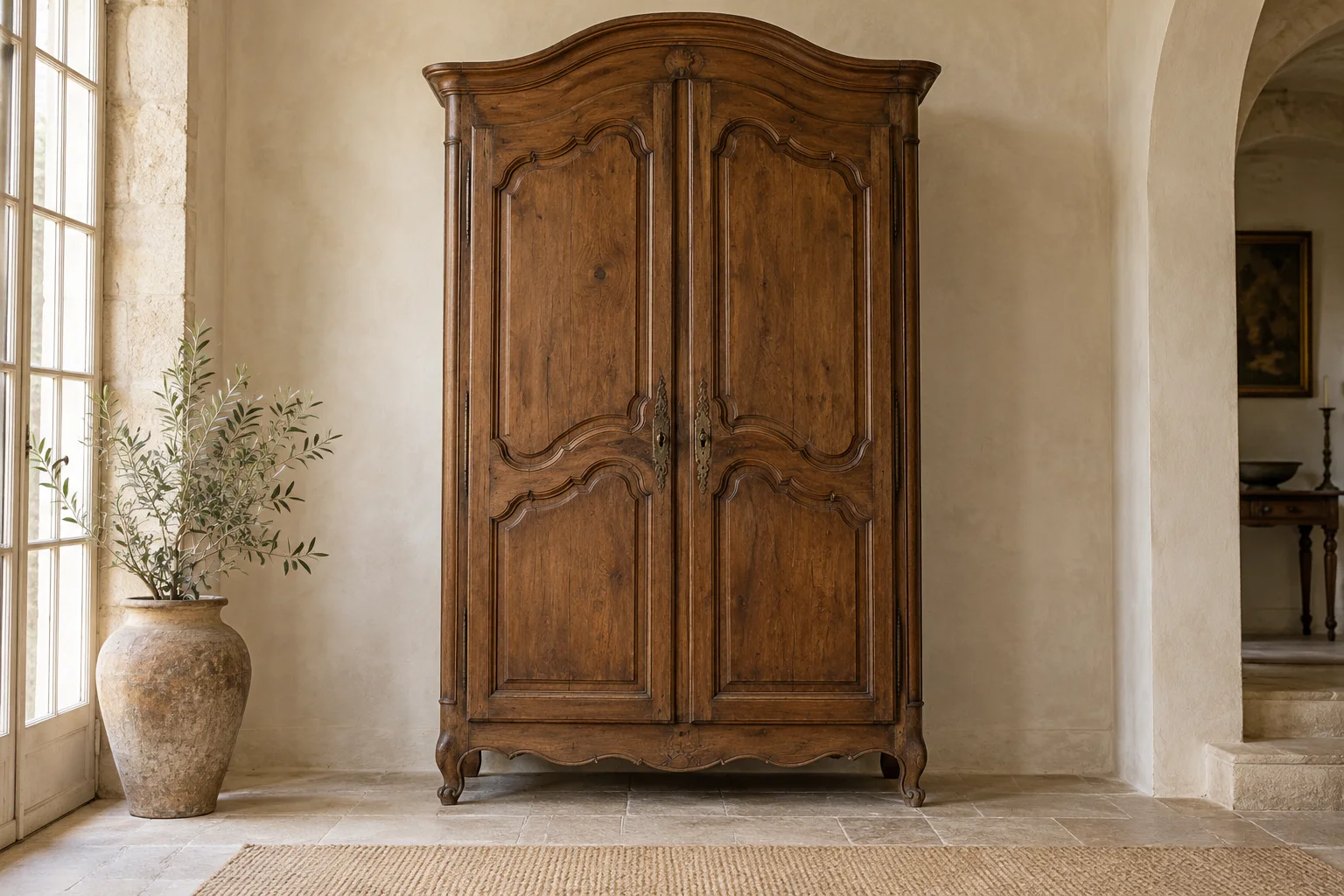
 AI-created styling idea
Furniture
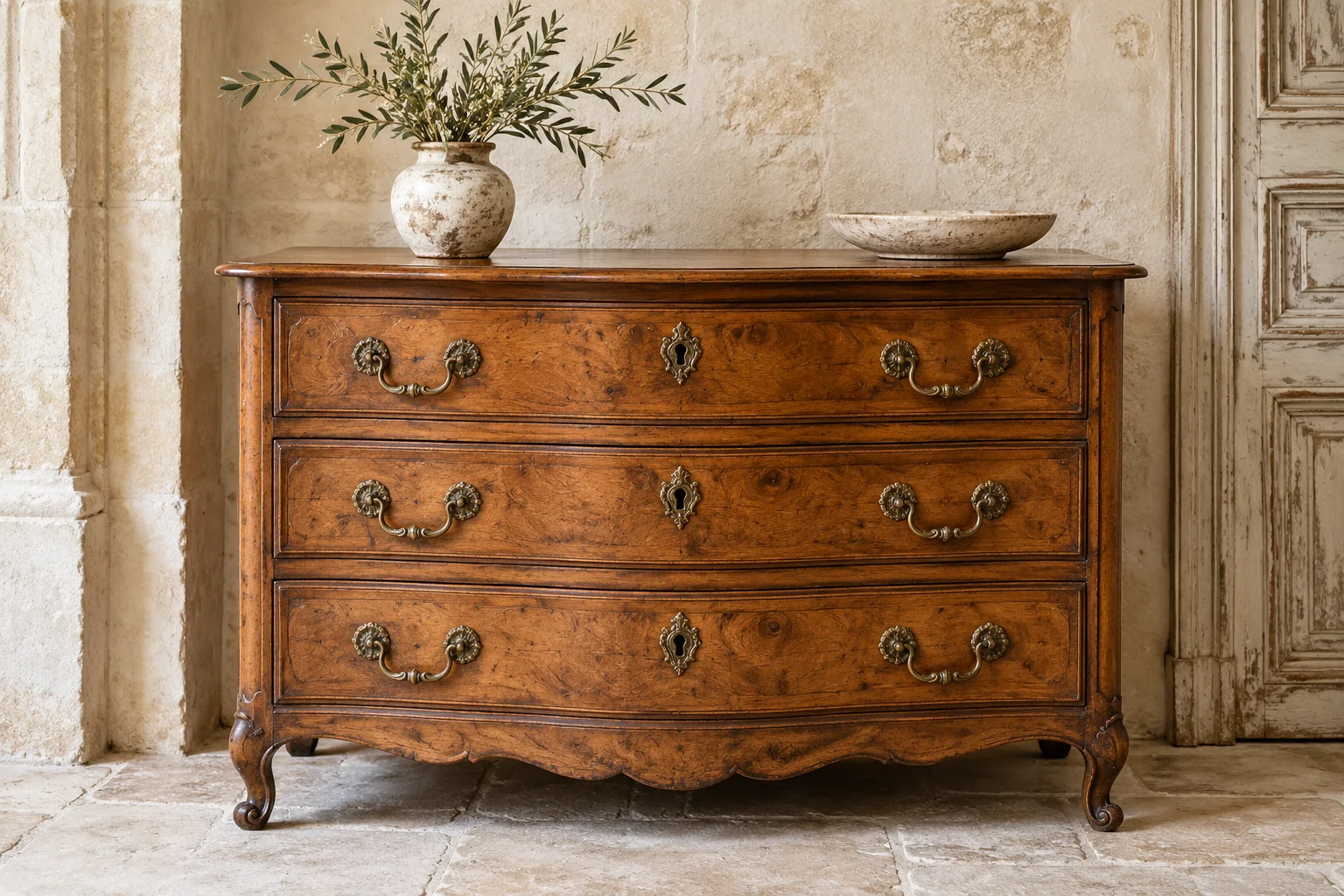
Armoires & wardrobes
Confirm the piece knocks down, then measure interior depth before planning hanging rails.
ExploreFrench Country · An inspiration catalogue · Updated November 2026
A French country bedroom is built from a few honest pieces: a bed with presence, an armoire that holds a household's linen, a bedside cabinet within reach, and layers of linen in quiet colors.
Piece by piece, the 25 ideas below cover the bed, the walls, the light and the linen, with the checks other idea lists leave out: whether an antique bed takes a US mattress and whether an armoire passes a 30-in doorway.
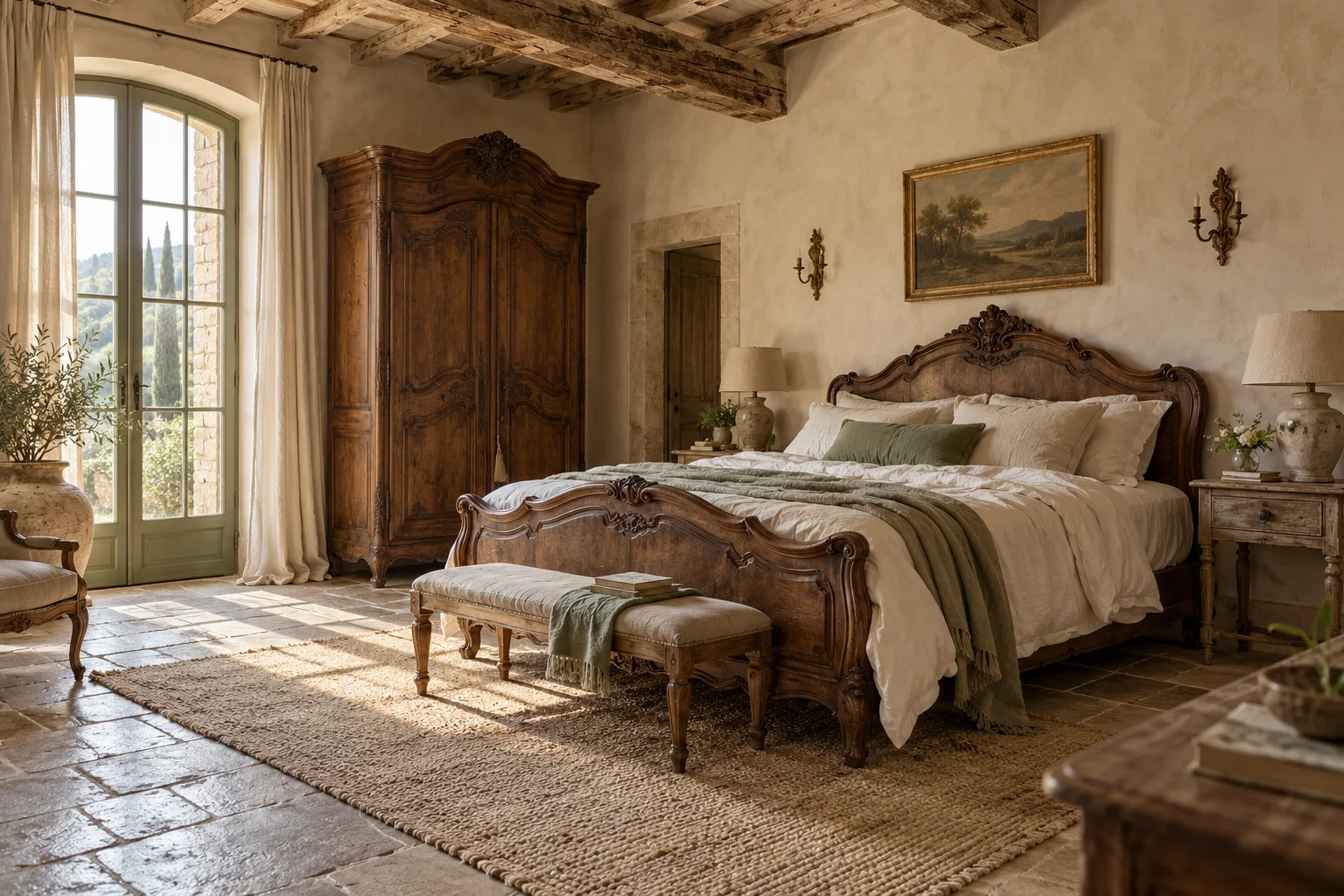
French country bedroom decor rests on three habits rather than a shopping list: a calm palette, furniture with presence instead of matching sets, and patina that is kept rather than manufactured. The room is the quietest in the house, so every addition should earn its place. If you are new to the style, our guide to French country decor sets out the codes that apply to every room.
Walls in limewash white, grège or a pale gray-blue; bedding in natural linen or a linen-cotton blend; one accent color at most, repeated twice. Texture does the work that pattern does elsewhere: a washed-linen duvet, a quilted boutis folded at the foot of the bed, a wool throw in winter. Curtains hang unlined so daylight stays soft.
A country bedroom rarely came from one workshop. A carved walnut bed, a painted pine armoire and a marble-topped bedside cabinet can share a room when their tones and proportions agree. Buy the bed and the armoire first; everything else is scaled to them. The French country furniture guide explains the forms, woods and construction to expect.
Wear on a drawer front, a softened edge on a bed rail or a cloudy mirror plate records use. Keep those finishes when their condition allows. Decorative distressing on new furniture reads differently and should be described as what it is: a finish, not an age.
The ideas move from the bed outward: frame, walls and bedside, then light, linen, textiles and the small pieces that keep a French country bedroom calm.
A low curved footboard keeps an iron bed light in a small room; under 30 in / 76 cm it does not block the view across. Check that the rails lock into head and foot and that old paint is sound. The headboard entry in our encyclopedia compares iron and wood forms.
A carved walnut bed with a headboard of 50 in / 127 cm or more fills the eye, so keep the rest of the room plain: painted or simple wooden chevets, no second carved piece on the same wall. Check the bolt holes for signs of widening, and browse antique French beds for the forms.
A small crown, or ciel de lit, fixed above the head of the bed turns two lengths of linen into a canopy. Choose a crown projecting 10–12 in / 25–30 cm, fix it into a joist, and cut the panels to touch the floor. Washed linen hangs best; see old French linen for curtains and hangings.
Toile de Jouy, the single-color printed scene on a pale ground, works best on the wall behind the bed, where the pattern frames the headboard. Match the repeat at eye level and keep the other walls plain. The pattern sits among toile, gingham and Provençal patterns; one papered wall of 10–12 ft / 3–3.7 m is enough.
Limewash gives a soft, moving surface that paint cannot imitate. It needs a porous wall or a mineral primer, two or three thin coats, and a test patch of 2 × 2 ft / 60 × 60 cm seen in daylight and lamplight. A warm white with a little ochre suits walnut and linen. See the French country palette.
Two different bedside pieces look intentional when their tops sit at the same height, within 1 in / 2.5 cm, and close to the mattress top. A small chest on one side and a table with a drawer on the other is a classic pairing. Look among small chests of drawers for the second piece.
A marble top takes a glass of water and a lamp without marking. Check the slab for cracks, especially at the corners, and set it on felt pads; tops are usually 3/4 in / 2 cm thick and lift off, so carry them separately. The forms of marble-topped chevets include the Louis-Philippe cabinet with a drawer.
A trunk or bench at the foot of the bed holds the quilt at night and a suitcase for guests. Keep it a few inches lower than the mattress, 16–20 in / 40–50 cm high, and leave 30 in / 76 cm to walk past. Check old trunks for loose hinges and lining odors. Browse antique trunks and chests.
A rail fitted front to back works when the interior is shallower than the 22 in / 55 cm a hanger needs. Fix rails to removable wooden blocks rather than the original panels, so the change can be reversed and the armoire still knocks down. Our page on pegged oak and walnut construction explains why that matters.
A small chandelier, 16–20 in / 40–50 cm wide, gives the bedroom a center without the weight of a dining fixture. Keep its lowest point at least 7 ft / 213 cm above the floor, fix it to a rated box, and rewire it to US standards. The antique chandelier entry explains what to check.
Swing-arm sconces free the bedside table and put the light where the book is. Mount them about 22 in / 56 cm above the mattress top and slightly outside the headboard, with a switch within reach of the pillow. Plug-in versions avoid opening the wall. See the wall sconce entry for forms and rewiring.
Three layers give the bed its depth: a métis sheet, a quilted boutis folded to a third of the bed, and a wool throw for winter. Keep the colors within two tones of each other and let the texture vary instead. Old French sheets are often 87 × 118 in / 220 × 300 cm. The wider family is grouped under French textiles.
Embroidered initials from a bridal trousseau mark the household, not a maker or a date. French pillowcases are often square, around 24–26 in / 60–65 cm, so check the size against your pillows or use them as shams. Wash at a moderate temperature and dry flat. See vintage pillows and pillowcases.
Unlined linen filters morning light instead of blocking it. Fix the rod 4–6 in / 10–15 cm above the window frame and 8–10 in / 20–25 cm beyond each side, and let the hem just touch the floor. Add a blackout blind behind if you need darkness. The bedroom room scenes show both versions.
A rug should extend 18–24 in / 45–60 cm beyond each side of the bed so bare feet land on wool. A faded or worn rug suits the room better than a bright new one; use a non-slip pad on painted boards. Wear and repairs are explained under faded wool rugs and tapestries.
A dressing table needs a knee space of at least 24 in / 61 cm and a top at 29–30 in / 74–76 cm. Check that the mirror tilts and holds its angle, and place the table side-on to the window for even light. Compare coiffeuses and vanity tables.
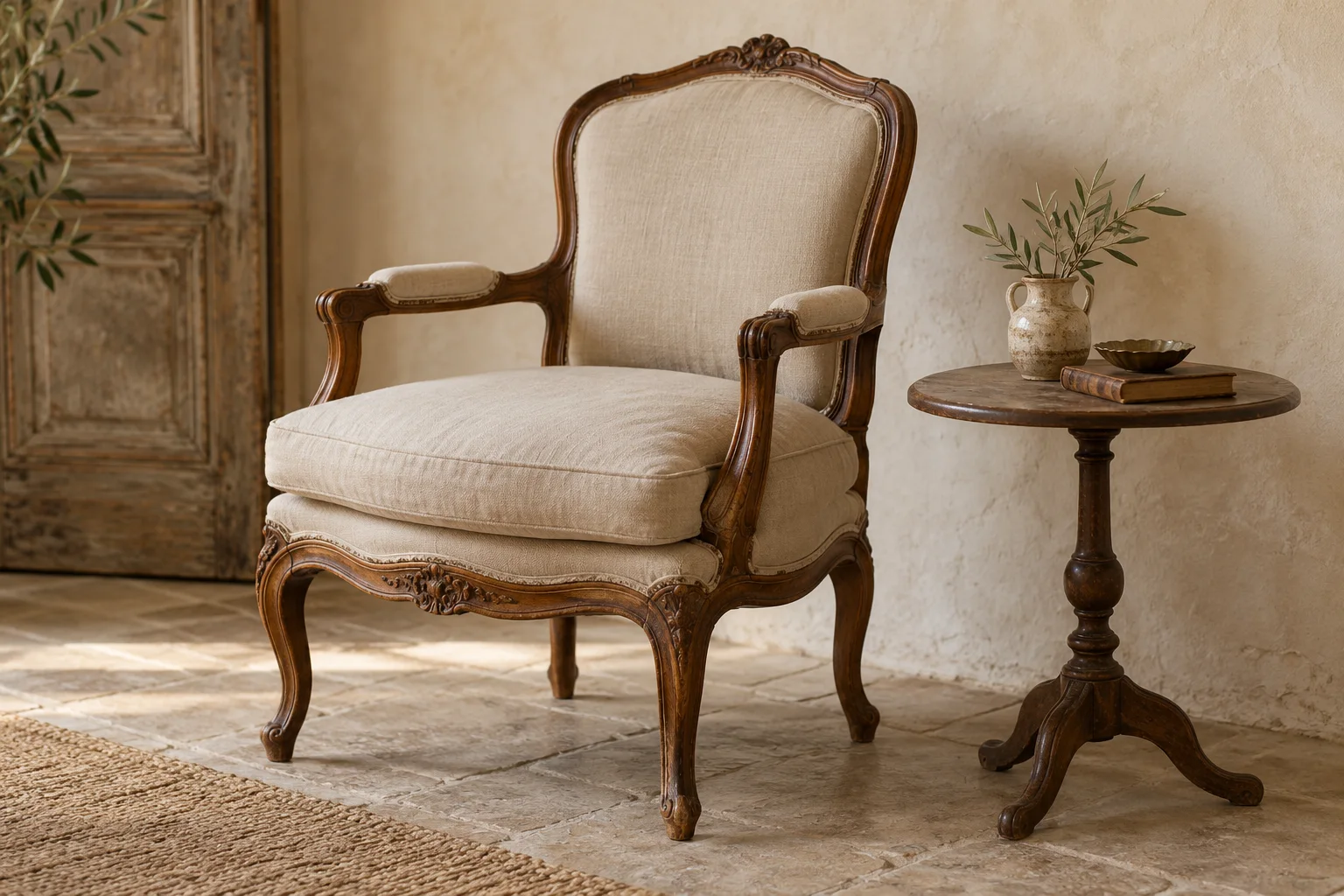
One armchair turns a bedroom into somewhere to sit during the day. A fauteuil with open arms takes less visual space than a full bergère; allow 18 in / 45 cm between chair and bed for passage. Check the frame at the joints before reupholstering. The fauteuil entry explains the variants.
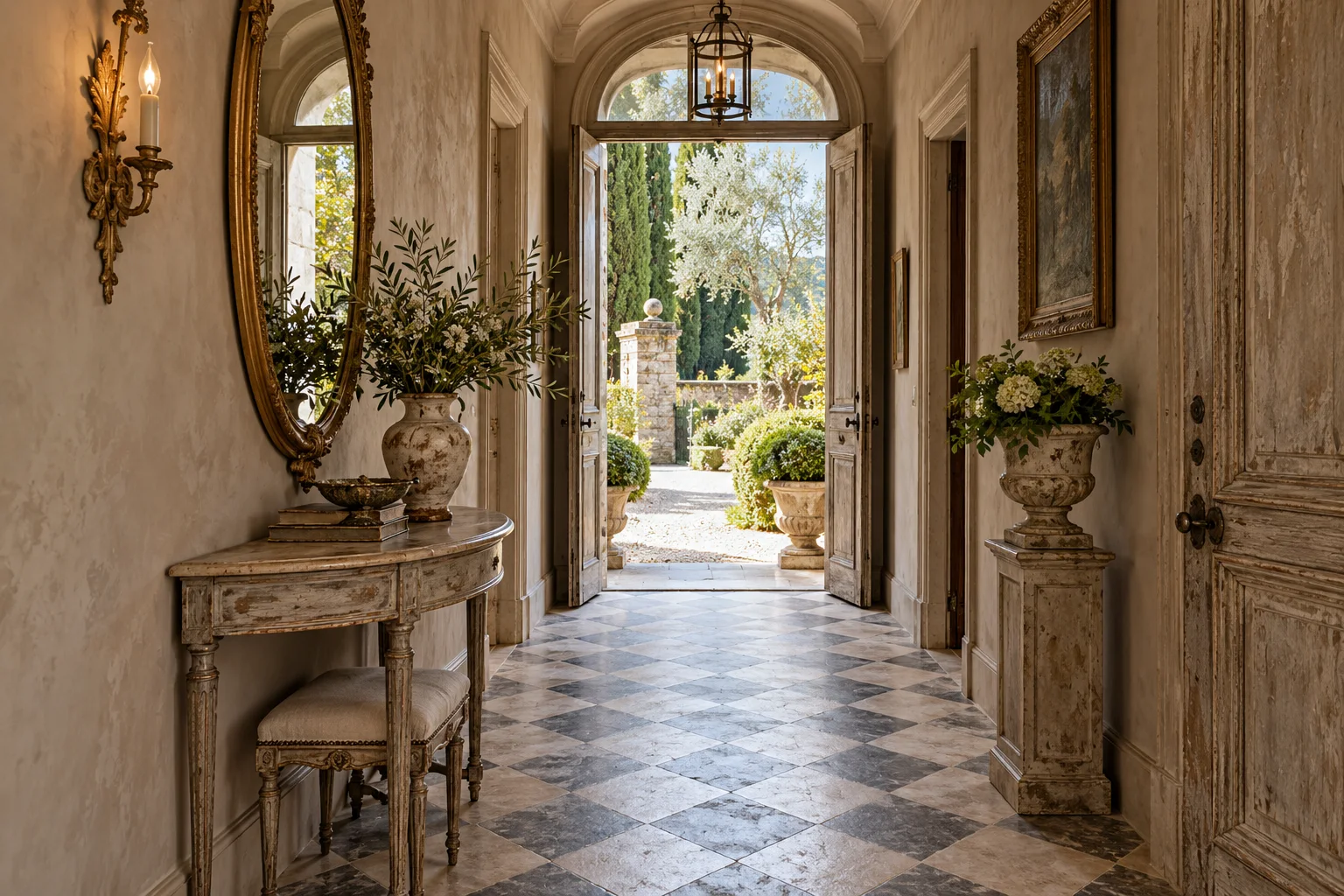
A gilt mirror facing the window doubles the daylight in a north-facing bedroom. Hang it with the center at 57–62 in / 145–157 cm, on two hooks for a frame over 20 lb / 9 kg, and check the gesso for loose flakes. Our complete guide to antique French mirrors covers plates and frames.
A pair of botanical prints sits calmly over a bed where a gallery wall would crowd it. Keep the bottom of the frames 8–10 in / 20–25 cm above the headboard and the pair about two-thirds of the bed width. Use two D-rings per frame so nothing slips. See botanical prints for paper and plate types.
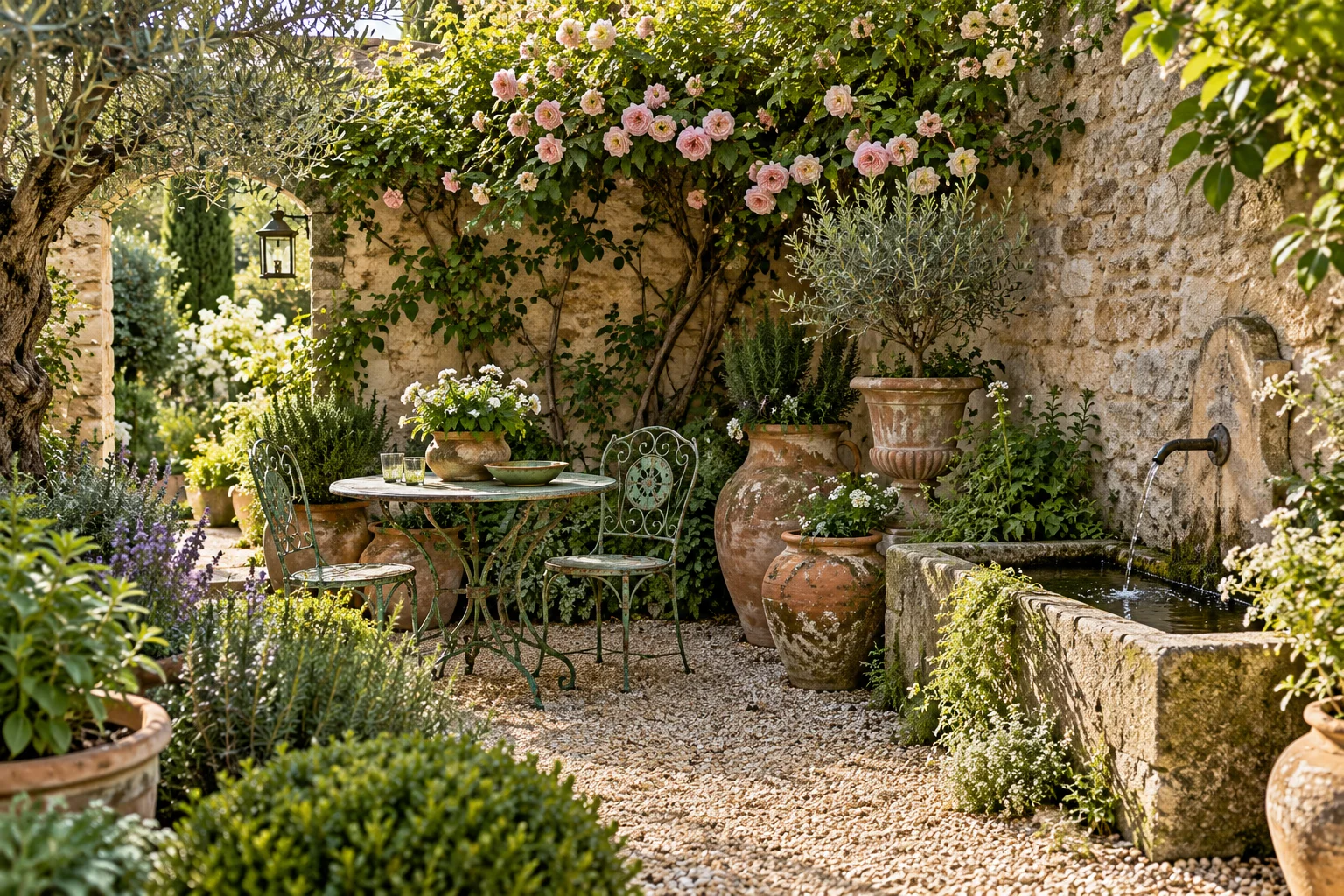
A stoneware or faience pitcher of cut garden flowers does more than any arrangement. Keep stems short, under 14 in / 35 cm, so the flowers do not hide the mirror, change the water every two days, and set a mat under the pitcher to protect wood or marble. Look among pitchers and jugs.
A bonnetière is a narrow single-door cupboard, often under 40 in / 100 cm wide, that fits where an armoire will not. Its shelves hold sheets and towels folded loosely, with a sachet of dried lavender. Check the door hinges and the shelf supports. Narrow pieces are grouped under narrow linen cupboards.
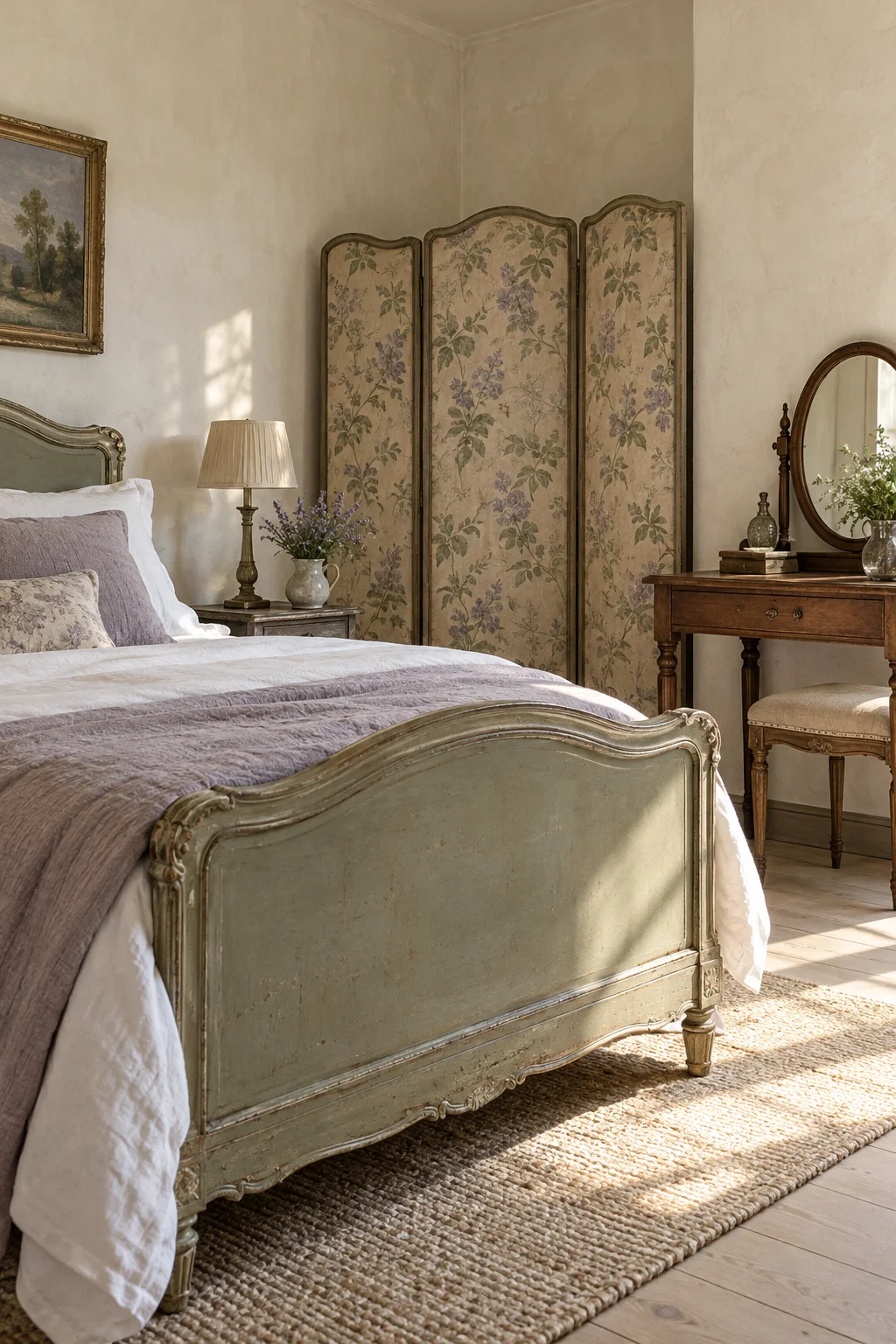
A three- or four-panel screen, 66–72 in / 168–183 cm tall, closes off a desk, a laundry basket or a dressing corner without building a wall. Painted canvas, cane or old wallpaper panels suit the style. Check the hinges and the feet so the screen stands firm. See folding screens and room dividers.
Oatmeal linen on the bed, faded rose in one textile and gray-blue on a painted piece give the bedroom its color without strong contrast. Use the main tone on about two-thirds of the surfaces and the third color sparingly. The pinker, more decorated cousin of this palette is described under shabby chic.
A guest room changes with two purchases: old linen sheets and a mirror. Dress the bed in washed linen and a folded quilt, and hang a mirror of about 24 × 36 in / 60 × 90 cm above a chest or a small table. The guest room scenes show how far that goes.
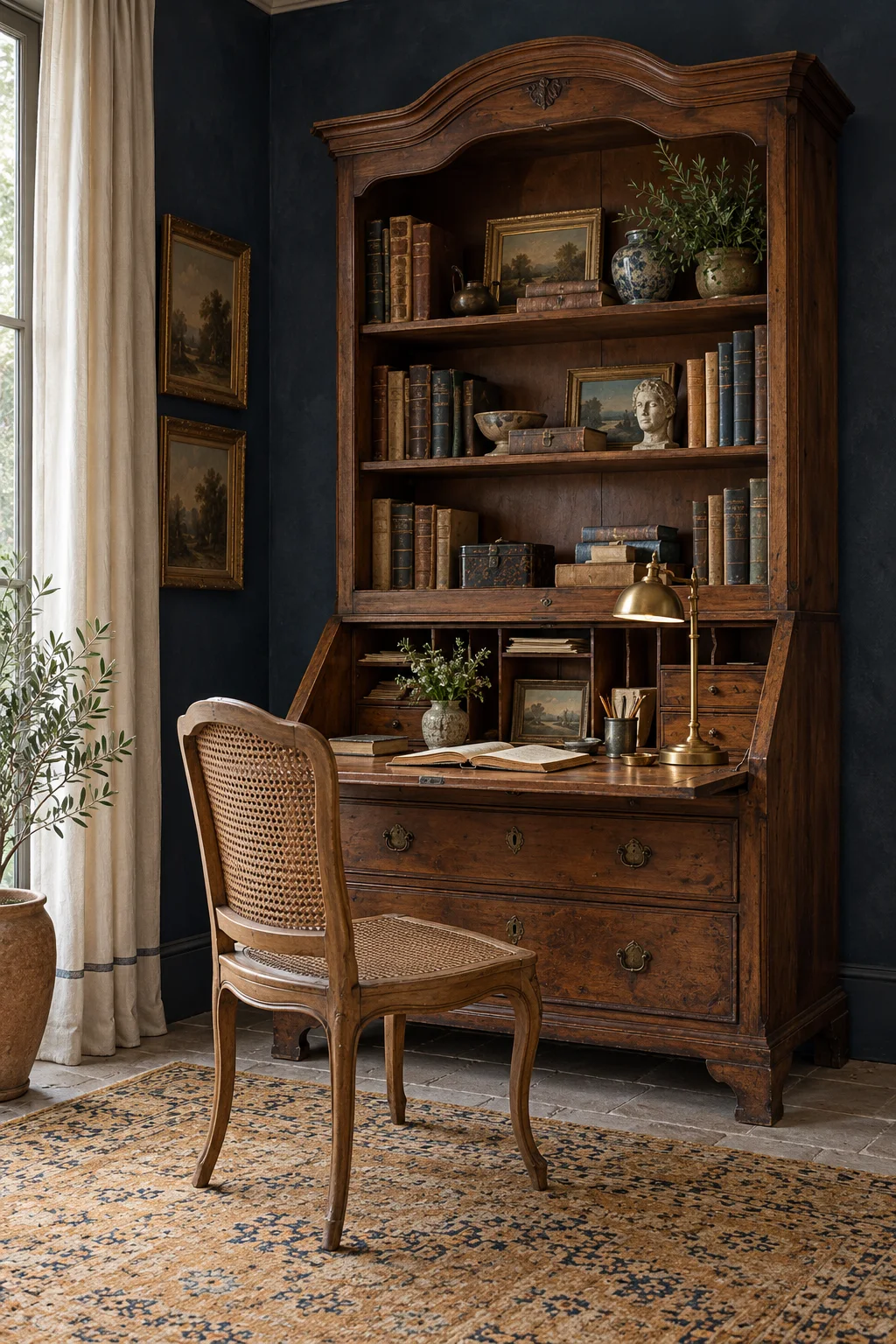
A television or a charging station hides well in a small cupboard or a secretary with a fall front. Do not drill the back panel of an antique; choose a piece that has already been altered, or run cables through a gap of 1 in / 2.5 cm behind it, and leave space for heat. See secretaries and writing desks.
French iron beds of the late 19th and early 20th century are light, often painted, and sized for the French market: a lit de 90 is 90 cm (35.4 in) wide, a lit de 140 is 140 cm (55 in). Check that side rails lock positively into the head and foot, that the frame stands square on the floor, and that old paint is sound (test a hidden spot; flaking paint on a pre-1950 bed can contain lead and should be stabilized or stripped professionally). Browse the forms in beds and headboards.
A lit bateau has scrolled ends of equal height; a lit corbeille (demi-corbeille) curves its headboard like a basket. Walnut, cherry and oak are the usual woods; carving on the headboard should be crisp where protected and softened where hands rest. Look at the inside of the rails for original bolt holes, which show whether the bed has been widened.
A US queen mattress is 60 × 80 in (152 × 203 cm); a US full is 54 × 75 in (137 × 191 cm). Most antique French double beds were made for 140 × 190 cm mattresses, so they are about 3 in (8 cm) too narrow and 5 in (13 cm) too short for a queen. Three honest solutions: a custom mattress, a reversible steel extension frame fitted inside the rails, or keeping the headboard alone against a modern base.
A French country armoire was built to be moved. The cornice lifts off, the doors lift off their pin hinges (fiches), and the sides, back boards and base are held with wooden pegs (chevilles) so the carcase comes apart into flat panels that pass through a 30-in doorway. Ask the seller to confirm the piece knocks down before you measure stairwells. The armoires and wardrobes category shows the main forms.
Two-door armoires from the 18th and 19th centuries usually have shelves rather than a rail. Interior depth is often 50–55 cm (20–22 in): a modern hanger needs about 55 cm (22 in) to hang straight, so hanging rails fitted later sit at an angle in shallower pieces. Mirror-door armoires of the 1880–1930 period have thinner plates; check the silvering for black spotting and the door for warp by closing it against the stop.
Typical height 215–240 cm (85–94 in), width 130–160 cm (51–63 in). Measure ceiling height at the exact wall, allowing 2 in (5 cm) above the cornice to lift it into place, and the swing of each door. For pieces offered for sale, Lo Cantou lists French armoires and wardrobes with dimensions and condition notes; a decorator working to a deadline can instead send a brief to Antiques 360 and receive three documented options with the landed cost known upfront.
A Louis-Philippe table de nuit has a marble top over a small drawer and a cupboard once meant for a chamber pot. Height runs 70–80 cm (28–31 in), while the top of a modern mattress sits at 60–70 cm (24–28 in): the cabinet top should finish within 2 in (5 cm) of the mattress top for a lamp and a glass to be reachable. Pairs are rare and priced accordingly; two different bedside tables of equal height read as intentional.
A small writing table with a hung mirror does the job of a coiffeuse in a narrow room. When buying a true dressing table, check that the mirror pivots and holds, and that the drawers run. A tall mirror near the window gives the best light for dressing; see the mirrors and wall decor guide for hanging heights.
A low commode under a window or a tall chest beside the armoire adds storage without another large wall piece. Our journal guide to antique dressers and tall chests covers usable drawer depth, runners and replaced tops.
Old French sheets are generous: a drap often measures 220 × 300 cm (87 × 118 in), which makes it useful as a top sheet, a curtain or a cover. Métis is a linen-cotton blend, cooler than cotton and softer than pure hemp; red cross-stitched monograms mark the household, not a maker. Store washed and dry, folded loosely; the Canadian Conservation Institute recommends keeping old textiles away from direct light and damp. Explore antique linens and cushions.
A Provençal boutis or a cotton piqué quilt at the foot of the bed gives the one patterned surface the room needs. Cushions in old ticking or a faded floral should stay to two or three; more than that reads as a shop display.
Choose the wall color after the furniture is in place, in daylight and lamplight. Warm whites suit walnut and cherry; cooler grays suit painted pine and iron. A guest bedroom can take one stronger tone on a single wall; see the guest bedroom scenes for examples.
A bedroom needs three kinds of light: a ceiling fixture for cleaning and dressing, a reading light on each side of the bed, and one low lamp on a chest for the evening. Keep bulbs warm, around 2700 K, and put the ceiling light on a dimmer. Antique fittings must be rewired to US standards before use; our page on choosing French country lighting covers shades and heights, and antique wall sconces lists what to check in an old bracket.
Layer a sheer voile against the glass for privacy by day and a heavier linen curtain on a second rod for the evening. Hang both from the same height so the window reads as one tall opening. A canopy repeats the curtain fabric above the bed and should be fixed to a joist, not drywall alone. Keep fabric away from bedside lamps by at least 12 in / 30 cm.
Choose one decorated wall surface per bedroom. Toile on one wall, limewash on the others, or painted panelling, known as boiseries, on the lower third of the wall. Salvaged panelling rarely fits a new room without cutting, so measure each panel and plan the joints before buying; reclaimed pieces appear among salvaged boiserie and architectural antiques.
These two pieces fix the scale of the room. Sketch the plan with the bed's real footprint (a queen with an antique frame can reach 66 × 86 in / 168 × 218 cm), the armoire's door swing and a 30-in (76 cm) walkway on each side of the bed.
A new mattress and base, a vintage 1930s bedside pair and an 18th-century armoire sit comfortably together. Buy new where comfort and safety matter (mattress, lighting cords), antique where presence matters (armoire, bed ends, mirror).
Fresh, pale wood dust in small round holes means active woodworm; old holes with dark edges are inactive but should be disclosed. Replaced backboards and shelves are normal in armoires and should be described. Request photographs of the back, the inside of doors and the feet before paying a deposit, and keep the dressing room in mind if the armoire turns out too shallow for hanging clothes.
AI-created styling ideaFurniture
Confirm the piece knocks down, then measure interior depth before planning hanging rails.
Explore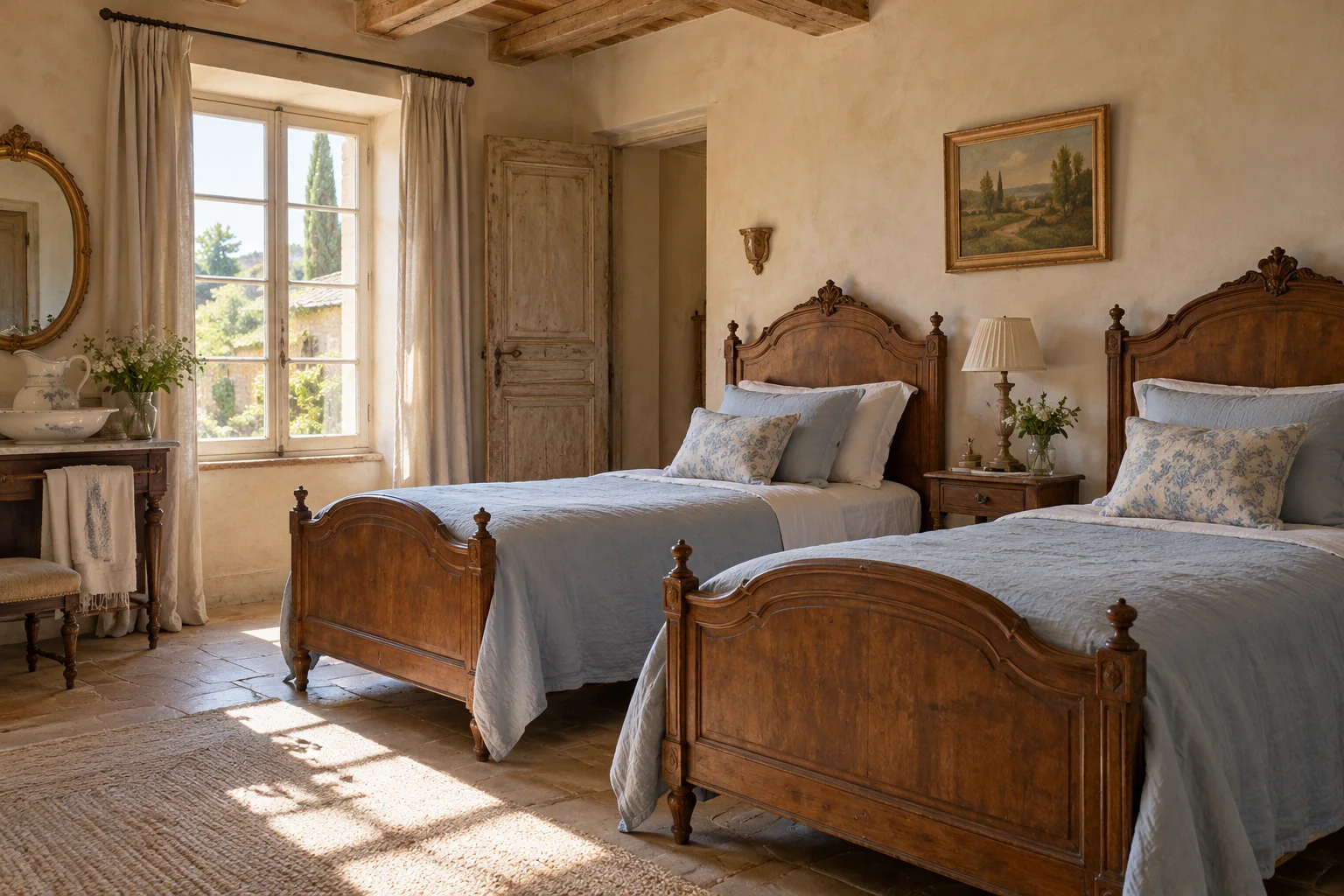 AI-created styling idea
Furniture
Compare the frame's internal size with your mattress before falling for the headboard.
Explore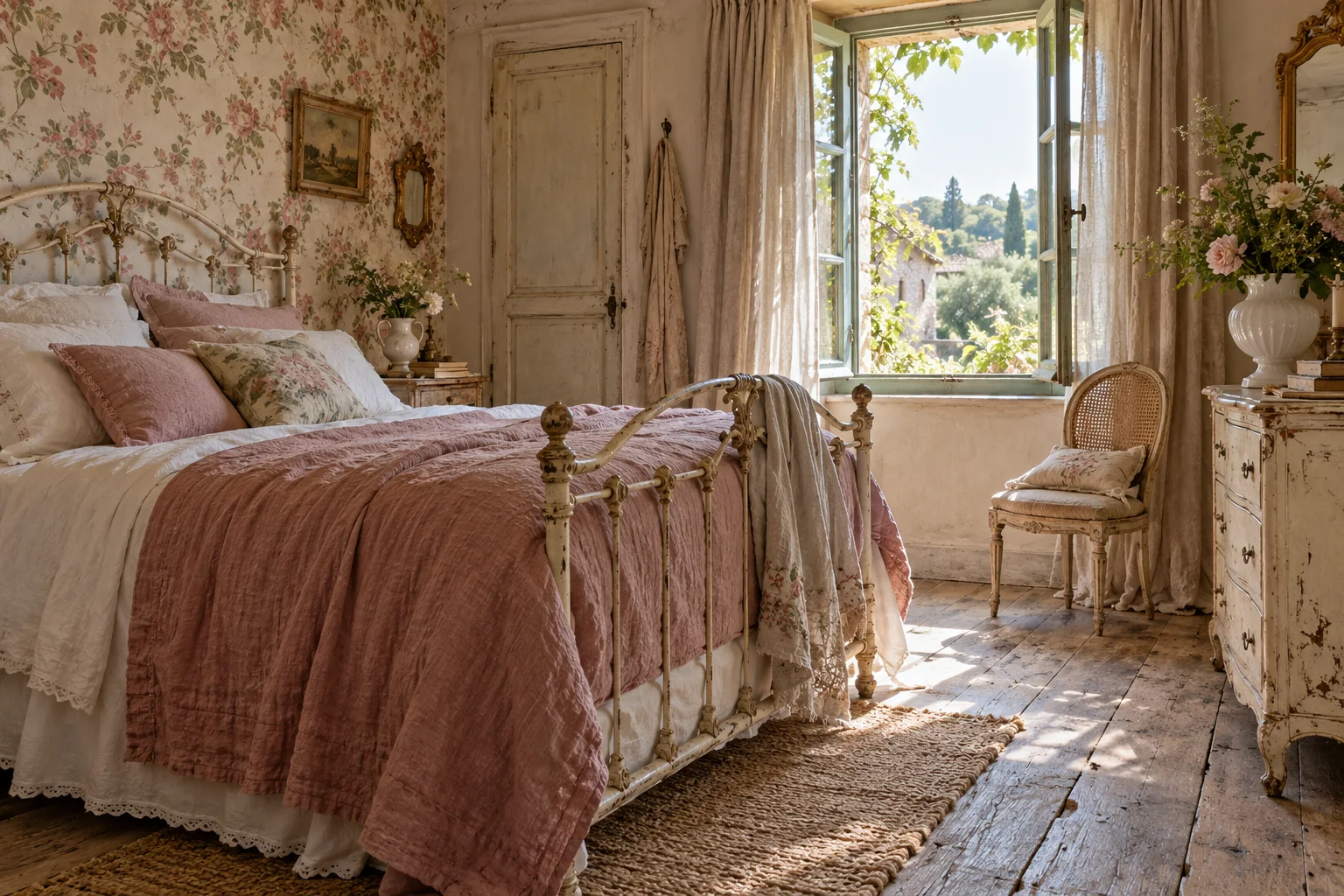 AI-created styling idea
Furniture
Match the cabinet height to the mattress top, within 2 in, before matching the pair.
Explore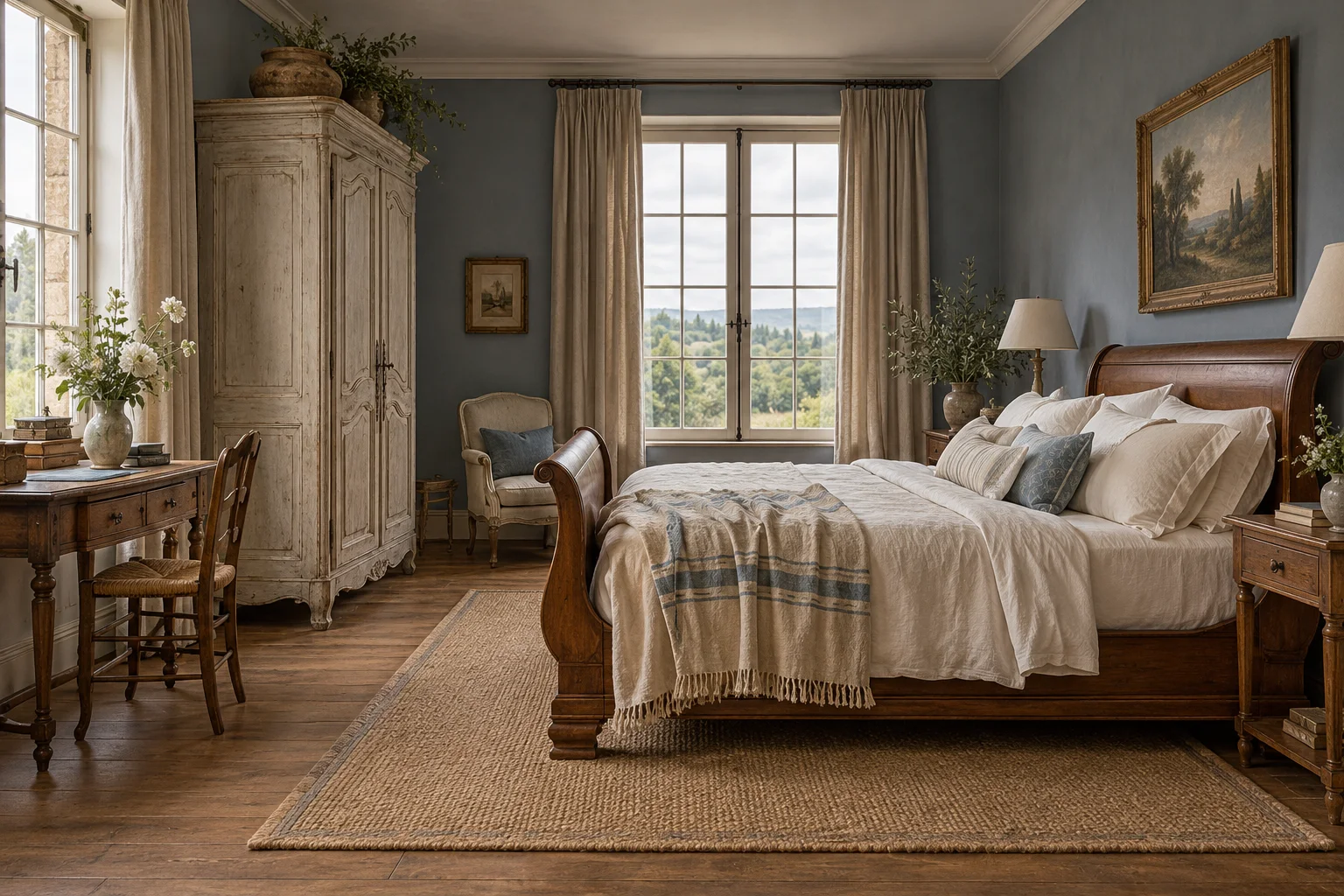 AI-created styling idea
Textiles
Identify the fiber and the condition before washing; old sheets are larger than modern ones.
Explore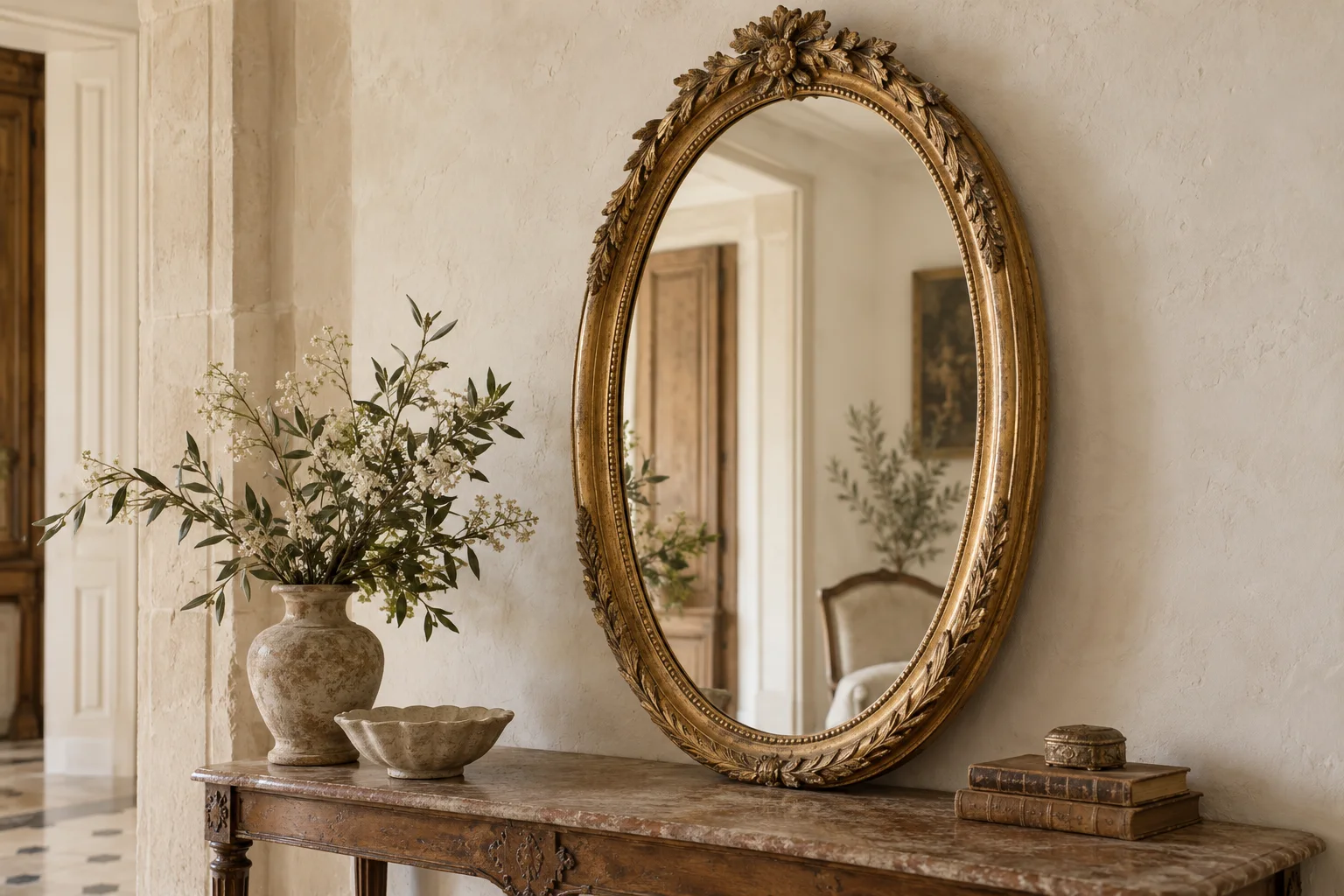 AI-created styling idea
Mirrors
A tall mirror near the window lights the dressing corner; check the plate and the frame separately.
Explore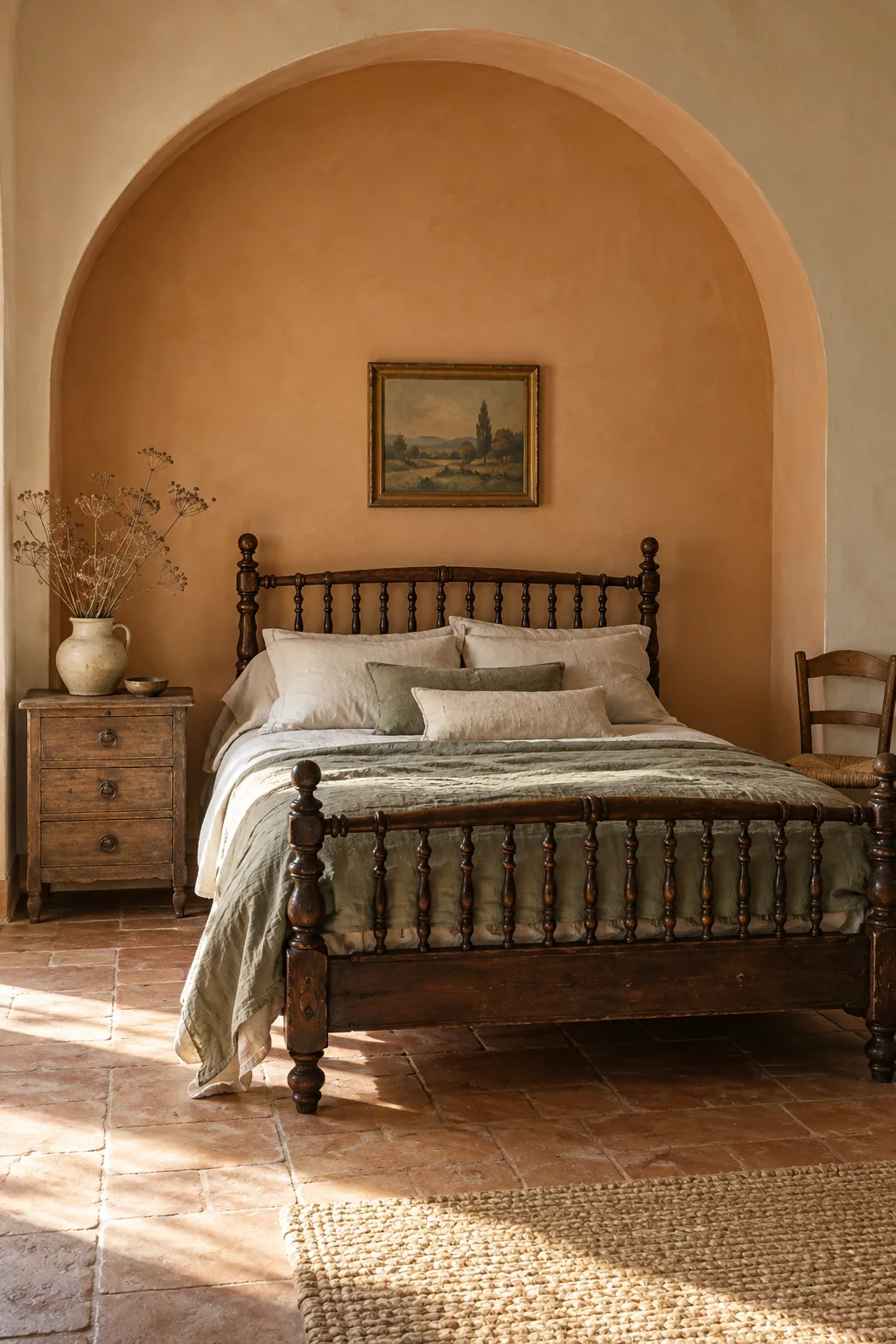 AI-created styling idea
Rooms
Five layouts for the same room: iron bed, carved bed, alcove, guest and attic versions.
ExploreEvery piece for the bedroom in one place, grouped by category. Each subcategory page explains what to check before you buy and links to the detailed guides.
Warm white, grège and pale gray-blue are the safest wall colors, chosen after the furniture is in place and tested in both daylight and lamplight. Keep bedding in natural linen tones and allow one accent color, repeated twice, on a quilt, a cushion or a lampshade. Walnut and cherry suit warmer whites; painted pine and iron suit cooler grays.
Yes, with two checks. Measure the interior depth: a hanger needs about 22 in (55 cm) to hang straight, and many armoires are only 20 to 22 in deep, so a rail may need to run front to back or the piece may suit folded clothes and linen better. Then confirm the shelves are removable and the piece knocks down for the move.
Rarely without adaptation. A French double frame was made for a 140 by 190 cm mattress, about 3 in narrower and 5 in shorter than a US queen. The usual answers are a custom-sized mattress, a reversible steel extension frame fitted inside the original rails, or using the headboard alone with a modern base. Keep any original rails and bolts with the bed.
Let the antique pieces carry the character and the bed carry the comfort. A plain upholstered or wooden bed in a quiet color sits well beside an 18th-century armoire and a pair of marble-topped chevets. Repeat one material from the antiques, such as walnut or brass, in a lamp or a frame so the new piece belongs to the room.
Use three layers: a small chandelier or ceiling light on a dimmer, a reading light on each side of the bed, and a low lamp on a chest for the evening. Swing-arm sconces mounted about 22 in (56 cm) above the mattress free the bedside tables. Keep bulbs warm, around 2700 K, and have any antique fitting rewired to US standards before it is used.
Start with the textiles and one wall piece. Washed linen or old métis sheets, a folded quilt and unlined linen curtains change the room more than new furniture. Add a mirror above a chest, limewash the walls in a warm white and replace one bedside table with an old chair or small chest. Buy the larger antiques, the bed or the armoire, later and one at a time.
Nov 6, 2026 · Antique guide
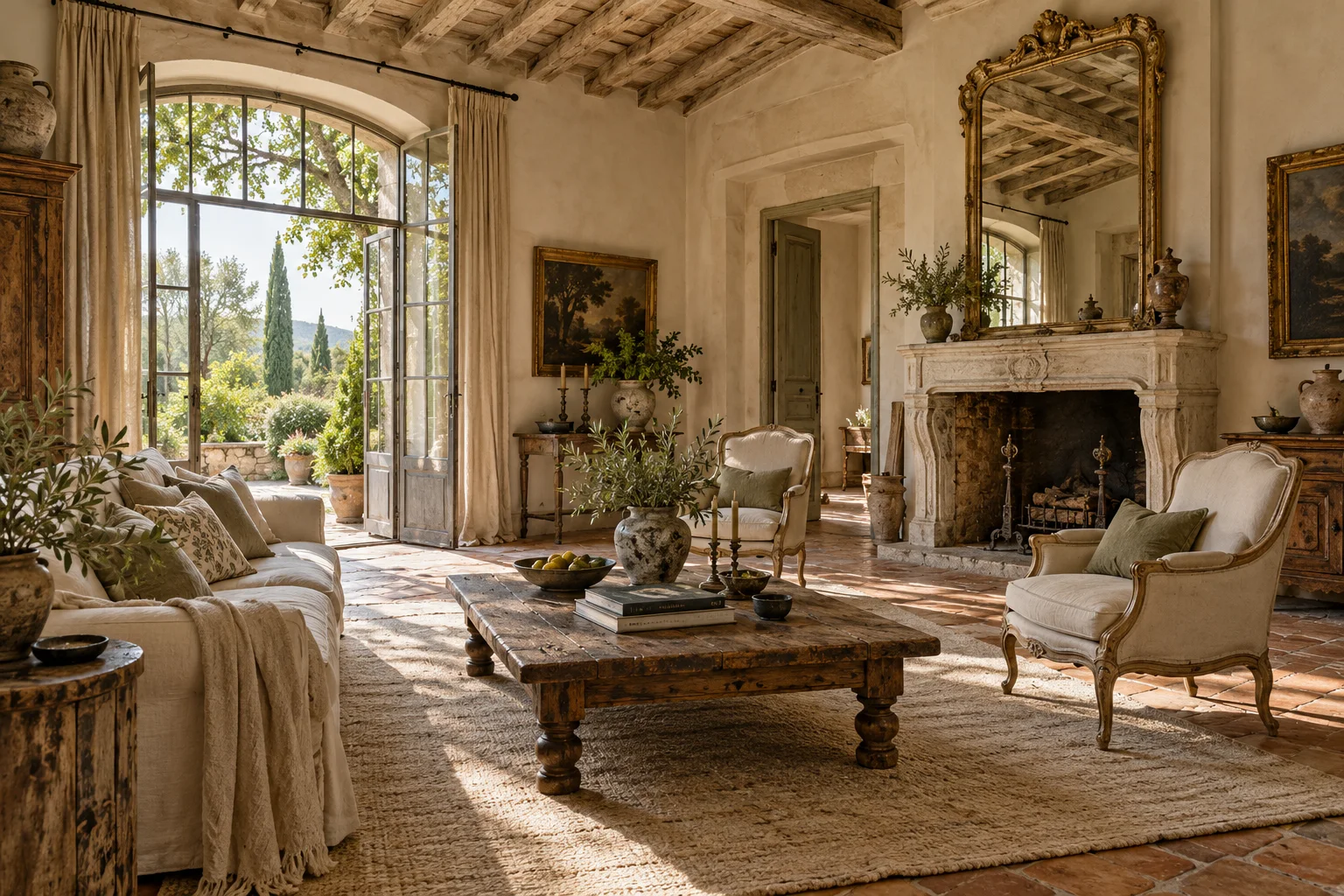
Choose the shape and distinguish the condition of the frame from that of the fabric.
Nov 5, 2026 · Antique guide
Mid-century French table lamps, made between about 1950 and 1975, fall into three families: glazed ceramic bases, articulated lamps and space-age designs.
Nov 5, 2026 · Antique guide
"Louis XV commode" can mean three different pieces of furniture: a period chest, a later Louis XV style chest, or a regional walnut commode.
Nov 4, 2026 · Antique guide
French country fabrics rest on a few patterns: toile de Jouy, gingham, ticking stripes, Provençal printed florals and plain linen.
Nov 4, 2026 · Antique guide
Compare exterior size, interior storage and delivery constraints when choosing an armoire.
Nov 3, 2026 · Antique guide
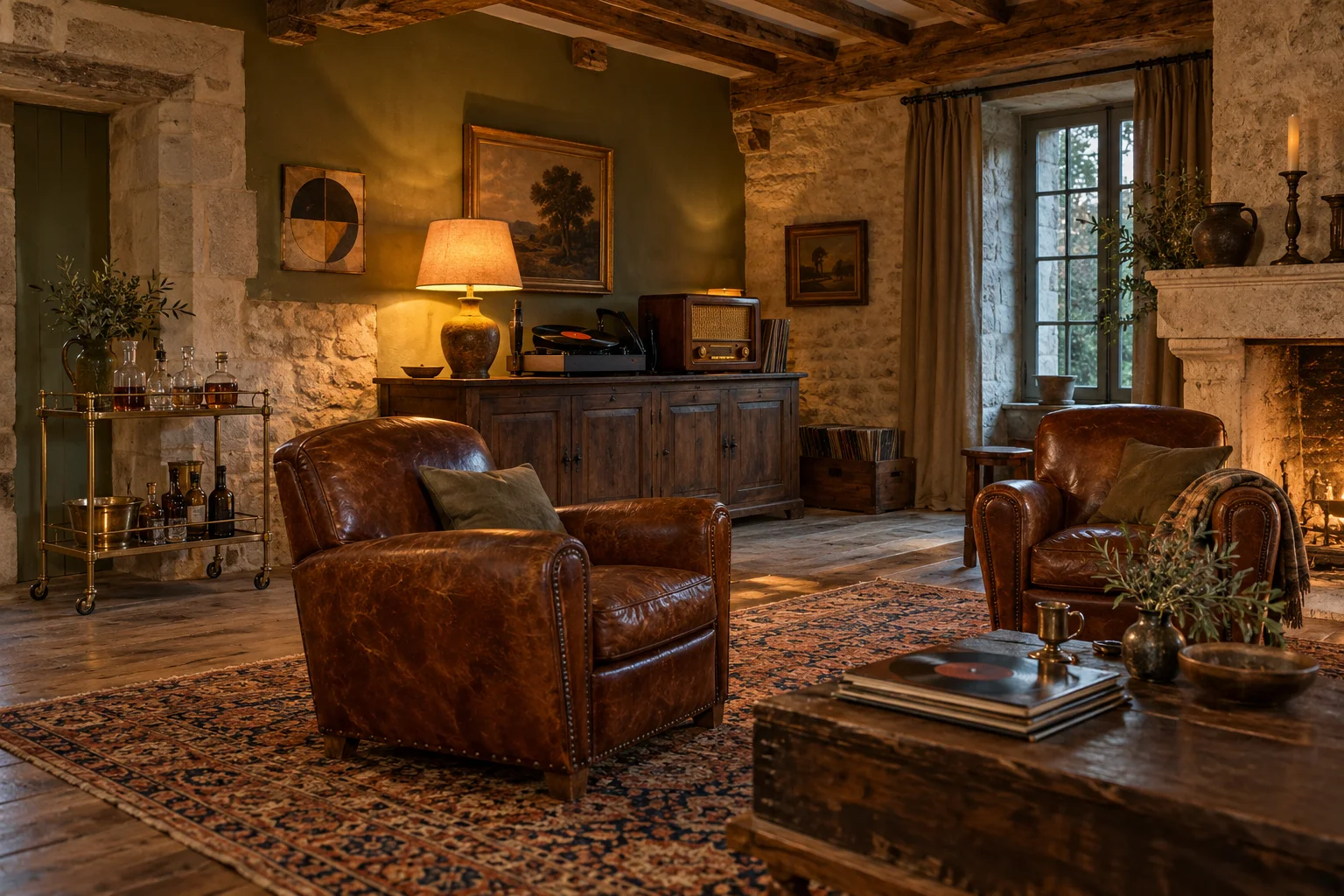
Club chairs, the leather fauteuils club made in France from the 1920s to the 1950s, are bought for their patina and kept for their comfort.