Spanish and French forms
Spanish olive jars are amphora-shaped: a narrow base, a swelling belly, a short neck, usually unglazed or glazed only inside, with the rough coil marks of hand building. Botijas were shipping jars, lighter and pointed; tinajas were storage jars, heavier and flat-based, from workshops in Andalusia and La Mancha. The clay fires buff to orange, and the surface often shows lime pops and salt bloom from years outdoors.
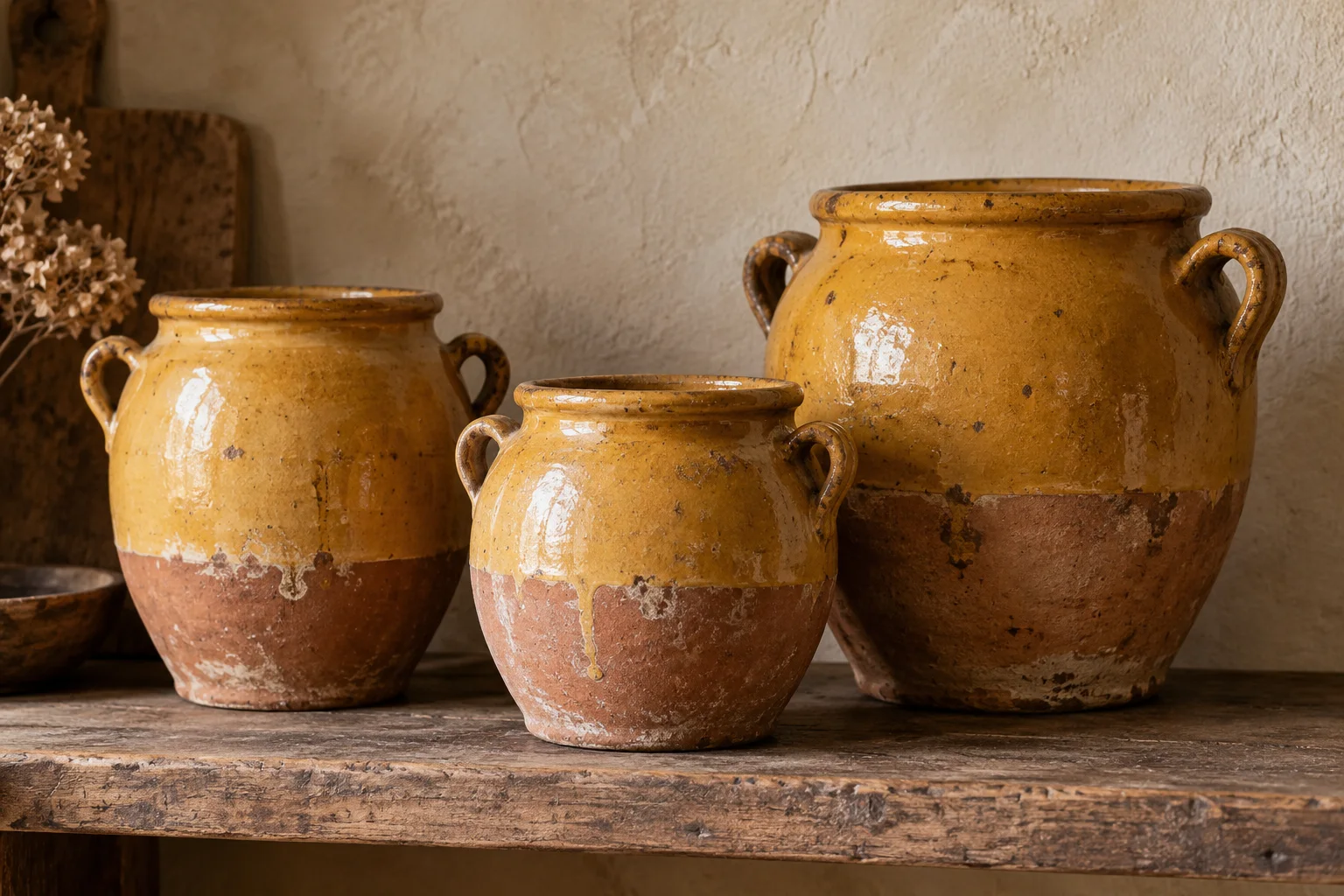
French jarres are rounder and sit on a wide foot. The jarres de Biot, near Antibes, carry a green or honey lead glaze poured over the shoulder and left to run; the Southwest made plain and half-glazed jars for grain and oil, in the same family as the confit pots of Gascony. Anduze jars, glazed and decorated with garlands and a medallion, are planters rather than storage jars and belong to a separate tradition covered in our French country garden guide.
Why dating an olive jar is uncertain
The same shapes were thrown or coiled from the 17th century to the 20th, and new jars are made today in Spain, Portugal and Tunisia in the old forms, often distressed to sell as antiques. No mark, no document, no reliable typology: a date on a jar is a guess unless the seller can show where it came from. Describe an olive jar by form, origin of the tradition, clay color and condition, and leave the century open.
Wear helps more than style. A jar that spent decades outdoors shows lichen in the pores, softened edges at the rim, a flat worn patch where it leaned, and an interior glaze crazed and stained by oil. A new jar distressed with a wire brush shows fresh, even scratching over the whole surface and clean, sharp pores. Weight is a clue too: old coiled jars are thick and heavy, 40 to 90 lb (18 to 40 kg) for a 30 in (75 cm) jar; thin, light jars are modern slip-cast or thrown reproductions.
Planting, siting and frost
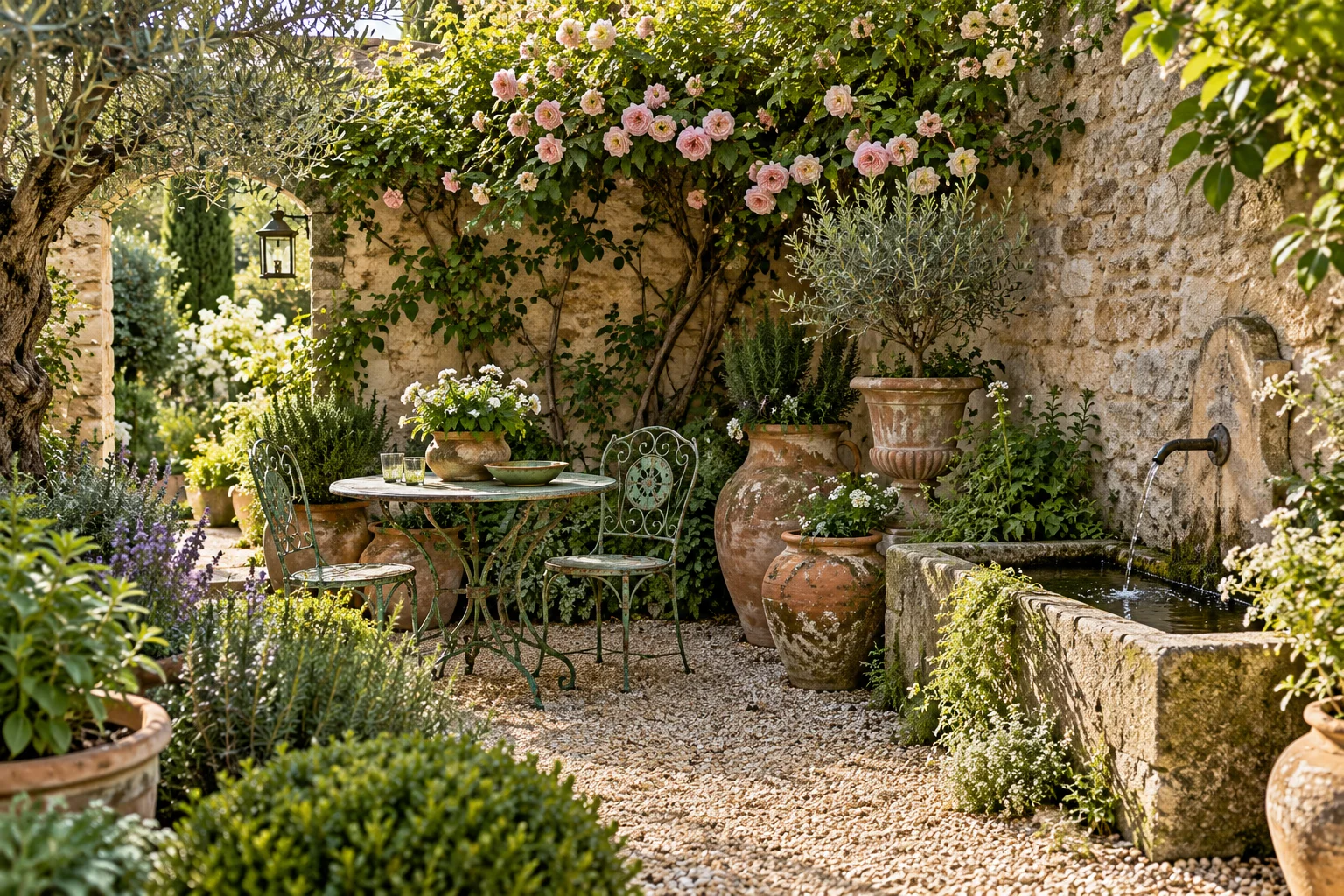
As a planter, a jar needs a drainage hole; drill one slowly with a masonry bit under running water, or stand a pot inside the jar on a bed of gravel so that the jar itself stays dry. Fill the lower half with gravel or an upturned pot to save compost and weight. Olive trees, lavender, rosemary and agapanthus suit the scale; a jar left empty, on gravel by a door, is just as effective.
Porous earthenware holds water, and water that freezes in the pores splits the jar. In a climate with hard frost, raise the jar on feet so it drains, empty and cover it in winter, or move it under cover; a hairline from one bad winter runs the full height by the next. The Canadian Conservation Institute gives the same rule for all low-fired ceramics: avoid water saturation and freezing. Our page on pots and planters shows the sizes that suit a terrace, a step or a wall.
What to compare
| Form | Suggested Use | Decisive Check |
|---|---|---|
| Spanish tinaja, unglazed, flat base | Gravel courtyard or hall, empty | Weight and genuine outdoor wear |
| French jarre with run glaze on the shoulder | Terrace focal point, planted | Hairlines from frost and glaze losses |
| Modern jar in an old form | Garden ornament at a modest price | Honest description as a reproduction |
Your buying checklist
Continue planning your room
Frequently asked questions
How can you tell an antique olive jar from a reproduction?
By wear and weight rather than shape, since the forms never changed. Old jars are thick and heavy, show lichen in the pores, softened rims and a worn patch where they leaned, and an oil-stained interior. Reproductions are lighter, evenly scratched by distressing, and sharp in the pores.
Can an olive jar be used as a planter?
Yes, with drainage. Drill a hole with a masonry bit under water, or place a pot inside the jar on gravel so the jar stays dry. Fill the lower half with gravel to save compost and weight, and choose plants that suit the scale, such as an olive, lavender or agapanthus.
Will an olive jar crack in winter?
It can. Porous earthenware absorbs water, and ice in the pores splits the clay. Raise the jar on feet so it drains, keep it empty and covered in a hard-frost climate, or move it under cover. A glazed jar is less porous but its unglazed base still takes up water.
What is the difference between a tinaja and a botija?
Both are Spanish. A tinaja is a heavy storage jar with a flat base, made to stand in a cellar or courtyard. A botija is a lighter shipping jar, often with a pointed or narrow base, made to be packed in a ship’s hold. Tinajas are the ones usually sold for gardens.
Sources & further reading
- Canadian Conservation Institute — Caring for ceramic and glass objects — Care of low-fired ceramics: water saturation, freezing and handling.