Why France shipped wine in giant glass
A demijohn is a glass bottle of roughly ten liters and up, fitted with a narrow neck and stopper, built to store and transport liquids in bulk. In France the large wine version is the dame-jeanne, and the everyday word is bonbonne. Wine, oil, vinegar and brandy all moved in them; a tavern kept one on the counter and refilled pitchers from it, and a farm’s chai could hold a wall of them.
The legend behind the name is a good story: a Queen Jeanne is said to have crossed France with the giant bottles in her luggage, and the glassblowers turned her name into the word for the bottle. Historians dispute the details, but the term is centuries old, and the English trade word demijohn is thought to descend from it. The bottles and demijohns index shows where each form sits in the house.
The sizes and the colors
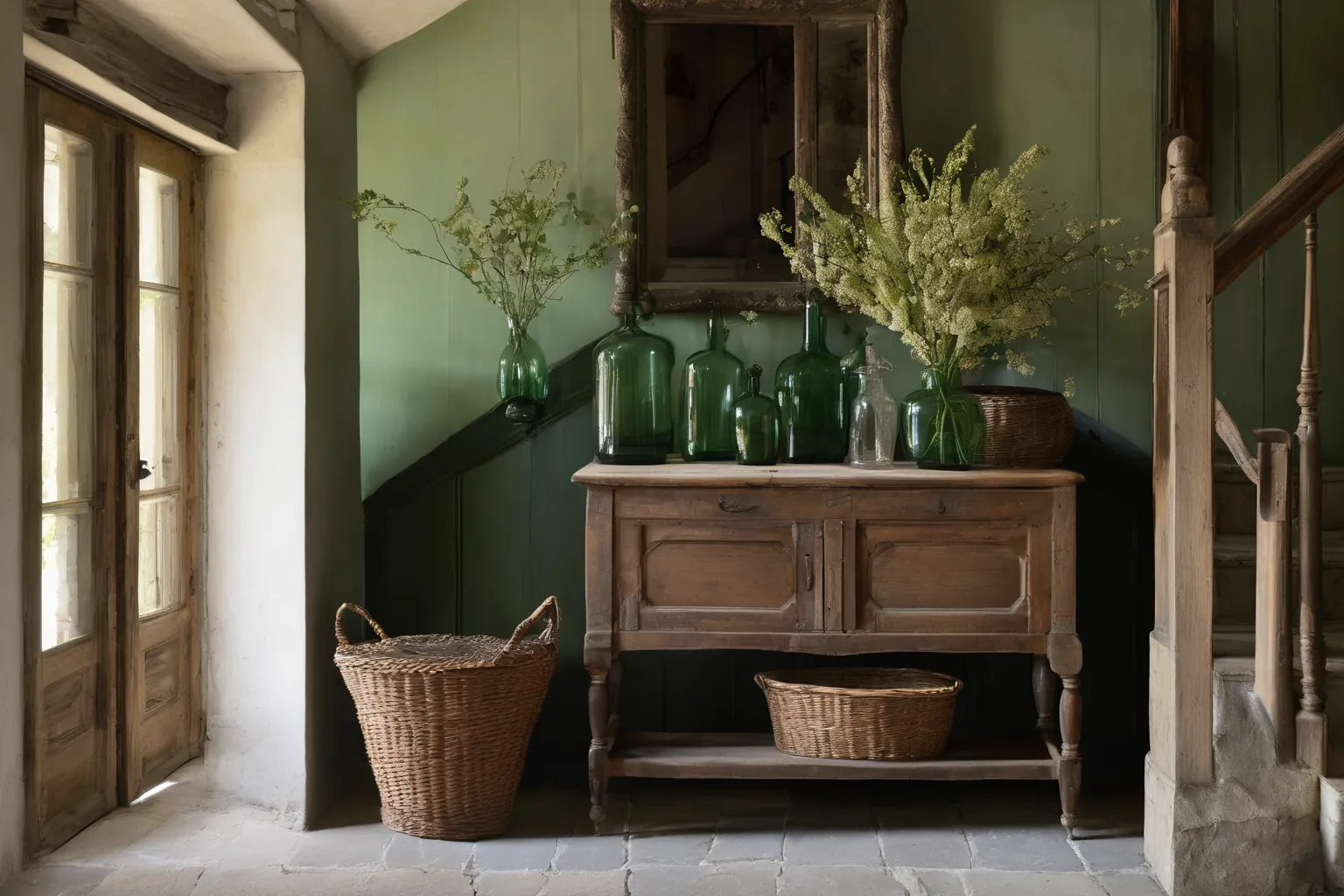
Color runs from clear through pale green to deep olive; amber and blue-green bottles exist and stand out. The deep green of old wine glass is the collector’s favorite because it turns almost black in shadow and glows at the edge in daylight. Wicker-wrapped demijohns — glass caged in woven straw — survive in good numbers and suit a room that finds bare glass too formal.
Hand-blown or mold-made: how to date one
Four tells separate early hand-blown glass from later machine-made bottles. Look for the pontil: a rough scar, or an open pontil ring, at the base where the blowpipe was detached — machine bottles have a flat, uniform base. Then bubbles and strata: hand-blown glass holds seeds and slight waves in the wall. Then asymmetry: the body of a blown dame-jeanne leans, the shoulder droops unevenly, the neck rarely sits perfectly straight. Finally the mold seams: fine vertical lines through the body and finish mark mold-made production, which spread as glass mechanized in the late nineteenth and early twentieth centuries. Our mouth-blown bottles encyclopedia entry shows the base details.
None of these tests dates a bottle to a precise year, and no honest seller should claim they do — but together they sort a cellar lot into early blown glass and later production within minutes.
Condition checks before you buy
Glass this large lives and dies at two points: the neck and the base. Run a fingernail around the lip — chips there are the most common flaw — then inspect the base and the shoulder where weight stresses the glass. Hairlines are hard to see: hold the bottle to daylight and rotate it slowly, looking for the line that catches.
Inside, milkiness and mineral staining are cosmetic in a display piece; rusted wire and a broken wicker cage are fixable; a base crack is not, because a filled demijohn weighs as much as a person. This follows the same discipline as the rest of our antique French glass checks — see also the honey and preserve jars guide for the smaller forms.
Displaying a dame-jeanne at home
The demijohn earned its place in French country rooms because it does the work of a sculpture at the cost of a bottle. One 20-40 liter bottle at the base of a staircase or in an entry corner anchors the space; on a console, a smaller bonbonne takes three to five thick dried stems — no more — and reads as a vase with a story. It can also stand with the other vase forms on a landing or veranda.
Two rules from the French houses we know: never fill an old bottle for display, and never crowd one — glass that big wants space around it.
What to compare
| Size | Usual role | Best display spot |
|---|---|---|
| 5-10 L | Countertop bonbonne for oil or wine | Kitchen shelf, buffet top |
| 10-20 L | Village tavern and farm standard | Entry console, hearth corner |
| 20-40 L | Cellar and transport demijohn | Floor piece: entry, veranda, stair landing |
| Wicker-wrapped | Protection in transit; second life as decor | Living room, garden room |
Frequently asked questions
What is the difference between a demijohn and a carboy?
They describe the same family of large glass bottles. Carboy is the English trade term, demijohn the everyday English word, and dame-jeanne and bonbonne the French words. Collectors use carboy more for industrial bottles and demijohn for wine and oil vessels.
Why are they called dame-jeannes?
The name follows a French legend about a Queen Jeanne whose baggage included the giant bottles; the glassblowers’ nickname became the word for the bottle itself. Historians dispute the story, but the term has been in use for centuries and gave English its word demijohn.
How much does an antique demijohn hold?
Most French demijohns hold between 10 and 40 liters, with small countertop bonbonnes from 5 liters and exceptional cellar bottles above 40. A filled 40-liter bottle weighs well over 40 kilograms — which is why display pieces are kept empty.
How can I tell how old my demijohn is?
Look for a pontil scar or open pontil at the base, bubbles and waves in the glass wall, and an asymmetrical body — these mark hand-blown glass. Mold seams through the body point to later machine-made production. These tests sort early from late glass but do not give an exact year.
Is it safe to put water or flowers in an old demijohn?
Dried stems are fine in the neck. Standing water stains old glass, adds weight the walls were not last asked to carry, and encourages residue; collectors display demijohns dry. A smaller vessel placed inside the mouth gives a terrarium look.
What do French demijohns cost?
Prices vary widely with size, color and how early the glass is; small clear bonbonnes are modest, deep-green blown bottles and wicker-wrapped pieces carry a premium. Condition around the neck and base moves the price more than age alone.