The banquette: the upholstered French bench
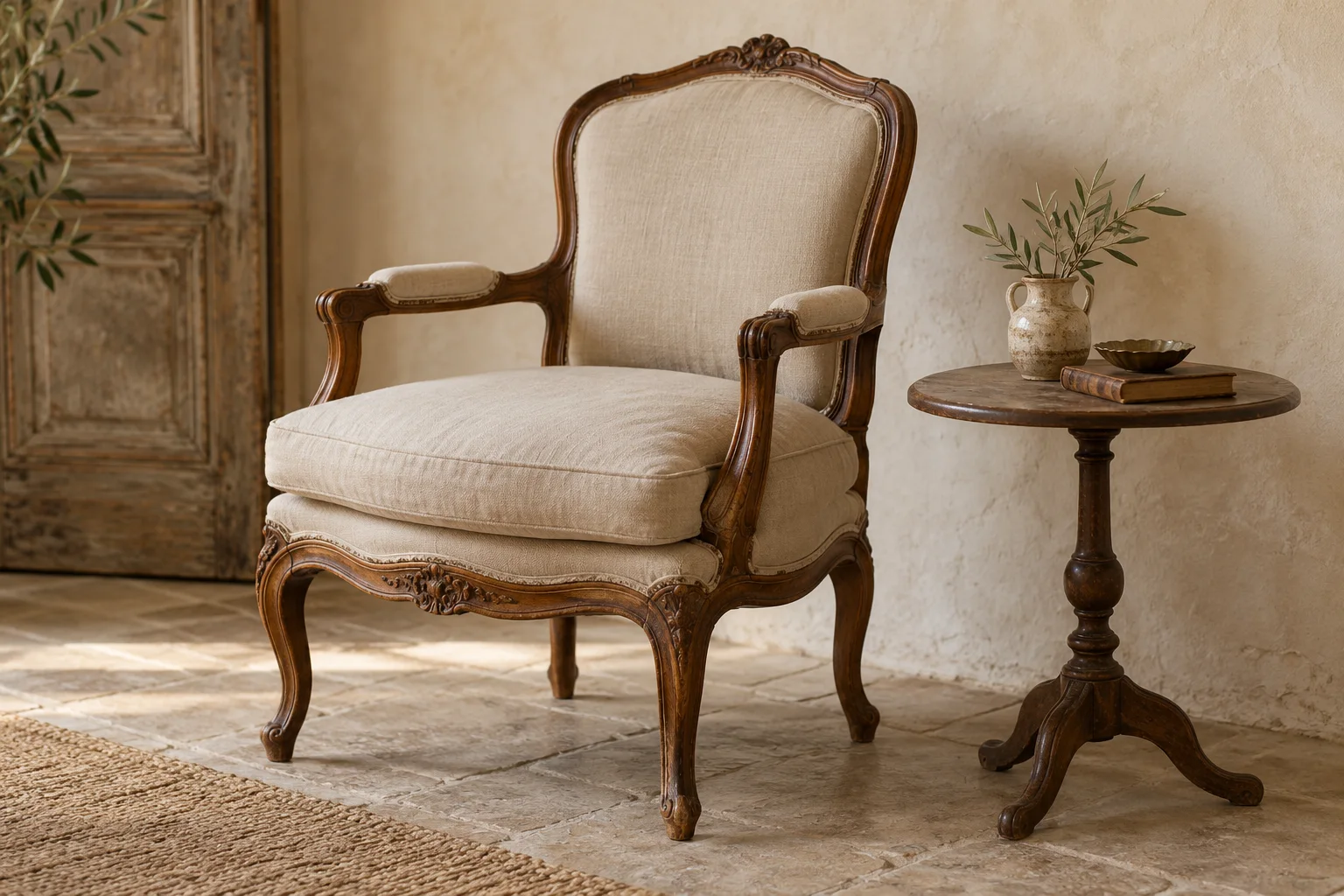
A banquette is a bench with a padded or caned seat on a show-wood frame, usually in the Louis XV or Louis XVI manner: cabriole or turned legs, a carved rail, sometimes a low upholstered back at each end. It is a bedroom and window piece, made for sitting briefly, so the frame is lighter than a farm bench. Sizes run from 36 in (91 cm) for a single window to 60 in (152 cm) at the foot of a wide bed.
Check the frame before the fabric. Press each corner: a banquette that racks has loose joints, which a restorer can reglue, but a frame with replaced legs or a cracked rail is a different purchase. Lift the seat cushion or look underneath for the webbing and springs; sagging webbing is normal and cheap to replace, broken springs are not. The Canadian Conservation Institute guidance on textiles supports keeping old upholstery out of direct sun and away from damp walls.
A style name describes an inspiration, not a documented date. A Louis XVI banquette may be eighteenth century, a nineteenth-century revival or a twentieth-century reproduction; the listing should say which, and only a mark or a document settles it.
The banc: farm bench and garden bench
In a French farmhouse the banc is a thick plank on splayed legs with a stretcher, made to slide under the table de ferme. It seats three at 17–18 in (43–46 cm) and carries weight without flexing. In the garden, the banc de jardin is the same word for a slatted wooden bench or an iron bench, placed on an axis, under a tree or against a south wall.
For the farm bench, test the wedged tenons where the legs pass through the seat and look for splits at those holes. For the garden banc, the wood species decides whether it can stay outside: oak, chestnut and teak last; pine does not. An iron banc follows the rules of any metal garden bench, with feet on stone and a sound coat of paint.
Hall benches and where each French bench belongs
The hall bench (banc d’entrée) has a back and often a lift-up box seat for boots and baskets; some have a high panelled back like a settle. In an entryway, 36–48 in (91–122 cm) long and 14–18 in (36–46 cm) deep leaves room to pass. Fix a tall-backed bench to the wall if children will climb on it.
Use the form to decide the room. A banquette sits at the foot of a bed, under a window, or in a dressing room; a farm banc belongs at the kitchen or dining table; a garden banc goes outside or in a sunroom. A caned banquette does not tolerate daily meals, and a farm bench looks heavy in a bedroom. When a bench must do two jobs, choose the plainer, sturdier form and add a cushion.
What to compare
| Form | Suggested Use | Decisive Check |
|---|---|---|
| Banquette (upholstered or caned) | Foot of a bed, under a window | Frame joints, webbing, replaced legs |
| Banc de ferme (plank bench) | Kitchen or dining table | Wedged tenons and splits at the leg holes |
| Hall bench with box seat | Entryway, shoes and baskets | Hinges, back fixing, depth |
Your buying checklist
Continue planning your room
Frequently asked questions
What is the difference between a banc and a banquette?
A banc is a plain bench, usually a plank seat on legs, used at a farm table or in the garden. A banquette is an upholstered or caned bench on a show-wood frame, made for a bedroom, a window or a dressing room. The banc carries weight and daily use; the banquette is lighter and needs its frame and webbing checked.
Where do you put a banquette in a French country home?
At the foot of the bed, under a window, or against a wall in a dressing room or wide hallway. Allow 2 to 4 inches (5 to 10 cm) below the mattress top at the foot of a bed so the banquette does not compete with the bed. Keep caned seats away from radiators and direct sun, which dry and crack the cane.
What size bench suits a hallway?
A bench 36 to 48 inches (91 to 122 cm) long and 14 to 18 inches (36 to 46 cm) deep leaves room to walk past in most entryways. Seat height of 17 to 18 inches (43 to 46 cm) makes it easy to sit and remove shoes. Measure the clear width of the hall and keep at least 36 inches (91 cm) free beside the bench.
Can a French garden bench be used indoors?
Yes, a wooden garden banc works well in a sunroom, a kitchen or an entryway once it is clean and dry. Brush off soil and lichen, let the wood dry slowly indoors for a few weeks, then wax it. An iron garden bench can come inside too, with felt pads under the feet to protect stone and wooden floors.
Sources & further reading
- Canadian Conservation Institute — Basic care: furniture and objects made of wood — Supports checking joints and keeping wooden frames away from damp and heat sources.
- Canadian Conservation Institute — Caring for textiles and costumes — Supports keeping old upholstery and cane out of direct sunlight and damp.