The Vocabulary of the Louis XV Style
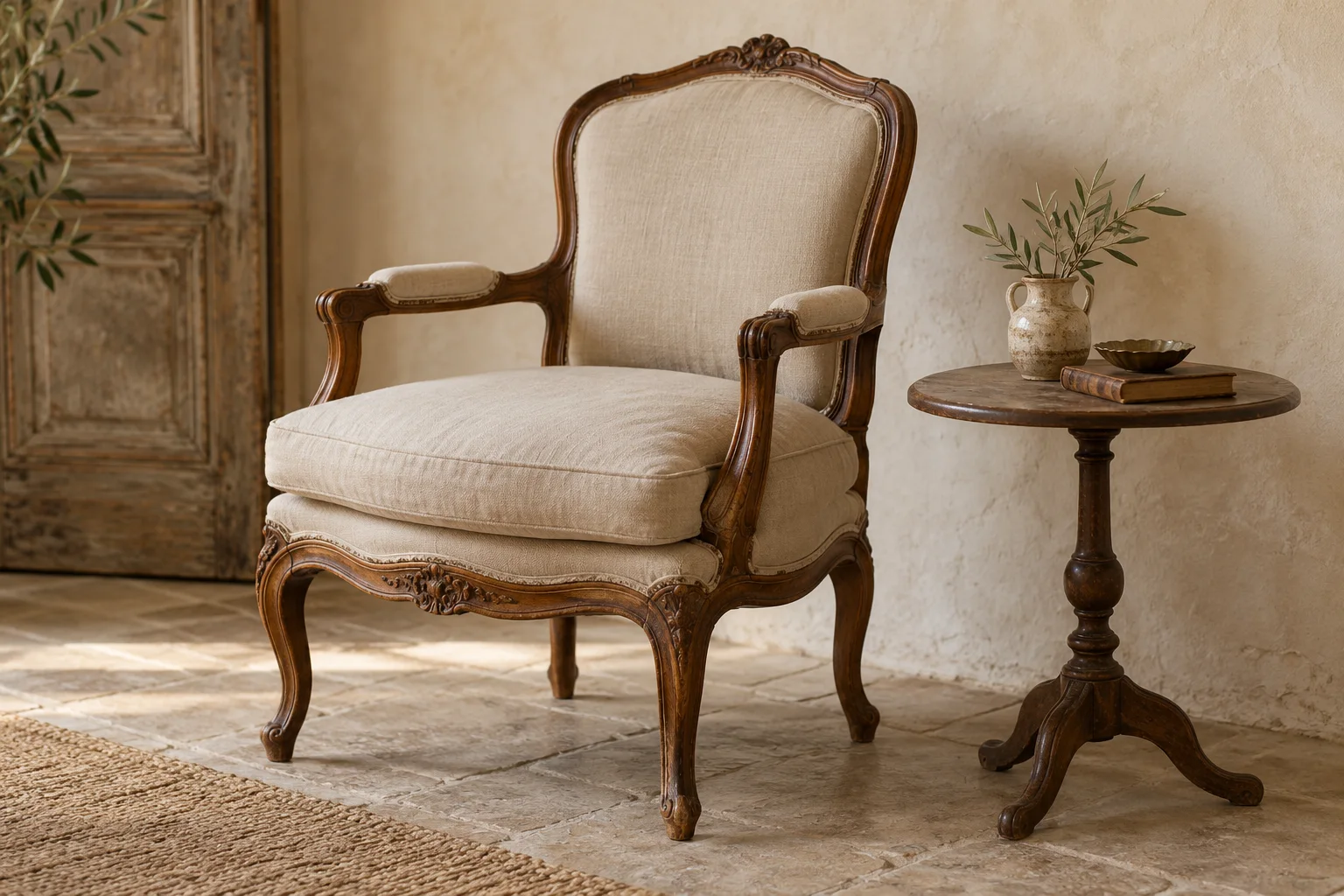
The cabriole leg is the signature: it swells at the knee, narrows at the ankle and ends in a scroll or hoof foot. Aprons and seat rails are carved with shells, foliage and C-scrolls that refuse symmetry, and the outline of a commode swells on the front and sides. Chairs come as the fauteuil à la reine with a flat back and the fauteuil en cabriolet with a curved back; both have a cartouche-shaped frame, and provincial versions in walnut or cherry keep the shape while simplifying the carving. The Metropolitan Museum’s survey of French case furniture shows the Paris version of the vocabulary at its most complete.
In the catalogue, the style appears most often among antique armchairs and settees and chaises, and in the quieter forms described on the French Provincial style page. Learning the vocabulary first makes the second step possible: deciding what the vocabulary does not tell you.
Period, Revival or Style: What Separates Them
An 18th-century piece shows 18th-century making. Secondary woods are hand-sawn with straight, irregular saw marks; dovetails are hand-cut and slightly uneven; carving varies from one leg to the next because each was cut by hand; shrinkage has opened the joints across the grain; wear sits where feet, hands and brooms would have put it. Paris guild furniture may carry a maker’s stamp and the JME mark used after 1743, but stamps were added later to many pieces, so a stamp supports an attribution and never proves it. The Getty’s catalogue of a documented pair of commodes with replaced marble tops is a useful reminder that even period furniture carries later elements.
Revival furniture of 1860–1900 keeps the curves but shows circular-saw arcs on hidden surfaces, machine-cut dovetails, more uniform carving and heavier gilding. Twentieth-century style pieces add plywood panels, pressed or moulded ornament, staples under the upholstery, modern screws and sprayed finishes. None of these are faults; they are facts to be written into the description. A style name describes an inspiration, and only documents and construction describe a date.
Buying Louis XV Style Furniture for a Country Room
One curved piece against straight lines is enough: a provincial commode under a plain mirror, or a pair of cabriolet chairs beside a linen sofa. Seat heights on older chairs are often 16–17 in (41–43 cm) and backs sit lower than modern seating, so try before you plan a dining set around them. Beech and walnut frames should be checked for woodworm: small round holes with fresh pale dust mean active insects, dark old holes do not. Press the back and arms to find loose joints before you pay for upholstery, which usually costs more than the frame on a style piece.
Our guide to French country furniture explains how the provincial pieces sit with farmhouse tables and painted cupboards, and the living room guide shows where a single ornate piece earns its place. Ask the seller to write one of three words in the invoice: period, revival or style.
What to compare
| Form | Suggested Use | Decisive Check |
|---|---|---|
| Period piece, 18th century | Collecting, a documented purchase | Construction marks and provenance papers |
| Revival piece, 1860–1900 | Dining and salon sets of six or eight | Carving uniformity and circular-saw marks |
| 20th-century style piece | Everyday use on a budget | Plywood, staples and sprayed finish |
Your buying checklist
Continue planning your room
Frequently asked questions
Is Louis XV furniture always from the 18th century?
No. Louis XV names a style that was made in the 18th century, revived between about 1860 and 1900 and reproduced throughout the 20th century. Only construction details, wear and documents place a piece in time. A listing that says Louis XV without the word period, revival or style is describing a look, not a date.
What is the difference between Louis XV and Louis XVI furniture?
Louis XV furniture is curved and asymmetric: cabriole legs, serpentine fronts, rocaille carving. Louis XVI furniture, from the 1770s onward, returns to straight lines: tapered and often fluted legs, rectangular or oval chair backs, symmetrical ornament such as ribbons and laurel. Provincial makers mixed the two for decades, so transitional pieces are common.
Does a stamp prove a piece is period?
It does not. Paris guild pieces were stamped from 1743, but stamps were faked, added to later furniture and copied from genuine examples. A stamp consistent with the construction and provenance supports an attribution. A stamp on a piece with circular-saw marks or plywood contradicts it. Ask for a written description that separates the two.
Can Louis XV style furniture work in a French country room?
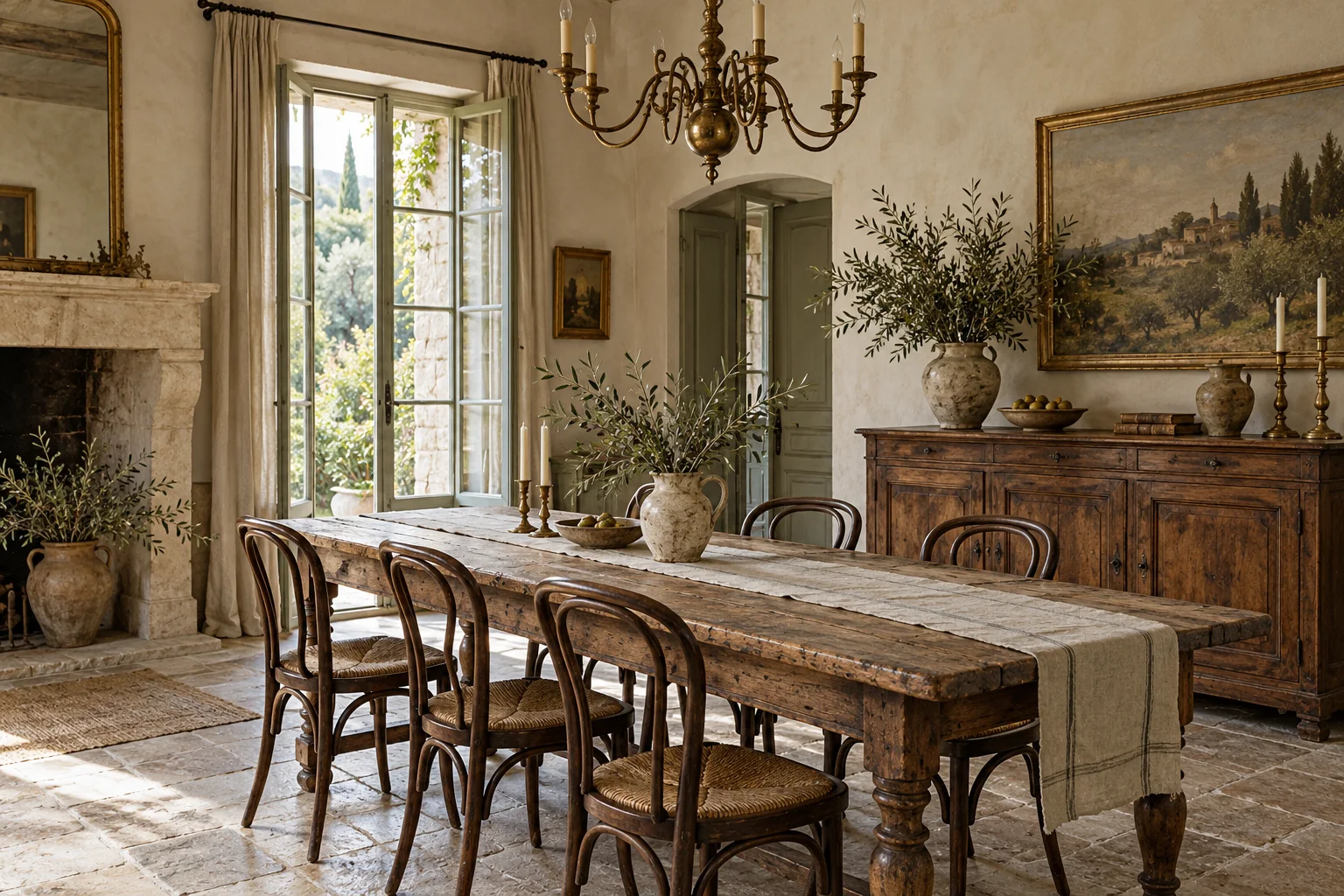
Yes, in small doses. One carved commode or a pair of curved armchairs gives a plain room with linen, limewash and a farmhouse table its moment of elegance. Several ornate pieces together read as a period reconstruction. Keep walls quiet and mix the curved piece with simpler provincial forms.
Sources & further reading
- The Metropolitan Museum of Art — French Furniture in the Eighteenth Century: Case Furniture — Describes the forms, materials and workshop practice of 18th-century French case furniture.
- Getty — Pair of commodes (documented example with replaced tops) — A documented pair of commodes with later marble tops, showing that period pieces carry replaced elements.
- Canadian Conservation Institute — Basic care: furniture and objects made of wood — Guidance on preserving old finishes and checking joints before use.