Natural rush or paper rush: telling them apart
Natural rush is made from the leaves of marsh plants, twisted into a cord by hand as the seat is woven; the strands vary slightly in thickness, show fine lengthwise ridges and a colour from pale straw to warm brown, and feel slightly waxy. Paper rush, or fibre rush, is a machine-twisted paper cord used widely from the 1920s onward; the strands are uniform, smooth, with a flat tan colour that greys with dirt rather than deepening.
Both are woven in the same pattern of four triangles meeting at the centre of the seat, so the pattern does not tell them apart. Look at a cut end under the seat rail: natural rush shows plant fibre, paper rush shows layers of paper. Weight helps too; a natural rush seat is heavier and denser. In France, village chairs were also seated in straw and, in some regions, in twisted hemp rope.
Neither material is better in every case. Natural rush suits an antique chair whose seat is part of its history; paper rush is a sound, durable choice for a chair used hard every day. Our bistro and dining chairs catalogue notes the seat material where it is known, and the guide to choosing antique chairs covers the other seat types.
Why rush seats sag and hole, and when to re-rush
A rush seat sags because the twisted cords stretch under weight and the stuffing of loose rush pushed under the surface compacts; the centre drops into a hollow of 1–2 in (2.5–5 cm). Sagging alone is not a failure, and many people prefer the shaped seat. Holes are different: they open at the front edge where knees rub and at the corners where the cords cross the rails, and once a strand breaks the seat unravels quickly.
Press the centre and the front edge. A firm seat with intact edges needs nothing. A seat with a deep hollow and dry, brittle strands that crack when flexed is near the end of its life and should be re-rushed before it fails under a guest. Do not patch a rush seat with glue or tape; repairs of a few strands rarely hold.
Re-rushing replaces the whole seat. A weaver removes the old rush, checks the rails, which are often round and may be worn thin at the corners, and weaves a new seat from the corners inward over several hours, then lets it dry for days. New natural rush is pale green to straw and darkens over a year; new paper rush stays tan. Ask for a quote per chair and whether the old seat can be kept if the chair is documented.
Care rules and everyday use
Never soak a rush seat. Water swells the fibres, which then shrink and loosen as they dry, and it carries dirt into the twist. Clean with a soft brush and a dry cloth; for a greasy kitchen seat, wipe with a barely damp cloth and dry at once. Keep chairs with rush seats away from radiators and out of direct sun, which make the fibres brittle, and off damp floors, which encourage mould in the stuffing.
Do not stand on a rush seat, and do not let a chair be used as a step; the cords were made for sitting weight spread over the surface, not for a heel. A flat cushion tied to the back posts protects the front edge and makes long meals easier. Rotate chairs around a table so the same two do not take every dinner.
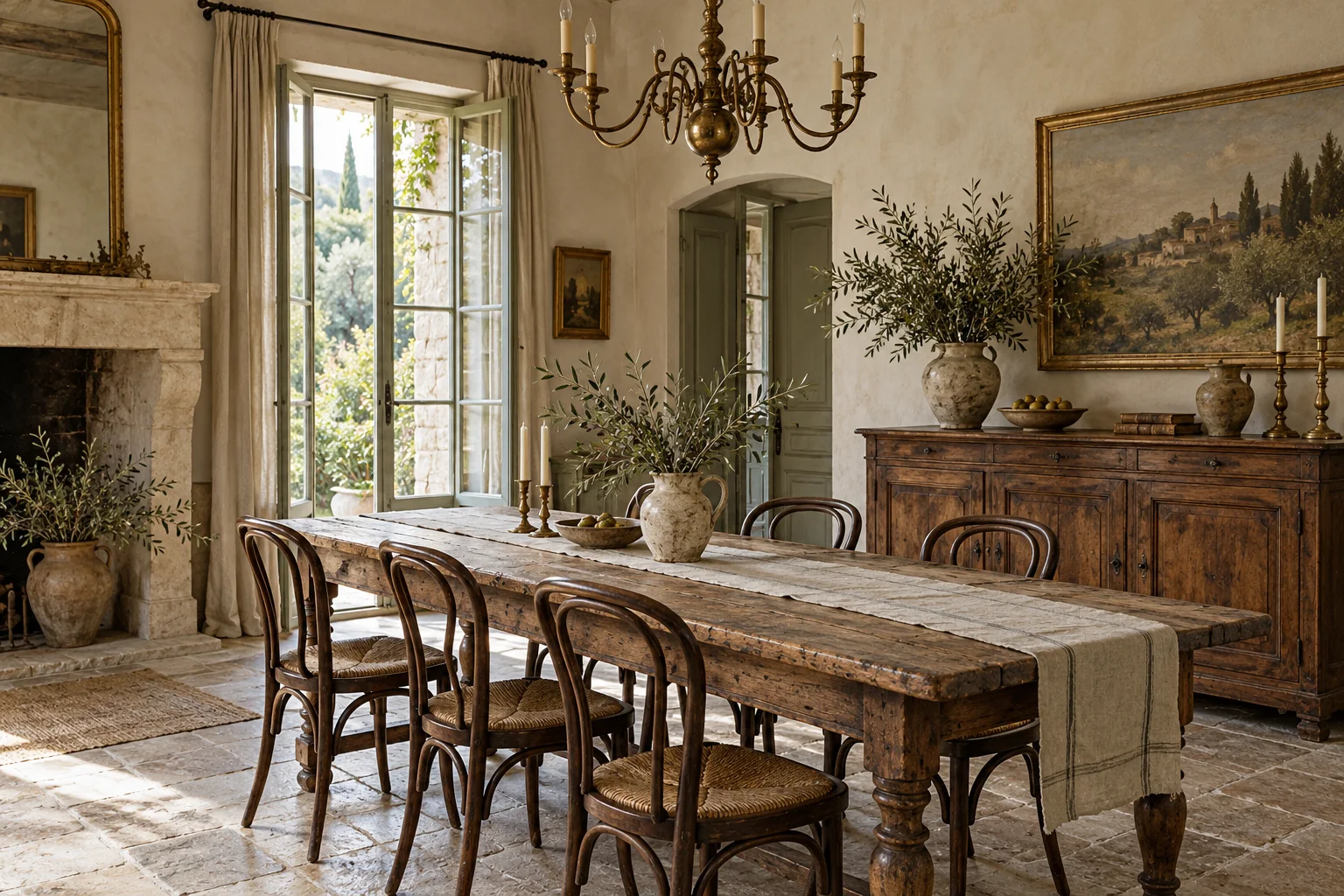
In a French country kitchen, rush seats pair with a scrubbed table and painted frames; in a bedroom, a single rush chair holds clothes without complaint. See our guide to the French country kitchen for the room, and the overview of French country chairs for mixing rush with cane and upholstery.
What to compare
| Form | Suggested Use | Decisive Check |
|---|---|---|
| Natural rush seat | Antique chair, documented piece | Plant fibre at cut ends, strands slightly uneven |
| Paper rush seat | Daily-use kitchen chair | Uniform smooth cord, tan colour |
| Sagging seat with sound edges | Keep as is, add a cushion | No broken strands at the front edge |
Your buying checklist
Continue planning your room
Frequently asked questions
How do I tell natural rush from paper rush?
Look at a cut end under the seat rail: natural rush shows plant fibre and slightly uneven, ridged strands with a waxy feel; paper rush is a uniform, smooth machine-twisted cord with a flat tan colour. The weaving pattern is the same for both, so the pattern alone does not identify the material.
Can a sagging rush seat be fixed without re-rushing?
A hollow seat with intact edges does not need fixing; many people prefer the shaped surface, and a flat cushion makes it comfortable. Once strands break at the front edge or the corners, patching with glue or a few new strands rarely holds, and the seat should be re-rushed as a whole.
How long does re-rushing a chair take?
A weaver works several hours per seat, from the corners inward, then the seat dries for days before use. New natural rush is pale and darkens over a year; paper rush stays tan. Ask for a quote per chair and confirm which material will be used.
Can I clean a rush seat with water?
Only with a barely damp cloth, dried at once. Soaking swells the fibres, which loosen as they dry, and carries dirt into the twist. A soft brush and a dry cloth are the routine; keep the chair away from radiators, direct sun and damp floors.
Sources & further reading
- Canadian Conservation Institute — Basic care: furniture and objects made of wood — Care of wooden furniture and plant-fibre seating: dry cleaning and avoiding damp and heat.