Nov 15, 2026 · Antique guide
Antique Terracotta Floor Tiles and Lime: A Gascon Guide
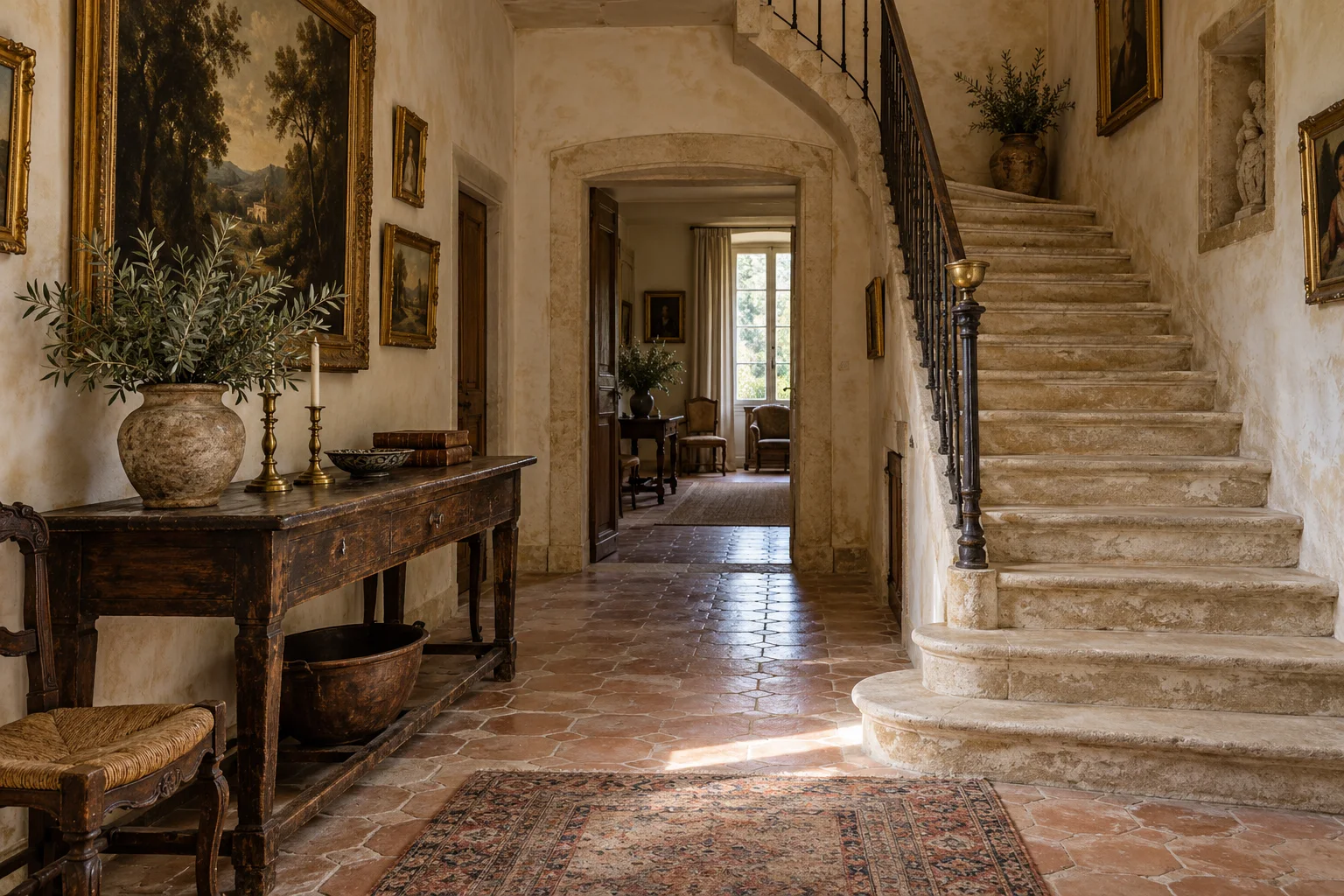
Two materials give the Gascon farmhouse its warmth: the terracotta tile underfoot and the lime on the walls.
Cayla ends his book with two errors that sum up all the others. The first is to forget the value of simplicity: to show one's means through unusual volumes, colours or window arrangements. The second is to try to give a house a rustic character with objects diverted from their proper use, or with poor imitations.
He also explains why old houses charm and new ones often do not: the absence of rigid measurement, the suppleness of the lines, the slight batter of a wall, the twist in a roof. The old builders worked by eye more than by string line and plumb bob, and that freedom shows. Every mistake below breaks that rule in one way or another.
In the Lot-et-Garonne, Cayla observed, the two leaves of an old casement window were glazed with panes of about 30 by 40 cm (12 by 16 in), three or four in the height of each leaf. Many new owners replace them with small panes of 20 by 25 cm (8 by 10 in), believing that small panes look more rustic. They do not belong to these houses.
What to do instead: keep or copy the original division. Windows in this region are always taller than wide, set above a sill about a metre from the floor, and their tops sit higher than the door. Their arrangement follows the rooms inside, and does not need to be symmetrical.
The old external shutters are solid wood, made of boards held by horizontal battens. The diagonal Z brace is rare, Cayla notes, and it becomes ugly when it is painted in loud colours to attract attention, against walls left in natural tones.
The best old shutters were also cleverly fitted: when closed, their edge on the hinge side sits in a rebate cut in the edge of the wall and the lintel, so that the shutter forms a continuous surface with the wall and rainwater runs off without getting in. On the timber-framed houses of the Landes, the same rebate is cut into the wooden window frame.
What to do instead: batten shutters, left in natural wood or painted in quiet, neutral tones. Keep old shutters if you can; our antique shutter entry explains how to assess them.
This is the most damaging mistake. Cayla explains why cement is wrong on old rubble or earth walls:
Lime mortar, by contrast, lets the wall breathe, barely shrinks and does not crack. Its surface catches the light through its grains of sand, and the sand gives it the colour of the local soil. Cayla recommends fat (air) lime, which hardens only on contact with the air, mixed with about two parts of lime to three of clean sand, low in clay, sieved from the local river or soil.
What to do instead: remove cement where it is causing damp, and render with lime. Cayla, writing in 1977, still allowed some cement in the first coat; conservation specialists today generally recommend lime throughout on old walls. Read our guide to terracotta floors and lime for more on the material.
Even with lime, the finish can go wrong. Cayla wanted render applied mainly with the trowel, thrown on and lightly smoothed with its edge. Machine-regular finishes made with a float, a spray or a Tyrolean gun give a surface that is too even and too shiny. Worse, he says, is a fake irregularity made by deliberate trowel strokes, as is too often done.
What to do instead: hire a mason who knows lime, apply the render in mild weather (never in heat, heavy rain or frost), protect it from sun and rain while it cures, and accept the small irregularities that come naturally from the hand.
Where stone is left visible, Cayla insists that the joints should be discreet, in the same tint as the stone, and flush, never projecting. You should not try to show off the stone with pointing that draws the eye around each block. The old builders, he notes, were content with very modest jointing; remember it when you restore.
What to do instead: brush the joints flush with a lime mortar coloured by local sand. Most farmhouse walls in rubble stone were rendered anyway; walls of dressed stone laid in courses are found mainly around Lectoure and Nérac.
The roofs of the region are low-pitched, covered with round canal tiles that stay in place only by overlapping, which is why the pitch stays around 22 to 25 degrees. The old tiles vary in colour, and the old roof frames, made of unsawn or split timber, give the ridge and the rows of tiles a gentle wave. Cayla regrets three modern habits:
What to do instead: reuse old canal tiles for the visible top layer, keep the old frame where it is sound, and restore the génoise rather than adding gutters where the overhang does the job.
The timber-framed houses of the Landes and the Armagnac were built from oak used in the round or roughly squared with an adze, assembled with mortise and tenon and acacia pegs, without metal. Their curves and irregularities are their charm. Cayla's verdict on restorations using today's sawn timber is blunt: with modern sawn wood you can only make false rustic, and everything false is depressing. Better to look for something else.
What to do instead: repair rather than replace, using old timber where possible, and leave the earth infill and lime coating if they are sound. If you must rebuild, do not imitate: build simply.
Old farms did not shut themselves in. The Landes airial had no fences or hedges at all; in the Gers and the Lot-et-Garonne, a planted hedge was more common than a wall, which was reserved for large estates. Cayla considered that a fence too prominent in colour or form, built to mark ownership and isolate a second home from the neighbours, offends the landscape.
The same goes for the props. The writer Gérard Boutet, recalling the clearing of village houses in central France, mentions wagon wheel hubs carted away to be turned into "ridiculous" standard lamps. A cart wheel against a wall or a plough in the garden does not make a farmhouse; real objects used for their real purpose do.
What to do instead: plant hedges of local species, keep gates simple, and furnish with pieces that still do a job. Our Gascon farmhouse style page and the article on where French country antiques came from show the alternative.
Most French departments have a CAUE (Conseil d'architecture, d'urbanisme et de l'environnement) that gives free advice to private owners on renovation. The national association Maisons Paysannes de France, which Cayla himself cites, works for the conservation of rural buildings and publishes technical guidance. If your house is near a listed monument, the Architecte des Bâtiments de France will also have a say in the works.
| Mistake | Why it looks wrong | Traditional alternative |
|---|---|---|
| Small 20 x 25 cm panes | Not the regional division | Panes about 30 x 40 cm, three or four per leaf |
| Z-braced, brightly painted shutters | Foreign brace, loud colour | Batten shutters, natural or quiet paint, set in a rebate |
| Cement render | Traps moisture, cracks, grey | Fat lime render with local sand |
| Machine or fake-irregular plaster | Too even, or theatrical | Trowel-applied lime with natural irregularity |
| Prominent pointing | Frames each stone | Flush, discreet joints in the stone's colour |
| Mechanical tiles and gutters | Hard lines, uniform colour | Old canal tiles, génoise, generous overhang |
| New sawn timber frame | "False rustic" | Repair with old timber, or build simply |
| Fences and props | Isolate and stage the house | Hedges, simple gates, objects used for their purpose |
Cement is impermeable, so moisture cannot escape from old rubble or earth walls and condenses inside, causing damp and saltpetre. It also shrinks and cracks, letting rain in. Lime mortar lets the wall breathe and barely shrinks.
Solid wooden shutters made of boards held by horizontal battens, usually without a diagonal Z brace, left natural or painted in quiet colours. On the best houses they close into a rebate so they sit flush with the wall.
Round canal tiles laid on a low-pitched roof of about 22 to 25 degrees, held only by overlapping. Old tiles vary in colour and project well beyond the wall, often over a génoise, so gutters were not needed.
Most departments have a CAUE, a public body that gives free advice to private owners on architecture and renovation. The association Maisons Paysannes de France also publishes guidance on traditional rural buildings.
Nov 15, 2026 · Antique guide
Two materials give the Gascon farmhouse its warmth: the terracotta tile underfoot and the lime on the walls.