Nov 16, 2026 · Antique guide
Antique Fish Plates and Fish Services: Forms and Checks
Antique fish plates were sold as a service: six or twelve plates, one long platter and sometimes a sauce boat, each decorated with a different fish.
The Gascon cellar is not a cave. Cayla is categorical: in the Armagnac, wine and brandy were never kept in an underground cellar, as in Burgundy, nor under the house itself, as in the Quercy. The chai and the cellier stand behind the house, facing due north, sheltered by a screen of trees or shrubs. They are often preceded by a gallery carried on wooden posts.
The reasoning is simple: a north wall in shade, thick masonry and trees keep the building cool and stable in temperature through a hot Gascon summer, without digging into wet clay. In the farm monograph from the Orthe district reproduced in Archives de Gascogne, the wine store opens directly off the kitchen, next to the dairy, under the same roof.
For Pesquidoux, eau-de-vie was the paying product of the country. It gave not wealth but something better, he writes: domestic security. With a few casks of brandy in the chai, a family could sleep soundly. Good brandy never failed to sell, and when sold, it restored the balance after a frost, a hailstorm or an epidemic. The grateful farmer gave it the name of his land: Armagnac.
Two towns set the trade, he notes: Eauze, in the Bas-Armagnac, where the year's prices were established, and Condom, in the Ténarèze, where brokers came every autumn and winter to build up stocks.
Pesquidoux's account of the spirit's history runs as follows. Armagnac was first used as a medicine, to wash venomous bites, rub sick limbs and stir the blood. A century later, people were drinking it. In the seventeenth and eighteenth centuries, casks were gathered at Mont-de-Marsan, sent down the Adour to Bayonne and shipped abroad by sea, and the brandy travelled the world without suffering from the voyage.
When distilling began, Pesquidoux writes, the vineyard of the Armagnac was planted with the local white grape he calls pique-poult, whose wine was light, slightly sharp and golden. It proved eminently suited to being "burnt", converted into spirit, and was grown more than ever. Phylloxera destroyed the vines but not the tradition: the growers grafted it onto American roots. In his day, the hybrid Baco blanc no. 22, a cross of Noah and pique-poult, had been admitted as a distilling grape.
Today the rules of the appellation, set by a decree of 1936, allow ten grape varieties. Ugni blanc covers more than half of the declared vineyard; Folle blanche, the historic variety, now only a small share.
Pesquidoux places the best brandy on poor, gravelly ground of clay and marl mixed with iron-stained pebbles, where the vine must root deep. The Armagnac is divided into three zones: Bas-Armagnac in the west, Ténarèze around Condom and Haut-Armagnac in the east. In his opinion, the brandy of the Bas-Armagnac came first.
The flame, Pesquidoux writes, is the soul of distillation. Too fierce, it gives the brandy a harsh "coup de feu"; too weak, it makes a spirit without body. The quality of the flame depends on the wood, and only wood was used: dry, non-resinous, smokeless and burning completely. The best fuel in his country was a mix of alder and oak.
Armagnac is distilled in winter. The official description of the craft says distilling usually starts around All Saints' Day and must end by 31 March of the year after the harvest.
At first, Pesquidoux recalls, brandy was distilled from door to door in small portable stills carried on a man's back or by a pack animal. The still stood on a tripod between the tapped barrel of wine and the keg to be filled, with a long pipe leading the spirit to a funnel. A bright flame rose under the tripod, fed by the distiller, the brûleur, while the children watched the sparks in silence.
Later, each large estate had its own still: enormous, built into the masonry in a corner of the chai, working day and night, its red glow lighting up the dark building whenever the firebox was opened. In his own day, travelling stills arrived on tall two-wheeled carts and were set up under the sheds, out of the wind.
The traditional Armagnac still is a column still that distils the wine in a single continuous run. The official description of the craft credits its development to the late eighteenth and early nineteenth centuries, and records the oldest dated still in Gascony, from 1804, at the Domaine d'Ognoas in the Landes, where it is listed as a historic monument. About a thousand stills were registered in the early twentieth century; only a hundred or so remain.
The distillers, Pesquidoux writes, worked from father to son and by experience. They knew that 100 litres of wine at 10 degrees gave 20 litres of brandy at 50 degrees. A drop rolled on the tongue as it left the still told them at what strength they were distilling. From mid-autumn they worked in twelve-hour shifts, eating and drinking at the still, wrapped in a blanket at night. He remembers one of them, known only as meste Jean, master Jean, who would not speak a word during the heating, listening to the wine and the wood.
The first neighbour was the appointed taster. Called when the still was running, he arrived with roasted chestnuts in his pocket, took a sip, ate a chestnut or two to clear his palate, sipped again and gave his verdict. Pesquidoux says it was never contested.
New brandy is good to taste but not ready to drink. It must settle and take its colour in oak casks. Pesquidoux insists on the black oak of Gascony, whose split staves give the spirit, after three or four years in cask, a fine wild scent it keeps for ever. Claudie Corty-Capdeville, quoting the Armagnac trade body, gives the standard cask, the pièce, as 400 to 420 litres, in oak from the forests of Gascony or the Limousin. As the brandy ages, its strength falls slowly through evaporation: the angels' share.
Old casks, staves and hoops are easy to find; the tools that made them are more interesting. Look for cooper's compasses, drawknives, crozes and hoop drivers, often stamped with the maker's or owner's initials. Our encyclopedia covers the cooper and the cooper's compass. A cask used as a table needs a sound head and hoops riveted, not just nailed.
A dark, windowless chai needed portable light. The iron candle holder with a spike, often called a cellar rat, could be pushed into a cask or a beam; see the cellar rat.
Old brandy has long been kept in glass demijohns once it has finished ageing in wood, and the large wicker-covered dames-jeannes of the southwest make striking decorative pieces. Mouth-blown bottles show a pontil mark on the base, slight asymmetry and small bubbles in the glass; see mouth-blown bottles and our bottles and demijohns collection. Check wicker for rot and the glass for star cracks before you buy, and never stand a large demijohn on its own on a hard floor without a ring or a basket.
Small stemmed glasses, carafes and tasting cups belong to the same world. Our bar and tasting accessories and decanter pages cover them.
You do not need a north-facing chai to keep brandy, but the principles hold: stable, cool temperature, no direct light, no vibration. Bottles of spirits are stored upright, unlike wine, so the strong alcohol does not attack the cork. A cellar or tasting corner furnished with an old cask, a farmhouse table, a rack and a few demijohns tells the story of the chai; see our wine cellar room ideas and the vine to wine chapter of the encyclopedia.
| Object | Role in the chai | Decisive check |
|---|---|---|
| Oak cask (pièce) | Ageing, about 400 to 420 litres | Sound head, riveted hoops, no active woodworm |
| Cooper's tools | Making and repairing casks | Original handles, maker's stamps, worn edges |
| Cellar rat | Portable candle holder | Hand-forged spike and holder |
| Demijohn (dame-jeanne) | Storing old brandy after ageing | Star cracks in the glass, rot in the wicker |
| Mouth-blown bottle | Serving and selling | Pontil mark, slight asymmetry, bubbles |
A chai is an above-ground building for making and storing wine or brandy. In the Armagnac it stands behind the house, facing north and shaded by trees, and is never dug underground or placed under the dwelling.
In winter, in a still heated by a wood fire of dry, non-resinous wood such as alder and oak. At first small portable stills went from farm to farm; later large estates had their own still built into the chai, and travelling stills came on carts.
The traditional Armagnac cask, called a pièce, holds about 400 to 420 litres and is made of oak from the forests of Gascony or the Limousin.
Upright, so the strong alcohol does not attack the cork, in a cool, dark place with a stable temperature.
Nov 16, 2026 · Antique guide
Antique fish plates were sold as a service: six or twelve plates, one long platter and sometimes a sauce boat, each decorated with a different fish.
Nov 16, 2026 · Antique guide
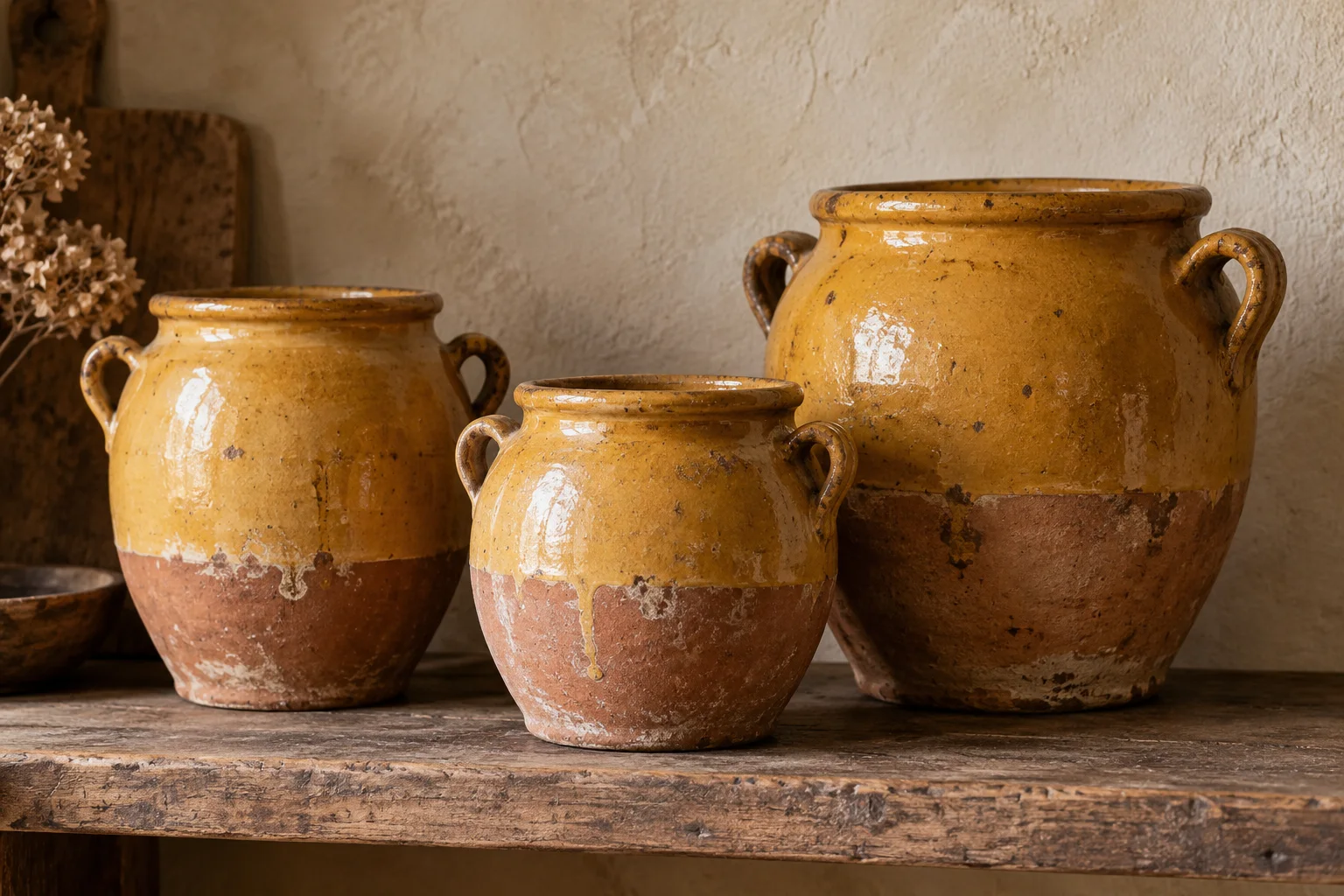
An antique stoneware crock is a high-fired clay vessel dense enough to hold brine, fat or oil without seeping, and French farms and kitchens used it under the name grès.
Nov 16, 2026 · Antique guide
Pressed glass, barbotine, porcelain or silverplate: how to choose a vintage cake stand, what size to buy and what to check before serving on it.