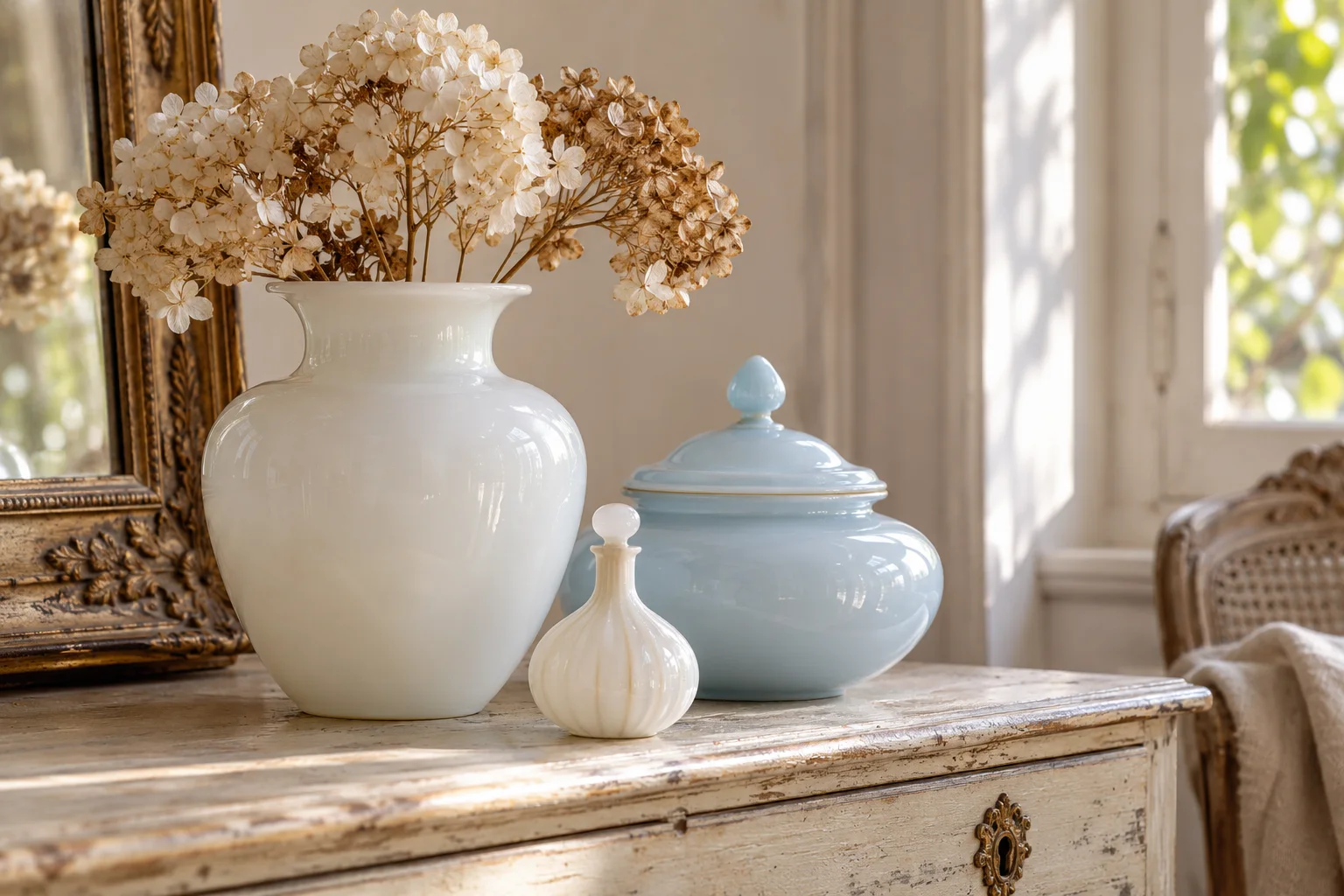
 AI-created styling idea
Glass
French opaline glass
Hold opaline to daylight and look under the base before reading a label.
ExploreFrench Country · An inspiration catalogue
Antique French glass is any glass made in France for the table, the pharmacy, the dressing table or the lamp, usually before about 1950: blown and pressed tumblers, bistro and crystal stemware, opaline and milk glass, apothecary jars, perfume bottles and candle holders. This page maps the field and links every guide in the series.
Collectors and designers look for antique French glass for two reasons that rarely meet in other materials: it is still useful, and it changes a room with light rather than with color or mass. A row of pressed tumblers on a shelf, a blue opaline vase on a windowsill or a pair of pharmacy jars in a bathroom costs little floor space and reads immediately as old. The guides below take each family in turn; this page gives the shared checks.
Three ways of making glass cover almost everything you will meet. Blown glass is gathered on a pipe and shaped by breath and tools; it is thin, slightly uneven and often shows a pontil scar under the base. Pressed glass is forced into a metal mold by a plunger; it shows faint seams, crisp patterns and thick walls. Crystal is a richer glass, historically with lead oxide, that is heavier, brighter and rings longer when tapped. A single shelf in a French kitchen often holds all three.
Opaline (opaline) is a semi-opaque glass, white or tinted in soft blue, green, pink or the pigeon-throat gray the French call gorge-de-pigeon. The finer pieces were blown and are faintly translucent against daylight. Milk glass is its cheaper, opaque, usually pressed cousin, made in quantity in France, Britain and the United States. The difference matters for value and for description; our guide to telling milk glass from French opaline sets out the tests.
A glass described as "Napoleon III opaline" or "Baccarat-type" names an inspiration, not a documented attribution. Glassworks reused molds for decades, and modern factories still press the old patterns. The safe habit is to describe what you can see (method, color, weight, wear) and to attribute a maker only by an acid-etched mark, a paper label or a document. That habit runs through every guide in this series.
French glassware for the table divides by use. The thick bistro glass holds about 4–6 oz (120–180 ml) on a short stem and survives daily washing; blown stemmed glasses hold a little more; crystal comes out for the Sunday table. Start with choosing French wine glasses, then read the guides to etched wine glass patterns and to lead crystal, marks and safe use. Mixed sets work when the bowls share one tone and roughly one height.
Opaline vases, boxes and cups were made for the dressing table and the mantel; milk glass compotes and hen-on-nest dishes for the sideboard. Apothecary jars, in clear glass, opaline or faience, held powders and syrups in French pharmacies and often carry a painted or gilt label, the cartouche. The guide to French apothecary jars covers labels, stoppers and reproductions, and Lo Cantou keeps a page on opaline apothecary jars.
Perfume bottles range from pressed-glass vanity flasks to cut-crystal bottles with ground stoppers and atomizers with silk bulbs; large dummy display bottles, called factices, were made for shop counters. Glass candle holders include pressed candlesticks, crystal pairs and the glass shades on a base known as photophores. See vintage perfume bottles, stoppers and atomizers and antique glass candle holders, photophores and hurricanes.
The pressed glass pitcher pours water at lunch and holds garden flowers in the afternoon; the stoppered carafe and the wine bottle sit beside it. Our guide to pressed glass pitchers explains where they chip and how to use them. Larger bottles and the wicker-wrapped dame-jeanne belong to bottles and demijohns.
Turn the glass over first. A rough or polished circular scar under the base, about ½–1 in (1–2.5 cm) across, is the pontil mark left when a blown piece was snapped from its rod; a polished pontil suggests careful finishing, not necessarily age. Fine raised lines running up the sides are mold seams, the sign of pressed or mold-blown glass. Neither proves a date on its own, because both techniques continued well into the twentieth century.
Crystal feels heavy for its size and gives a long, clear note when the rim is flicked; ordinary soda-lime glass sounds shorter. Hold opaline to daylight: many blown pieces show a soft translucency and a warm, faintly fiery edge, while milk glass stays flat and opaque. Some collectors use an ultraviolet lamp, under which different glass formulas glow differently; treat the result as a clue to compare against known pieces, not as proof.
Some French glassworks used acid-etched marks or paper labels on the base; many pieces were never marked at all. A mark should match the factory's known form and sit cleanly in the glass, not as a fresh scratch. Real age also shows as a fine, random web of scratches on the foot from decades of sliding on tables. A perfectly unworn foot on a "nineteenth-century" glass deserves a second look.
Run a fingertip slowly around every rim and foot. Small nicks, called flea bites, are common on old table glass and acceptable on everyday pieces if described; a chip that catches the lip is not. Check stoppers and the necks they fit, where tight grinding causes hairline cracks, and the handle joins of pitchers. Ask any seller for photographs of the rim and base in raking light.
A milky film that will not wash off is usually etching of the surface by years of hard water or dishwasher detergent, sometimes called sick glass. It rarely clears completely, whatever the vinegar or tablet promises. Decide whether a cloudy decanter is still worth having as a vase or a light-catcher, and price it accordingly. Clear glass with only surface grime will come clean with warm water and mild soap.
Lead crystal is fine for serving wine or water at the table. It should not be used to store wine, spirits, vinegar or juice for days or weeks, because acidic liquids can draw lead from the glass over time. Use old decanters for serving, empty them after the meal, and keep long-term storage in modern bottles.
Hand wash antique French glass in warm, not hot, water with a little mild detergent, one piece at a time, on a towel in the sink. Dry at once with linen. Store stemware upright, not on its rim, with space between pieces. The Canadian Conservation Institute's guidance on caring for ceramic and glass objects covers handling, cleaning and display in more detail.
Glass for daily use should be pressed or bistro glass, sound at the rim and replaceable. Glass for display can be cloudy, chipped at the back or missing a stopper, as long as the price reflects it. Opaline and crystal sit between: use them for flowers and for serving, not for the dishwasher. Deciding which category a piece belongs to settles most of the condition questions before you buy.
A matched set of twelve old glasses is rare and priced accordingly. Six or eight glasses of one form, assembled from two or three sources, work well if the bowls share a tone (clear, faintly green or faintly gray) and differ by no more than about ½ in (1 cm) in height. Count glasses by use: for eight guests, eight water glasses and eight wine glasses cover most meals.
Lo Cantou describes glass by method, condition and dimensions, with chips photographed, in its pages on vintage perfume bottles and antique glass candle holders. A designer furnishing a client project can send a brief to Antiques 360 for documented pieces from dealers in southwest France, with the landed cost known upfront; our French country antiques guide explains what that documentation covers.
In the kitchen, pressed tumblers, preserve jars and a glass pitcher live on open shelves where they catch window light. In the dining room, bistro and etched glasses join faience and silverplate; our page on French country tableware shows how glass sits with pottery on a mixed table, and the French country kitchen page shows the shelves.
Apothecary jars hold cotton and bath salts in a bathroom; opaline boxes and perfume bottles group on a tray on a dressing table. Keep perfume bottles out of direct sun, which fades labels and can bleach colored glass. Three to five pieces on one tray read as a collection; more becomes clutter.
Colored opaline and pressed glass look best with light behind them: a windowsill, a glass-fronted cabinet or a mantel facing a lamp. Glass photophores protect candle flames on a garden table and multiply candlelight indoors. For lamps with glass shades and opaline bases, see our French country lighting page and the complete guide to antique French lighting.
Each guide takes one family of antique French glass, with the checks before you buy and the uses that suit it. New guides are added as they are published.
AI-created styling ideaGlass
Hold opaline to daylight and look under the base before reading a label.
Explore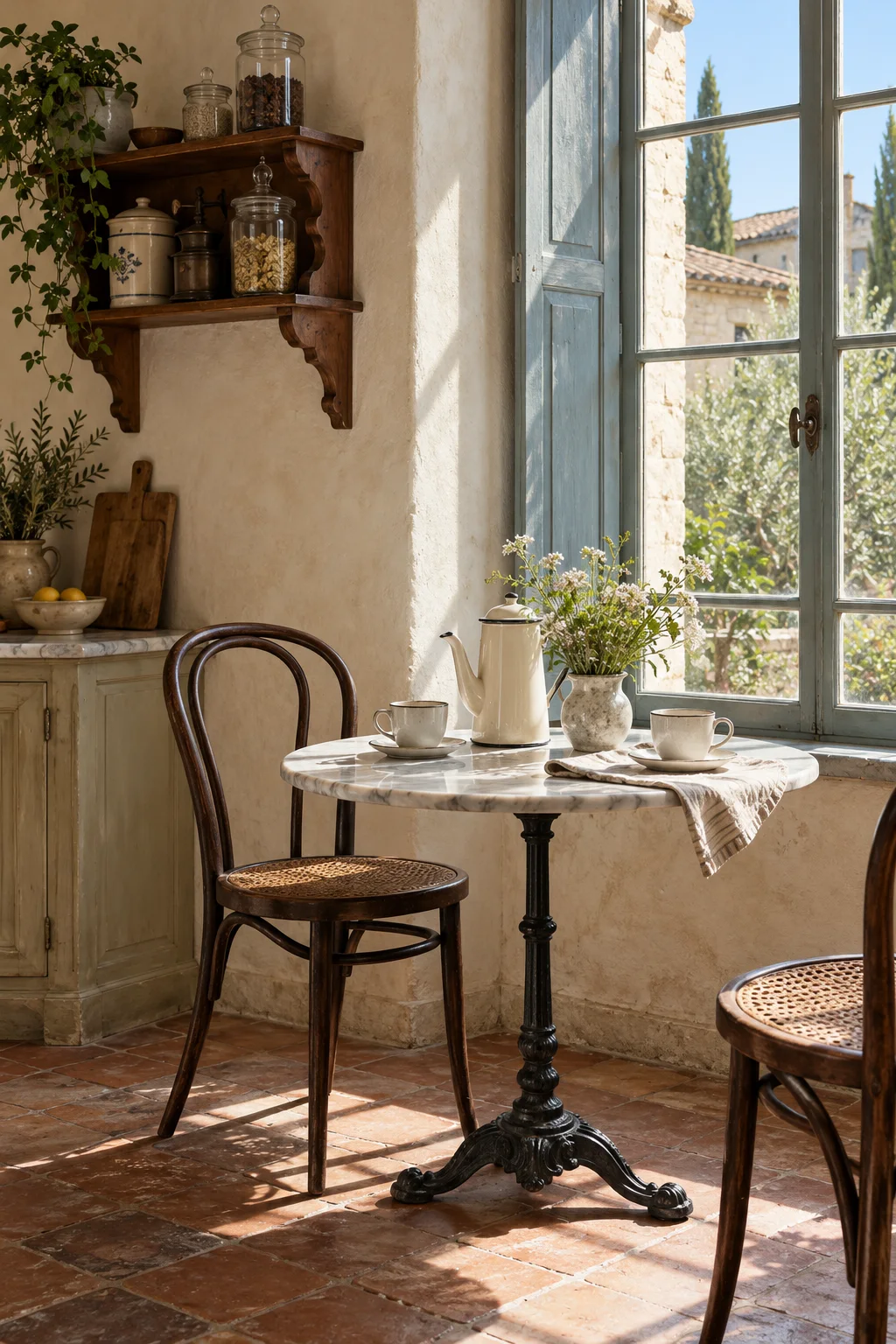 AI-created styling idea
Glass & pharmacy
Check the stopper fit, the label and the neck for hairline cracks.
Explore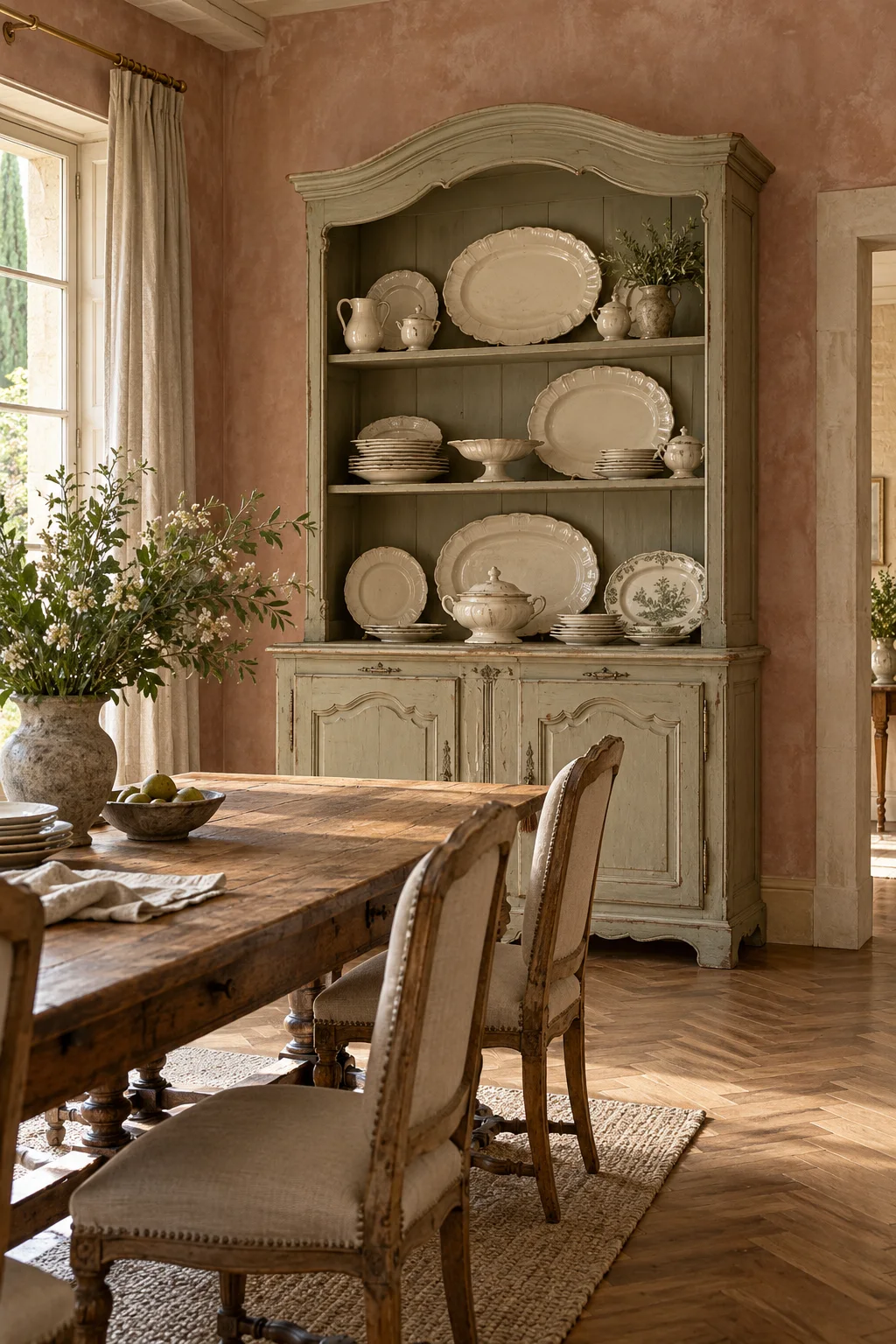 AI-created styling idea
Tableware
Bistro glass for every day, crystal for Sunday; check rims and cloudiness.
Explore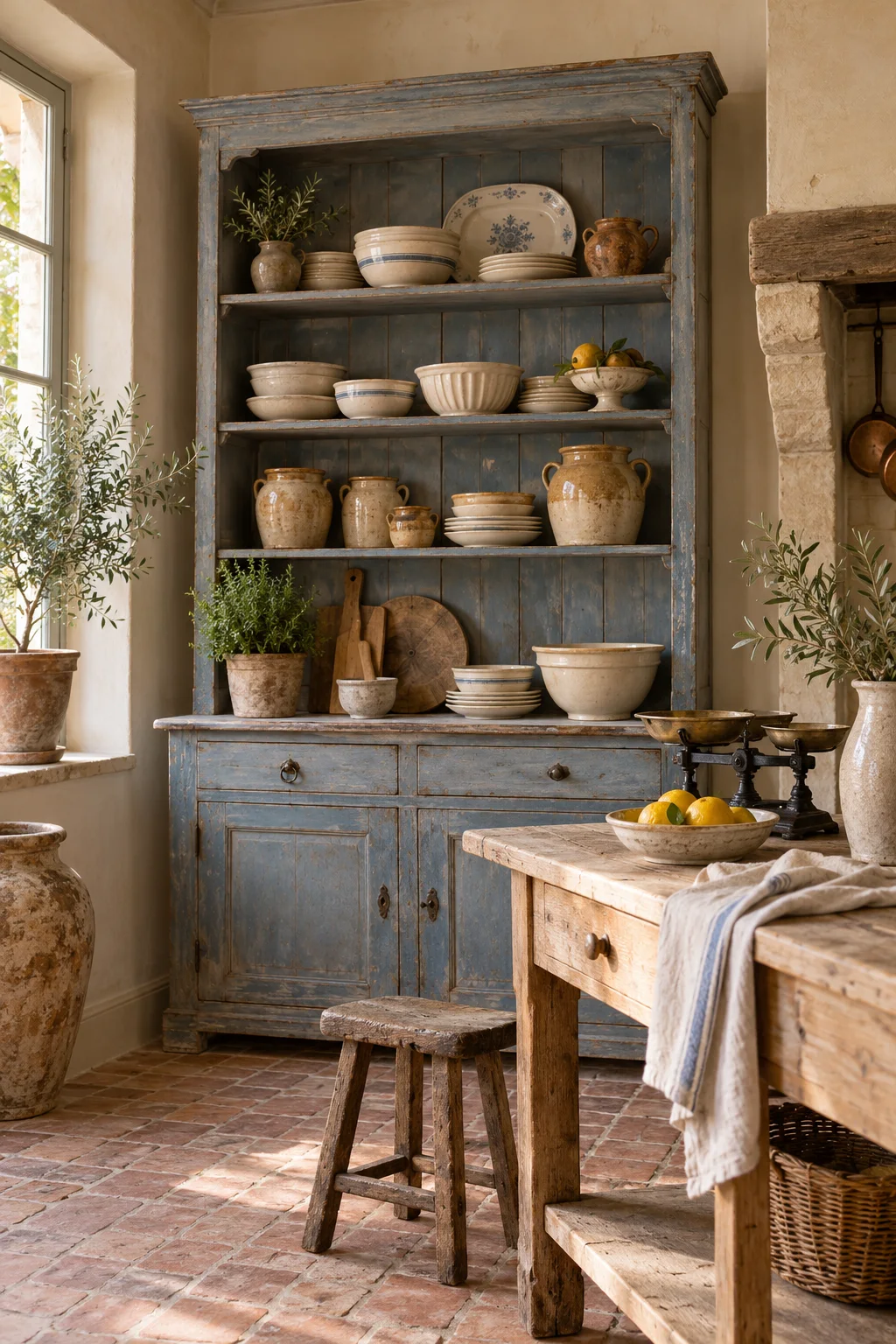 AI-created styling idea
Tableware & kitchen
Look at the lip and the handle joins, where pressed pitchers chip first.
Explore AI-created styling idea
Cellar
Bottles and demijohns: check the base for cracks before filling with water.
Explore AI-created styling idea
Lighting
Glass candlesticks and photophores: a level base and a sound socket rim.
ExploreStart with the method and the wear rather than the country. Look for a pontil mark or mold seams under the base, a random web of fine scratches on the foot, and the weight and color of the glass. Attribute it to France, or to a factory, only when an etched mark, a label or a document supports it; otherwise describe it as French in style.
French opaline is usually mouth-blown, softer in tone and faintly translucent when held to daylight, often in white, blue, green or pink. Milk glass is fully opaque, usually pressed in molds, and was made in large quantities in France, Britain and the United States. Opaline often shows a pontil mark under the base; milk glass more often shows mold seams.
Yes, for serving. Drinking wine or water from old lead crystal at a meal is generally considered fine. The caution is storage: acidic drinks such as wine, spirits or juice should not sit in a lead crystal decanter for days or weeks. Pour from the decanter during the meal, empty it afterwards, and keep long-term storage in modern bottles.
Only when the cloud is a deposit. Mineral film from hard water can often be loosened with a soak in warm water and a little white vinegar. If the cloud stays after cleaning, the surface itself has been etched by water or detergent, and no household method will clear it. Such pieces still work as vases or window pieces, priced as damaged.
Wherever light can pass through it. Pressed glass and preserve jars suit open kitchen shelves, bistro and etched glasses the dining table, apothecary jars the bathroom, opaline and perfume bottles a dressing table or windowsill. Group three to five pieces of one tone together; scattered single pieces tend to disappear in a room.
Nov 6, 2026 · Antique guide
A French country Thanksgiving table takes its look from the farmhouse: a linen cloth, white ironstone or faience plates, mixed silverplate, short bistro glasses,…
Nov 6, 2026 · Antique guide
French kitchenware from 1880 to 1960 was made for daily work, which is why the good pieces are still at it.
Nov 6, 2026 · Antique guide
Samadet faience is the tin-glazed tableware made in a single village of the Landes, in the Tursan hills south of Mont-de-Marsan, from about 1730 to 1840.
Nov 5, 2026 · Antique guide
Vintage silver and vintage silverplate look alike on a sideboard and behave differently in the hand, in the sink and at resale.
Nov 5, 2026 · Antique guide
Vintage pottery from French kitchens and workshops falls into two bodies and three glazes.
Nov 5, 2026 · Antique guide
An antique magazine rack is one of the few small antiques that still does its original job and several new ones.