Three kinds of joints and what they tell you
Pegged mortise-and-tenon joints are the oldest construction still common on vintage wooden chairs: a rail ends in a tenon that passes into a mortise in the leg, locked by a wooden peg visible as a small oval on the outside of the leg. Pegs shrink and stand slightly proud with age; a peg that sits perfectly flush and shows fresh wood may be a later repair. Workshops used this joint on country chairs well into the twentieth century.
Dowelled joints replaced the tenon with round dowels in drilled holes, glued. They are invisible from outside and common on factory chairs from the 1900s onward. A dowelled joint fails by the glue drying out, so the chair becomes loose all at once rather than at one rail. Screwed joints, with a screw through a corner block or a metal bracket, belong to bentwood and to repairs; original screws are slotted, with irregular threads, while modern cross-head screws indicate later work.
Turn the chair over and photograph the underside. Corner blocks, glue runs, nails driven into a loose joint and metal straps each change what the chair is worth and how it should be restored. Our guide to choosing antique chairs covers how these checks fit into a purchase; this article goes deeper under the seat.
Seats: solid wood, rush, cane and drop-in
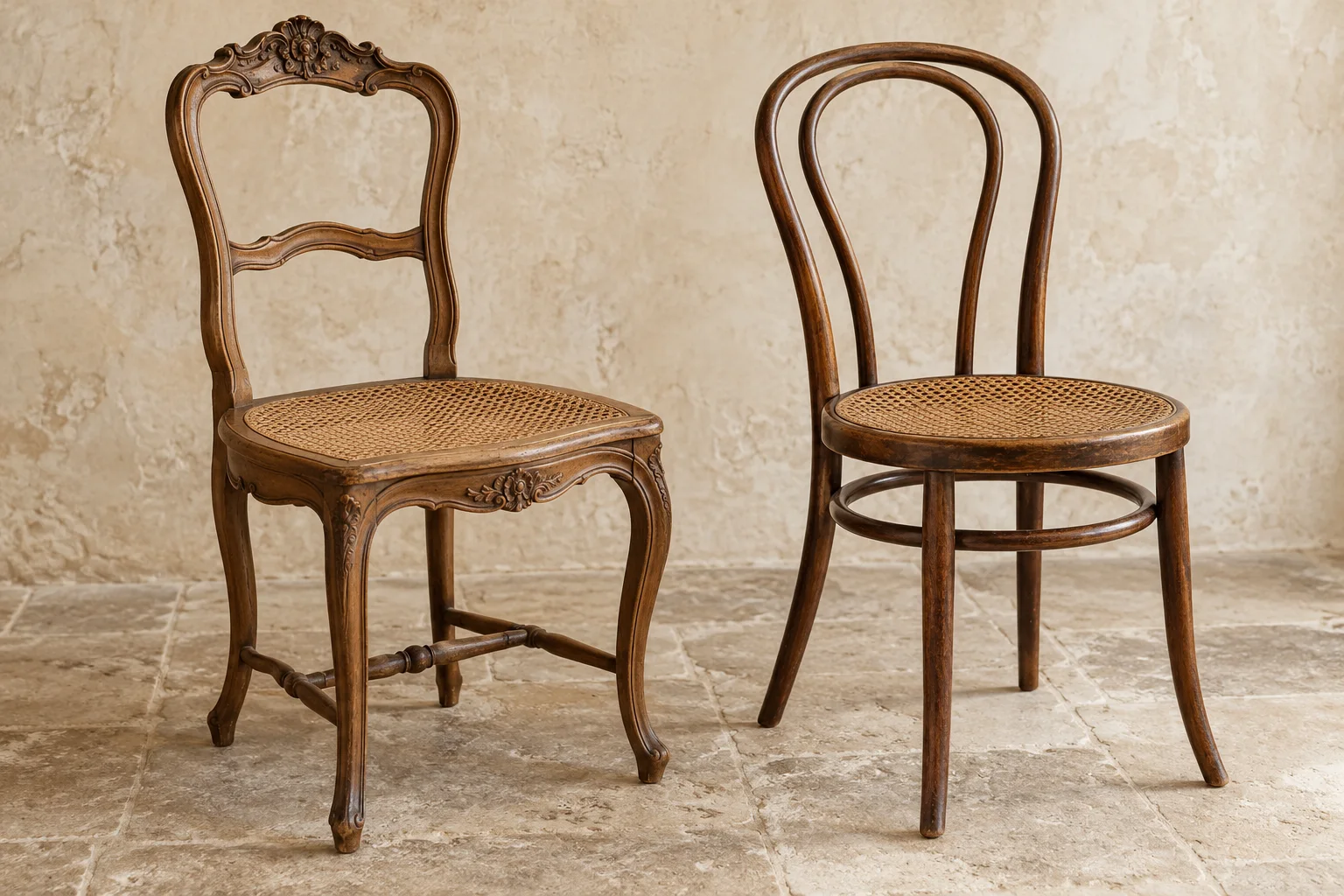
A solid wooden seat, shaped into a shallow saddle on better chairs, is the most durable; look for a split along the grain and for a seat that has shrunk and pulled away from its rails. Rush seats, woven in natural rush or twisted paper rush, sag with use and are re-woven rather than repaired. Cane seats come in two families: hand-caned through drilled holes, with the holes visible on the underside, and machine-woven sheet cane pressed into a groove with a spline, common from the 1880s onward.
Drop-in upholstered seats lift out of the frame and can be recovered without touching the chair. Check that the seat frame itself is sound and that the chair rails have not been cut to accept a thicker seat. Vinyl and leatherette seats of the 1950s–1970s are part of the chair's identity; replacing them in linen changes the piece, so decide whether you want a period look or a country look.
Seat height decides comfort at a table: 17–19 in (43–48 cm) suits a table of 29–30 in (74–76 cm). Chairs that were cut down sit lower and show fresh end grain under the feet. The bistro and dining chairs catalogue lists seats by type so a mixed set can be assembled at one height.
Bentwood, repairs and everyday use
Bentwood chairs are made of steam-bent beech hoops joined with screws, not tenons; the seat ring, the back hoop and the leg ring are separate parts. Loosening is normal and is corrected by tightening the screws, not by gluing. Look at the paper or stamped label under the seat for a maker, but treat it as a clue rather than proof; many factories across Europe produced near-identical models for a century.
Good repairs are reversible: hide glue in a cleaned joint, a new peg in the old hole, a re-woven seat. Poor repairs are nails, angle brackets, epoxy and screws driven across a tenon; they hold for a while and make a proper repair harder later. For a vintage wooden chair you intend to use every day, pay for the reversible repair once.
Keep chairs away from radiators and off wet floors, wax bare wood twice a year, and lift rather than drag. In a kitchen, a wooden chair lives with spills; in a bedroom, it carries clothes and a lamp. Both are legitimate uses once the joints are sound, and our overview of French country chairs helps match form to room.
What to compare
| Form | Suggested Use | Decisive Check |
|---|---|---|
| Pegged country chair | Kitchen, dining, daily use | Pegs proud and original, no split seat |
| Dowelled factory chair | Dining set, bedroom | All joints tight at once, no loose rails |
| Bentwood chair | Bistro table, café corner | Screws tight, hoops uncracked, label intact |
Your buying checklist
Continue planning your room
Frequently asked questions
How can I tell if a vintage wooden chair is sturdy?
Sit on it and shift your weight forward and sideways; then turn it over. Tight pegged or dowelled joints, no cracks along the seat grain, no nails or brackets added later and feet with old wear rather than fresh end grain are the signs of a chair that will take daily use. Loose joints should be reglued before use.
What is the difference between hand-caned and machine-caned seats?
Hand caning passes strands through holes drilled around the seat frame, visible underneath as a ring of holes. Machine caning is a pre-woven sheet pressed into a groove and held by a spline, used from the 1880s onward. Both can be redone; hand caning takes longer and costs more in labour.
Can bentwood chairs be glued when they loosen?
No. Bentwood chairs are assembled with screws through steam-bent beech hoops, so loosening is corrected by tightening the screws. Glue in these joints makes future tightening impossible. Check the hoops for cracks at the bends and keep the paper or stamped label under the seat as a clue to the maker.
What seat height works at a dining table?
A seat height of 17–19 in (43–48 cm) suits a table of 29–30 in (74–76 cm), leaving about 11 in (28 cm) for the legs. Measure from the floor to the front edge of the seat, since many old chairs slope backward. Cut-down chairs sit lower and show fresh wood under the feet.
Sources & further reading
- Canadian Conservation Institute — Basic care: furniture and objects made of wood — Guidance on preserving finishes, reversible repairs and keeping wooden furniture away from heat and damp.