Rush seats: the chaise paillée and the ladder-back
The chaise paillée has a seat woven in rush or straw over a frame of turned beech, walnut or cherry, with a back of two or three horizontal slats. It is light, 7–10 lb (3–4.5 kg), stackable in spirit if not in fact, and the most common French dining room chair found in southwest France and Provence. The ladder-back is its taller cousin, with more slats and a higher back of 36–40 in (91–102 cm).
Rush seats sag with use and are re-woven rather than patched. Press the centre of the seat: a firm, slightly springy surface is sound; a hollow with loose strands needs re-rushing before daily meals. Look for painted frames, which were common and should be kept, and for feet shortened by decades of scrubbing floors.
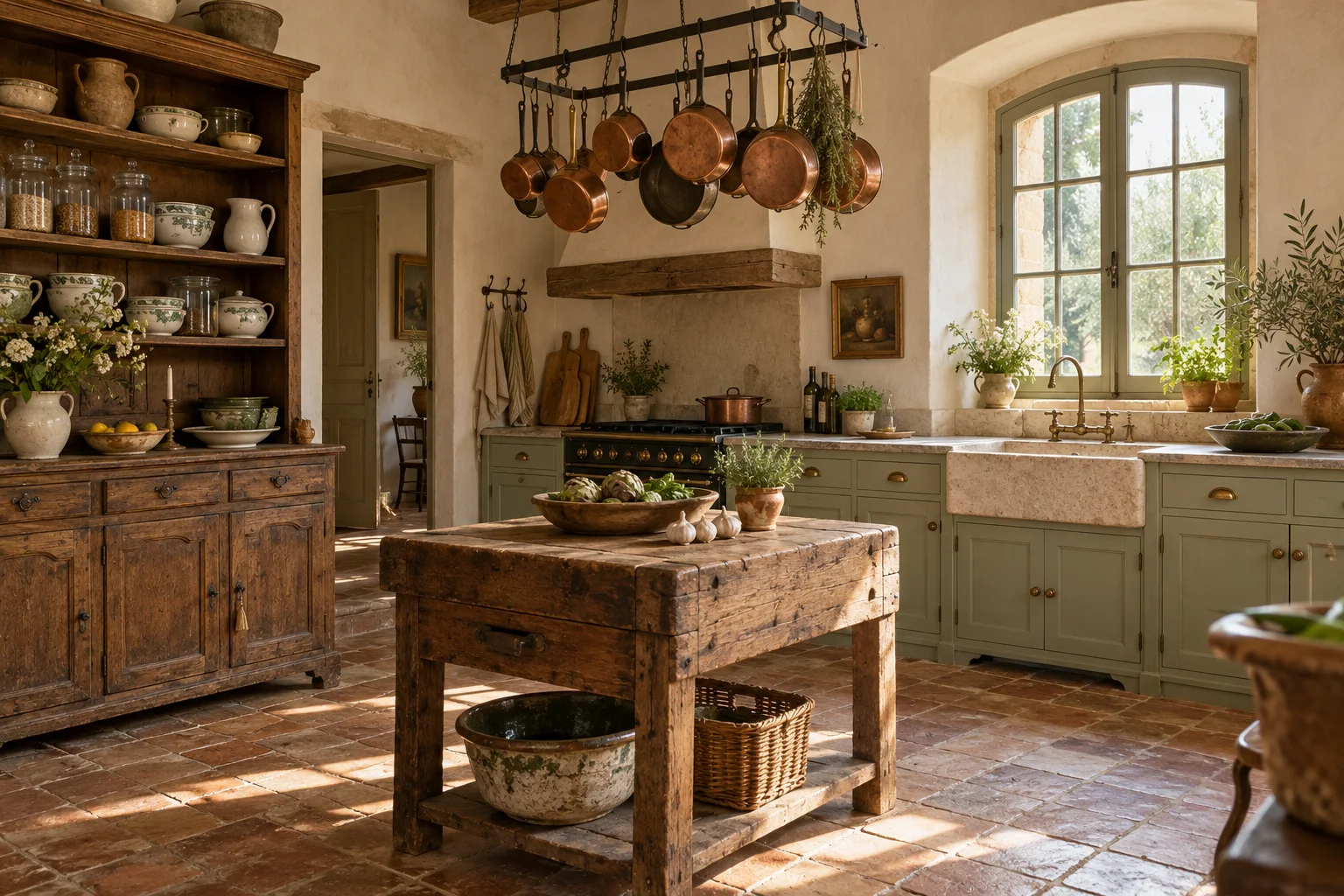
These chairs suit a French country kitchen and a scrubbed table rather than a polished one. The chairs catalogue lists rush-seated sets by number and height.
Cane and upholstered seats: Louis styles at the table
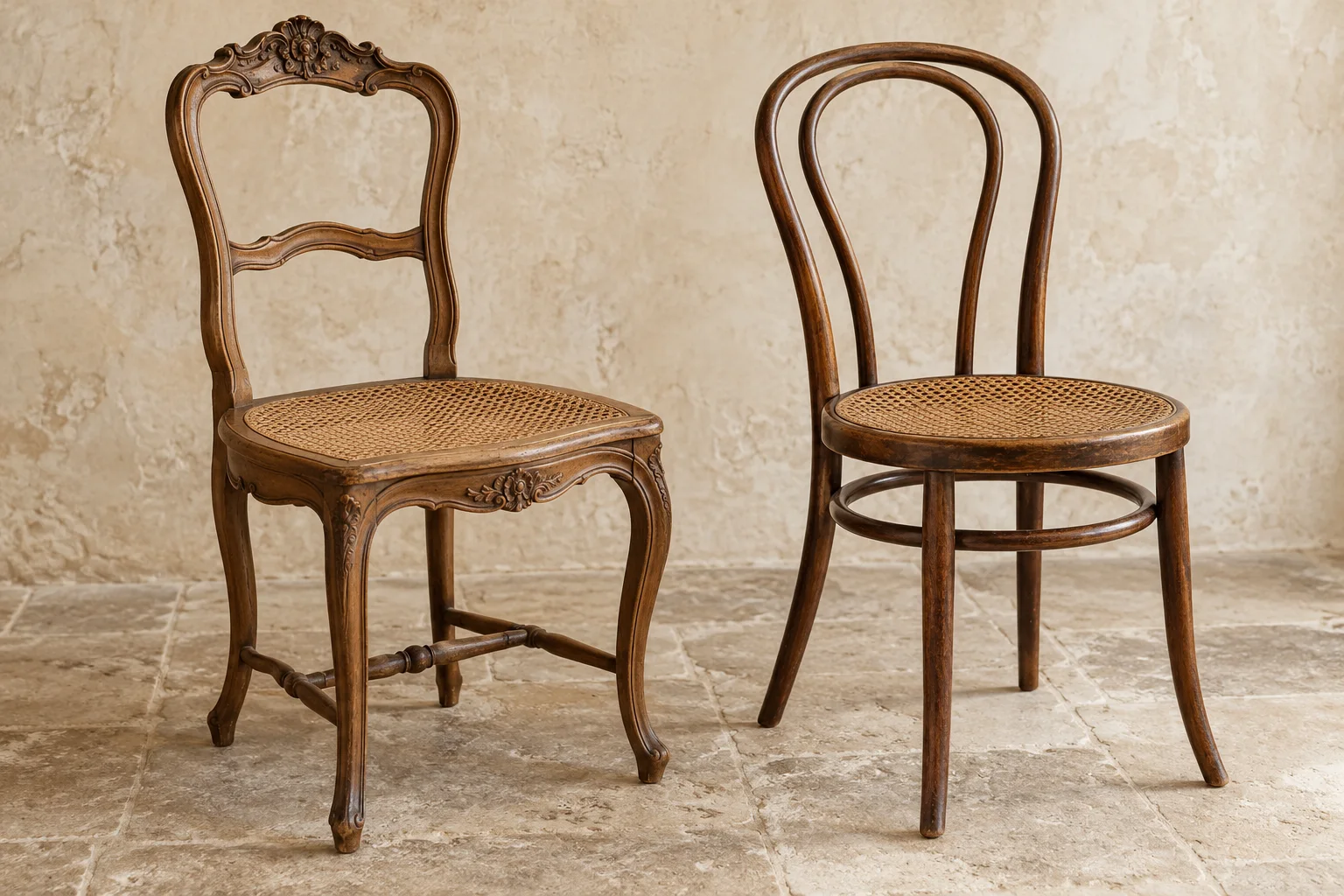
Caned chairs (cannage) have a woven cane seat and often a cane back inside a moulded frame; Louis XV versions curve, Louis XVI versions have straight fluted legs and a round or square back. Cane is cool to sit on, light, and breaks at the edges first; hand-caned seats show a ring of holes under the frame, machine cane sits in a groove with a spline.
Upholstered French dining room chairs follow the same two styles plus Louis Philippe and Restauration, with gondola or curved backs. The seat is either a drop-in frame or fixed with tacks. A style name describes an inspiration, not a date: nineteenth-century workshops and twentieth-century factories reproduced Louis XV and XVI chairs in quantity, and only documentation attributes a period.
Armchairs of these styles serve as carvers at the ends of a table when the arms pass under the apron. Our antique armchairs catalogue shows the forms; the comparison with provincial furniture continues in the French Provincial style pages.
Checks and mixing rules
Whatever the seat, the checks are the same: sit and shift, press the back sideways, turn the chair over. Pegged tenons, tight dowels and unbroken stretchers are the goal; nails, brackets and epoxy are repairs to price in. Seat height between 17 and 19 in (43–48 cm) and a back height around 36 in (91 cm) keep a mixed set in line.
Mix within a family before mixing across families: six rush chairs of three different turnings read as one set, while rush beside upholstered reads as two. When two families must share a table, give each an end, or alternate them and add loose cushions in one linen. A bentwood bistro chair is the neutral that bridges rush and cane.
For the room around the chairs, see our overview of French country chairs and the dining room scenes, and for the table itself our guide to French country dining tables.
What to compare
| Form | Suggested Use | Decisive Check |
|---|---|---|
| Rush-seated chaise paillée | Kitchen, farmhouse table | Firm seat, no loose strands, feet not shortened |
| Caned Louis-style chair | Dining room, lighter look | Cane intact at the edges, frame joints tight |
| Upholstered Louis XV or XVI | Formal dining, carvers | Drop-in or fixed seat, no worm in the rails |
Your buying checklist
Continue planning your room
Frequently asked questions
What is a chaise paillée?
A French country chair with a seat woven in rush or straw over a turned frame of beech, walnut or cherry, usually with two or three horizontal back slats. It is light, common in southwest France and Provence, and suits a kitchen or a scrubbed farmhouse table rather than a polished dining room.
Which is more durable, rush or cane seats?
Both wear, but differently. Rush sags into a hollow and is re-woven as a whole; cane breaks at the edges first and is replaced as a sheet or re-caned by hand. Rush tolerates heavier daily use; cane stays cooler and lighter. Neither should be soaked when cleaning.
Are Louis XV dining chairs really from the eighteenth century?
Rarely. Louis XV describes a style with cabriole legs and curved backs that workshops reproduced through the nineteenth and twentieth centuries. Only documentation, a maker's stamp or an expert opinion attributes a period; treat the name as an inspiration and judge the chair on construction and condition.
Can I mix rush chairs with upholstered chairs at one table?
Yes, with a rule: give each family an end of the table or alternate them, keep seat heights within 1 in (2.5 cm), and unify the set with loose cushions in one linen. Mixing within a family, for example rush chairs of different turnings, is easier and reads as one set.
Sources & further reading
- Canadian Conservation Institute — Basic care: furniture and objects made of wood — Checking joints and preserving painted or waxed finishes on chairs returning to daily use.
- The Metropolitan Museum of Art — French Furniture in the Eighteenth Century: Case Furniture — Context on eighteenth-century French furniture trades and the workshops that produced Louis XV and Louis XVI forms.