Gauge: the thickness that separates cookware from decor
Professional French copper was made at 2.5 to 3 mm; domestic and hotel pans run 1.5 to 2.5 mm; decorative copper and many 20th-century export pieces are 1 mm or less. Measure the rim with calipers or compare weight: a 9.5 in (24 cm) sauté pan at 3 mm weighs about 6.5 lb (3 kg) with its iron handle, while a thin one of the same size weighs half that. Thick copper spreads heat evenly and holds a steady simmer; thin copper scorches and dents.
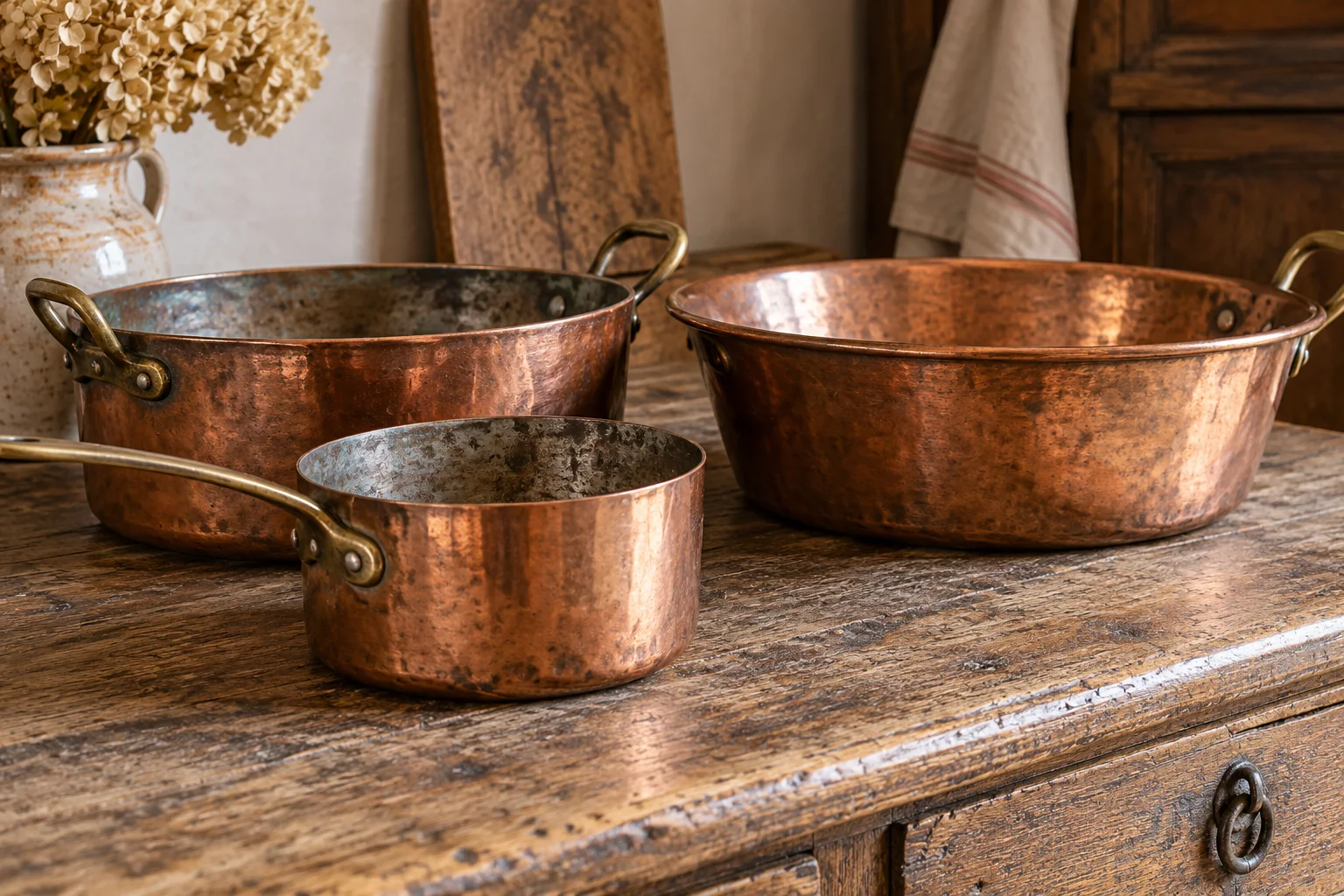
Handles tell a second story. Cast-iron handles fixed with two or three copper rivets are the classic French fitting; brass handles appear on lighter and later pans. Rivets should be tight and flush inside the pan, because a loose rivet leaks. Look along the body for a dovetailed seam, visible as a zigzag line near the base on hand-made pans; later pans were spun or drawn without a seam.
Tinning: reading the lining and knowing when to retin
Traditional French pans are lined with tin, applied hot and wiped, which leaves a soft grey surface with wipe marks. Tin keeps copper out of the food. A new lining is bright; with use it dulls to grey, which is normal. The rule of thumb in professional kitchens: retin when copper shows through the tin over an area larger than a coin, or in several spots on the cooking surface. Patches on the wall of the pan above the food line matter less.
Tin melts at about 450 °F (232 °C), so a tinned pan must never be heated empty and never used under a broiler. Scrubbing with steel wool or scouring powder removes tin quickly; wash with a soft sponge. Some 20th-century French pans carry a stainless or nickel lining, bright and hard, which needs no retinning and tolerates metal tools. Retinning is a specialist job; budget for it when a pan is priced as cookware rather than as decoration.
Stamps, cleaning and the choice between stove and wall
Stamps are struck on the body or the handle: a maker, a town, a retailer, a hotel or a restaurant. Villedieu-les-Poêles in Normandy is the historic copper town and its name appears on many pans; retailers stamped their own names on pans made by others, so a stamp identifies a source, not always a maker. Attribute a pan to a workshop only when the stamp is present; an unstamped pan with a dovetailed seam and 3 mm walls is still a fine pan.
For the outside, the Canadian Conservation Institute’s note on brass and copper recommends the least abrasive method that works and warns that frequent polishing wears the metal; a lemon with salt, rinsed and dried, keeps cooking copper presentable. Pans that hang on a rack can keep their patina. Our page on copper cookware and utensils shows how a row of pans reads in a country kitchen, and the French country kitchen guide covers the rest of the room.
What to compare
| Form | Suggested Use | Decisive Check |
|---|---|---|
| Sauté or saucepan, 2.5 to 3 mm, cast-iron handle | Daily cooking after retinning if needed | Copper showing through tin on the base |
| Hotel pan, 1.5 to 2 mm, stamped with a hotel name | Light cooking and display | Rivets tight and flush inside |
| Thin export copper, under 1 mm | Wall rack or shelf | Dents and a lining that cannot be renewed |
Your buying checklist
Continue planning your room
Frequently asked questions
How thick should a French copper saucepan be for cooking?
Between 2.5 and 3 mm (0.1 to 0.12 in) for serious cooking; 1.5 to 2 mm pans still cook but scorch more easily; anything under 1 mm is decorative. Weight is the practical test: a 24 cm pan at 3 mm with its iron handle weighs about 3 kg (6.5 lb).
When does a tinned copper pan need retinning?
When copper shows through the tin over an area larger than a coin on the cooking surface, or in several spots. Dull grey tin with wipe marks is normal and sound. Never heat a tinned pan empty, because tin melts at about 232 °C (450 °F).
What do the stamps on French copper pans mean?
A stamp names a maker, a town such as Villedieu-les-Poêles, a retailer, or the hotel or restaurant that owned the pan. Retailers stamped pans made by others, so a stamp proves a source rather than a maker. Attribute only when the stamp is present and legible.
Can old French copper pans be used on an induction stove?
Not directly: copper is not magnetic. An induction interface disc placed between the hob and the pan works for simmering but loses the responsiveness that makes copper worth having. On gas and electric coils, old copper performs as it always did.
Sources & further reading
- Canadian Conservation Institute — CCI Notes 9/3: The Cleaning, Polishing and Protective Waxing of Brass and Copper — Cleaning, polishing and protective coatings for copper and brass.
- Canadian Conservation Institute — Care of metal objects — General care of metal objects, including avoiding abrasive cleaning.