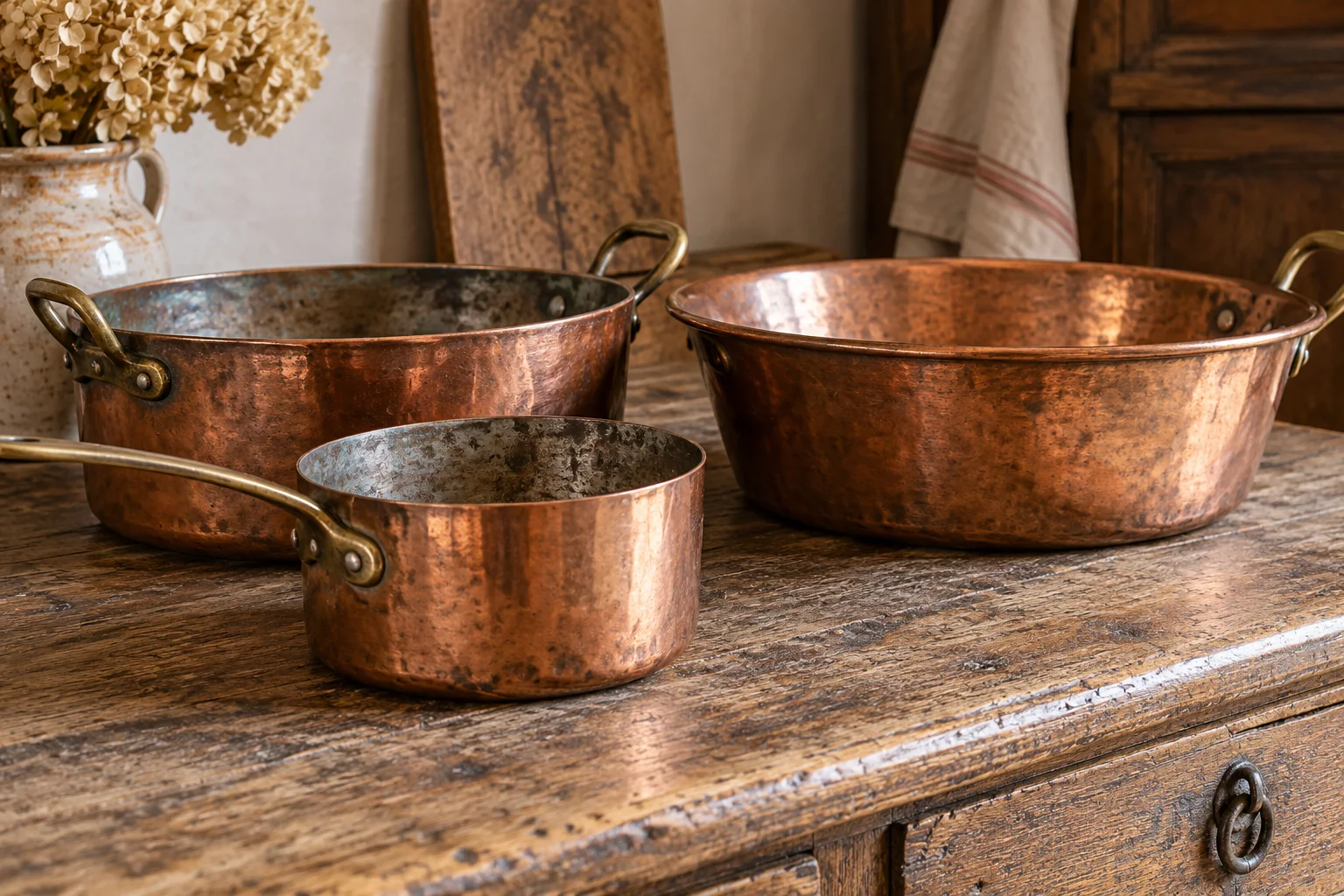
 AI-created styling idea
Tableware & kitchen
Copper cookware & utensils
Tinning, gauge and stamps decide whether a pan cooks or decorates.
ExploreFrench Country · An inspiration catalogue · Updated November 2026
A French country kitchen is built around a table, open storage and objects that work: copper, glazed pottery, enamel, wood and stone, arranged for cooking first and looking second.
The 25 ideas below start with the shell of the room, floor, tiles, hood and cabinet colors, then move to the kitchenware worth collecting and the checks that keep antiques safe in use, with sizes in inches and centimeters.
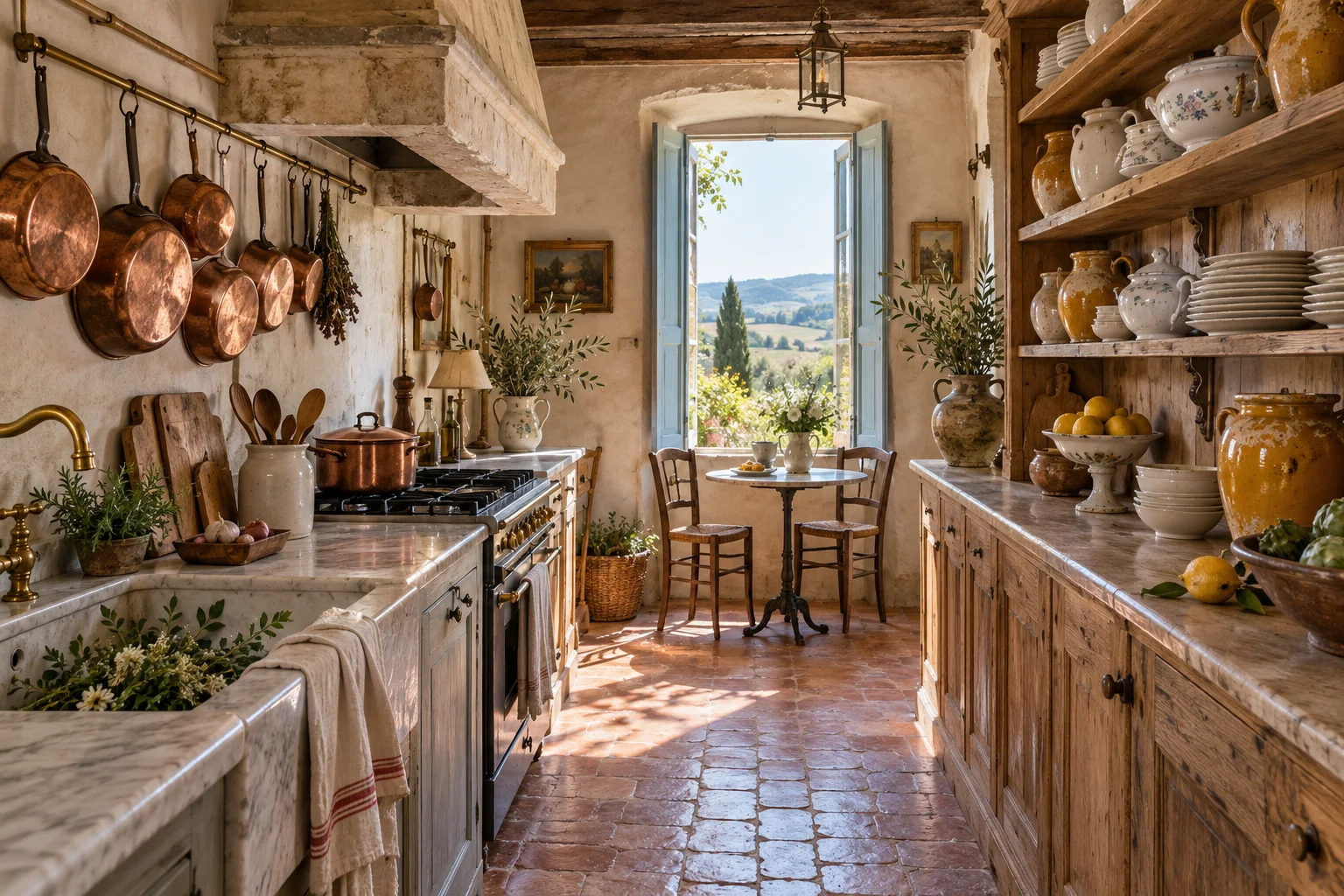
The French country kitchen was the main room of the farmhouse, and the table stood in the middle of it. Everything else, the dresser, the sink under the window, the hearth and later the range, was arranged around that table. Keep the principle even in a small kitchen: a farmhouse table or a worktable at the center, 28–30 in / 71–76 cm high, and the storage on the walls. Our guide to French farmhouse tables covers the sizes.
Dishes on a plate rack, pans on a rail, jars on a shelf: the room shows what it uses. Open storage is practical only when the objects are used and washed often, so keep the display to the pieces that earn it and give everything else a door. A vaisselier with its plate rack above a buffet is the traditional answer to both needs.
Terracotta tiles or stone flags on the floor, a stone or wooden sink, a worktop in wood or marble, walls in limewash, and tiles only where water splashes. The palette comes from the materials, not from paint: ochre, gray, cream and the warm brown of oiled wood. Patina is expected; a scrubbed table and a chipped tile are part of the room, not a repair list.
The ideas run from the shell of the room to the small objects that make a French country kitchen look used.
A central table makes the kitchen a workroom and a dining room at once. Allow 36 in / 91 cm of clear floor on every side so chairs pull out while someone passes. The French farm table entry in our encyclopedia explains tops, stretchers and replaced legs.
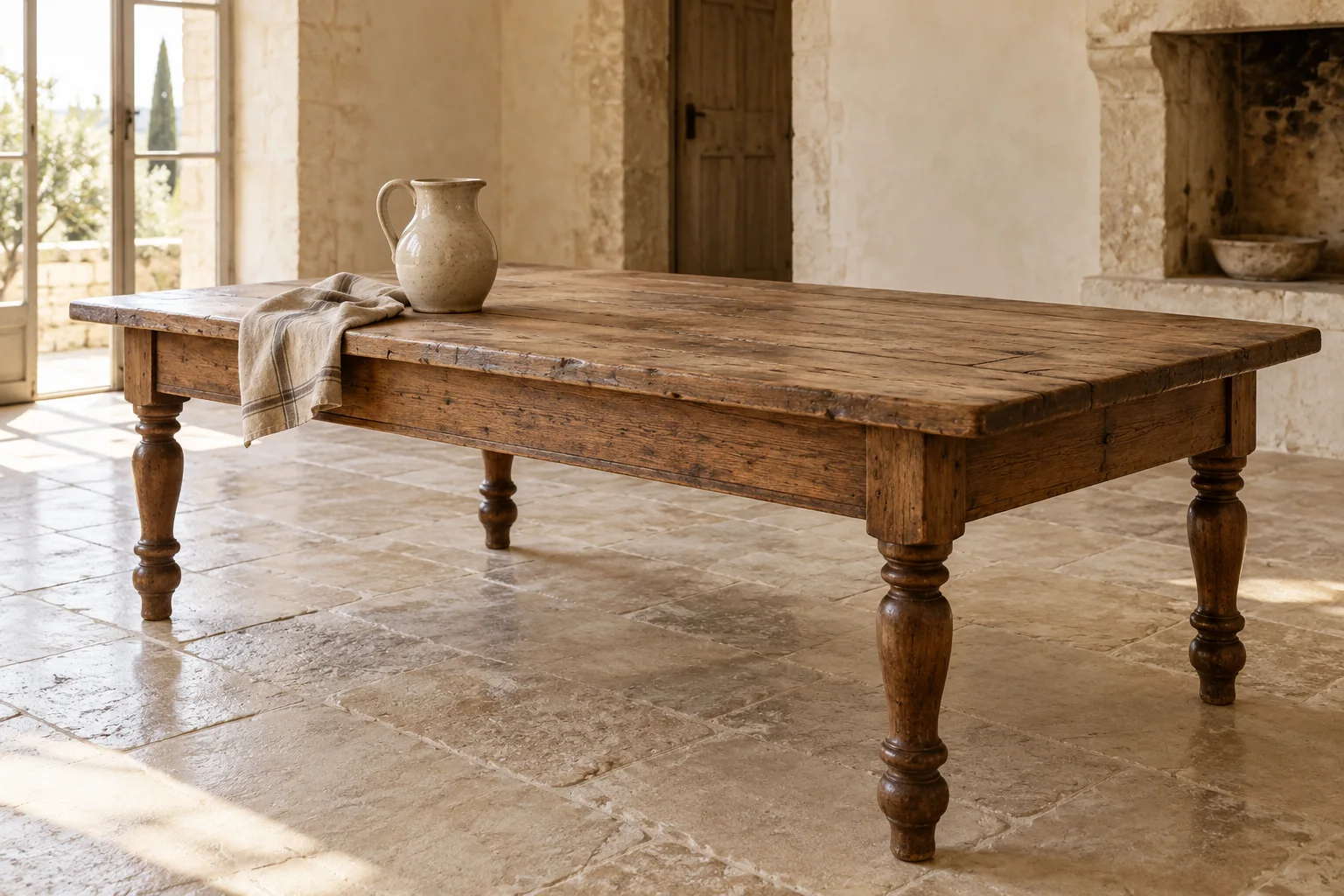
Take down one run of wall cabinets and stand a dresser in its place. Plates stand on edge in the rack, bowls sit on the counter shelf and linen goes behind the doors. Check that the grooves take your plate diameter, then read about hutches and vaisseliers before measuring the wall.
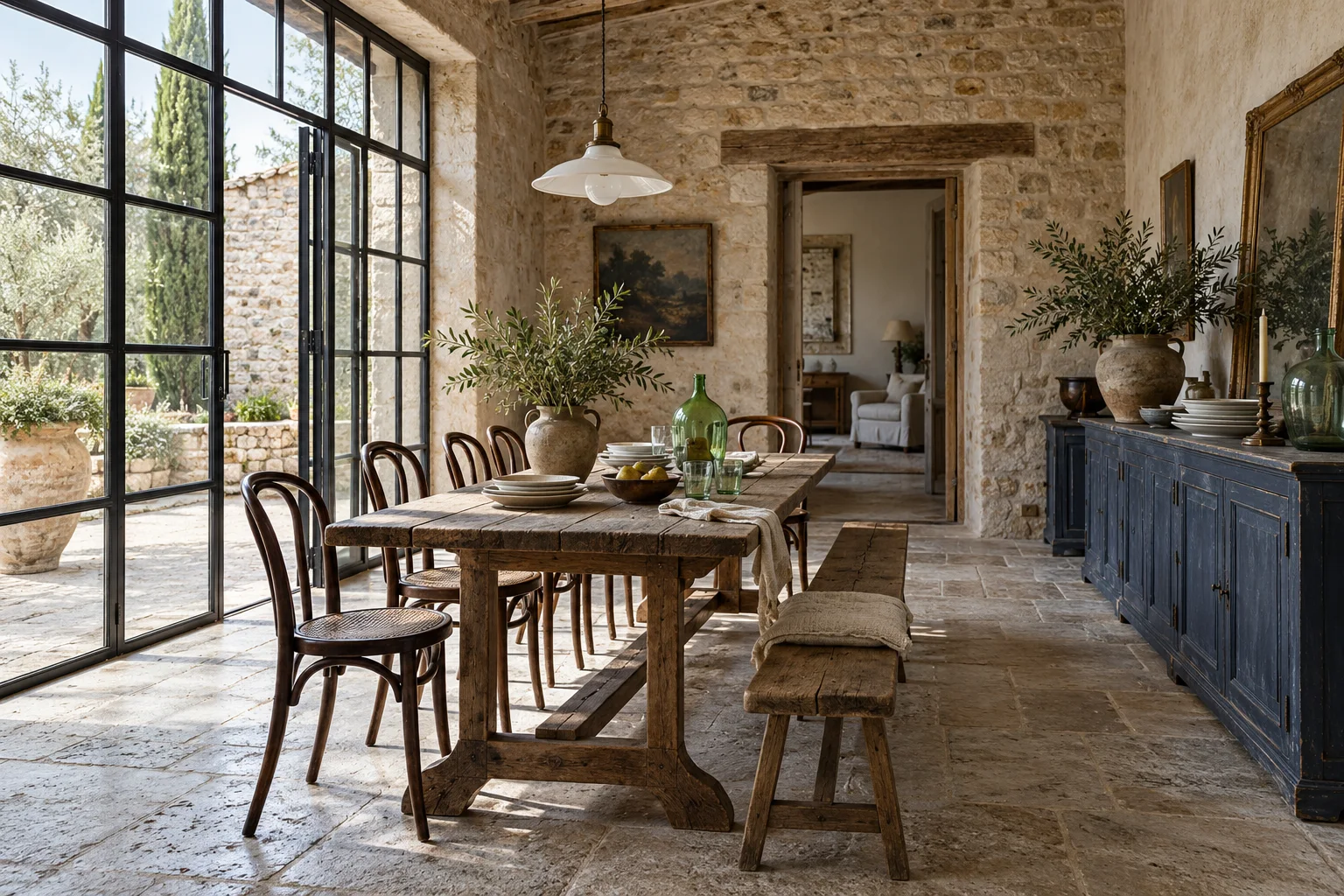
A gathered curtain replaces a pair of doors and softens a run of cabinets. Use washable linen or a cut-down métis sheet, 1.5 to 2 times the opening width, stopping 1/2 in / 1 cm above the floor. Old fabrics are compared in French linen and antique textiles.
A single basin 8–10 in / 20–25 cm deep takes a roasting pan and suits the style better than two shallow bowls. A reclaimed stone évier is heavy: the cabinet and floor must be built for it, and the drain checked before purchase. Salvaged stone sits with architectural materials and ornaments.
Hexagonal terracotta tomettes, about 6–7 in / 15–17 cm across, or square stone flags give the room its base color. Reclaimed tiles vary in thickness, so they need a bed that absorbs the difference, and terracotta needs a breathable sealer near the sink. More salvage is grouped under architectural antiques.
Handmade tiles with an uneven glaze carry the light without adding pattern. Keep to one color and run the tile from worktop to shelf, usually 18 in / 46 cm, or full height behind the range. Glaze and body are explained on the French faience and pottery page.
A plastered hood shaped like a chimney breast hides a standard extractor insert. Build it 3 in / 8 cm wider than the range on each side and follow the insert maker's height and duct rules. A shelf at its base works like a mantel from fireplace surrounds and accessories.
Painting only the lower cabinets keeps the room light while the color works at hand height. A gray-green with some yellow in it sits well beside oak and terracotta. Judge test boards of 12 × 12 in / 30 × 30 cm morning and evening. A cupboard from freestanding kitchen cupboards can set the color.
Wood is kind to knives and marks in a way that suits the room. A top of 1½ in / 4 cm or more stays flat; seal the end grain near the sink and oil the surface with a food-safe oil every few months. See how old oak and walnut behave.
A pale wash keeps exposed beams from closing a low kitchen. Brush off dust, look for fresh pale powder that would signal active woodworm, then test a diluted limewash on a section 2 ft / 60 cm long. The French farmhouse interiors page covers lime and old timber.
A wall rail 20–24 in / 50–60 cm above the worktop keeps pans within reach and off the counter. Hang the heaviest pans near the brackets and leave space for the lids. Tinning, gauge and stamps are explained in our French copper cookware guide.
A row of glazed pots, 8–14 in / 20–36 cm tall, gives an open shelf rhythm and color. Group them by glaze and check each base for cracks. Old glazes may contain lead, so keep the pots for dry goods, utensils or display. The wider family is described under French pottery.
Stoppered jars turn flour and rice into decoration. Choose a set that fits a shelf 10–12 in / 25–30 cm deep and check that each stopper seats properly. Opaline is for display or dry goods only. See the glass apothecary jars for the pantry and the opaline apothecary jars at Lo Cantou.
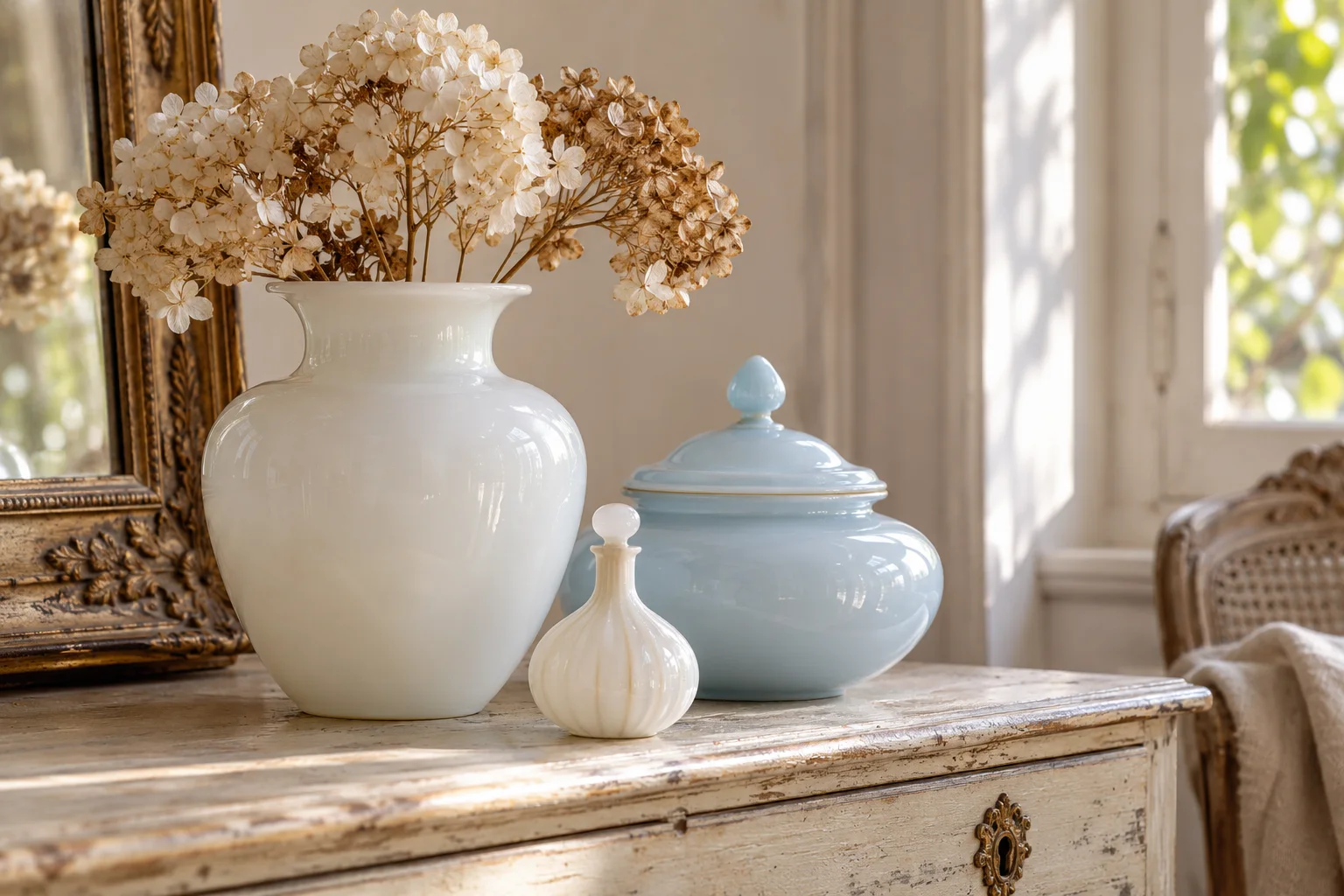
An end-grain block on legs, 30–34 in / 76–86 cm high, adds a second work surface that can move. A dip worn into the top is history; deep cracks that trap food are not. Scrape, wash, dry and oil after use. Similar working pieces appear among antique tables of every shape.
A brass-pan balance that still weighs flour convinces more than one kept for show. Check that the pans level when empty and that the weights are complete or nearly so. Scales, moulds and grinders are surveyed in vintage French kitchenware.
Mixed seating makes a table look used. A bench along the wall saves 12 in / 30 cm of clearance, chairs fill the open side and one armchair takes the head. Keep seat heights within 1 in / 2.5 cm of one another. Long seats are grouped under kitchen benches and banquettes.
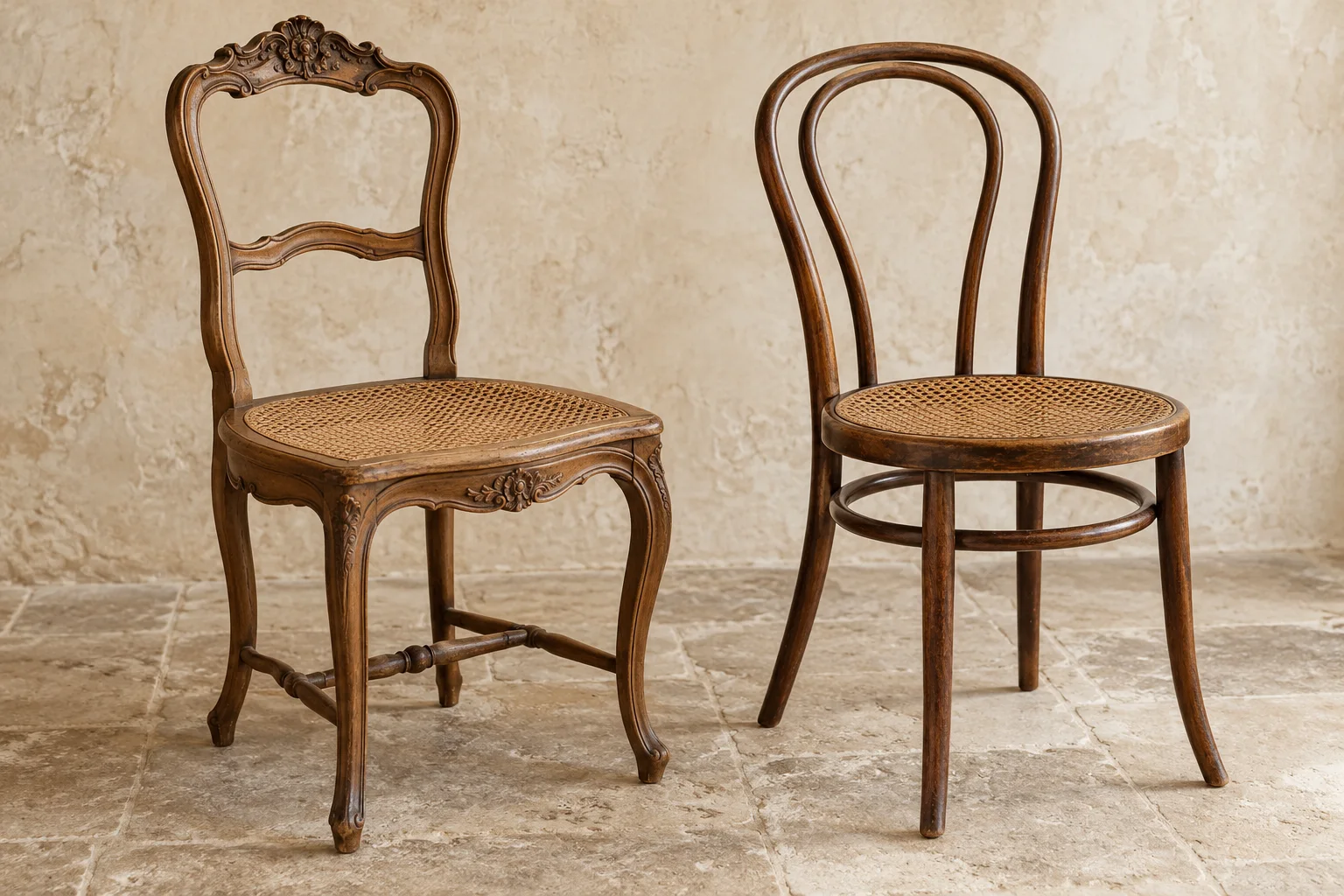
Two pendants spread light along a long table better than one large fitting. Divide the table in three and hang one at each third, 30–36 in / 76–92 cm above the top. Rewire old fittings to US standards. Shades and cords are covered in our guide to French country lighting.
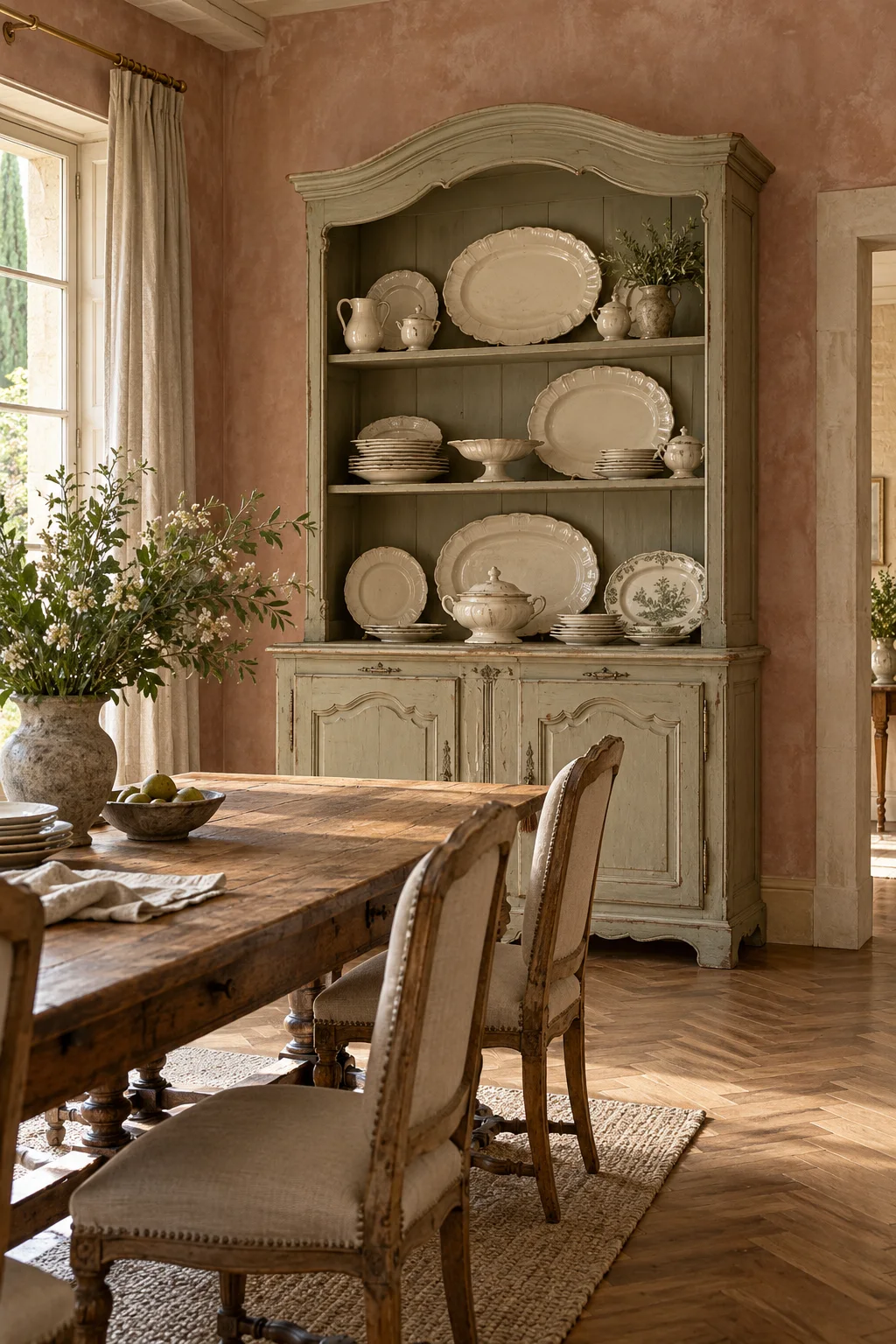
Striped linen tea towels, or torchons, look better used. Keep six to eight folded on a shelf and one on a rail by the range, at least 12 in / 30 cm from the burners. Old towels wash at a moderate temperature and soften with time. Browse old linen towels and cloths.
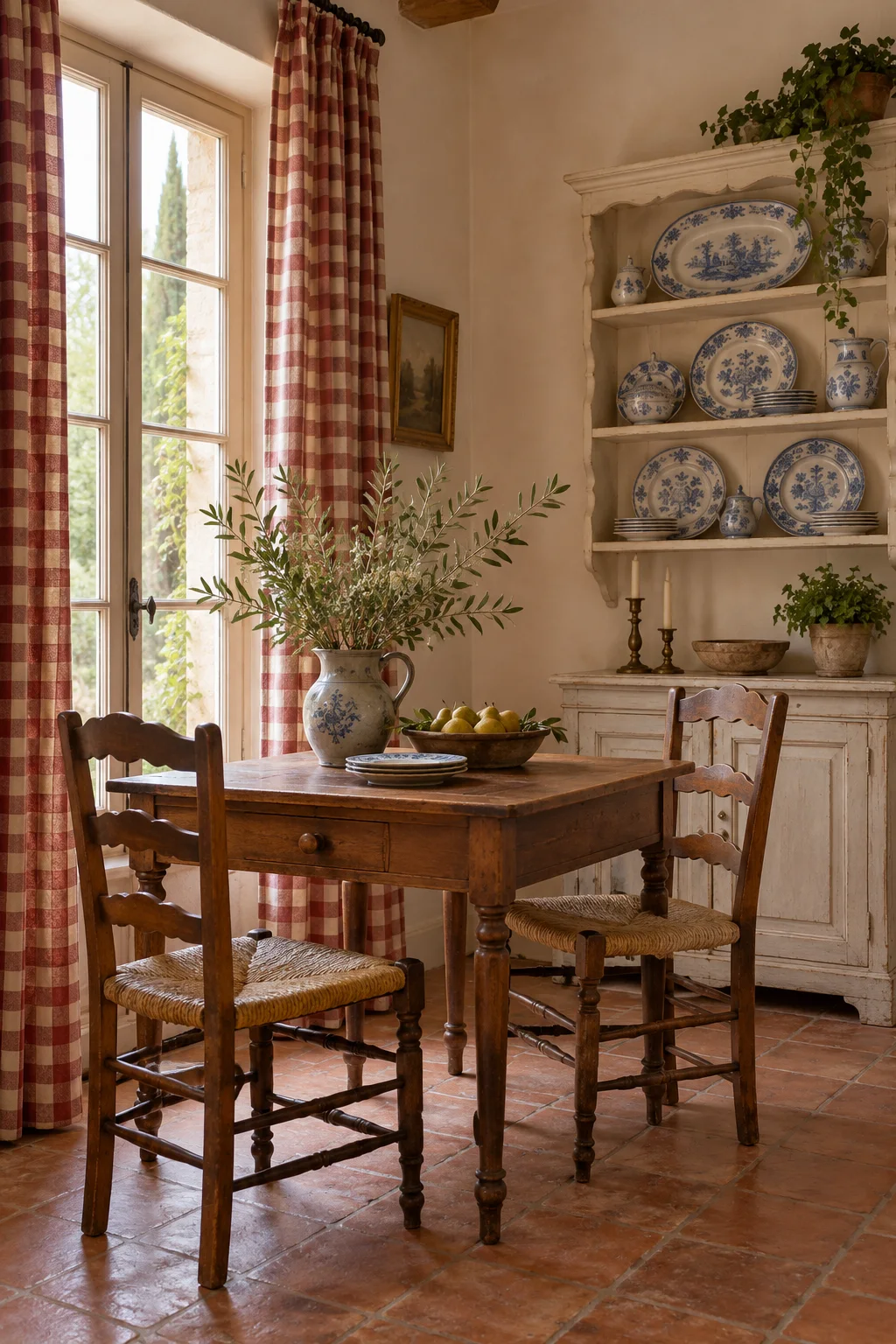
A wicker market basket, 16–20 in / 40–50 cm long, holds onions, garlic and potatoes in open air. Keep it in a cool, dark corner rather than above the range. Weaves and handles are explained in French rattan, cane and wicker.
Grouping by color turns small objects into one display. Choose three or five pieces in one color family and two heights, about 6 in / 15 cm and 10 in / 25 cm. Chipped enamel stays on the shelf, not on the stove. A grinder completes the group, as the vintage coffee grinders at Lo Cantou show.
A garde-manger, the ventilated food cupboard with a mesh front, keeps bread and cheese cool. Check the mesh and the door, and place it on an outside wall at least 3 ft / 1 m from the range. A thick board on top serves the bread, like the antique bread boards at Lo Cantou.
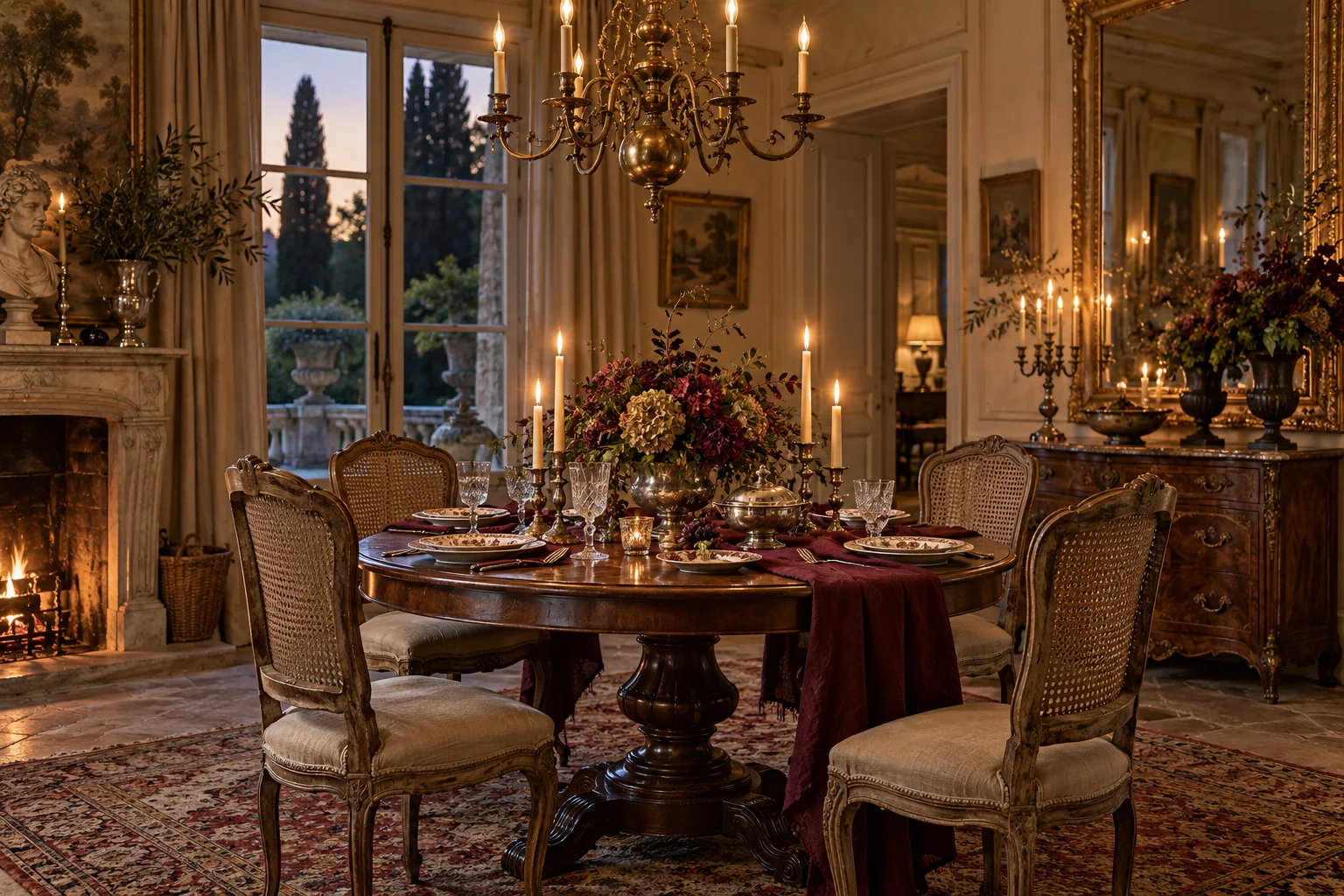
One flat object stops a bare wall looking like a showroom. Hang a carved board, a menu or a shop sign with its center at 57–60 in / 145–152 cm, away from the steam of the range and the splash of the sink. Wall pieces are collected under old shop signs and wall pieces.
Hardware is the cheapest way to age fitted cabinets. Use cup pulls on drawers and small knobs or latches on doors, with pulls at a 3 in / 76 mm hole spacing so they fit modern boxes. Our page on how antique brass ages explains cleaning.
Thyme, rosemary and parsley in plain terracotta bring the garden onto the work surface. Pots of 5–6 in / 13–15 cm fit most sills; set them on saucers to protect stone or wood and turn them weekly toward the light. See terracotta pots and planters.
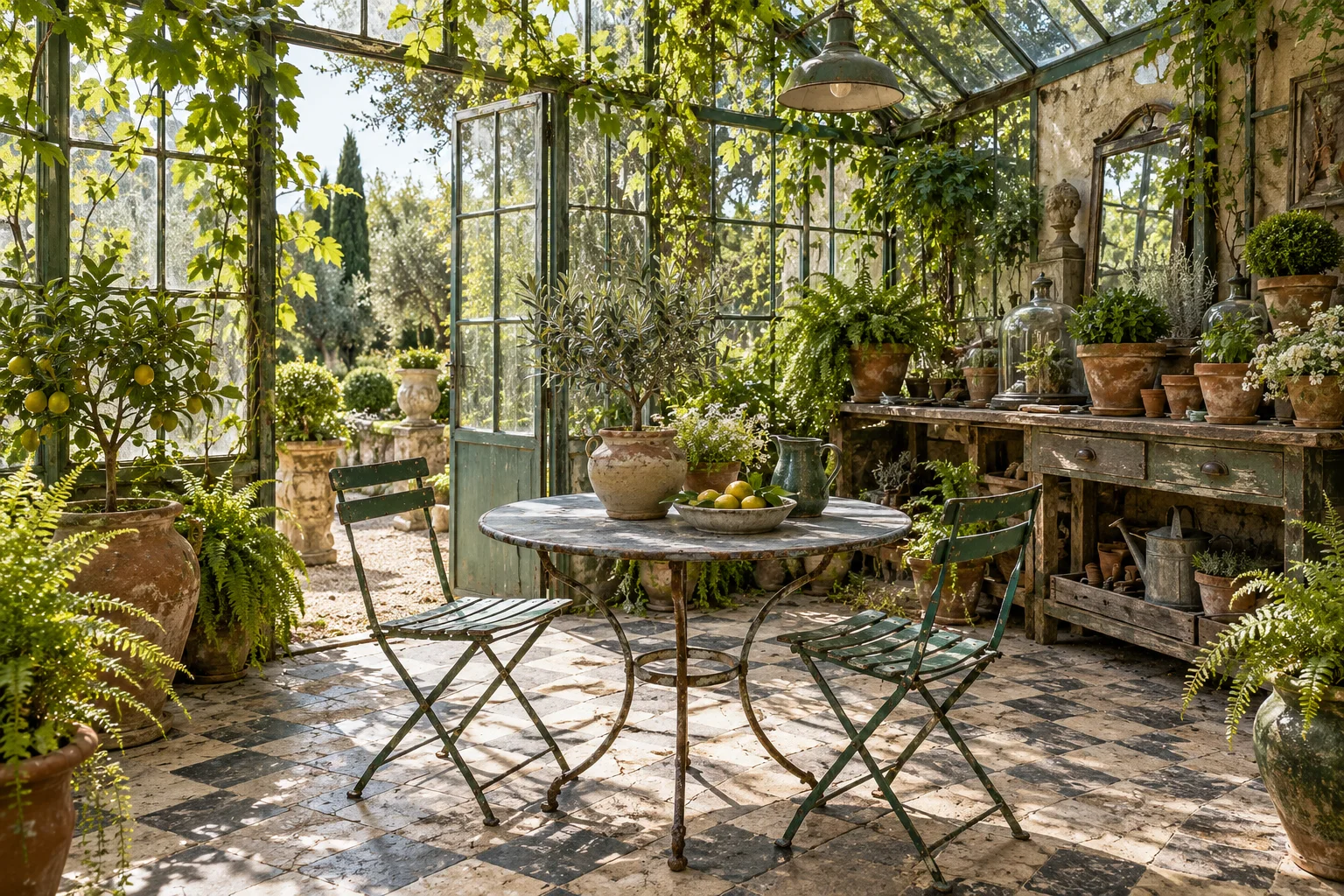
Change one wall, live with it, then decide on the next. The wall opposite the sink is usually easiest: a dresser or worktable of 60–72 in / 152–183 cm changes the room without touching the plumbing. Designers sourcing several pieces for a client can start from our page for interior designers.
The plate dresser does the work of several fitted cabinets: closed storage below, a serving surface at 36–40 in / 92–102 cm, and racks above for plates stood on edge. Measure the plates you own; most racks take dinner plates of 9½–10½ in / 24–27 cm. The forms are compared on the buffets and sideboards page, and the plates themselves on the serving dishes and tableware page.
An old butcher's block, a baker's table or a shop counter makes a better island than a built one: it stands on legs, it can move, and its top can be scrubbed. See kitchen islands and workbenches for the forms. Working height for standing is 34–36 in / 86–92 cm; many antique tables are lower and gain 4–6 in / 10–15 cm on turned blocks under the feet without altering the piece.
One long shelf at eye level, 12 in / 30 cm deep, carries jars, pottery and the plates in daily use. A brass or iron rail under it takes the copper. Shelves in chestnut or oak, brackets in iron, and nothing stacked more than two high: the rule keeps the wall readable and the dusting manageable.
A deep single sink in stone, fireclay or hammered copper with a wall-mounted bridge tap belongs to the style; a double bowl in stainless steel does not, though it can hide behind the same apron. Wooden worktops want oil twice a year; marble wants coasters and tolerance for stains. Both age well if they are allowed to.
The floor sets the color of the kitchen before a cabinet is painted. Terracotta runs from pale apricot to deep red-brown depending on clay and firing; stone runs from cream limestone to gray slate. Reclaimed terracotta wears into soft hollows at the sink. Lay a sample of 3 × 3 ft / 1 × 1 m before committing.
The backsplash is the one area of glaze a French country kitchen allows. Handmade tiles in a single color keep the wall calm. Lay them with a narrow joint, 1/16–1/8 in / 2–3 mm, in a grout a shade darker than the tile. Patterned cement tiles suit a pantry floor or a bathroom better than the wall behind a range, where grease shows in every recess.
Oak or walnut marks and can be sanded back. Marble stains with lemon and wine and etches with vinegar, so it suits a pastry station more than the sink run. Zinc darkens to a soft gray. Two surfaces are enough in one kitchen, wood on the island and stone by the range, for example, each with a square or softly rounded edge 1½–2 in / 4–5 cm thick.
In an old farmhouse the cooking happened in the fireplace; the hood above a modern range takes the place of that chimney breast. A plastered hood is built on a frame around an extractor insert and finished in lime plaster or paint, with a stone or wooden shelf at its base. Size it to the range, 3 in / 8 cm wider on each side, with the lower edge at the height the insert manufacturer specifies. A salvaged stone lintel from the salvaged stone and architectural pieces can serve as the shelf if a mason confirms the support.
A freestanding range in enamel or steel, 36–48 in / 91–122 cm wide, reads as furniture rather than an appliance. Choose a color from the room, cream, black, deep blue or muted green, and match its trim to the cabinet hardware. A plain range under a plaster hood, with copper on a rail beside it, achieves most of the effect for less.
Saucepans, sauté pans, jam basins and moulds in copper are the heart of French kitchenware. For cooking, the tin lining must be intact and the gauge heavy, 2.5–3 mm; a stamp on the handle or the body identifies a maker only when it is legible. Worn tinning can be redone by a specialist; a dented pan still hangs well on a rail.
The ochre-glazed confit pot, the toupin, the salt box and the stoneware jar are the pottery of the southwest kitchen. Describe each piece by material and condition before assigning an origin; a regional name is a description, not a provenance. Frost cracks and rim chips are common on pieces that lived in a cellar and are stable once the pot is indoors.
Enamel coffee pots, utensil racks with their row of ladles, and the bread bin or panetière add color: cream, French blue, red and the speckled gray of the 1930s. Chips in enamel are permanent and should be kept away from food; a chipped coffee pot holds wooden spoons or flowers. See kitchen pots and jars for the forms.
A brass-pan balance with its weights, a thick bread board, glass preserving jars with their rubber seals: the small working pieces that make the room. The pages on vintage kitchen scales and baskets and boxes list what to check; our guide to French country accents explains how to use them without clutter.
Start from the materials in the room and add one color: the soft blue of enamelware, the green of a painted dresser, the yellow of a confit pot. Cabinet doors in a chalky gray-green or off-white, walls in limewash, and the warm notes left to copper and wood. The palette rules in our French country decor guide apply here with one adjustment: the kitchen can take more color, because it has more work to do.
One pendant over the table and one over the worktable, hung 30–36 in / 76–92 cm above the surface, plus a small lamp on the dresser for the evening. Enamel pendant lights, a wrought-iron chandelier or a converted oil lamp suit the room; a row of spotlights does not.
A linen runner on the table, striped tea towels on the rail, a cushion on the bench. Keep textiles washable and keep them few. A single pitcher of garden flowers on the table does more than any arrangement.
French country color comes from earth and mineral pigments: a little gray, a little warm, never bright. Six shades work on cabinets and dressers: a gray-green like dried sage; a faded blue-gray like old enamel; a warm off-white with a touch of ochre; a putty or stone beige; a pale ochre yellow, best on a single dresser; and a dark oxblood red for a small area such as an island base. The American farmhouse kitchen leans to bright white and black hardware; the French version uses softer whites. For the wider palette, see the French country style page.
Eggshell or satin hides brush marks and still wipes clean; a flat finish marks with every hand. Paint the lower cabinets and the island, leave the dresser in its old paint or wax, and keep the walls in limewash. Two painted colors is the limit, plus the wood of the table. If an antique dresser carries old paint, take the cabinet color from it rather than repainting it, and test before sanding: old paint can contain lead.
Decide for each piece whether it cooks, serves or decorates. Copper with sound tin cooks; copper with bare patches decorates. Old glazed pottery may carry lead in the glaze, so use it for dry goods and display rather than for acidic food. Enamel with chips, cracked faience and old lead crystal all serve better than they store.
Wash pottery and glass by hand, warm not hot, and never in a dishwasher. Oil wooden boards and tables, wax brass and copper you do not cook with, and leave the patina on iron. A piece that needs more than cleaning, such as a cracked pot or a loose handle, should be priced and described as such; the kitchen pieces at Lo Cantou show how a listing separates wear from damage.
Measure shelf depth before buying plates, rail height before buying pans with long handles, and the clearance behind a table before buying benches. A dresser needs a wall at least 4 in / 10 cm wider than itself and a ceiling 2 in / 5 cm above its cornice. The kitchen room scenes show the proportions that work in a room of 130–200 sq ft / 12–18 m².
The categories below are the kitchen pieces most often asked about. Tableware is covered separately in our guide to French country tableware, and the dining side of the room in the dining room scenes.
AI-created styling ideaTableware & kitchen
Tinning, gauge and stamps decide whether a pan cooks or decorates.
Explore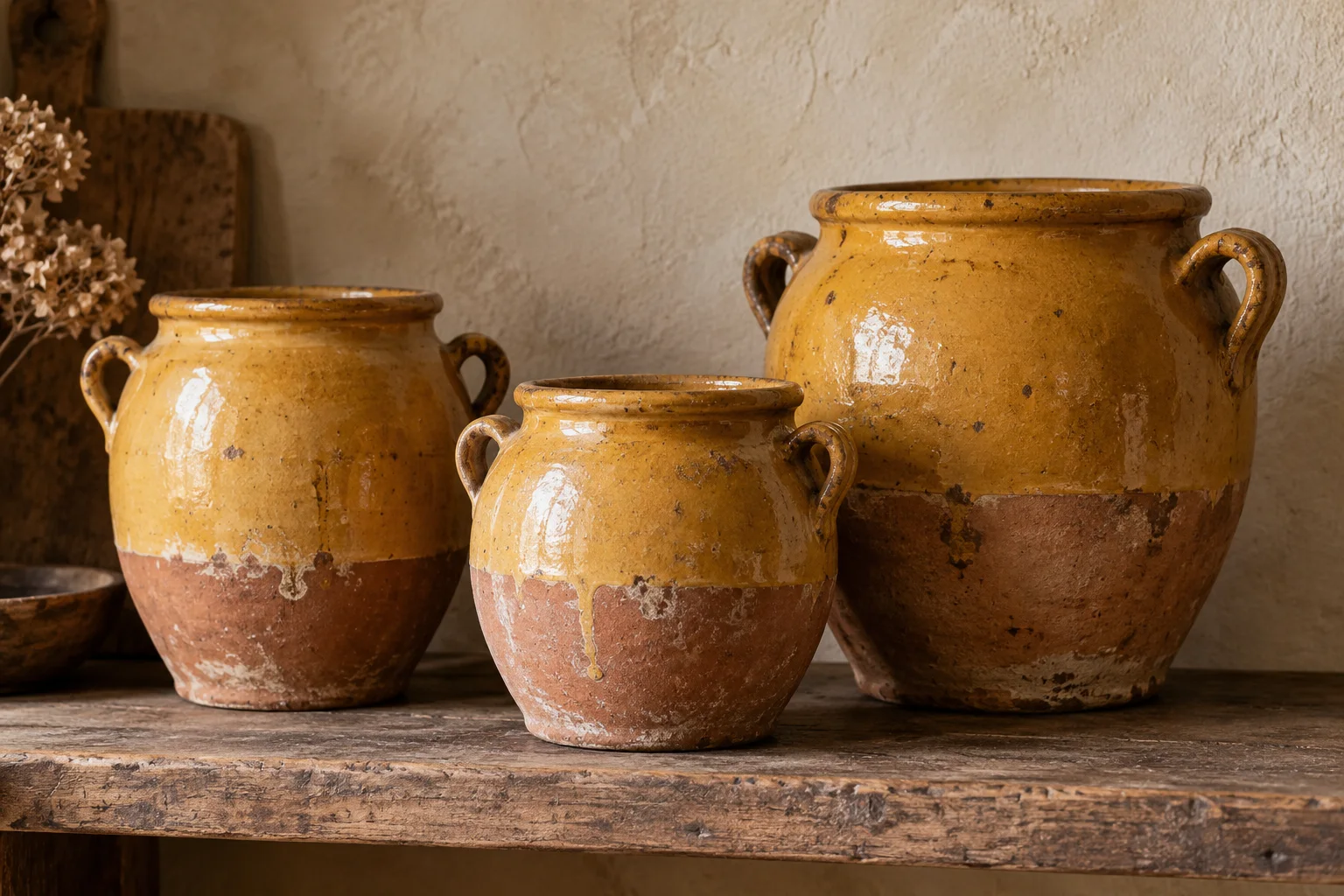 AI-created styling idea
Tableware & kitchen
Describe a confit pot by material and condition before assigning an origin.
Explore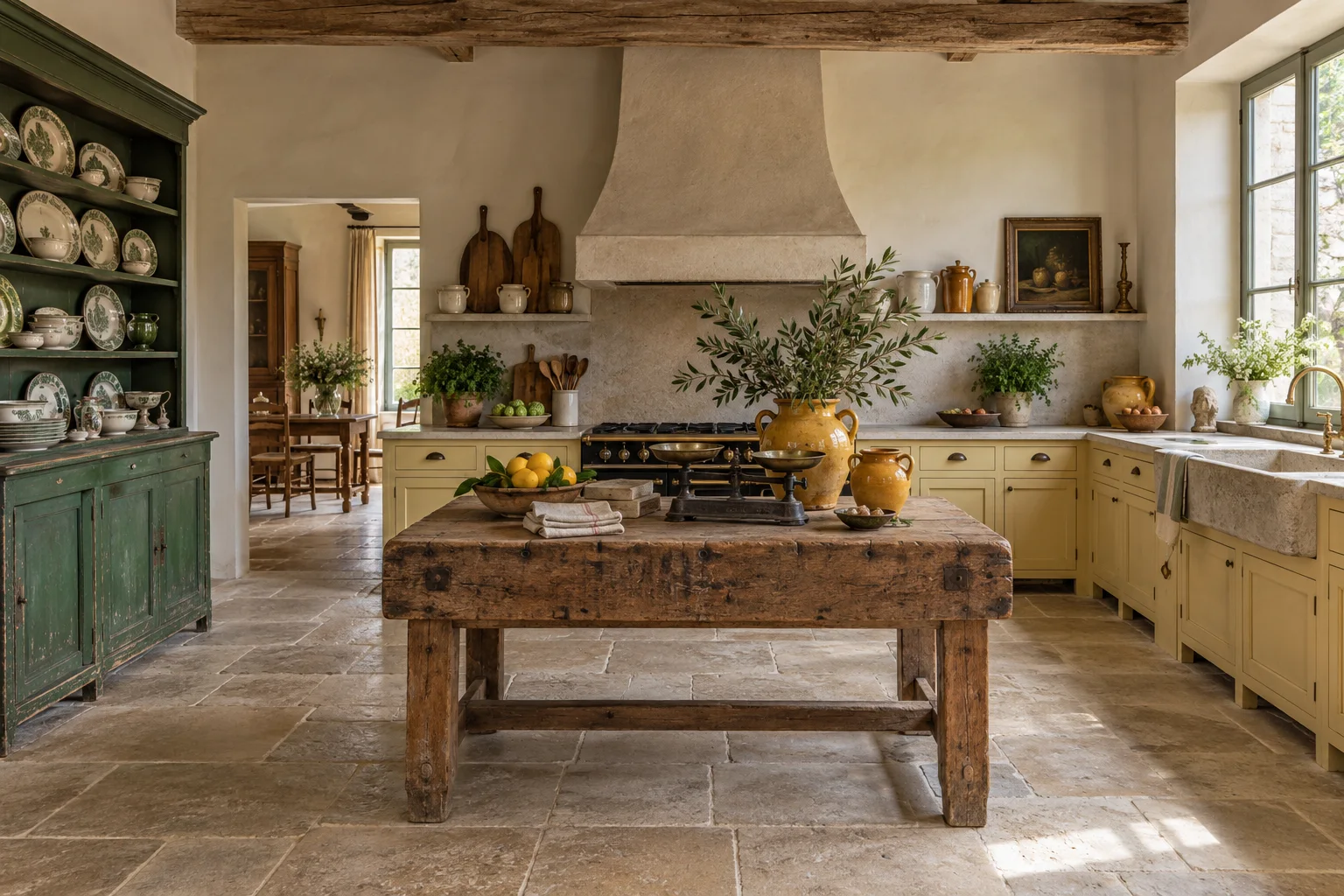 AI-created styling idea
Tableware & kitchen
Enamel, stoneware and glass: keep chipped pieces for dry goods and display.
Explore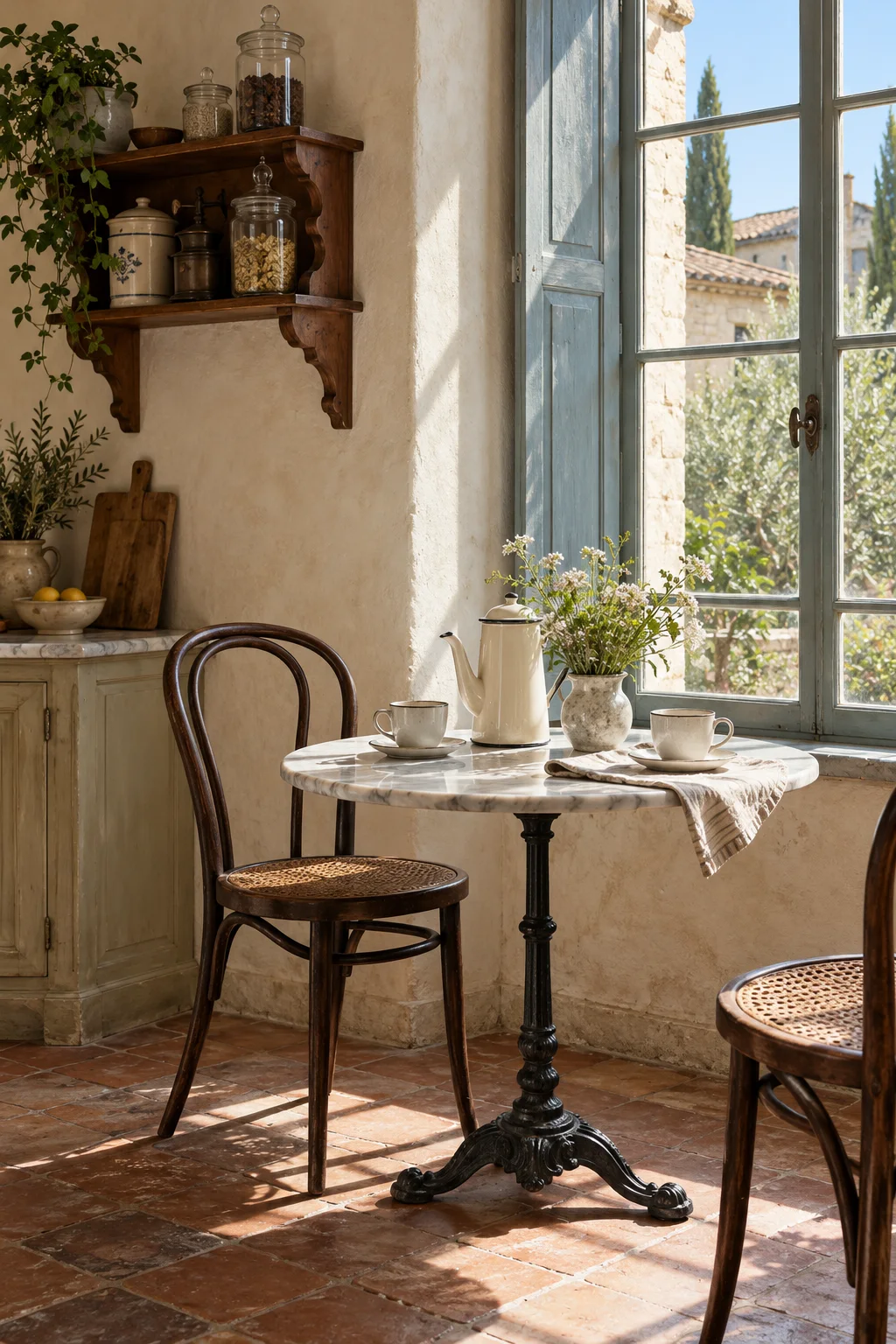 AI-created styling idea
Furniture
A block or baker's table on legs beats a built island: it moves, and its top can be scrubbed.
Explore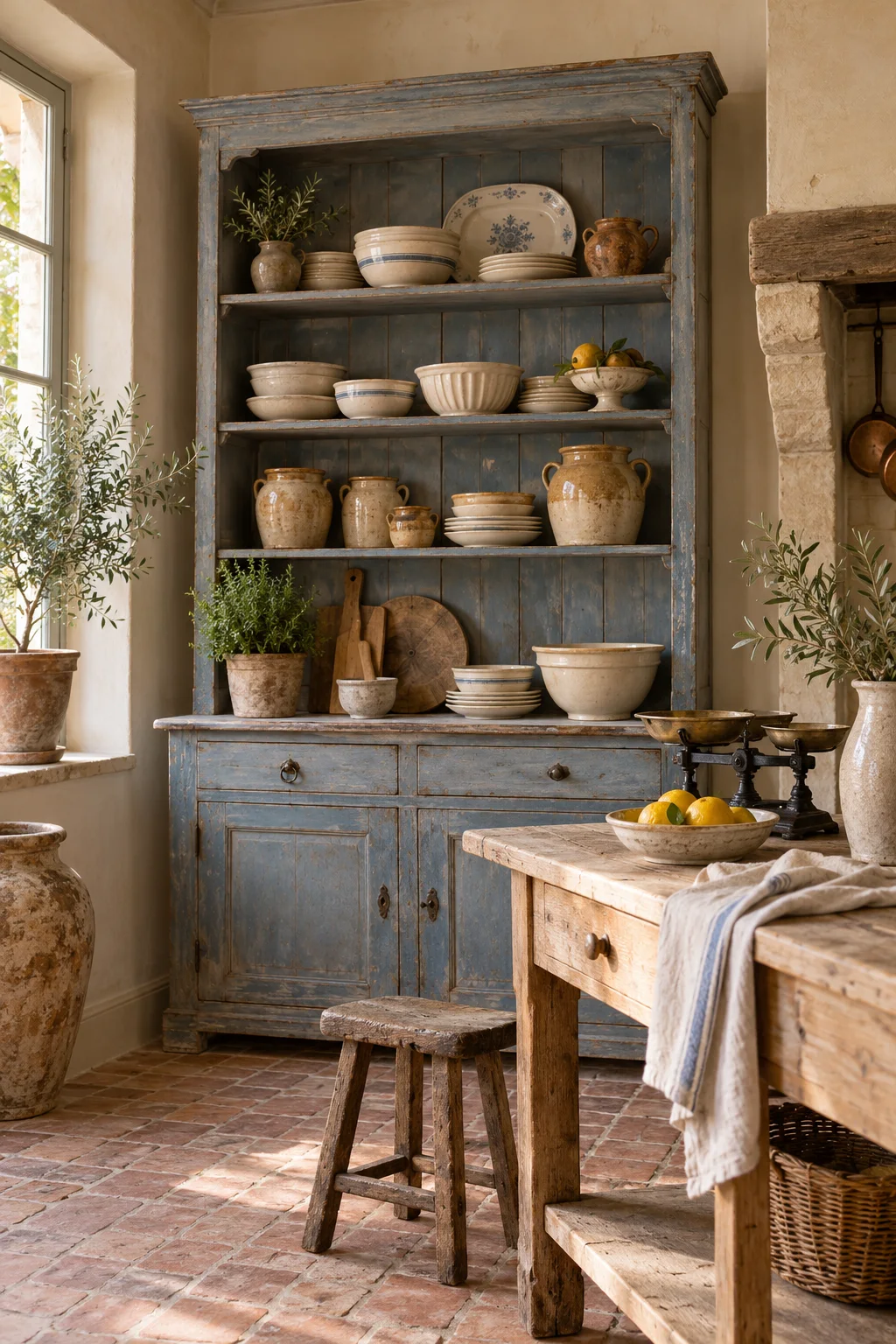 AI-created styling idea
Tableware & kitchen
A balance with its full set of weights is worth more than the pans alone.
Explore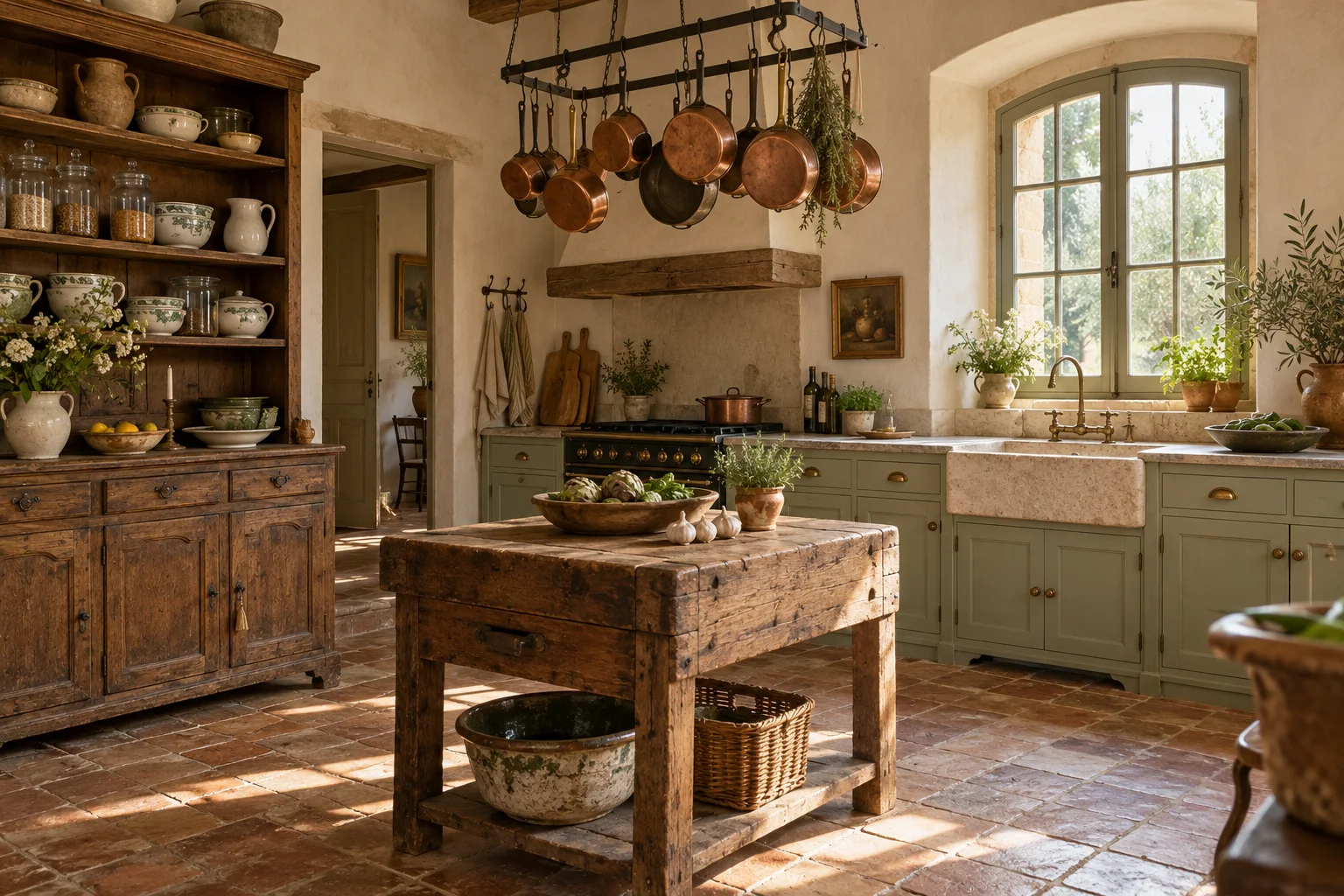 AI-created styling idea
Tableware & kitchen
Plates on the rack are the display; keep the ones you use within reach.
ExploreEvery piece for the kitchen in one place, grouped by category. Each subcategory page explains what to check before you buy and links to the detailed guides.
A table at the center, storage on the walls, and materials that age well: terracotta or stone floors, wooden or stone worktops, limewashed walls and a plate dresser. The objects are the decoration, copper on a rail, pottery on a shelf, enamel in use, and the palette comes from those materials with one added color such as French blue or sage green.
Yes, when the tin lining is intact and the copper is heavy, around 2.5–3 mm. Bare copper patches, a worn lining or a nickel lining that has flaked mean the pan should be retinned by a specialist or kept for display. Wash by hand, dry at once, and expect the outside to darken; polishing is a choice, not a maintenance step.
Start from the materials, cream limewash, warm wood, gray stone and ochre terracotta, then add a single color on the cabinets or the dresser: chalky gray-green, soft blue, off-white or, more rarely, a deep red. Copper and brass supply the warm notes. Keep the ceiling pale and the floor dark so the room reads as grounded rather than painted.
Replace one run of cabinets with a freestanding dresser or a worktable, add a single open shelf at eye level for pottery and jars, and hang copper on a rail. Keep the appliances and the sink where they are and let the fitted doors stay plain. One or two antique pieces at full scale change the room more than a dozen small objects spread across the counters.
Terracotta tiles and stone flags are the traditional choices, and both age well under daily use. Reclaimed terracotta gives the softest color but needs sealing near the sink and the range; limestone is cooler and smoother underfoot. Wide oak boards work in a kitchen that opens onto a living area. Lay a sample of about 3 by 3 ft (1 by 1 m) and look at it in evening light before ordering.
A French country kitchen uses softer whites, gray-greens and ochres, terracotta or stone floors, copper and glazed pottery, and freestanding furniture such as a dresser and a scrubbed table. The American farmhouse kitchen tends toward bright white cabinets, shiplap, black hardware and a large built island. Both value worn wood, but the French room relies on antiques and patina rather than new rustic finishes.
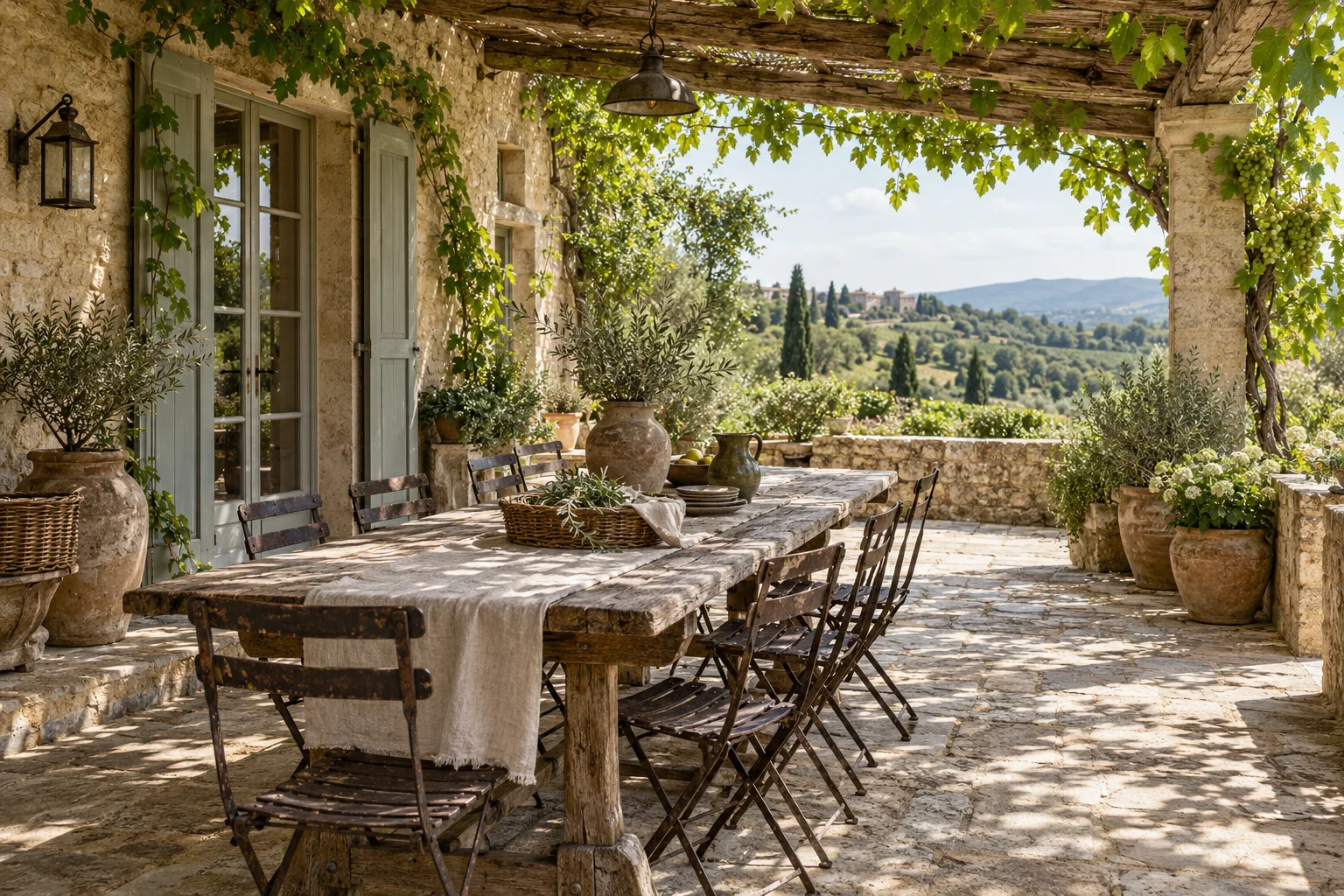
Nov 6, 2026 · Antique guide
Vintage metal chairs bring the terrace indoors.
Nov 6, 2026 · Antique guide
A French country Thanksgiving table takes its look from the farmhouse: a linen cloth, white ironstone or faience plates, mixed silverplate, short bistro glasses,…
Nov 6, 2026 · Antique guide
French kitchenware from 1880 to 1960 was made for daily work, which is why the good pieces are still at it.
Nov 5, 2026 · Antique guide
Vintage silver and vintage silverplate look alike on a sideboard and behave differently in the hand, in the sink and at resale.
Nov 5, 2026 · Antique guide
Vintage pottery from French kitchens and workshops falls into two bodies and three glazes.
Nov 5, 2026 · Antique guide
An antique magazine rack is one of the few small antiques that still does its original job and several new ones.