How to tell an antique from a reproduction: joinery and tool marks
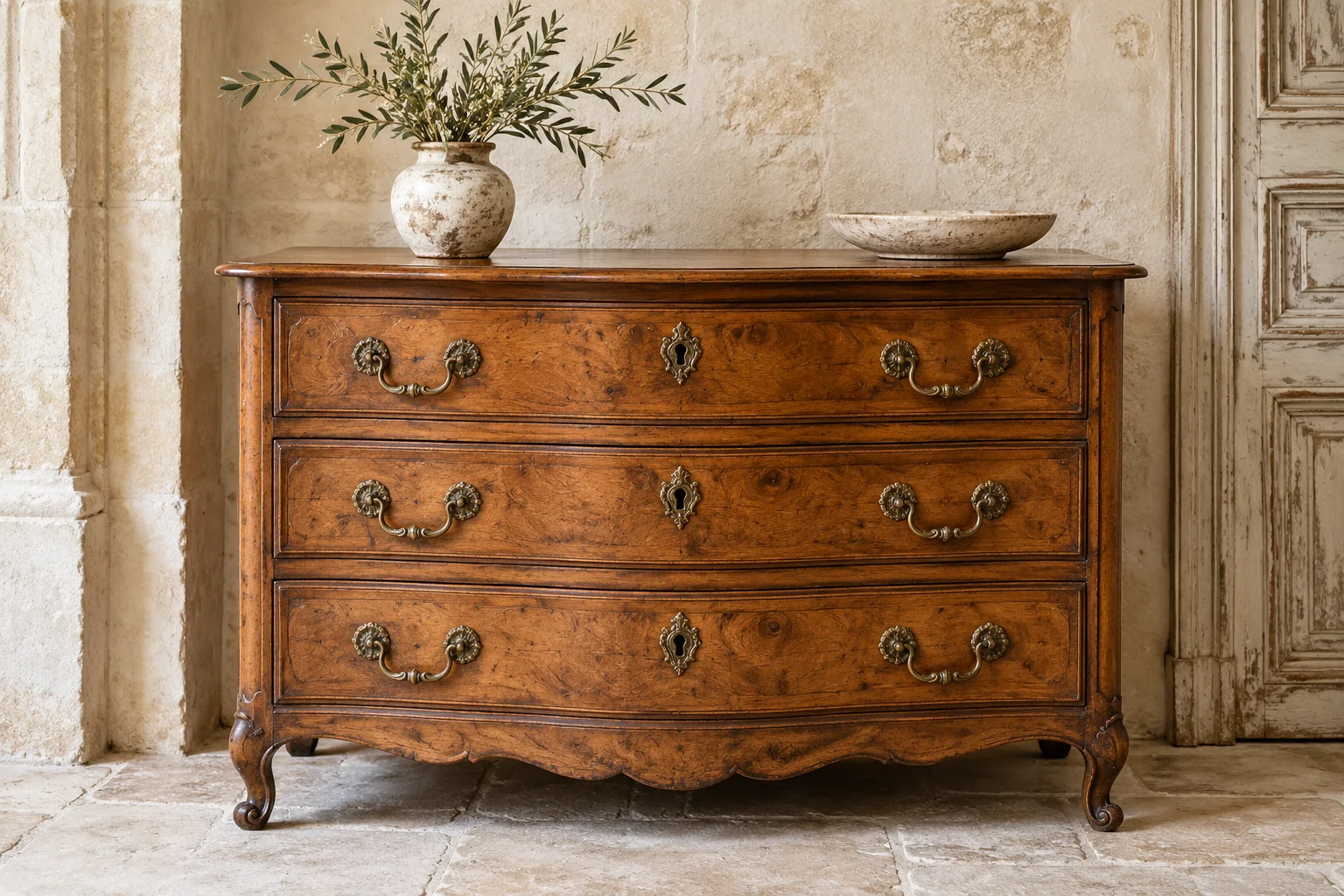
Start with the drawers, because they show how a piece was built. On hand-made French provincial case furniture, dovetails are few, uneven and cut with saw and chisel; the scribed line marking their depth often still runs across the drawer side. Machine dovetails, common from the late 19th century, are evenly spaced with identical pins. Frames are joined by mortise and tenon secured with wooden pegs (chevilles); as the wood shrinks, the pegs stand slightly proud and are rarely perfectly round.
Then read the tool marks. Hand planing leaves shallow, scalloped undulations on backs and drawer bottoms that you feel more than see under raking light. Straight saw marks at irregular angles point to hand sawing; regular curved arcs point to a circular saw. These clues are evidence, not proof, because country workshops kept hand methods long after factories mechanized. A style name such as Louis XV furniture describes an inspiration, not a documented date.
Wear, secondary woods, hardware and finish
Honest wear follows use. Feet are rounded where they were dragged, drawer runners are worn into grooves, the front edge of a top is softened where arms rested, and the wood around a keyhole is darkened by hands. Decorative distressing is spread evenly, even where no hand would reach; our note on real wear versus decorative distressing shows the difference. Old French pieces use oak, walnut, cherry or chestnut outside and pine, poplar or oak for backs and drawer bottoms, in boards of uneven width. Plywood, particleboard or perfectly matched narrow boards belong to the 20th century or later.
Hand-forged nails have irregular square shanks; early screws have shallow, uneven threads and off-center slots. Replacement handles are common and acceptable when disclosed: look for filled holes or a ghost outline around the current pull. Original wax or shellac finishes soften and darken; a hard, plastic-looking sheen often means a modern lacquer or polyurethane.
What each category means for price, use and import
An antique carries age, handwork and the marks of a long life, and its price reflects rarity and condition rather than materials alone. A piece over 100 years old with documentation of age may be entered under heading 9706 of the US tariff schedule, which lists a free general rate; classification is decided at entry, so no rate should be promised in advance. Vintage pieces and reproductions enter under the furniture headings of chapter 94.
A reproduction is the right choice when the use is hard or the size is fixed: a king bed, a kitchen cabinet that needs modern runners, twelve matching dining chairs, a child's room. A solid-wood reproduction is a sound purchase; the problem is only a reproduction described as old. A middle ground is the 'style' piece made between about 1880 and 1930 in an earlier manner: some are now over a century old and carry real wear. Our guide to French country furniture and the page on antique wood furniture show where each fits in a dining room or a bedroom.
Reading an honest listing
'Antique' should mean a stated, documented age over 100 years; 'vintage' a 20th-century piece of known decade; 'in the style of' a later piece in an earlier manner; 'reproduction' a modern copy. A good listing photographs the back, the inside of a drawer and every repair, with dimensions in inches and centimetres. For an antique armoire, it says whether the cornice and feet are original and whether the piece dismantles; for a buffet or enfilade, whether the top was replaced. Dealers in Occitanie and southwest France who supply French country antiques to US clients describe pieces this way, every flaw photographed.
What to compare
| Form | Suggested Use | Decisive Check |
|---|---|---|
| Antique, documented over 100 years | Focal piece | Hand-cut joinery; age documents |
| Vintage, about 1920 to 1980 | Bedrooms, everyday storage | Original finish; stated decade |
| Reproduction or later 'style' piece | Kitchens, fixed modern sizes | Solid wood; honest description |
Your buying checklist
Continue planning your room
Frequently asked questions
How can you tell if country French furniture is antique or a reproduction?
Look inside before you look at the front. Hand-cut dovetails, pegged joints, plane marks on the back, secondary woods in boards of uneven width and wear at the points of use suggest hand construction and age. Uniform machine dovetails, plywood, identical cast hardware and evenly spread distressing suggest a later piece. No single clue is proof, so read several together.
Is reproduction country French furniture worth buying?
Yes, when it is well made and honestly described. A solid-wood reproduction suits hard daily use, fixed modern sizes such as a king bed, and matching sets that are rare among antiques. It will not carry the value of age, so pay for its materials and construction rather than for an implied history.
What are the key characteristics of country French furniture?
Country French furniture uses solid regional woods such as walnut, oak, cherry and chestnut, simple curves borrowed from Louis XV style, carved aprons with shells or flowers, cabriole or scroll feet, pegged joinery and waxed or painted finishes. The forms were made for use: armoires, buffets, farmhouse tables and rush-seat chairs, built to be repaired rather than replaced.
Where can I buy antique country French furniture?
Homeowners can start with the Lo Cantou listings, where each piece is photographed and its condition described; check availability before planning a room around one piece. Interior designers working on a client project can send a brief to Antiques 360, which sources from dealers in Occitanie and southwest France and returns three documented pieces within 72 hours with the landed cost known upfront.
Sources & further reading
- The Metropolitan Museum of Art — French Furniture in the Eighteenth Century: Case Furniture — Construction of documented French case furniture.
- USITC — Harmonized Tariff Schedule, heading 9706 (antiques of an age exceeding 100 years) — Heading 9706 for antiques over 100 years; rates are confirmed at entry.
- U.S. Customs and Border Protection — Importing antiques — Proof of age when importing antiques.