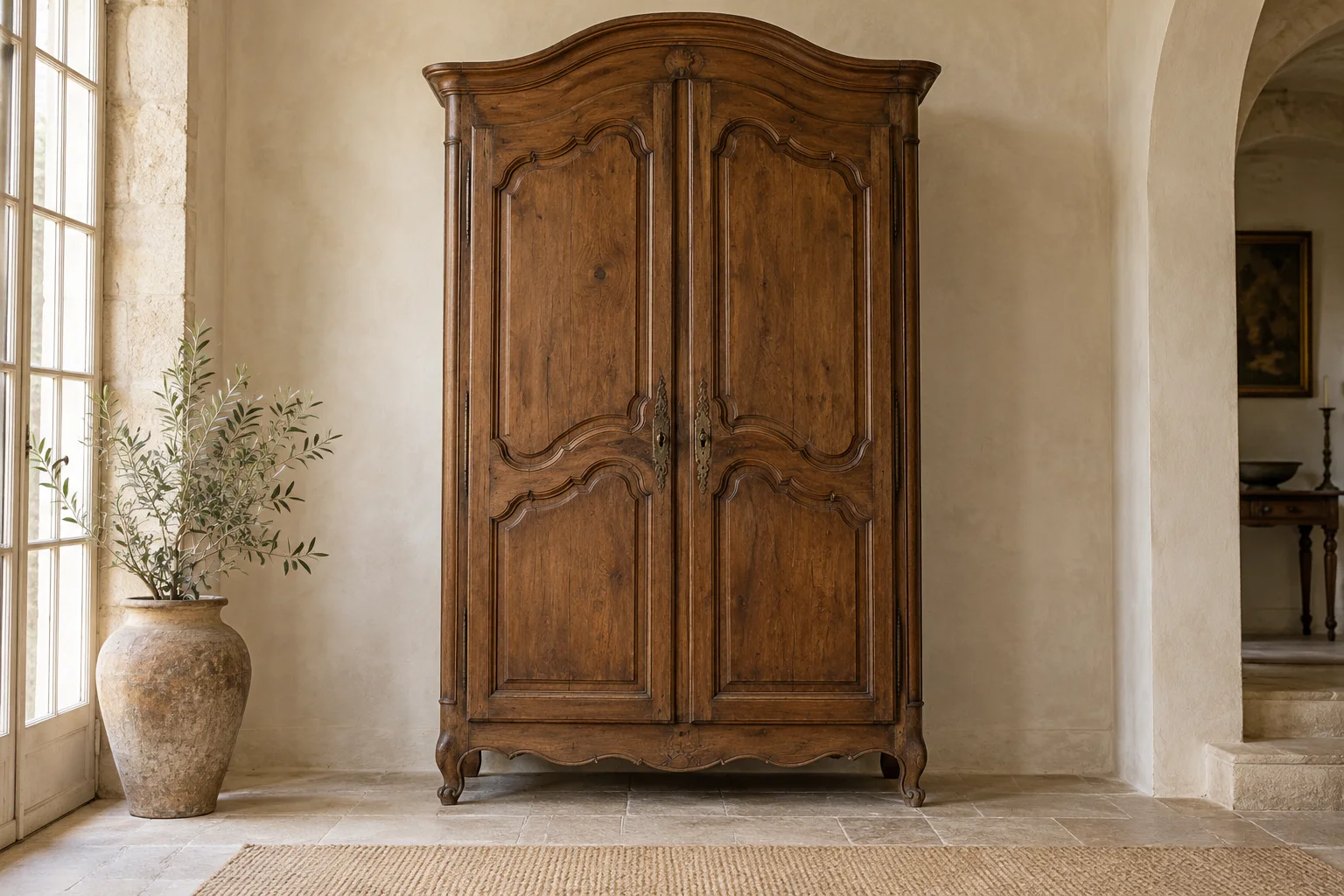
 AI-created styling idea
Furniture
Armoires & wardrobes
Check the cornice height, the pegged joints and the route into the room before anything else.
ExploreFrench Country · An inspiration catalogue · Updated November 2026
French country furniture is working furniture made beautiful by use: armoires, buffets, farmhouse tables and rush-seated chairs in oak, walnut, cherry and chestnut.
What is French country furniture? It is the farmhouse and provincial furniture of rural France, made by local joiners and copied ever since: armoires, buffets, farmhouse tables, rush-seated chairs and commodes in oak, walnut, cherry and chestnut, with pegged joints, simple lines and carving kept to the cornice, the doors and the apron.
French country furniture was built for farms, village houses and small manors, not for salons. Each form answers a daily need: the armoire stored linen and clothes, the buffet held dishes, the table de ferme seated the household, the pétrin kept dough. The lines are simple, the proportions generous, and the decoration limited to a carved cornice, a shaped apron or a turned leg. That restraint is why these pieces still work in a modern house: they were designed to be used, moved and repaired.
The wood usually follows the region. Oak is common in Normandy and Brittany, walnut in the southwest and the Lyonnais, cherry and other fruitwoods in the Loire and Burgundy, chestnut in the Massif Central and the southwest, pine in mountain areas. A regional name on a listing describes a tradition, not a proof of origin; the wood itself can be identified from grain and color, the region cannot. Expect color variation inside one piece: boards were chosen for size and soundness, not for a uniform tone.
Traditional pieces use mortise-and-tenon joints locked with wooden pegs, frame-and-panel doors that let the wood move, and dovetails cut by hand with slightly irregular spacing. Many armoires were made to be taken apart: the sides, back, cornice and base assemble with pegs and no glue, which is also how they travel today. Drawer sides and backs are often in a cheaper secondary wood such as poplar or pine, a normal practice that does not lower the interest of the piece.
The French armoire is the anchor piece of the style: two panelled doors, a shaped cornice, often a single interior shelf and a drawer at the base. Typical sizes run 86–95 in / 220–240 cm tall, 55–63 in / 140–160 cm wide and 22–26 in / 55–65 cm deep. Measure the ceiling height with the cornice in place and the route to the room before buying. Shelves can be added for a pantry, a linen press or a hidden television without altering the frame.
The low buffet (buffet bas) stands about 36–40 in / 92–102 cm high and 20–24 in / 50–60 cm deep, with two or three doors and drawers above. The enfilade stretches the same idea to three or four doors and 71–98 in / 180–250 cm of length. The vaisselier adds open plate racks above the buffet. Our page on buffets and sideboards compares the forms; the key checks are the backboards, the locks and whether the top has been replaced.
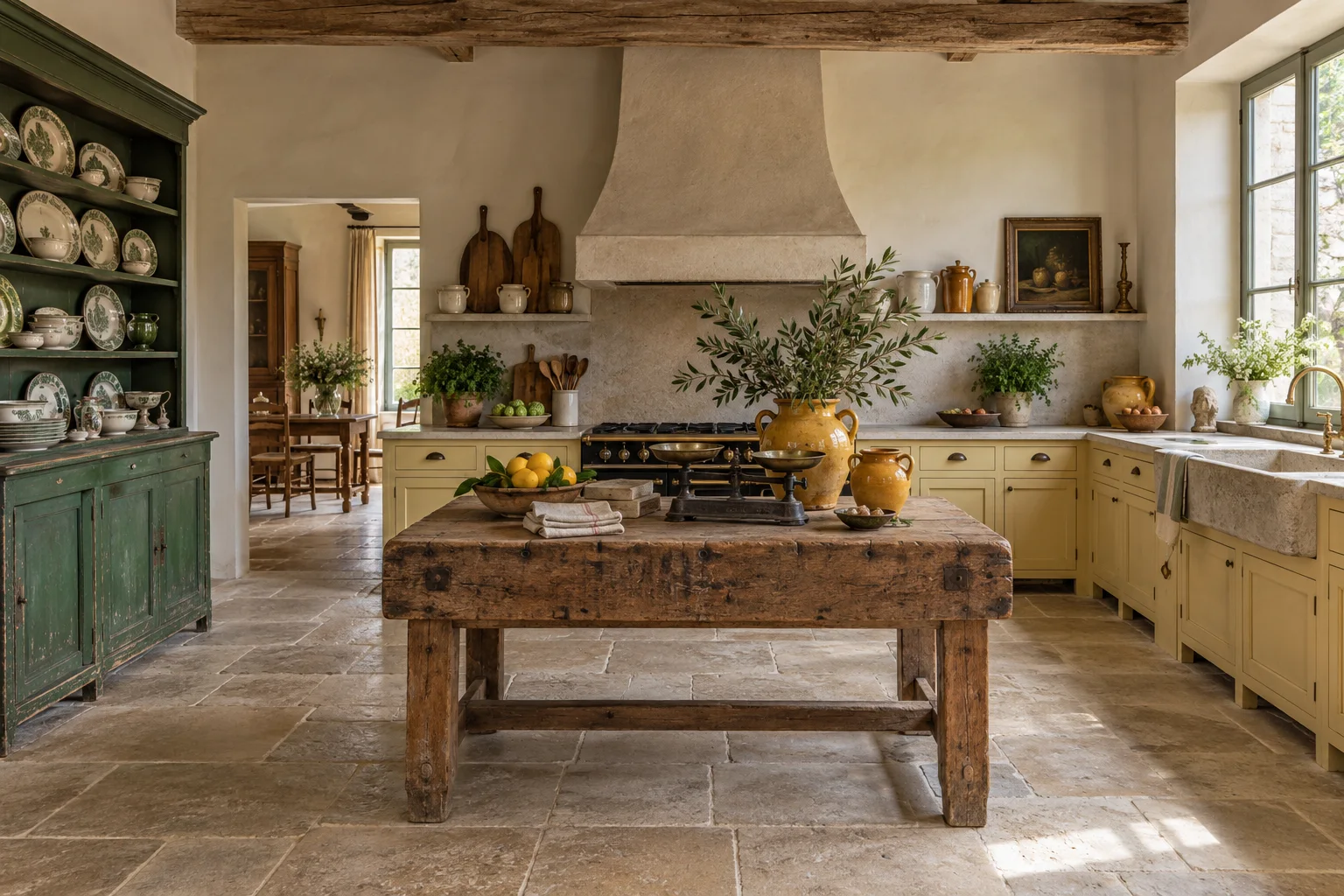
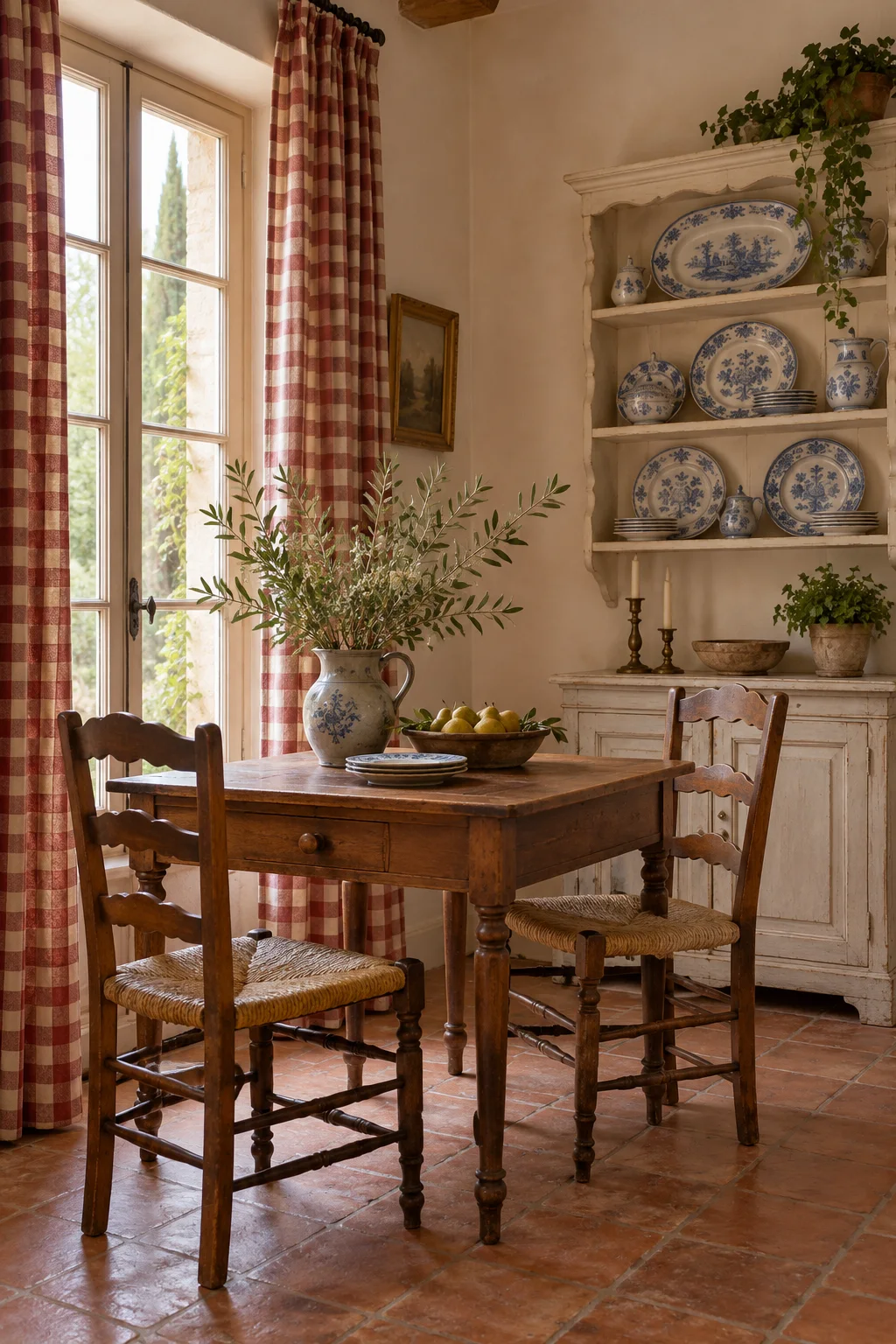
A farmhouse dining table has a thick plank top, a deep apron with one or two drawers, and turned or square legs joined by stretchers. Height is usually 28–30 in / 71–76 cm; allow 24 in / 60 cm of edge per seat. The matching seat is the chaise paillée, a rush-seated chair with a ladder or spindle back, 17–19 in / 43–48 cm at the seat. Mixed sets are normal in a country house; the guide to antique chairs explains how to pair them.
The provincial commode has three or four drawers and a shaped front; the bonnetière is a narrow single-door cupboard originally for bonnets; the pétrin is a dough box on legs that now serves as a side table or bar. Read the guide to dressers and tall chests for the drawer checks, and the page on dressers and chests of drawers for the forms. Smaller pieces travel easily and often carry the most wear, which should be described, not hidden.
Each of the twenty pieces below comes with its usual size in inches and centimetres and the one check that matters most before buying. A style name describes a form; only a mark or a document dates a piece.
The two-door armoire is the largest piece in a French country house and often the oldest. Look for doors that close flush, a cornice that lifts off, and wooden pegs rather than screws in the frame. Most need 87–95 in / 220–240 cm of ceiling height. Our article on how French country armoires are pegged, opened and moved explains the dismantling.
The bonnetière is a narrow single-door cupboard, about 30–40 in / 76–100 cm wide and 75–85 in / 190–215 cm tall, first made to hold lace bonnets. It fits a bathroom, a hall or a small bedroom where an armoire would crowd the space. Check the single long door for warping. Related forms sit among the storage cabinets for every room.
The buffet deux corps is a two-part cabinet: a low buffet with a recessed upper cupboard, sometimes glazed, set on top. It stands 85–100 in / 215–255 cm tall. Check that both parts were made together, with matching wood, carving and back boards, because married pieces are common. The encyclopedia entry on the French buffet lists the variants.
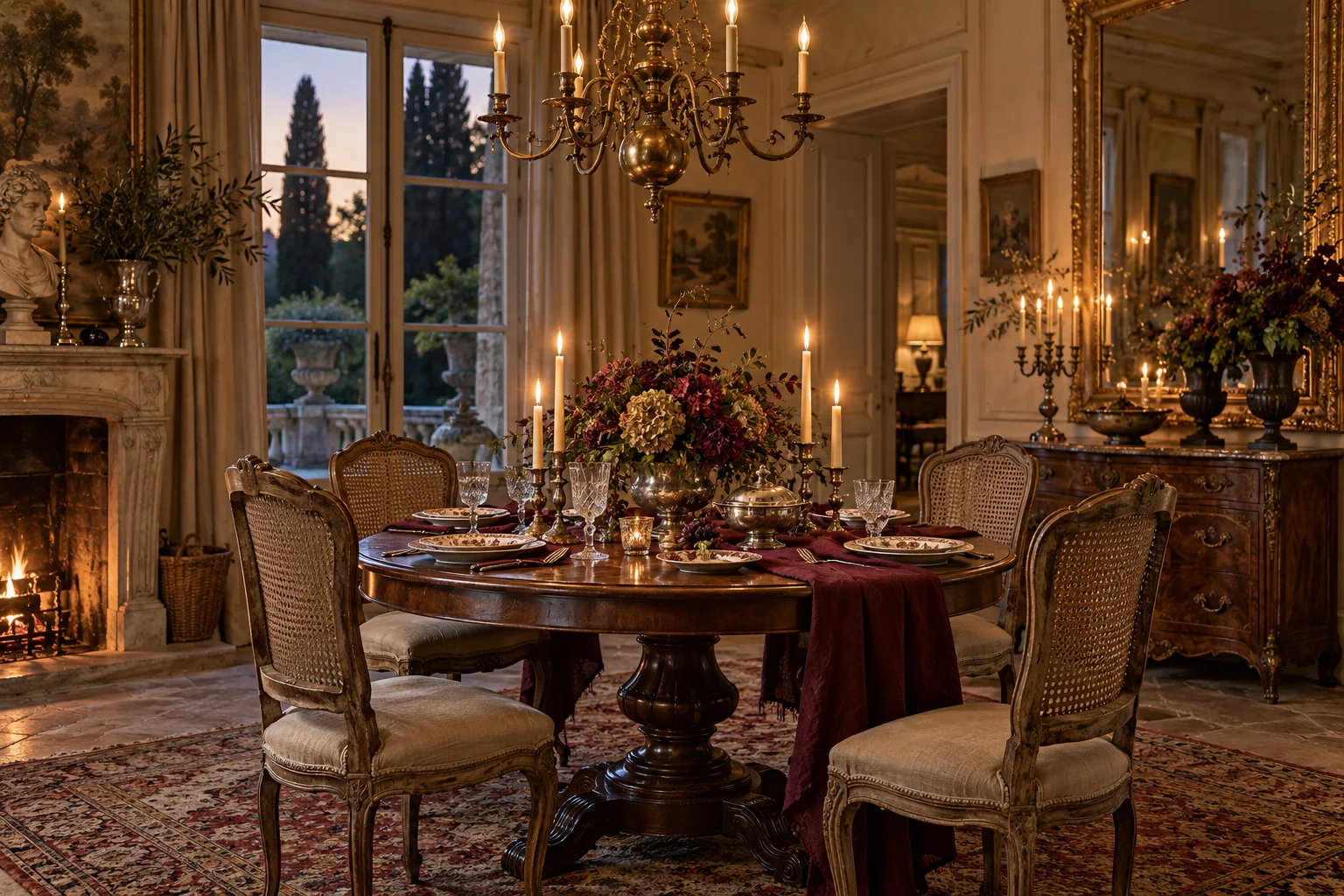
The enfilade is a long, low buffet with three or four doors in a row, about 36–40 in / 92–102 cm high. It holds dishes and linen and works as a sideboard in the dining room or a media cabinet in the living room. Open every door, since hinges on the middle doors wear first. See antique sideboards and buffets: forms, woods and checks.
The vaisselier is a buffet with an open plate rack above, its shelves cut with a groove or fitted with a rail so plates stand upright. Overall heights run 75–90 in / 190–230 cm. Check that the rack was made for the base and not added later: compare the wood, the color and the back boards. The encyclopedia page on the hutch and vaisselier shows how.
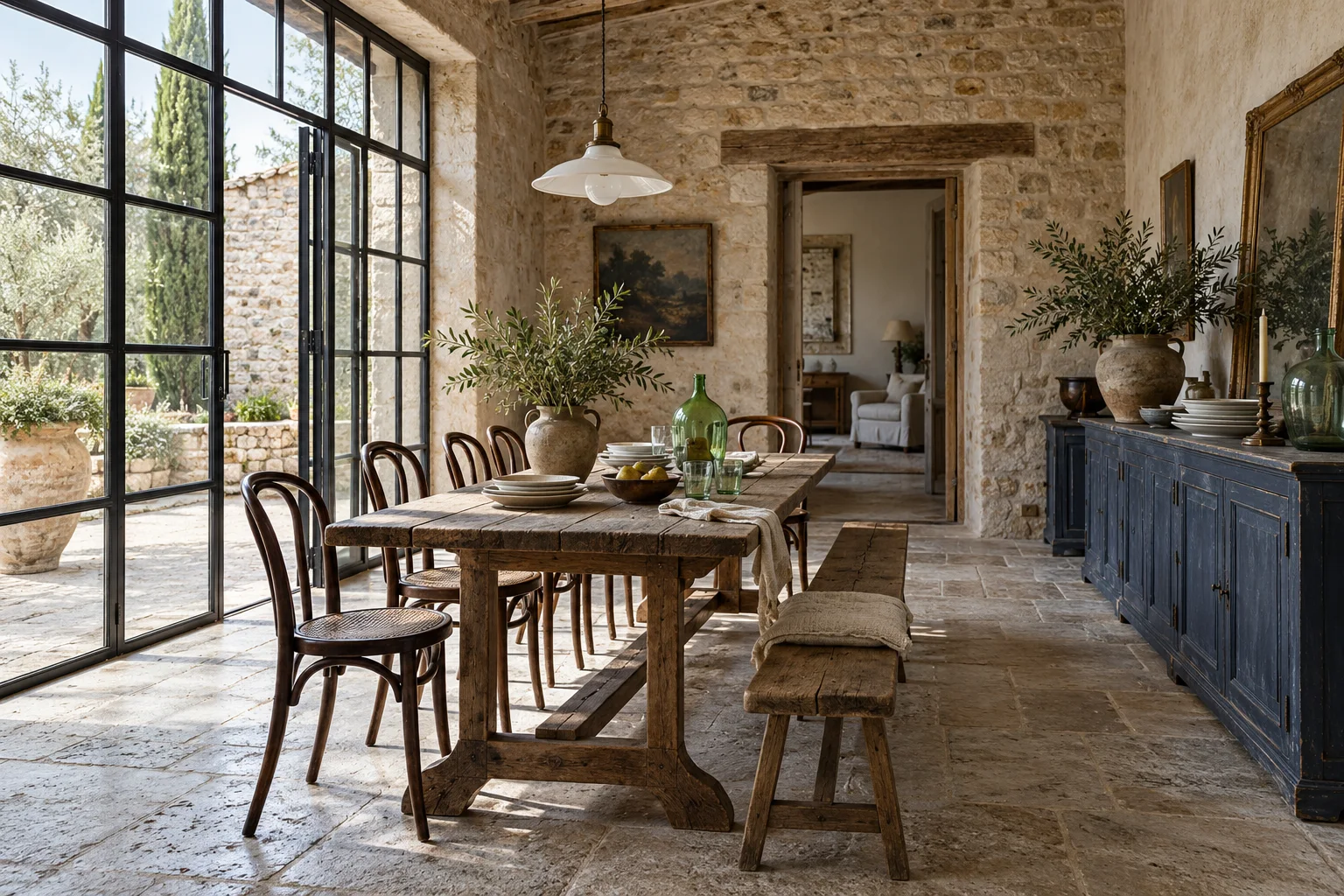
The table de ferme has a plank top 1.5–2.5 in / 4–6 cm thick, an apron with one or two drawers, and square or turned legs. Many tops were replaced over the years. Ask for photographs of the underside, where fresh saw marks and new screws show, before you pay. The French farm table entry names each part of the frame.
Extending tables gain length from pull-out leaves, the rallonges, at each end, or from loose leaves set in the middle. Each leaf usually adds 16–20 in / 40–50 cm. Test the runners in both directions and check that the leaves match the top in color and wear. Our article on antique wooden dining tables, extensions and size compares the systems.
The chaise paillée has a woven rush seat and a ladder or spindle back, with a seat height of 17–19 in / 43–48 cm. Rush is inexpensive to renew but must be woven by hand, so a torn seat is no reason to refuse a sound frame. Check the joints of the back rungs. Chairs with rush seats covers care and re-rushing.
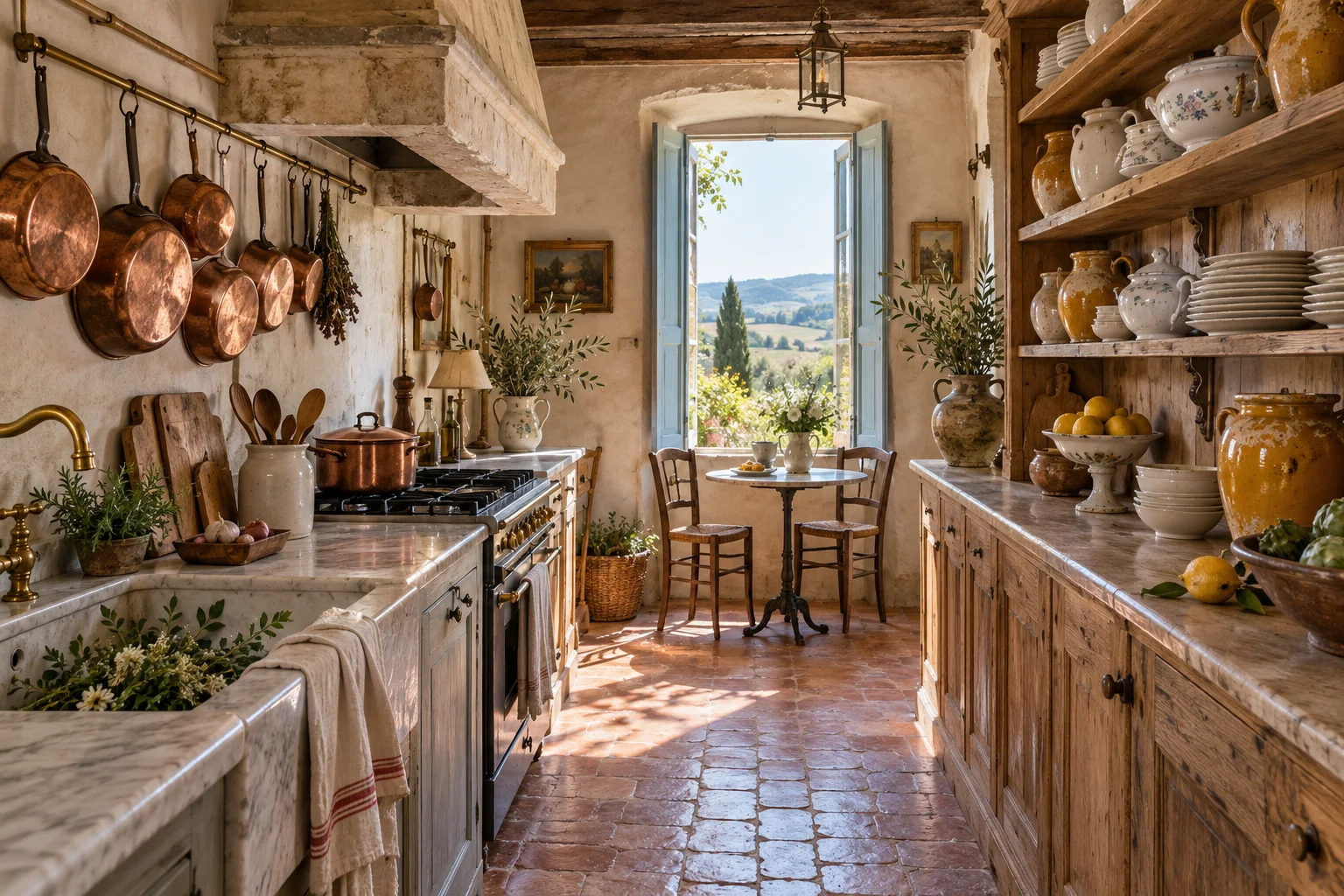
Steam-bent beech chairs with cane or plywood seats came into French cafés in the late 19th century and stayed. Most found today are vintage, from the 20th century, and some carry a maker's paper label or a stamp under the seat. Attribute only by mark. The guide to bentwood chairs, labels and checks explains what to read under the seat.
The bergère is an upholstered armchair with closed sides and a loose seat cushion, lower and deeper than a dining chair, with a seat height around 15–17 in / 38–43 cm. Test the frame before thinking about fabric, because new upholstery is the larger cost. The encyclopedia page on the bergère chair shows the forms.
The cabriolet is an open armchair with a concave back that curves around the sitter, usually on cabriole legs. It is lighter than a bergère and moves easily around a room. Check the arm joints, which carry the weight when people push themselves up. Our guide to the French chair: fauteuil, bergère and chaise names sorts out the vocabulary.
The canapé is a French settee with a carved frame and an upholstered seat and back, usually 55–75 in / 140–190 cm wide, narrower than a modern sofa. It suits a small living room, a landing or the foot of a bed. Upholstered antique seating usually ships as a frame only. Read about French sofas, settees and the banquette.
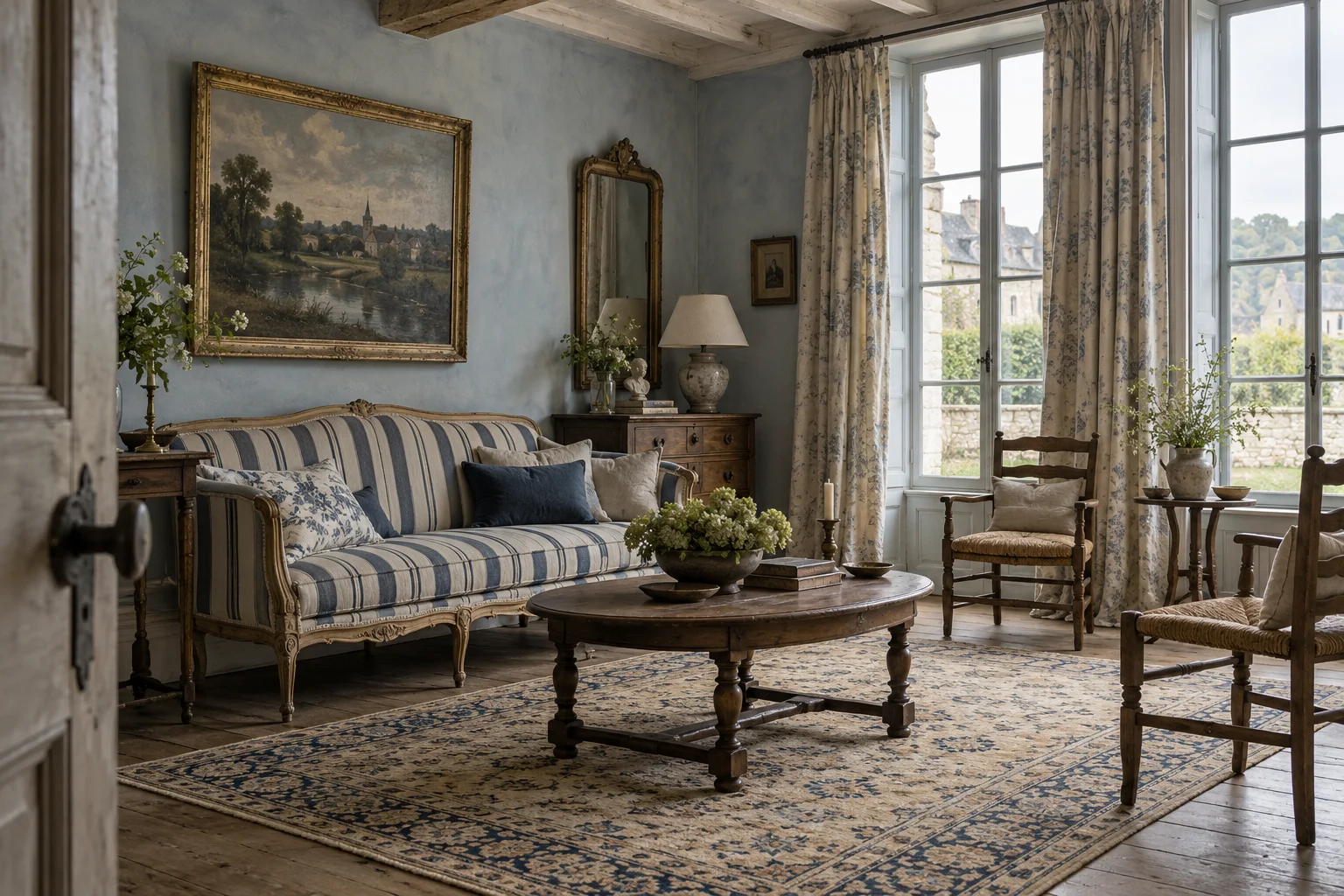
The provincial commode has three drawers, a shaped apron and a straight or serpentine front, about 34–36 in / 86–92 cm high. Pull every drawer fully out and check the runners, the dovetails and the back boards. A replaced top is common and should be stated. The encyclopedia entry on the French commode explains the regional forms.
The chevet is a small bedside cabinet with a door or a drawer, often under a gray or white marble top. Heights of 28–32 in / 71–81 cm suit a modern mattress. The marble should sit in a recess; a chipped corner is normal, a crack right across is not. See French bedside cabinets: tables de nuit and chevets.
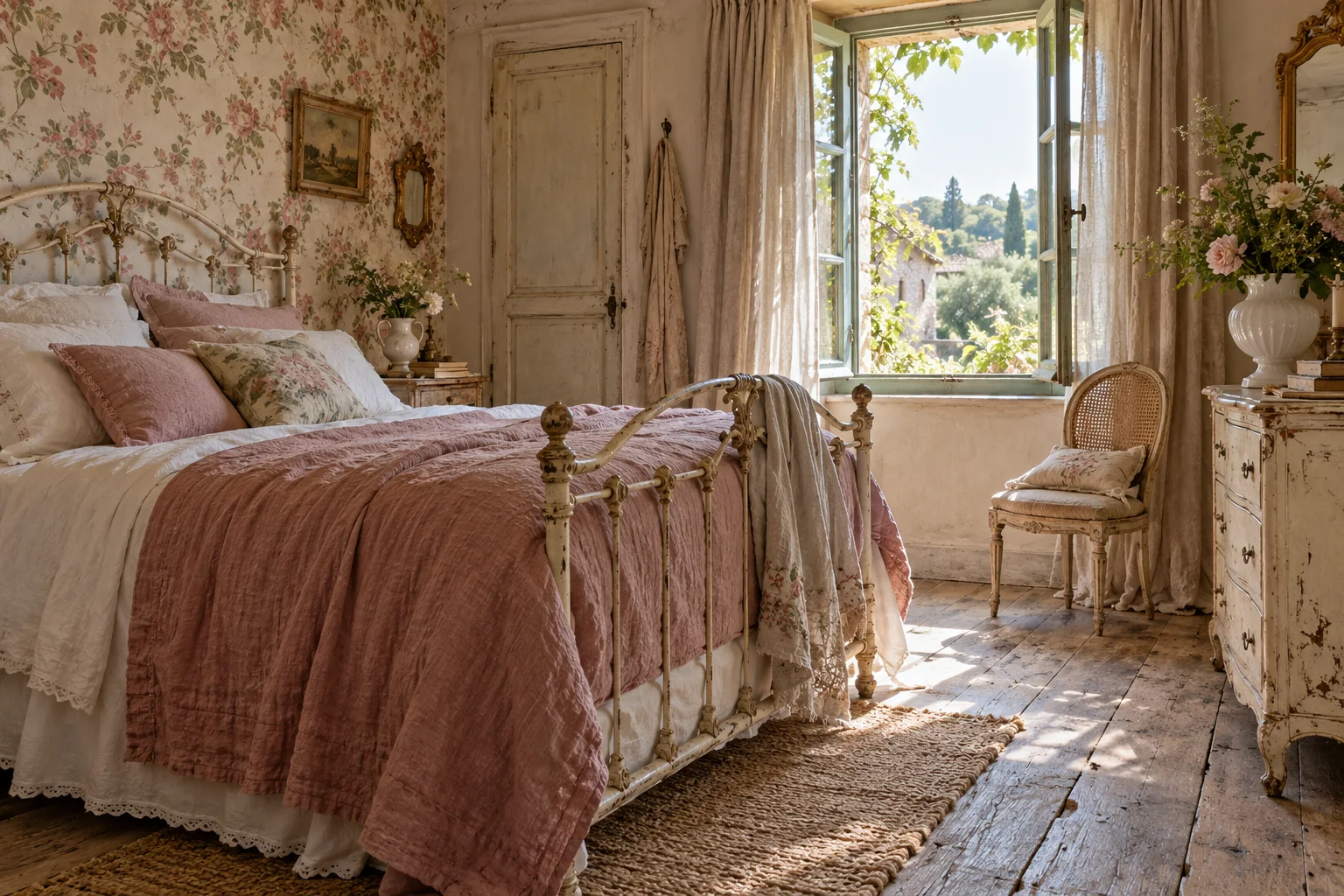
The pétrin is a dough bin on legs with a lid, 40–50 in / 100–125 cm long, now used as a console, a bar or a linen chest. The inside often shows flour-worn wood and old woodworm holes; ask whether the infestation is inactive and treated. The legs are often later replacements. More in our guide to farmhouse antiques such as pétrins and tables.
The panetière is a Provençal bread cage with spindles on three sides, usually carved in walnut and hung on the wall, about 30–36 in / 76–91 cm wide. Many were later set on a stand or a buffet. Check the spindles for breaks and the hanging points for strength. The forms are shown in wooden bread bins and panetières.
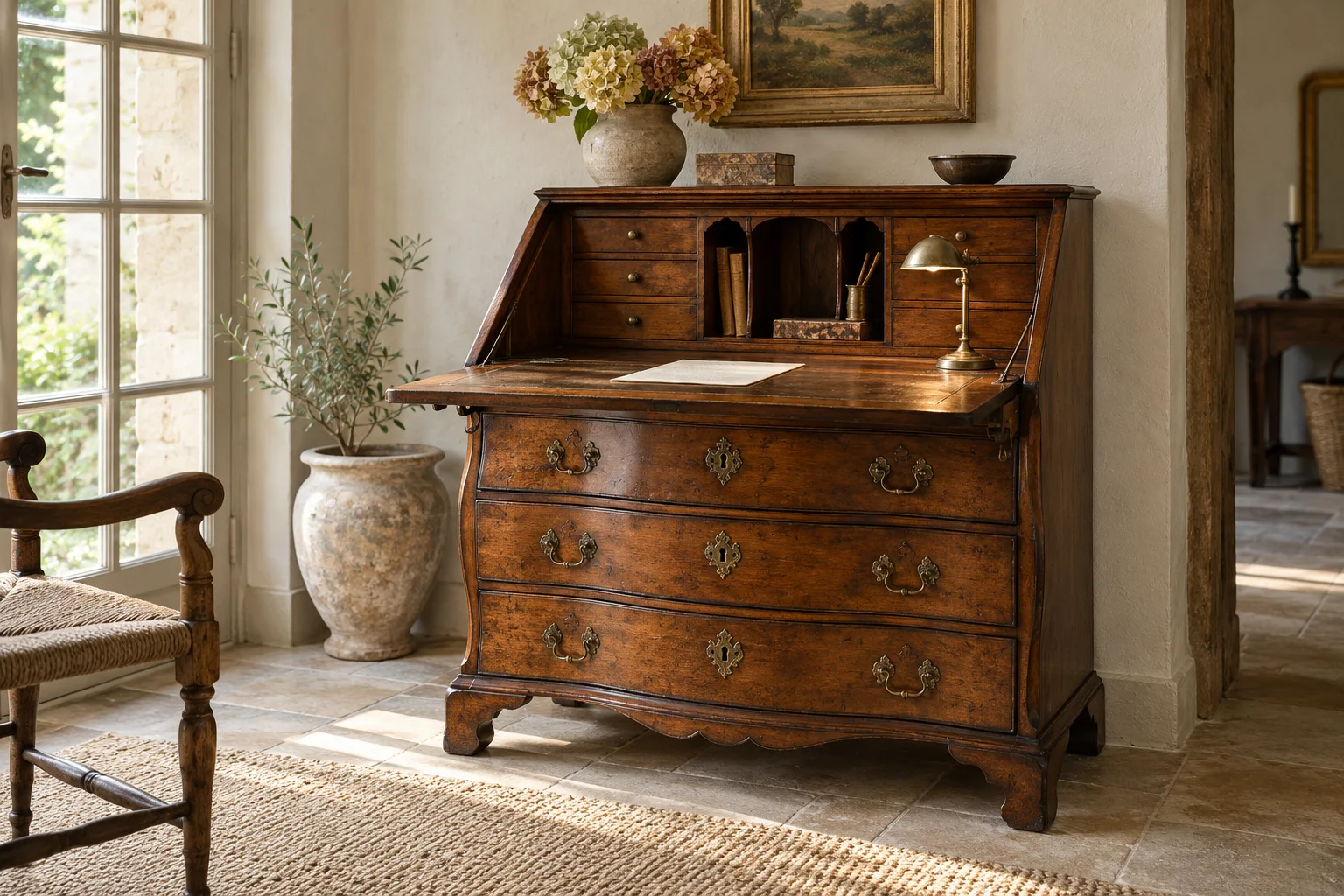
The secrétaire à abattant has a drop front that opens into a writing surface over small drawers and pigeonholes, about 55–60 in / 140–150 cm tall. Check the hinges and the supports of the flap before writing on it, and ask for the key. Our article on French desks, from the bureau plat to the writing table compares the forms.
A country console is a narrow table, 12–16 in / 30–40 cm deep, set against a wall. The demi-lune is its half-round version, sometimes with a folding top that opens into a full round table. Both suit a hall or the space behind a sofa. See demilune cabinets and half-moon consoles and the encyclopedia entry on the console table.
French beds come in carved walnut or oak, or in iron with cast details. Old frames are often 47–55 in / 120–140 cm wide, narrower than a US queen at 60 in / 152 cm, so plan for widened rails or a custom mattress. Check the side-rail fixings first. Our article on antique iron bed frames, sizes and conversions explains the options.
Benches 6–8 ft / 1.8–2.4 m long seated the household along the table, with a seat height of about 18 in / 46 cm. A trestle base or a low stretcher keeps them steady on uneven floors. Indoors a bench also works at the foot of a bed or in a hall. The range is shown in French benches, banquettes and garden bancs.
The cabriole leg curves out at the knee and in at the ankle before ending in a scroll or a hoof foot. It reached provincial workshops from Louis XV court furniture and stayed in use long after the court style changed, so a cabriole leg alone does not date a piece. The apron above it is often cut in a soft arc, sometimes with a carved center. Read curved French furniture: bombé, serpentine and cabriole forms and reading Louis XV furniture without dating the piece.
Country carvers worked from a small repertoire: baskets of flowers, wheat sheaves, shells, hearts, birds, and wedding motifs such as doves or linked rings on armoires made for a marriage. The carving sits on the cornice, the door panels and the apron. Sharp-edged carving on an otherwise worn piece may have been added later; old carving is softened by hands and wax. Botanical and floral motifs in French antiques shows how to read them.
Most country pieces were waxed, and the wax has darkened with time. Painted furniture in gray, green or blue was common in the east and in Provence; original paint wears through on edges and around handles, while later paint sits over old damage. Limed oak, or céruse, keeps white pigment in the open grain. Applied distressing is a finish, not a history: real wear versus decorative distressing separates the two.
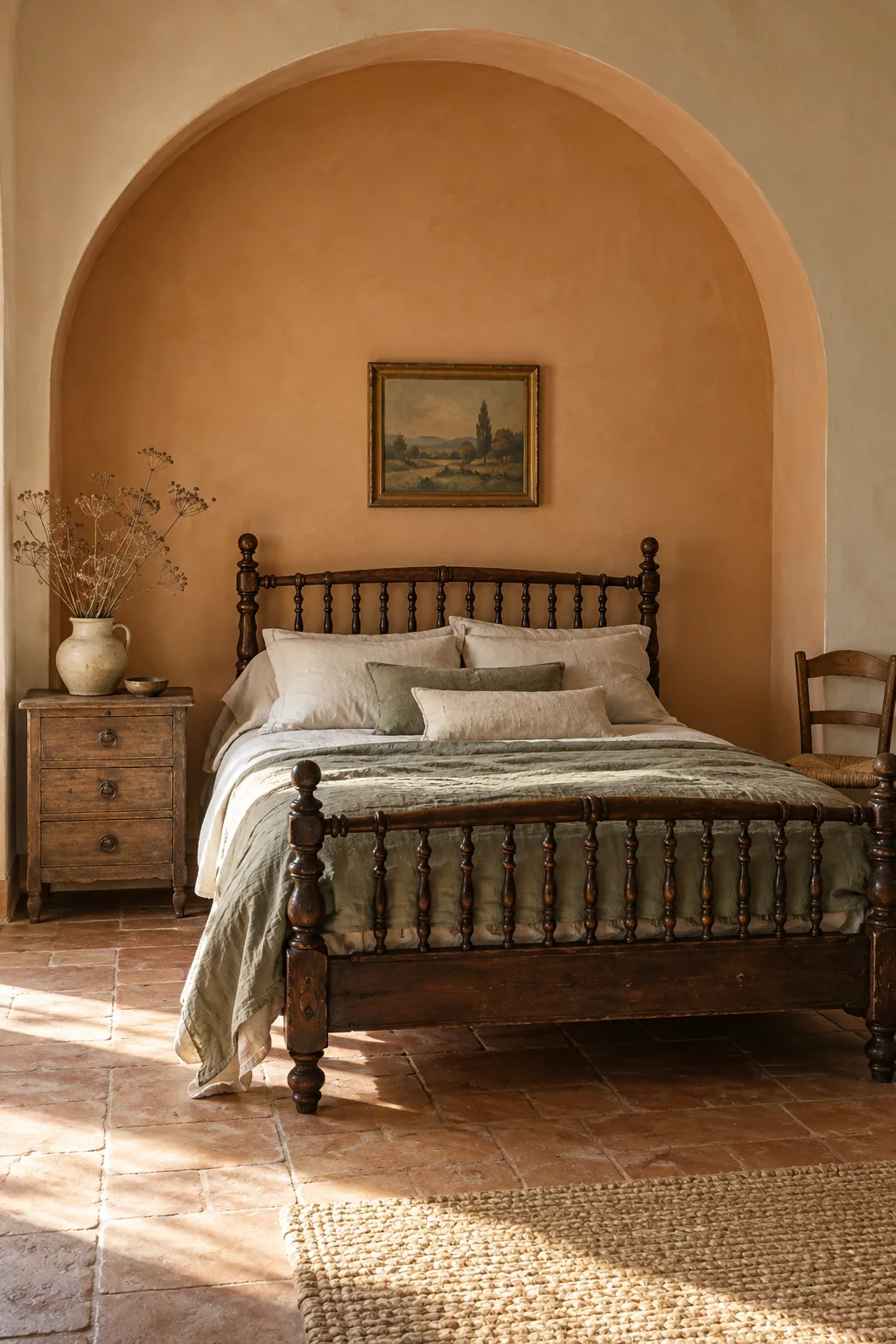
Armoires carry long brass or steel escutcheons around the keyhole, sometimes 12 in / 30 cm or more, and fiche hinges, the tall pin hinges set into the door edge. Commodes use brass pulls and drop handles. Replaced hardware is common and leaves traces: filled holes, darker outlines on the wood and new screws. Our page on antique brass and bronze explains cleaning hardware without stripping its patina.
One large piece is enough: a buffet bas under a mirror, or an armoire used as a bookcase. Add a low table cut from an old worktable, a pair of antique armchairs in linen, and leave the rest to textiles. The living room scenes show how a single carved cornice can carry a plain room.
The table sets the scale; the buffet or vaisselier sets the storage; the chairs set the mood. In the kitchen, a freestanding pétrin or a worktable replaces fitted units. In the dining room, an enfilade along the long wall holds dishes and doubles as a serving surface at the right height, 36–40 in / 92–102 cm.
An armoire, a bed with a carved or iron frame, and two bedside cabinets (chevets) make the room. Keep the armoire 2 in / 5 cm from the wall so the cornice clears skirting and the back can breathe. The bedroom scenes pair pale linen with dark walnut, the contrast the style relies on.
A narrow console or a bench, a mirror and hooks are the whole program. Depth matters more than length in a hall: 12–16 in / 30–40 cm keeps the passage free. See the entryway ideas for proportions.
An antique is more than 100 years old, which is also the customs definition used for documented antiques entering the United States under heading 9706. A vintage piece is younger, often 1920–1970, and may be a 20th-century interpretation of an older form. A reproduction is new furniture made in an old style, sometimes with real distressing. None of the three is wrong; each should be named correctly in the listing, priced accordingly and shipped under the right declaration.
Look at the back, the underside and the inside of drawers before the front. Hand-cut dovetails vary in spacing; machine dovetails repeat exactly. Straight saw marks suggest hand or band sawing, repeated arcs suggest a circular saw and generally later work. Wear belongs where hands and feet go: drawer runners, stretchers, the front edge of a top, the bottom of the feet. Uniform wear on surfaces nobody touches is decorative distressing, which is acceptable only when described as such.
Measure three times: the piece with its cornice and feet, the doorways and stair turns on the route, and the wall with a drawer or door fully open. Allow 36 in / 90 cm behind a dining chair for circulation. Ask for the usable interior depth of a buffet; it can be 2–4 in / 5–10 cm less than the outside dimension because of the backboards.
For a homeowner, the listings at Lo Cantou show each piece with its condition details and availability. For an interior designer working to a client deadline, Antiques 360 turns a brief into three documented pieces within 72 hours, each with photographs of every flaw, written age documentation and a landed-cost quote covering crating, freight, insurance and brokerage. The pieces come from established dealers in Occitanie and southwest France, the walnut country described above.
French country furniture keeps the structure visible: flat panels, square or simply turned legs, iron or brass hardware, a waxed or scrubbed finish. Carving stays on the cornice and the apron. The pieces read as rural and are usually in oak, chestnut or fruitwood.
French provincial furniture borrows the court styles, Louis XV and Louis XVI above all, and softens them for the provinces: cabriole legs, serpentine fronts, carved shells and flowers, often in walnut. The pages on French provincial furniture at Lo Cantou show the vocabulary. A style name describes an inspiration; it does not date the piece.
Most French houses mix them. A provincial commode in a plain room, or a farmhouse table with provincial chairs, is the usual balance. Follow the rules in our French country decor guide: one ornate piece per room, repeated materials, and empty space around the carving.
Both styles prize sturdy tables, benches, open shelving and wood that shows its age. A French table de ferme sits easily in an American farmhouse kitchen, and a painted American cupboard can stand in a French country room. Both are built around use rather than display.
French country furniture adds curves and carving: cabriole legs, shaped aprons, carved cornices, brass escutcheons. American farmhouse furniture keeps straighter lines, painted or reclaimed surfaces and black iron hardware, and much of what is sold under the name today is new. French pieces are usually walnut, oak or fruitwood; farmhouse retail often uses pine or reclaimed boards. The French farmhouse decor ideas show the plainer French version of the farmhouse.
Yes, in a particular form. Vintage and antique pieces ranked among the top designer choices in the 1stDibs 2026 Interior Design Trends survey. The demand is for single pieces with a history beside clean-lined new furniture, which is how French country furniture has always been used. Our note on what the 1stDibs designer survey means for sourcing reads the results.
A new French country sideboard repeats a form; an old one brings its own wear, proportions and documentation. Both are legitimate, but they are bought differently: the new piece from a catalogue, the old one from a listing with photographs of every flaw. One antique per room usually carries the style.
The categories below group the pieces by use. Documented antiques over a century old, and the way they are described and shipped, are covered in our guide to French country antiques; every category also appears in the furniture catalogue.
AI-created styling ideaFurniture
Check the cornice height, the pegged joints and the route into the room before anything else.
Explore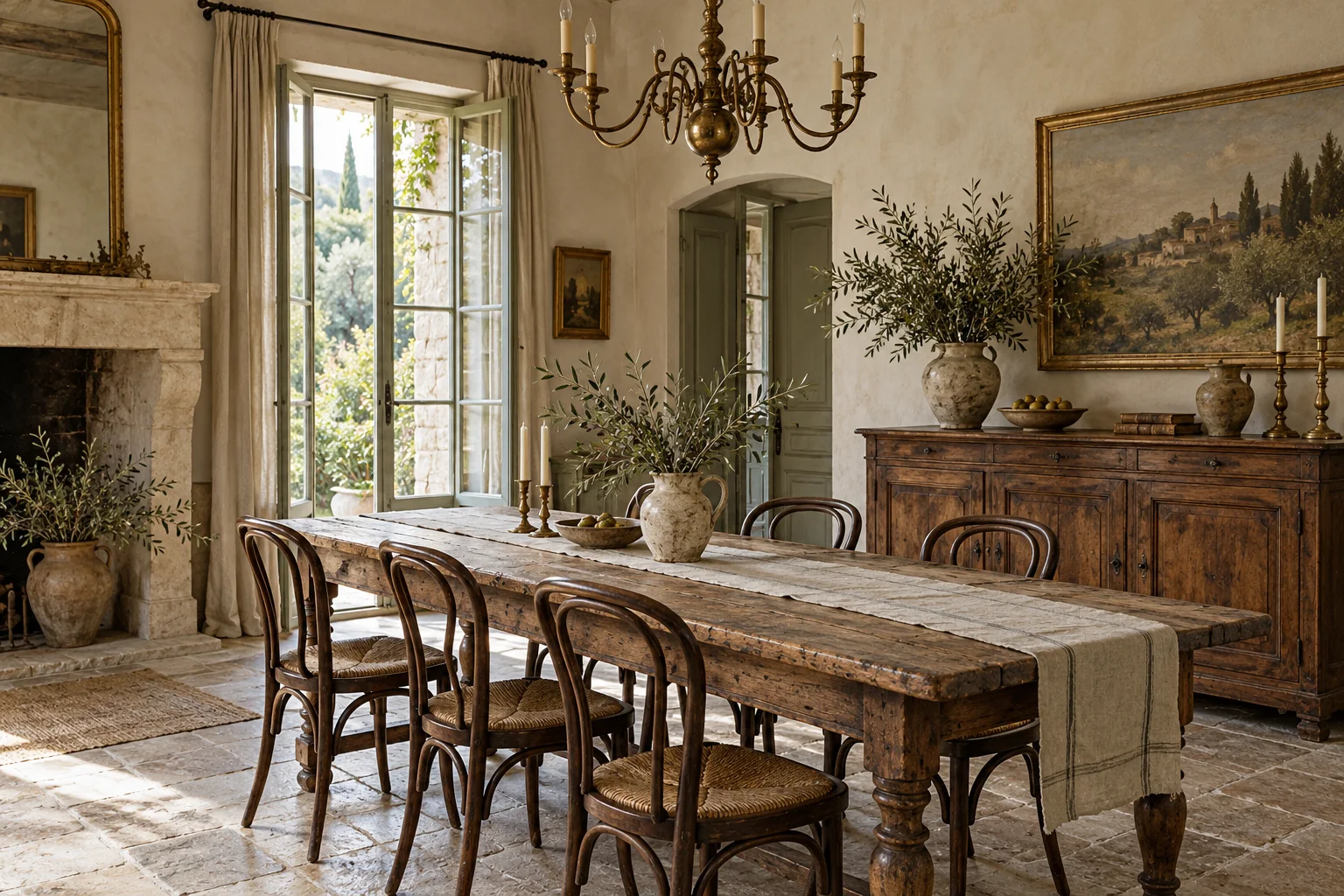 AI-created styling idea
Furniture
Choose a sideboard around your serving dishes, access needs, and useful serving surfaces.
Explore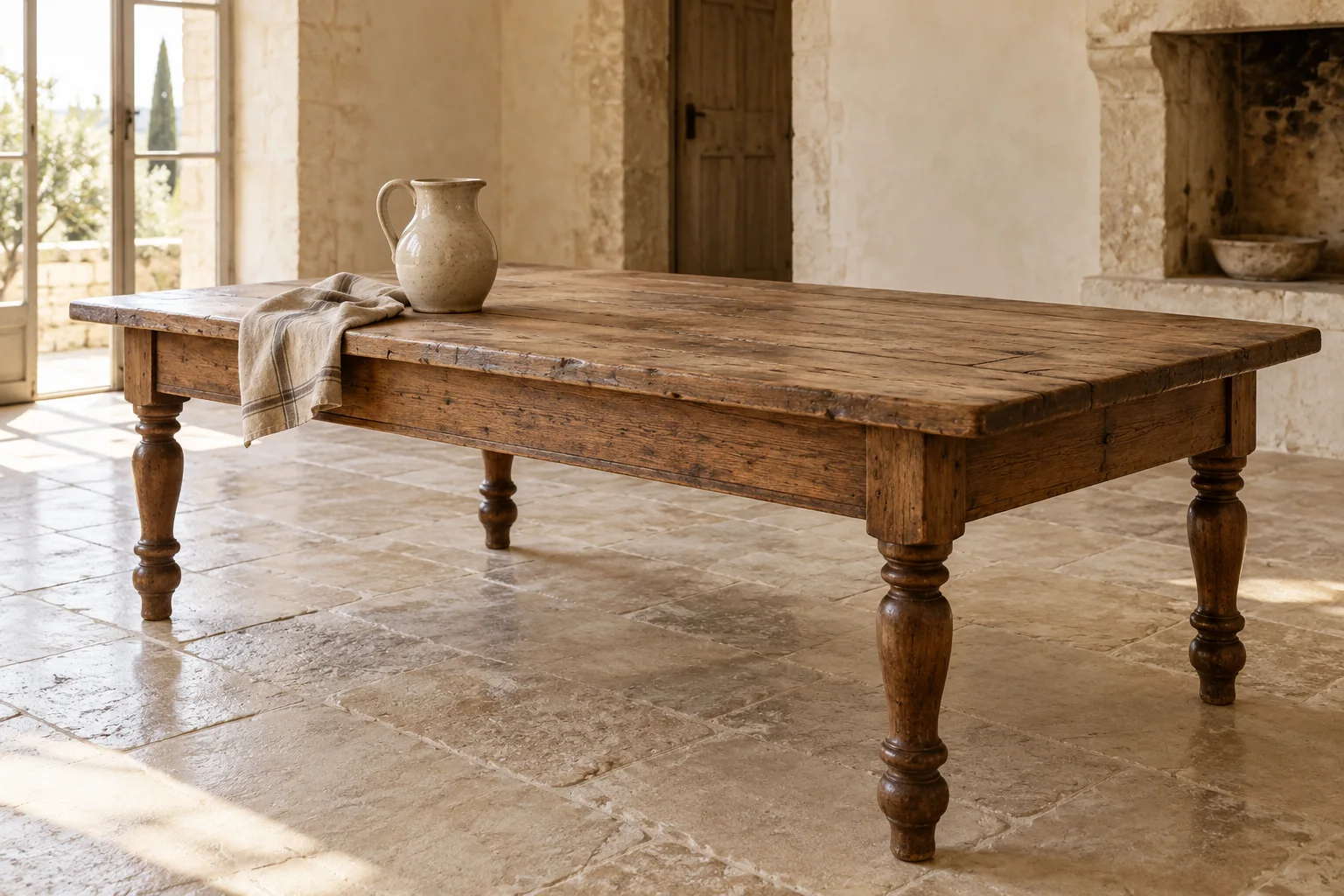 AI-created styling idea
Furniture
Plank tops, deep aprons and stretchers: measure the seats and the knee room before the length.
Explore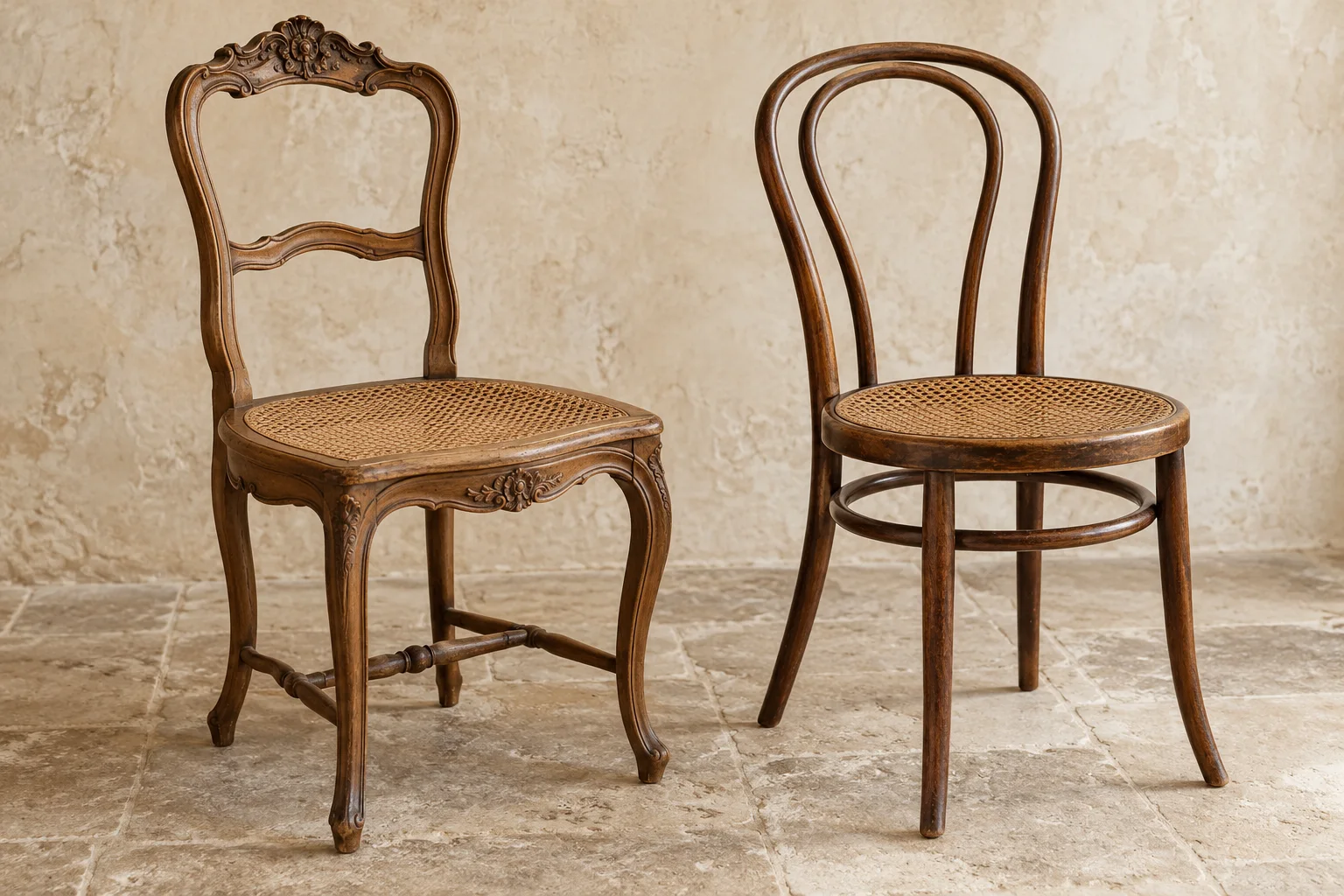 AI-created styling idea
Furniture
Compare seats, backs, and joints to choose antique chairs that work in everyday life.
Explore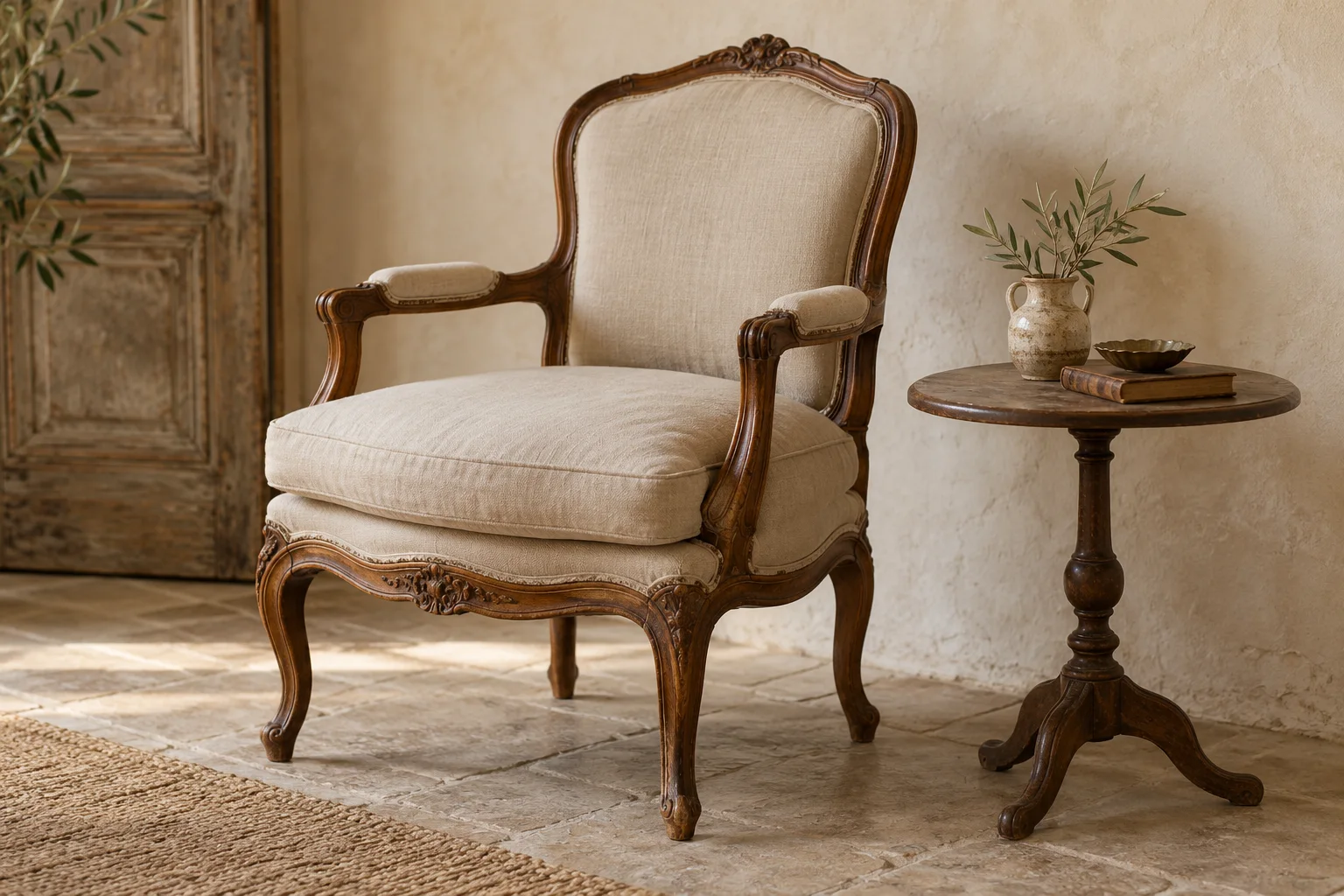 AI-created styling idea
Furniture
Frame first, upholstery second: test the joints, then decide whether the cover is yours to change.
Explore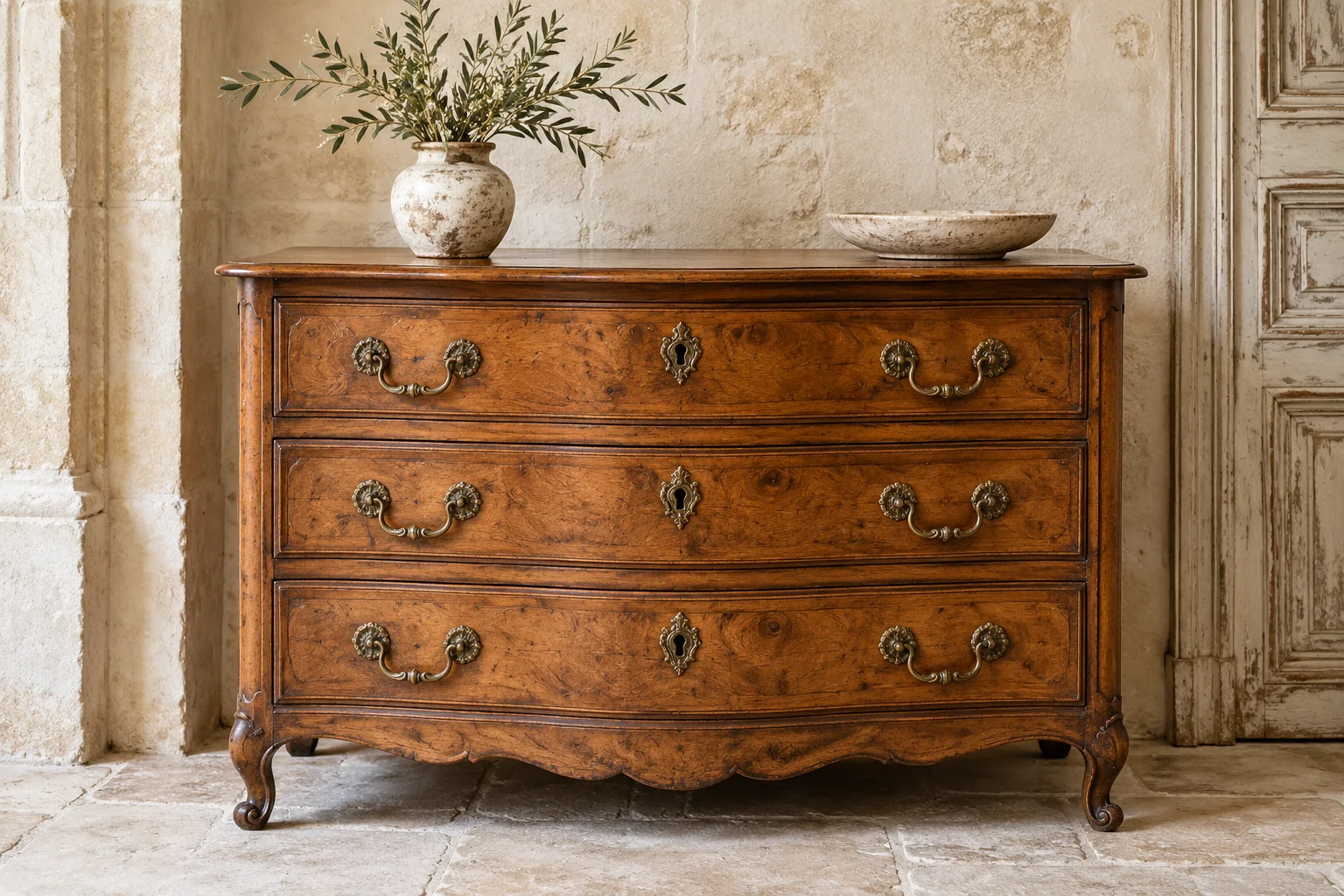 AI-created styling idea
Furniture
Understand volume, veneer, and drawers before selecting antique storage furniture.
ExploreThe furniture subcategories, arranged by the room where they usually belong.
Mostly oak, walnut, cherry and other fruitwoods, chestnut and pine, chosen by region and availability. Drawer sides and backs often use a cheaper secondary wood such as poplar. The wood can be identified from its grain and color; the region of origin cannot be proven from the wood alone, so treat regional names as descriptions rather than documented facts.
Turn the piece around. Hand-cut dovetails with uneven spacing, pegged joints, straight saw marks and wear concentrated on runners, feet and stretchers point to age. Identical machine dovetails, uniform distressing on untouched surfaces and modern screws point to a reproduction. Ask the seller for written age documentation when the piece is sold as an antique.
Usually, because most traditional armoires were built to be dismantled: the cornice, doors, sides, back and base separate and reassemble with wooden pegs. Measure the largest panel against the doorway and stair turns, and measure the ceiling against the full height with the cornice in place, typically 86–95 in or 220–240 cm.
Yes, and the contrast is part of the style. Pair one substantial antique such as a buffet, armoire or farmhouse table with clean-lined seating, then repeat one material across the room so the mix reads as intentional. Our guide to pairing a modern sofa with an antique chest shows the proportions that make it work.
Yes, mostly as single pieces rather than full matching rooms. Designers continue to specify vintage and antique furniture beside clean-lined seating, and a French armoire, buffet or farmhouse table fits that mix. Choose one sound old piece per room, check its construction and condition, and let new upholstery and lighting keep the room current.
Nov 6, 2026 · Antique guide
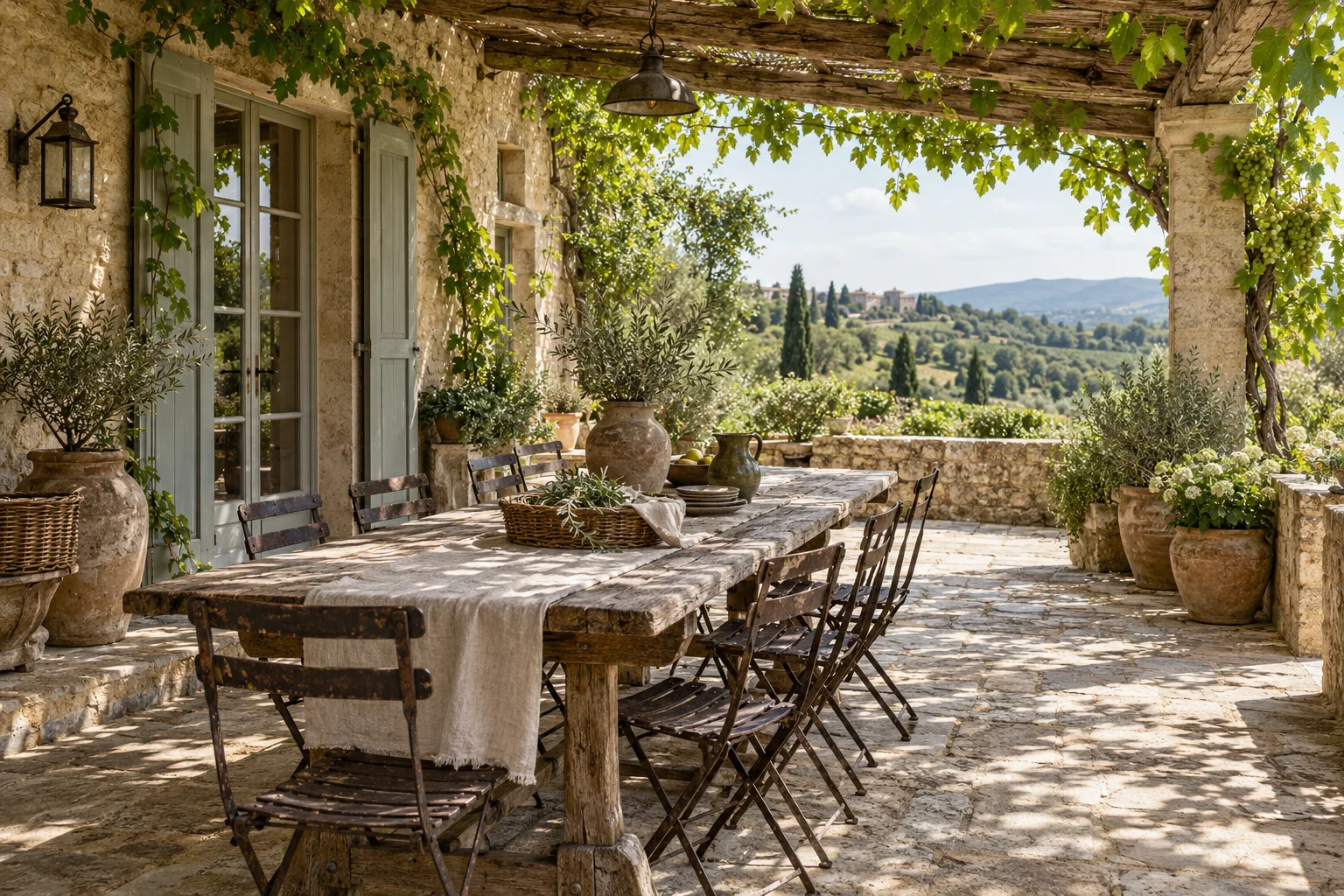
Vintage metal chairs bring the terrace indoors.
Nov 6, 2026 · Antique guide
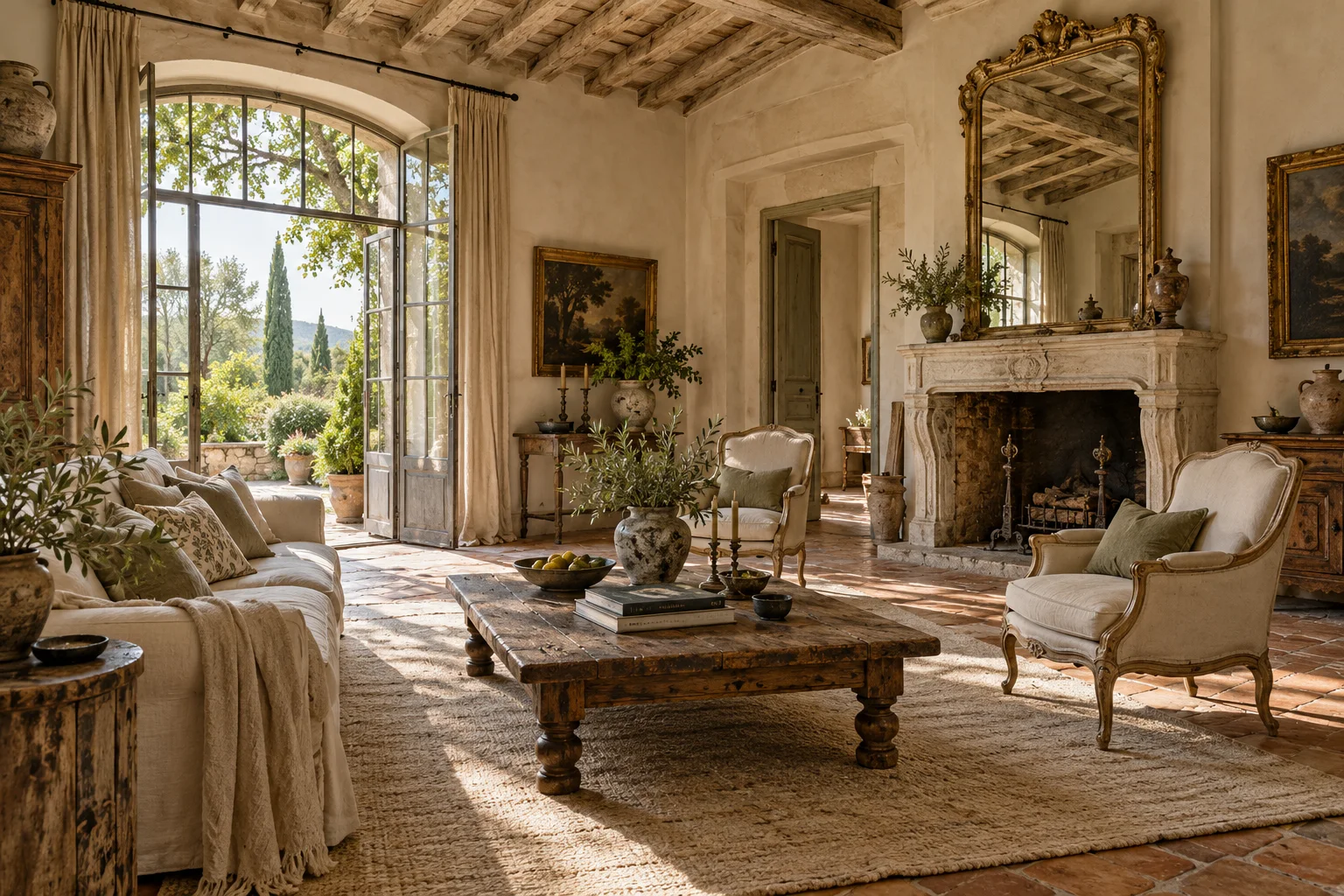
Choose the shape and distinguish the condition of the frame from that of the fabric.
Nov 5, 2026 · Antique guide
"Louis XV commode" can mean three different pieces of furniture: a period chest, a later Louis XV style chest, or a regional walnut commode.
Nov 5, 2026 · Antique guide
Vintage dining chairs made between 1920 and 1970 are the easiest antique seating to live with: factory-made, sturdy, and plentiful enough to assemble a set.
Nov 4, 2026 · Antique guide
Antique dining chairs rarely arrive in the number you need.
Nov 4, 2026 · Antique guide
Compare exterior size, interior storage and delivery constraints when choosing an armoire.