Proportions: Height, Length and the Drop Leaves
Most sofa tables stand 28–30 in (71–76 cm) high, the height of a desk or dining table. Behind a sofa, the top should sit level with or just below the sofa back, which on most models is 30–36 in (76–91 cm). A length of two-thirds to the full width of the sofa keeps the piece in proportion. The drop leaves at each end rest on swinging fly brackets or pull-out lopers; open each one and check that it stands level, because a sagging leaf cannot carry a lamp. Compare the form with console tables, which are shallower and meant for a wall, and side tables, which are shorter.
French versions range from Directoire and Restauration mahogany with end supports joined by a turned stretcher, through Louis-Philippe walnut, to provincial fruitwood tables of the later 19th century. Twentieth-century reproductions in mahogany veneer are common; their lighter weight and plywood drawer bottoms give them away without diminishing their usefulness.
Placement: Behind the Sofa, Under a Window, as a Desk
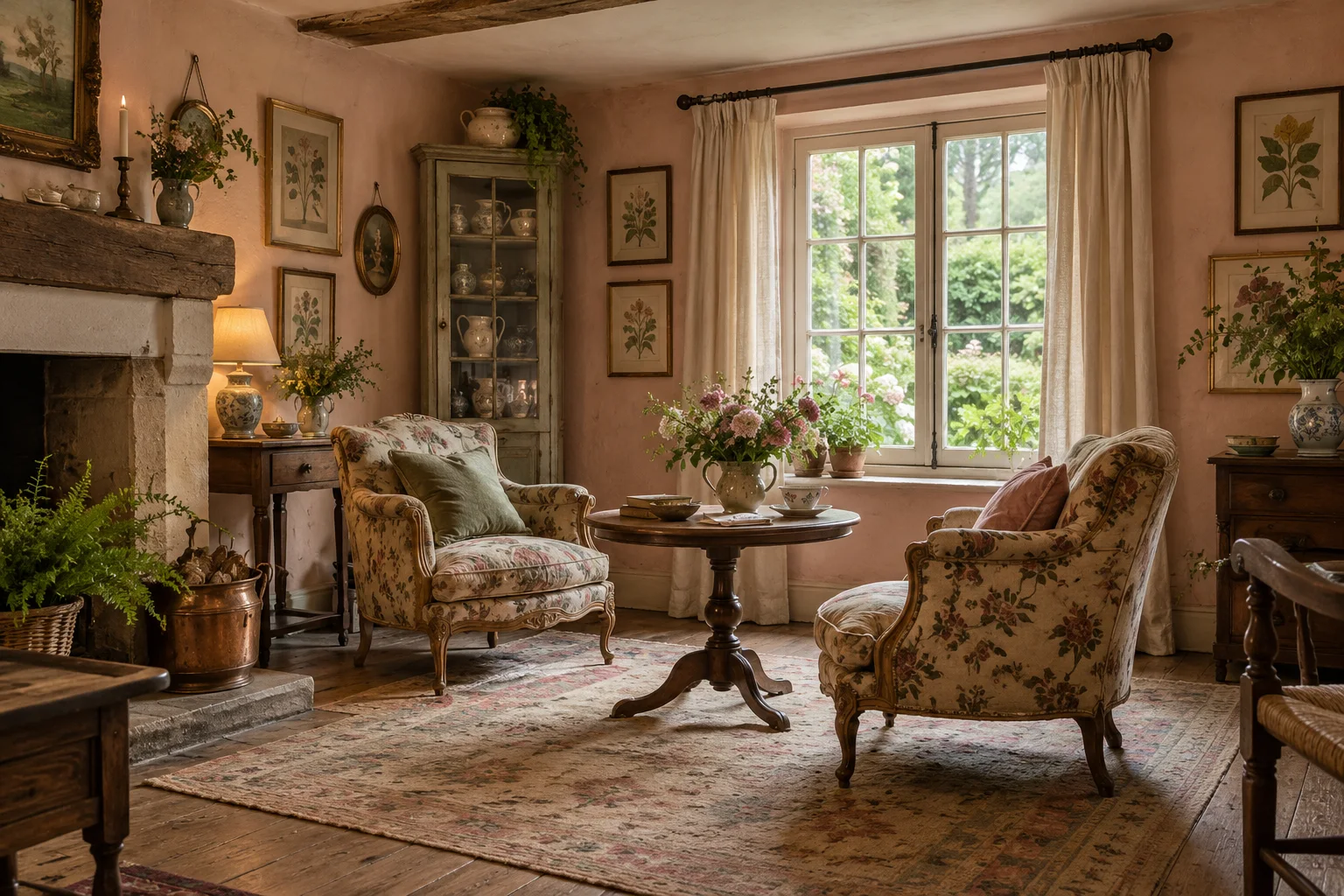
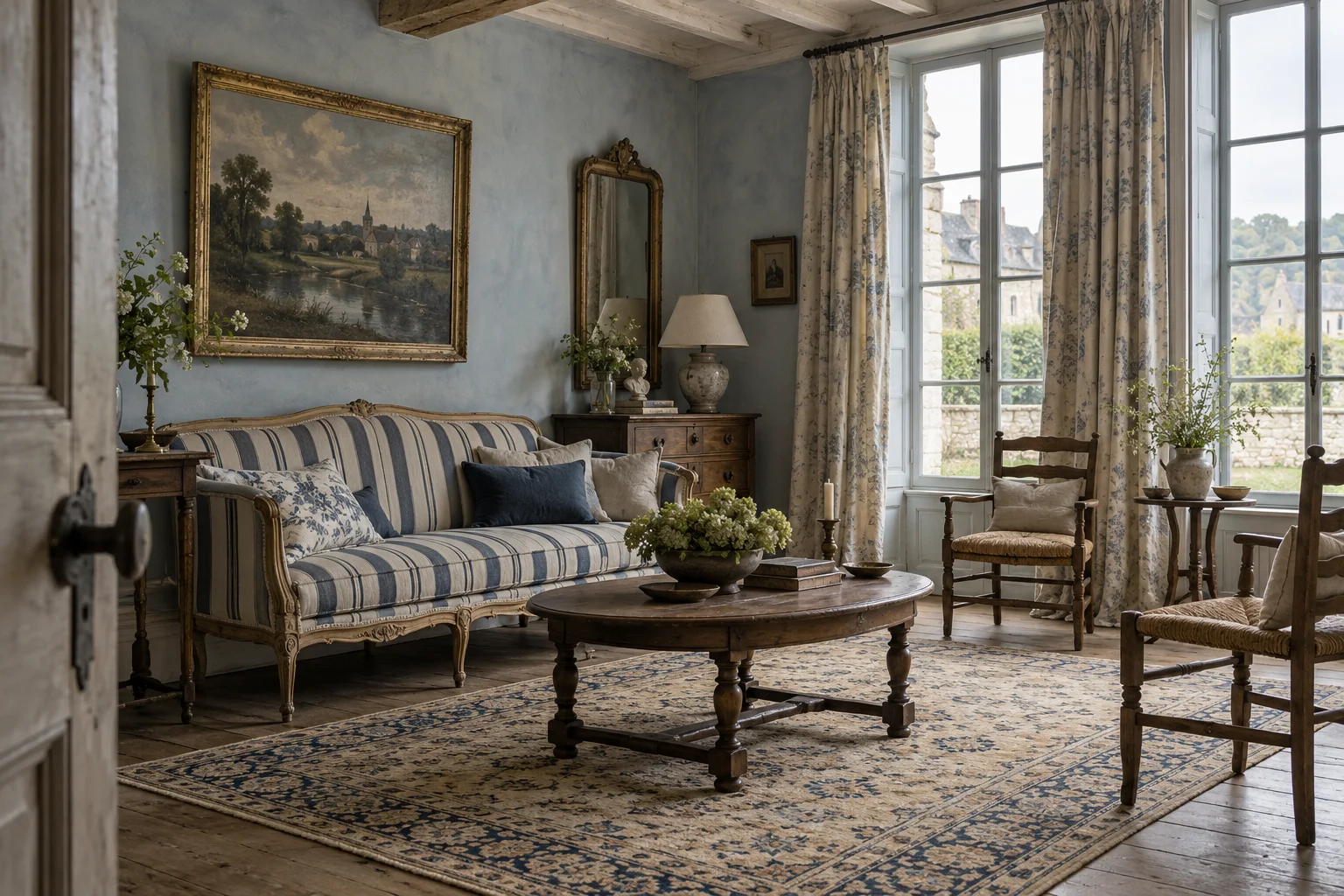
Floating a sofa in a large room and setting the table behind it defines the seating area without a wall. Leave a gap of 2–4 in (5–10 cm) so cushions can be plumped, and plan a floor outlet or a flat cord for lamps. Under a window, the leaves fold down for a narrow hall or up for a buffet when guests arrive. The living room page and our French country living room guide show both arrangements with antique seating.
As a writing table the form works when the frieze drawer leaves knee room: measure at least 24 in (61 cm) from floor to the underside of the frieze, and check that the stretcher does not fall where your feet go. A sofa table with a single shallow drawer is the easier desk; one with deep drawers on both sides is better kept for display.
Condition Checks: Leaves, Brackets, Veneer and Finish
The ends of the top take the most damage. Look there for lifting veneer, chipped edges and the rule joint of each leaf, which should close without a gap. Open the brackets and watch for loose knuckle hinges. Splits in a solid top follow the grain and come from shrinkage; they are stable if old and dark, recent if pale inside. Brass cup castors are often replaced, which is acceptable when disclosed. The guide to antique tables and their shapes covers the same points on dining and center tables.
An old shellac or wax finish marks under heat and water; a modern polyurethane finish does not, and tells you the top was refinished. Neither is wrong. Wax a shellac finish lightly once or twice a year and use a tray under anything that might drip, which keeps a two-century-old surface readable for the next owner.
What to compare
| Form | Suggested Use | Decisive Check |
|---|---|---|
| Drop-leaf sofa table | Behind a sofa, leaves up for a party | Brackets and hinges open fully and level |
| Trestle-end sofa table with stretcher | Under a window or in a narrow hall | Stretcher joints and splits in the top |
| Four-leg sofa table with drawers | Writing table in a living room | Knee clearance and drawer runners |
Your buying checklist
Continue planning your room
Frequently asked questions
What is the difference between a sofa table and a console table?
A sofa table is a freestanding four-sided table, usually with drop leaves and drawers, designed to stand behind a sofa with all sides visible. A console table is made for a wall: shallower, often with an unfinished back, sometimes fixed to the wall or supported on two legs. A sofa table can serve as a console; the reverse rarely works.
How high should a sofa table be?
Level with or slightly below the top of the sofa back. Most antique sofa tables are 28–30 in (71–76 cm) high, and most sofa backs are 30–36 in (76–91 cm). If the table stands taller than the sofa, it looks like a barrier; if it stands much lower, lamps end up at an awkward height.
Can an antique sofa table be used as a desk?
Yes, if there is at least 24 in (61 cm) of clearance under the frieze and the stretcher does not fall under your feet. The narrow depth of 18–24 in (46–61 cm) suits a laptop and a lamp. Protect the top with a leather or felt mat, because old finishes mark under a warm computer and a coffee cup.
Are drop leaves on an antique sofa table fragile?
They are the most vulnerable part. The rule joint and the hinges take strain each time a leaf is lifted, and the fly brackets loosen with use. Lift leaves with both hands, support them while swinging the bracket out, and never rest heavy objects on a leaf. A loose bracket is a simple repair for a furniture restorer.
Sources & further reading
- Canadian Conservation Institute — Basic care: furniture and objects made of wood — Guidance on preserving old finishes and handling furniture with moving parts.
- USDA Forest Products Laboratory — Wood Handbook: Wood as an Engineering Material — Explains shrinkage across the grain, the cause of splits in wide tops.