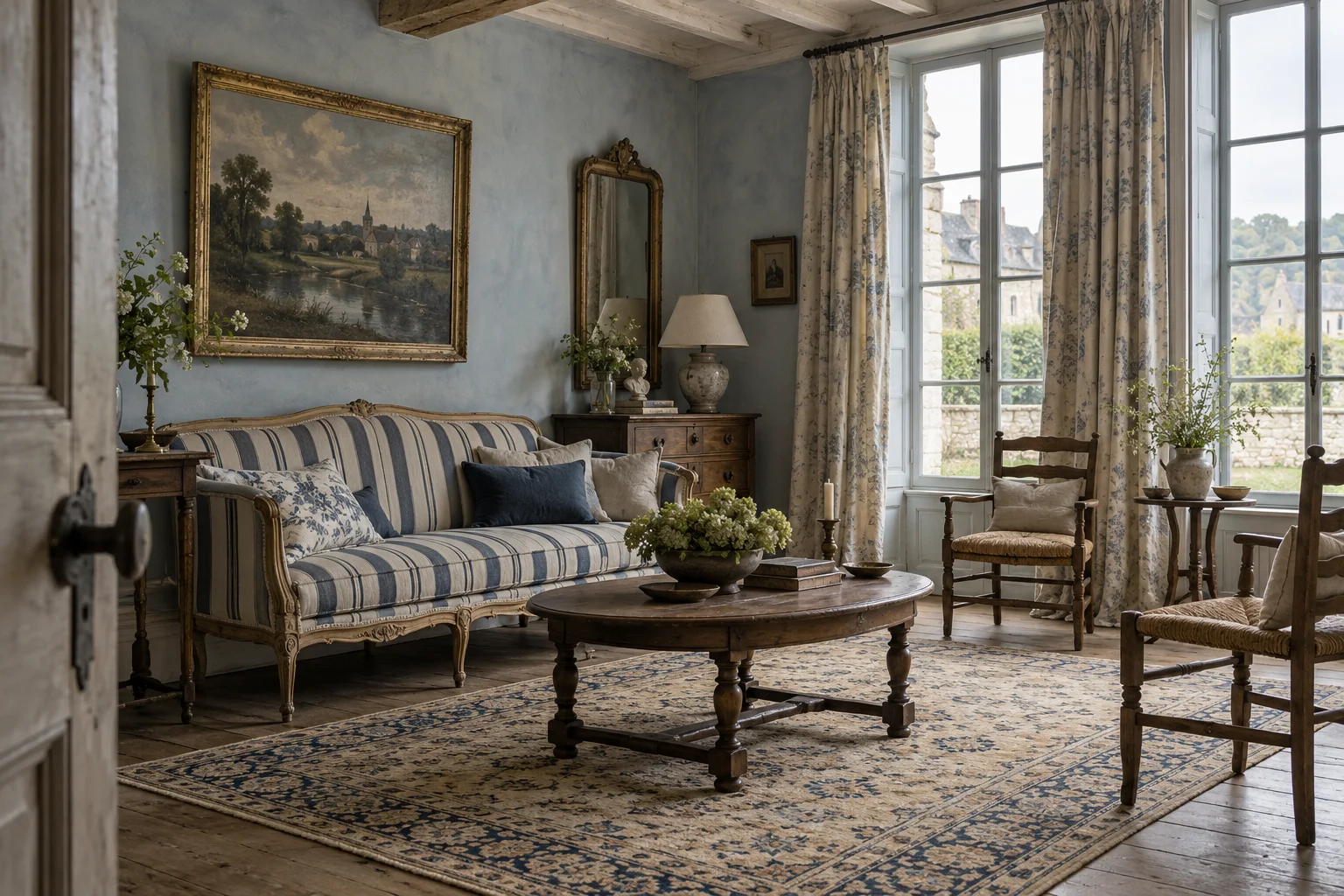
 AI-created styling idea
Furniture
Settees & chaises
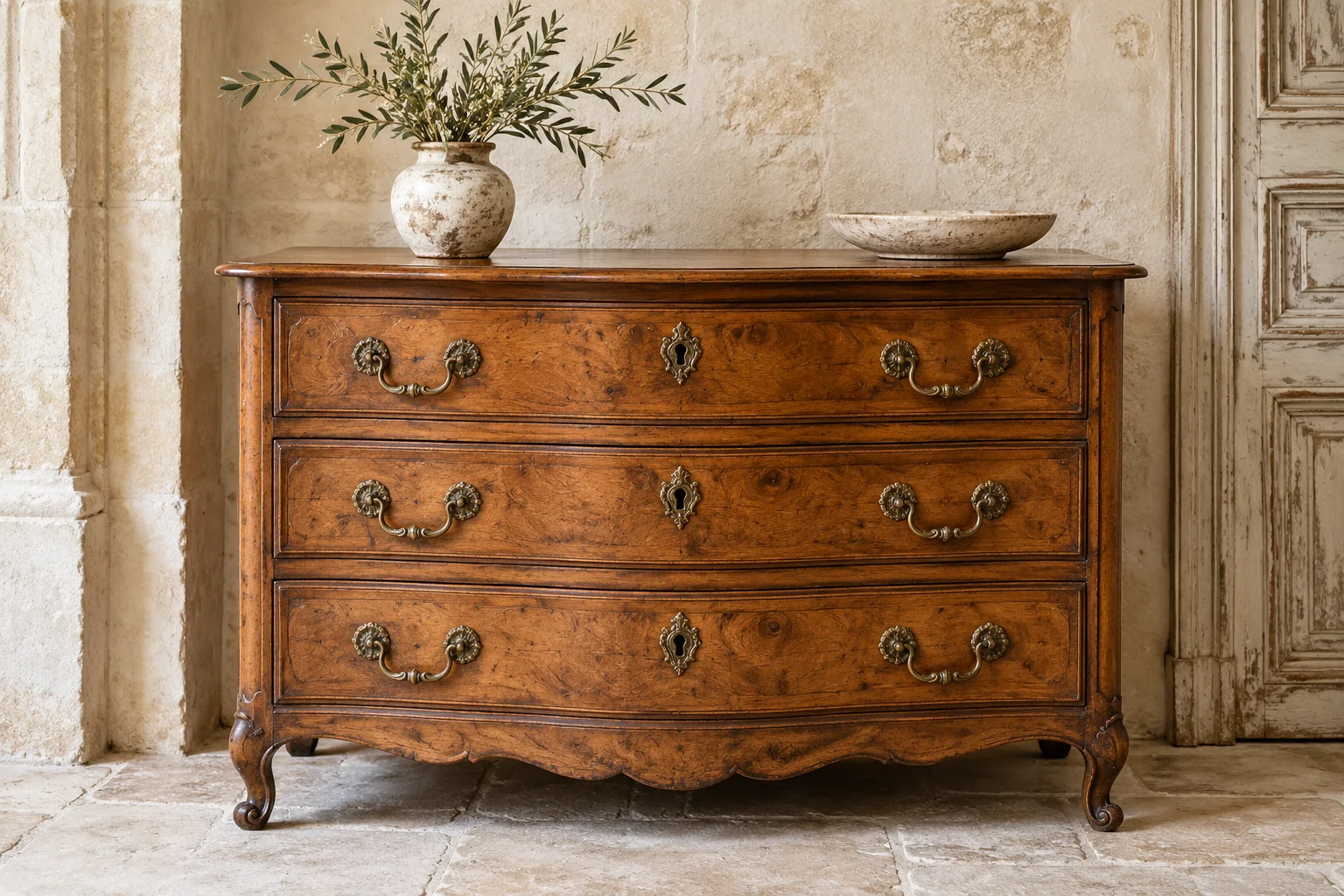
Check the frame joints and the springing before planning new upholstery.
ExploreFrench Country · An inspiration catalogue · Updated November 2026
A French country living room starts with where people sit and what they can reach: a settee or a pair of club chairs, a low table at the right height, a side table within arm's reach, and a mantel that anchors the wall.
Working from the sofa out, the 25 ideas below cover bergère chairs, the mantel, low tables, light and walls, each with the measurement that makes it work: seat and table heights, distances between chairs and hanging heights in inches and centimeters.
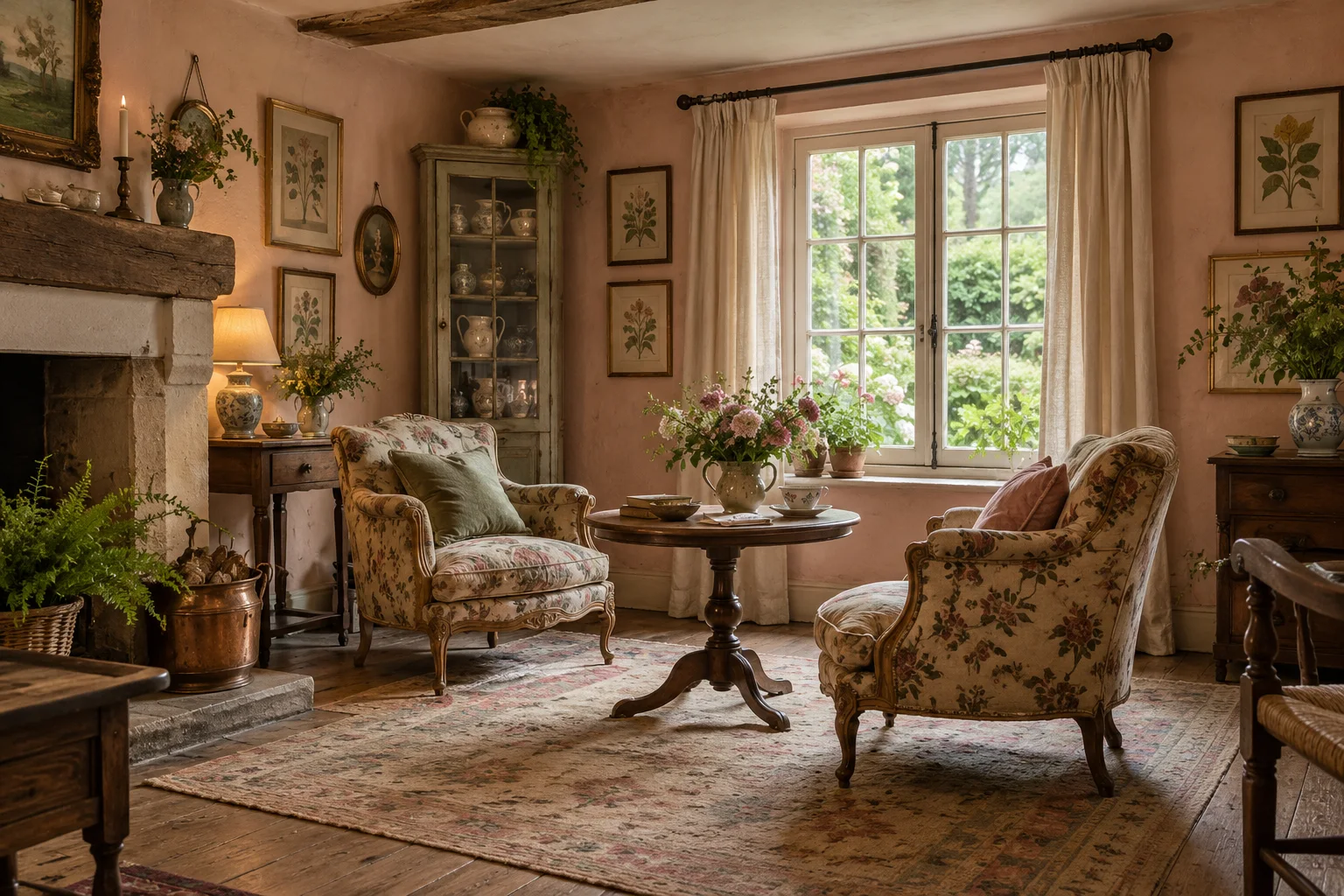
French country living room decor is less a look than an order of decisions: comfort first, then character, then the objects that finish a wall. The codes of the style are the same ones described in French country decor, room by room: timeworn wood, natural textiles, soft colors, curved lines and a few pieces with a past.
The seat you use every evening should be chosen for its springs and its depth, not its carving. An antique settee can be the room's best-looking piece and its least-used one; that is acceptable as long as a deep sofa or two club chairs take the daily work.
Repeat four materials and the room coheres: a waxed wood table, linen on the seating, a stone or marble top somewhere, iron or brass in the lighting. Each material should appear at least twice, in different sizes.
The mantel wall takes the mirror or the painting; the opposite wall takes the bookcase or the tall cabinet; the window wall takes the light. A wall with two strong pieces competes with itself.
The ideas move from the seats outward: chairs and sofa, mantel and tables, then light, textiles, walls and the small pieces that make a French country living room feel lived in.
A bergère is an armchair with closed, upholstered sides and a loose seat cushion. Two of them facing each other across a low table, 7–8 ft / 2.1–2.4 m apart, make a conversation group without a sofa. Check the frame joints and the cushion filling. The bergère chair entry describes the forms.
A loose linen cover turns a plain modern sofa into a country one and can be washed after a winter of use. Prewash the fabric before cutting, because linen can shrink, and allow 2 in / 5 cm of tuck-in at the seat. A relaxed fit looks right. Fabrics are compared in washed linen and antique textiles.
A tall painted mirror above the mantel, often called a trumeau when a painting or carved panel sits above the glass, carries light up a wall. Keep it 2–4 in / 5–10 cm narrower than the shelf on each side and fix it with a cleat rated for its weight. See mantel mirrors and trumeaux.
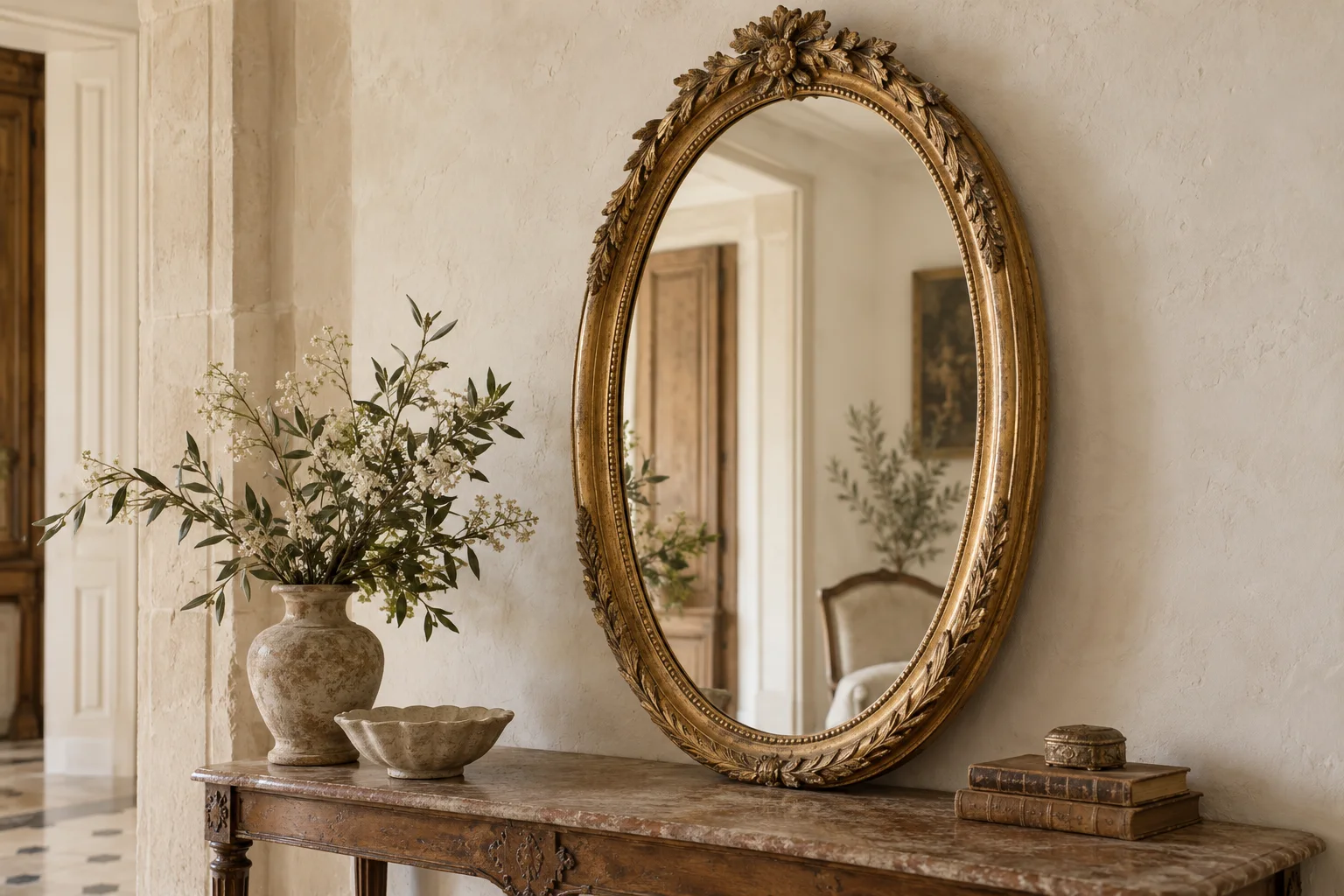
One mirror or painting above and two small objects on the shelf give the mantel order. Keep the small pieces at about a third of the height of the big one, 8–12 in / 20–30 cm for most mantels, and set them toward the ends. Brass pairs work well; browse candlesticks and candelabras.
Oak and stone both take cups, books and feet without fuss. Aim for a top about two-thirds of the sofa length and 16–18 in / 40–46 cm high. A stone top on an iron base is heavy, so check that the floor is level and the top is supported in the middle. See antique tables in oak, walnut and stone.
Every seat needs a surface for a glass within arm's reach. A round table 18–20 in / 45–50 cm across, with its top within 2 in / 5 cm of the armrest, fits between chairs without catching knees. Marble-topped café tables are sturdy for their size. Look at round bistro tables.
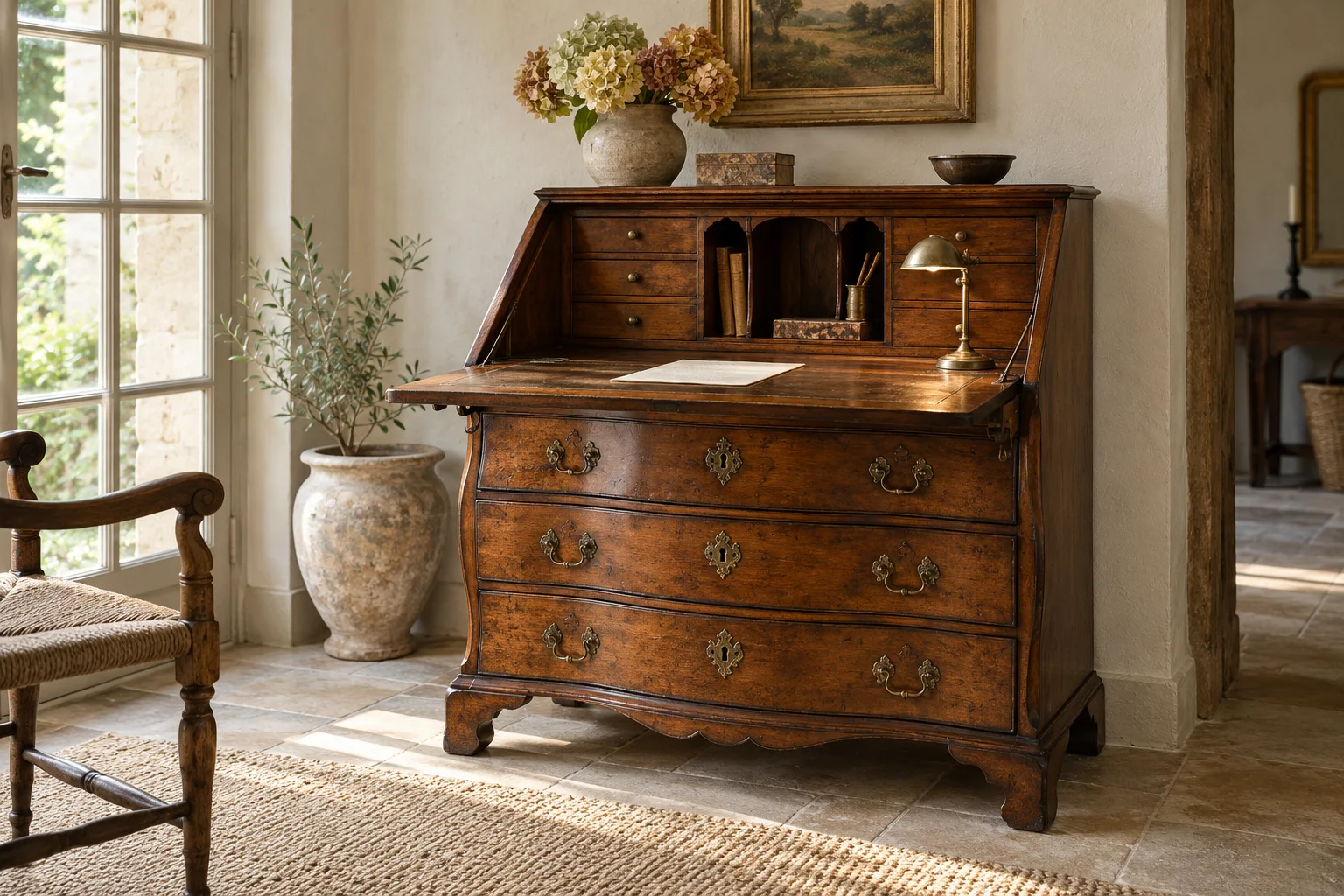
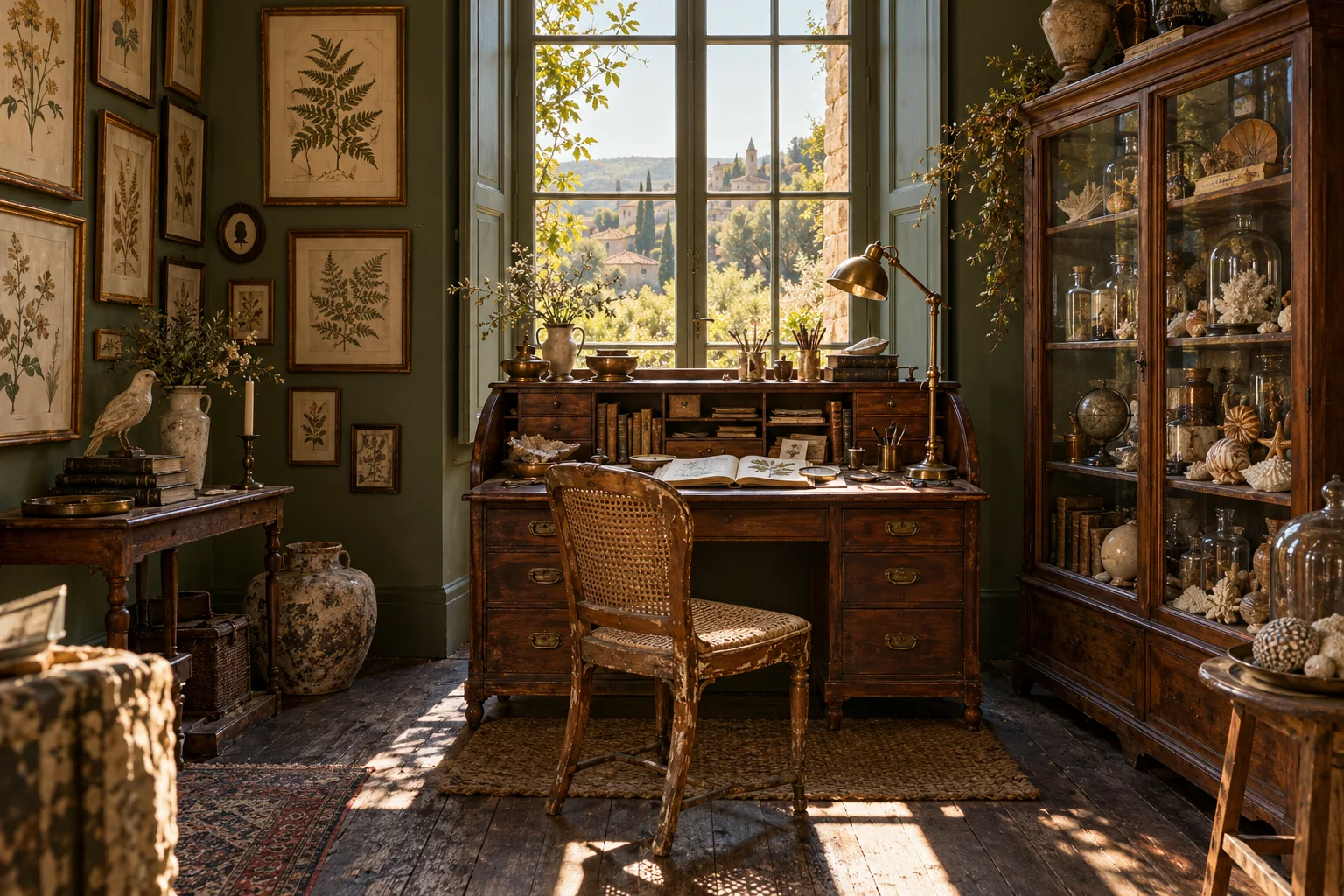
A desk in the living room gives it a second use and a piece of real furniture. A fall-front secrétaire needs about 30 in / 76 cm of depth when open; check that the supports slide and hold. Set it near a window, with a lamp. The antique desk entry describes the types.
Books give a country room weight and color that bought objects cannot. Keep shelf spans under 32 in / 81 cm so they do not sag, leave a few gaps for a pot or a small frame, and fix tall bookcases to the wall. Forms and woods are compared under painted bookcases and open shelves.
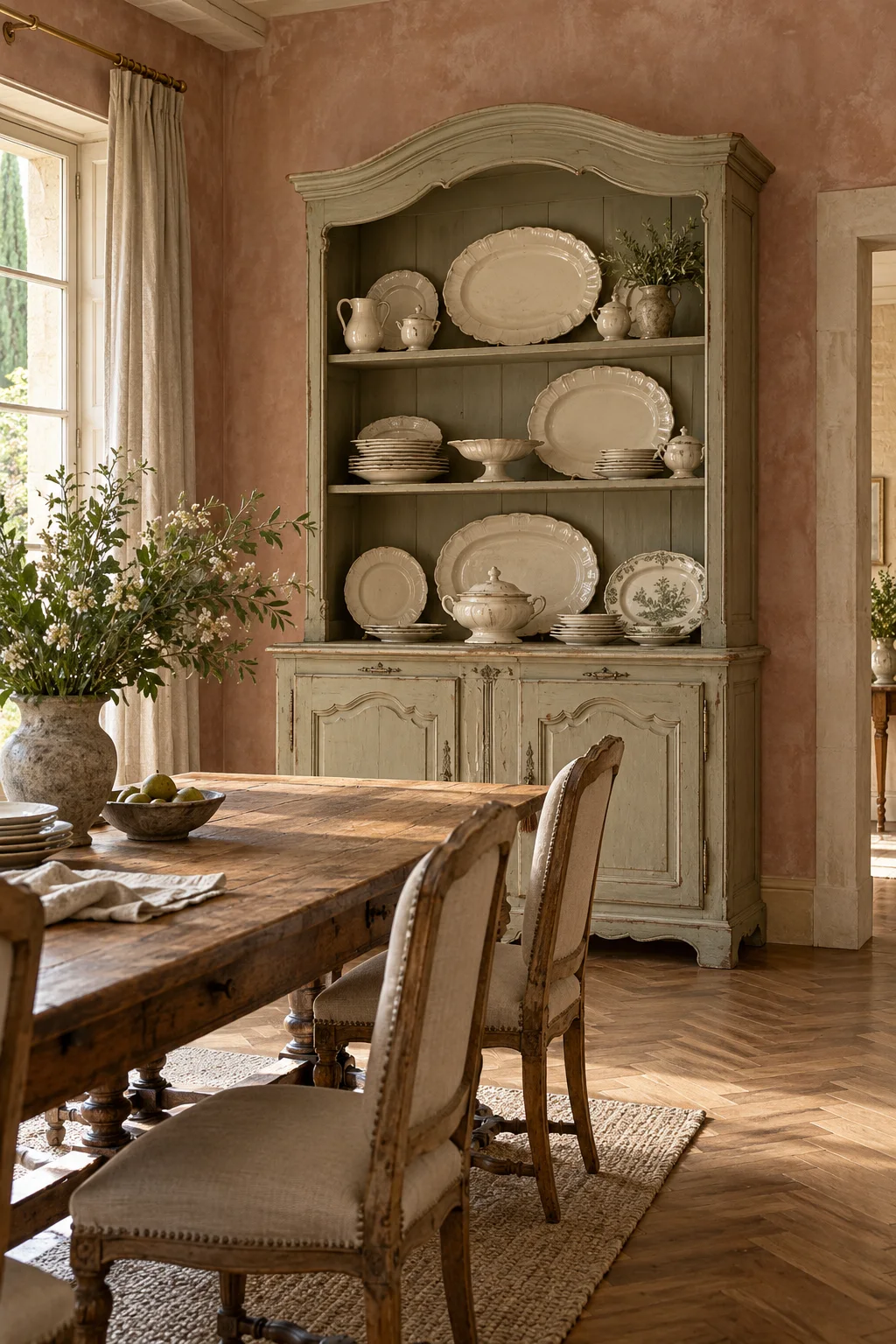
Three lamps at different heights light a room evenly in the evening: a table lamp at 24–30 in / 61–76 cm, a floor lamp of 58–64 in / 147–163 cm by the reading chair, and a small lamp low on a chest. Rewire old bases to US standards. Browse table lamps with old bases.
A painted wooden or wrought-iron chandelier suits a beamed ceiling better than crystal. As a rule of thumb, add the room's length and width in feet to get a diameter in inches, and keep the bottom at least 7 ft / 213 cm above the floor. Our complete guide to antique French lamps and lighting covers rewiring.
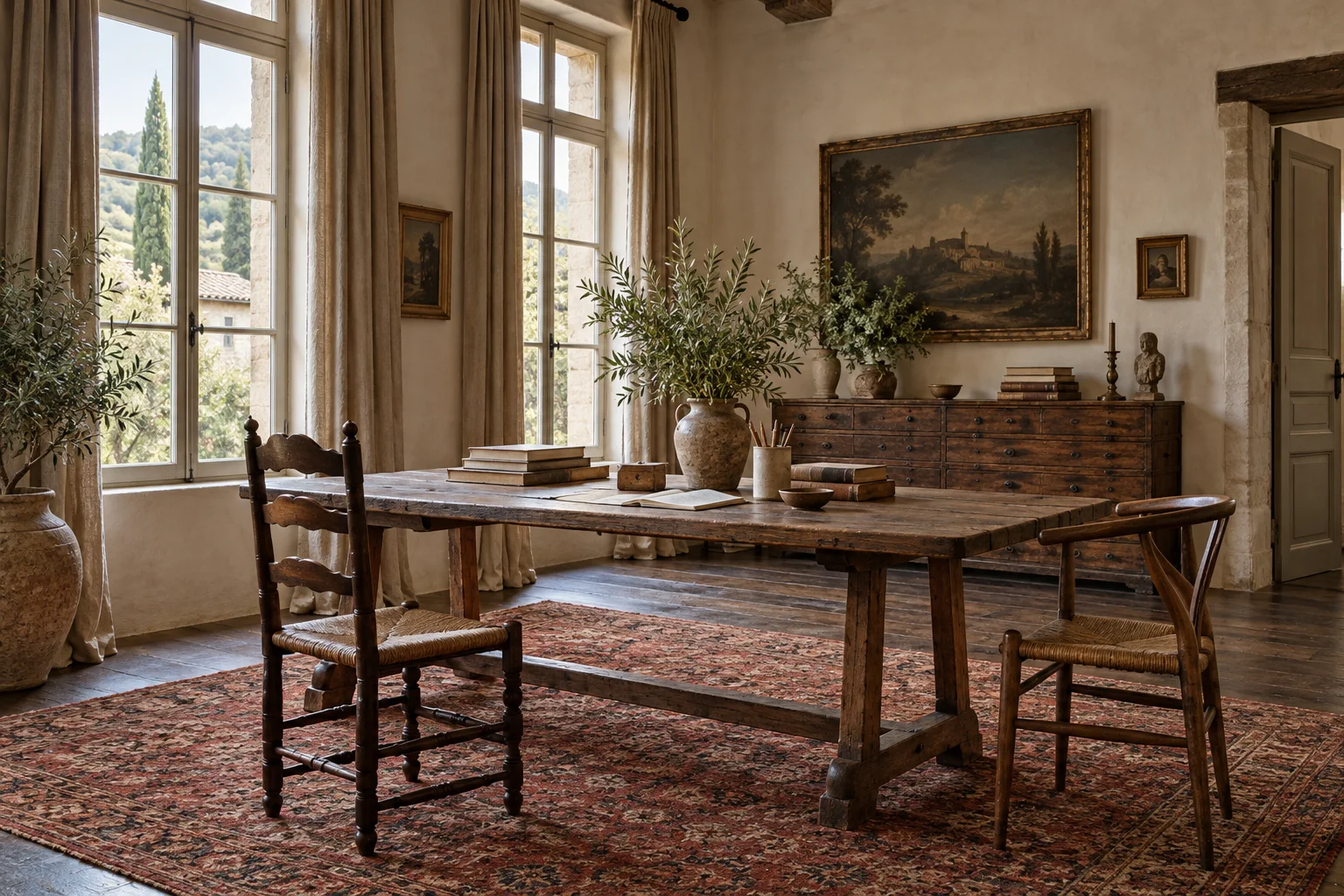
A faded wool rug or a flat-weave softens stone and boards without competing with the furniture. Choose a size that takes the front legs of every seat and leaves 12–18 in / 30–45 cm of floor around the edge. Wear in the pile is acceptable; holes and moth damage are not. See faded and flat-woven rugs.
Linen on a plain iron rod keeps the window simple. Use a rod about 1 in / 25 mm thick with rings, panels 1.5–2 times the window width, and a hem that just touches the floor. Unlined linen lets light through; add a lining only on the coldest wall. Old panels appear among antique linen panels.
Exposed beams and stone are the structure of the style, so clean them rather than cover them. Repoint stone with a lime mortar, never cement, which traps damp; brush beams and check for fresh woodworm dust. Leave at least one wall of bare stone 8 ft / 2.4 m wide or more. See reclaimed beams and stone.
A carved settee is often too shallow for lounging but right for reading by a window. A seat depth of 20–22 in / 51–56 cm and a firm cushion make it comfortable; add a lamp behind one arm. Check the arm joints before reupholstery. Compare forms under carved settees and méridiennes.
A footstool earns its place in front of the chair that is used every evening. Keep it about 2 in / 5 cm lower than the seat and within 12 in / 30 cm of it. A large upholstered ottoman can double as a low table with a tray. See footstools and poufs.
Two paintings of similar size give a wall calm where a crowded gallery wall breaks it up. Hang them 2–4 in / 5–10 cm apart with their shared center at 57–60 in / 145–152 cm. Attribute a painting only by signature and documentation. Our page on French paintings and art for the home covers framing.
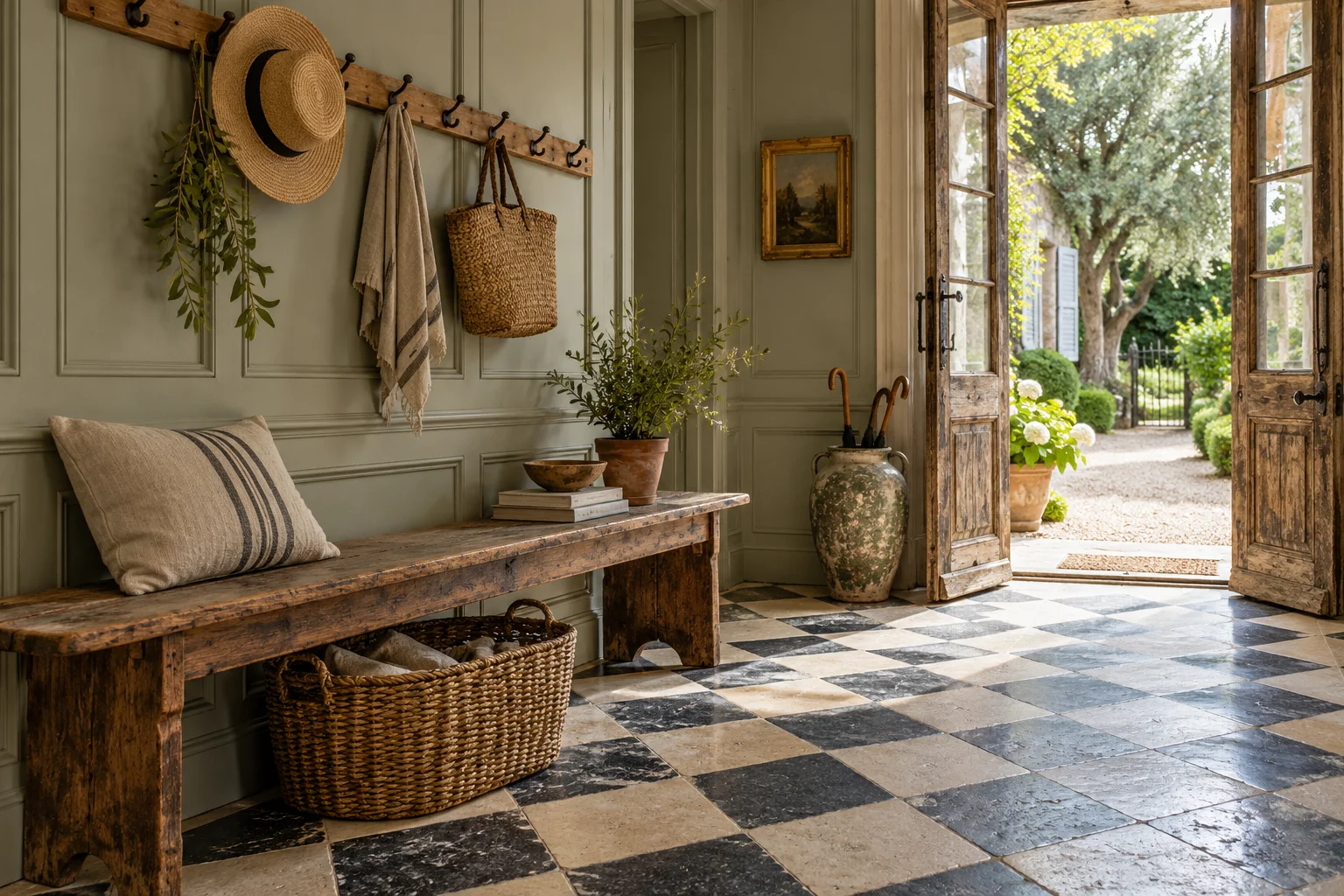
A French mantel clock gives the room a center and a sound. Set it on a level surface, remove the pendulum before moving it, and have a clockmaker service an old movement before running it daily. A clock 12–16 in / 30–40 cm tall suits most mantels. Browse mantel clocks and pendules.
A log basket beside the hearth makes the fire part of the furniture. Keep it at least 36 in / 91 cm from the opening, or the distance your local code requires, and store only dry, seasoned wood indoors. Iron firedogs and a fender complete the hearth; see andirons, fenders and fire tools.
One striped or checked fabric, repeated three times, ties a room together: a cushion on the sofa, a chair seat, a lampshade or a curtain border. Keep the stripe or check small, 1–2 in / 2.5–5 cm, so it reads as texture. Old ticking and vichy suit the style; see vintage cushions and pillows.
Cut branches of olive, magnolia or blossom bring scale that a small bunch of flowers cannot. Use a jar 18–24 in / 45–60 cm tall with branches about one and a half times its height, and put a liner inside if the glaze is crazed. Old jars are described under stoneware jars and vases.
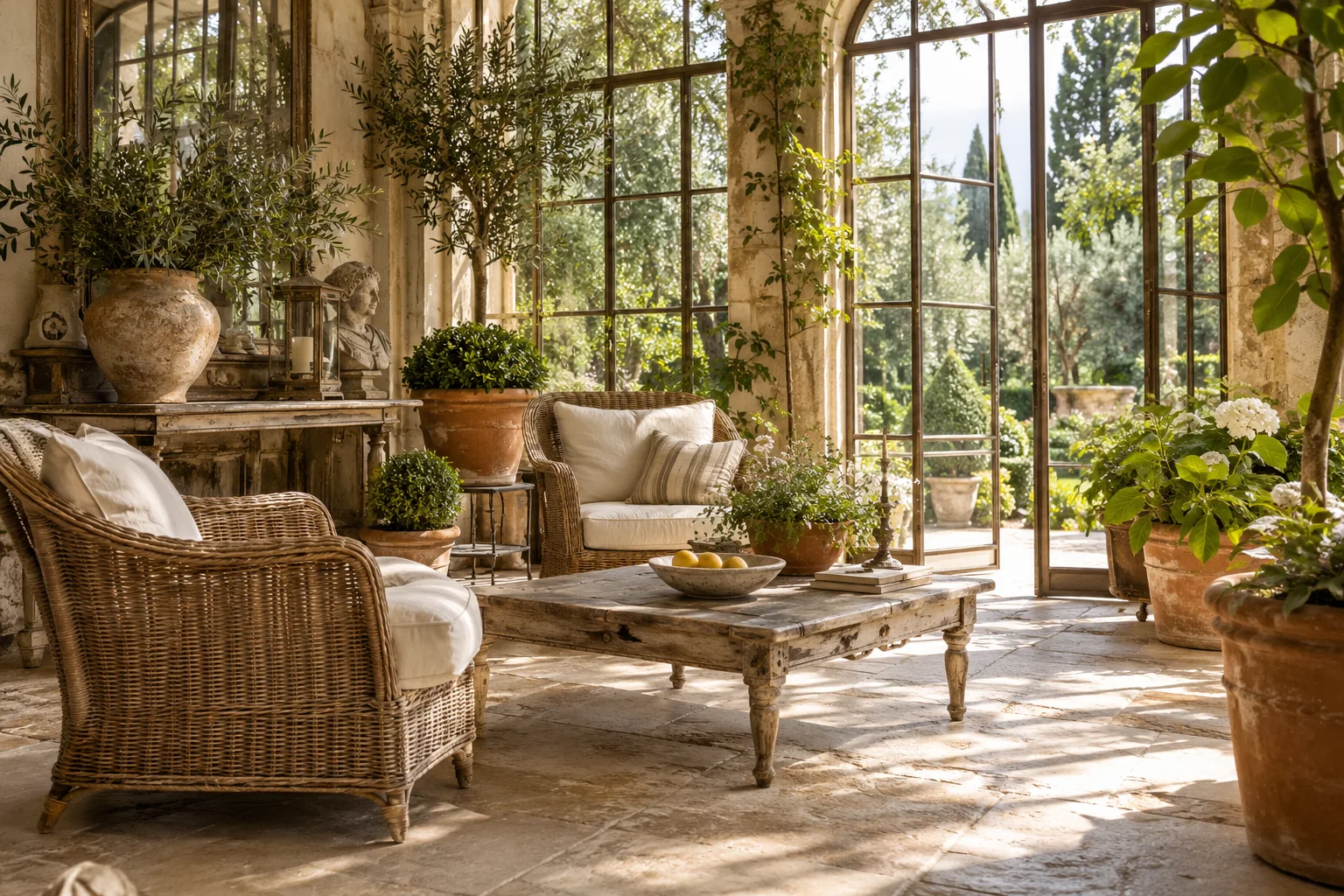
A plain modern low table lets carved chairs and a settee carry the room. Glass, plain oak or a simple stone slab all work, as long as the height stays at 16–18 in / 40–46 cm. Avoid a second decorative piece in the center. Mid-century pieces sit in low tables from the 1950s to 1970s.
Pale mineral colors let the furniture and the light do the work. Limewash or a mineral paint in warm white, stone or pale ochre suits stone and oak; test a sample of 2 × 2 ft / 60 × 60 cm in morning and evening light. The wider palette is set out on the French country style page.
Small accents in opaline or brass add color and shine without clutter. Group them in threes on one surface, keep pieces under 10 in / 25 cm tall, and dust rather than polish old brass. Opaline is for display, not water. See opaline vases and boxes and how antique brass and bronze age.
In a room under 150 sq ft / 14 m², a drum table between two chairs replaces sofa and coffee table. A top of 20–24 in / 50–60 cm holds a lamp and a book, and two chairs about 24 in / 61 cm wide fit a window bay. Open-armed French fauteuils keep it light.
Group the main seats so people face each other, 7–10 ft / 2.1–3 m apart, and put the television to one side or inside a cabinet. A screen above the mantel forces the room to face one way. The living room scenes show conversation layouts in rooms of several sizes.
A French canapé of Louis XV or Louis XVI form has an exposed carved frame and a seat height of about 17–18 in (43–46 cm). A 19th-century provincial settee often sits lower and shallower than a modern sofa, which suits reading more than lounging. Check the frame at the arm joints and the seat rail for old repairs, and look under the seat for the type of springing before you plan reupholstery. The settees and chaises category shows the main forms, including the méridienne with its one raised end.
A pair of 1930s leather club chairs (fauteuils club) gives a country room its daily comfort and tolerates children, dogs and winter boots. For a lighter touch, a bergère with a loose cushion or a fauteuil with a cane back brings the curved line the style needs. Our guide to two antique armchairs around a round table shows how a pair organizes a corner; browse antique armchairs for the types.
Facing seats should be 7–10 ft (2.1–3 m) apart, close enough to talk without raising a voice. Leave 16–18 in (40–45 cm) between the sofa front and the coffee table, and a clear path of 30 in (76 cm) behind seating that people walk around.
A low table works when its top sits within 1–2 in (3–5 cm) of the seat cushion height, usually 16–18 in (40–46 cm). Many French country coffee tables are cut-down farm tables, 1950s–70s low tables or a tray on a stand; a cut-down table should show its reduced legs honestly. Compare forms in vintage coffee tables.
A French country side table earns its place by height: the top should finish within 2 in (5 cm) of the armrest beside it, which in practice means 24–28 in (61–71 cm). A French provincial end table with a small drawer, a marble top on a turned base, or a wine-taster's table all do the job. See side and nesting tables.
A French provincial drum table (a round top over a cylindrical base with drawers) or a round side table lets people pass without catching a corner, which matters in a room under 150 sq ft (14 m²). A diameter of 20–24 in (50–60 cm) is enough for a lamp and a book.
A limestone or marble surround gives the French country fireplace mantel its weight; a painted wood surround is lighter and easier to fit to a modern firebox. Antique surrounds come in sections and are heavy (a limestone mantel can exceed 400 lb / 180 kg), so plan the floor and the fixing before buying. Explore fireplaces and accessories.
One large object above (a mirror or a painting) and no more than three things on the shelf: a pair of candlesticks and one ceramic, or a clock between two small frames. The mirror or painting should be 2–4 in (5–10 cm) narrower than the shelf on each side, or clearly smaller and centered.
Keep combustible mantel material at the clearance required by your local code and the firebox manufacturer, commonly 12 in (30 cm) above the opening for a 1.5-in-deep shelf, more for deeper shelves. An antique surround installed around a working fire should be checked by a professional installer.
A chandelier or pendant gives the room its center, two or three table lamps give it evenings, and a sconce or a floor lamp lights the reading corner. Our page on choosing French country lighting covers hanging heights, rewiring to US standards and shade proportions; the journal guide to a window reading corner works through one corner in detail.
A gilt mirror above the mantel or opposite a window doubles the daylight in a low-ceilinged room. Hang it so the center sits at 57–62 in (145–157 cm) when it is not above furniture; above a mantel, leave 4–6 in (10–15 cm) between shelf and frame. The mirrors and wall decor guide explains what to check in the glass and the gesso.
A wool or jute rug should be large enough for the front legs of every seat to rest on it; unlined linen curtains hung from a simple iron pole finish the window without weight. Browse rugs and tapestries.
Modern French country keeps the materials, oak, linen, stone and iron, and lets go of most of the small objects. Keep one antique piece per wall, the walls pale and the floor bare or covered by a single rug. Leave out matching sets, heavy swagged curtains and shelves of ornaments. The room should read in a glance from the door, with the eye landing first on the mantel or the best piece of furniture.
A contemporary sofa in linen or wool gives daily comfort; antique chairs, a commode and a mirror give character. Keep the sofa low and plain, in a color drawn from the old wood or stone. Our journal shows how pairing a modern sofa with an antique commode works in practice, and how arranging two old armchairs around a table creates a second seating group.
Limewash and mineral paint give walls the soft, uneven surface the style depends on. Limewash needs a porous base or a mineral primer; on drywall a mineral paint is easier. Keep woodwork a shade darker or lighter than the walls rather than bright white.
Wide oak boards, limestone flags and terracotta tiles all suit a French country living room. Oak is warmest underfoot; stone and terracotta stay cool in summer and need rugs in winter. Reclaimed materials vary in thickness, so allow for a bed that levels them, and see architectural antiques and reclaimed floors.
Beams lower the apparent ceiling, so keep them pale or clean and keep the furniture low in rooms under 8 ft / 2.4 m. Hang lights between beams, not below them, and choose a chandelier that keeps at least 7 ft / 213 cm of clearance. Our page on French farmhouse interiors covers old timber and lime.
Draw the room at scale with doors, windows, radiators and the fireplace. Place the main sofa first, then the second seat, then the tables, keeping the distances above. A French settee that is 72 in (183 cm) long needs a wall or a float position of at least 84 in (213 cm) to breathe.
A contemporary sofa, an 18th-century commode and a 1950s lamp make a better room than three pieces from one decade. The journal shows how to make a modern sofa and an antique chest work together, and the French country furniture guide sets out the forms and woods to expect.
Ask for photographs of frames from below, of the back of case pieces and of any veneer in raking light. Lo Cantou lists French provincial furniture with condition notes and dimensions; a designer sourcing for a client can send a brief to Antiques 360 and receive three documented pieces within 72 hours, with crating, freight and brokerage quoted before committing.
AI-created styling ideaFurniture
Check the frame joints and the springing before planning new upholstery.
Explore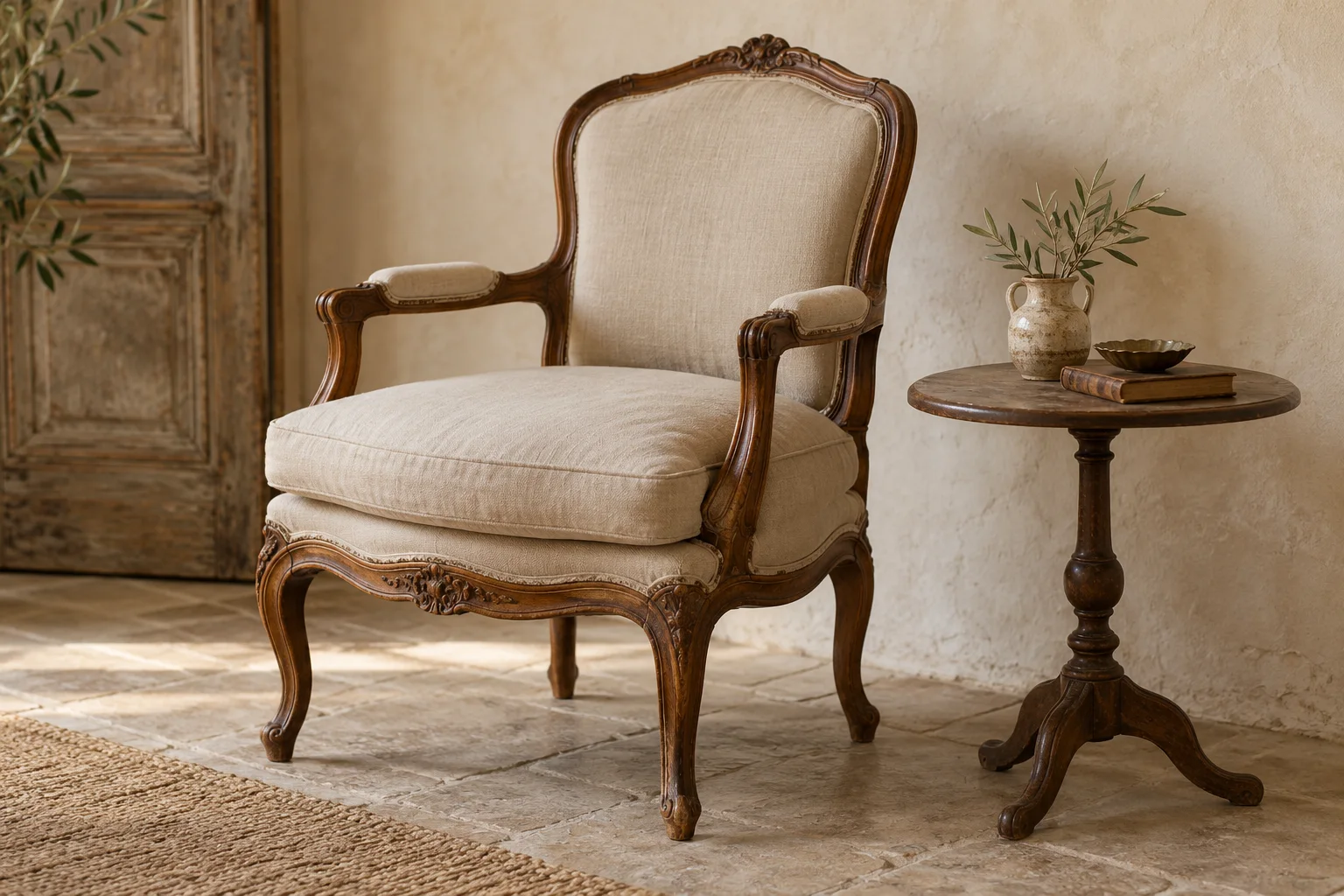 AI-created styling idea
Furniture
Fauteuil, bergère or club chair: choose by how you sit, then by the carving.
Explore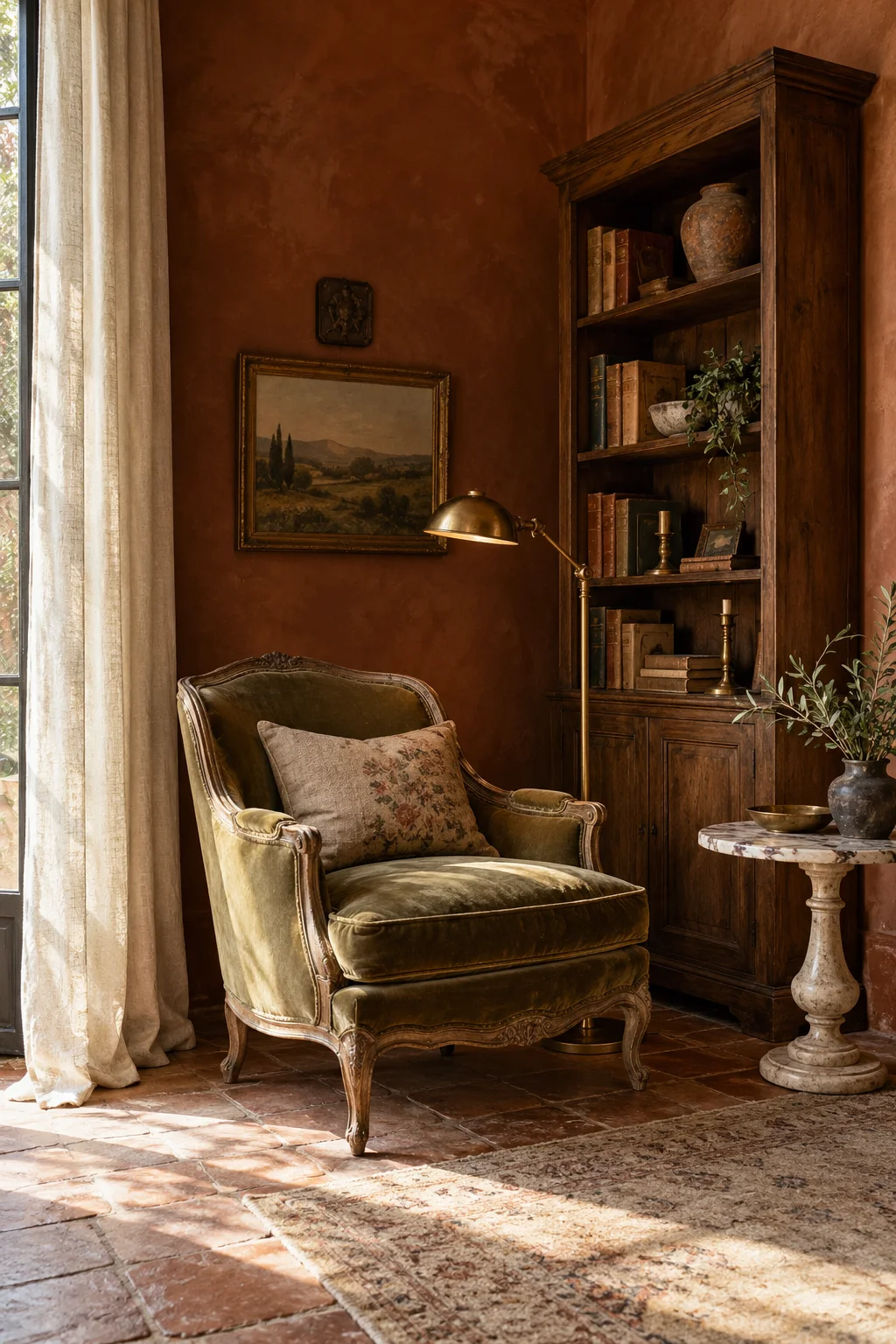 AI-created styling idea
Furniture
A top within 2 in of the seat height; a cut-down table should say so.
Explore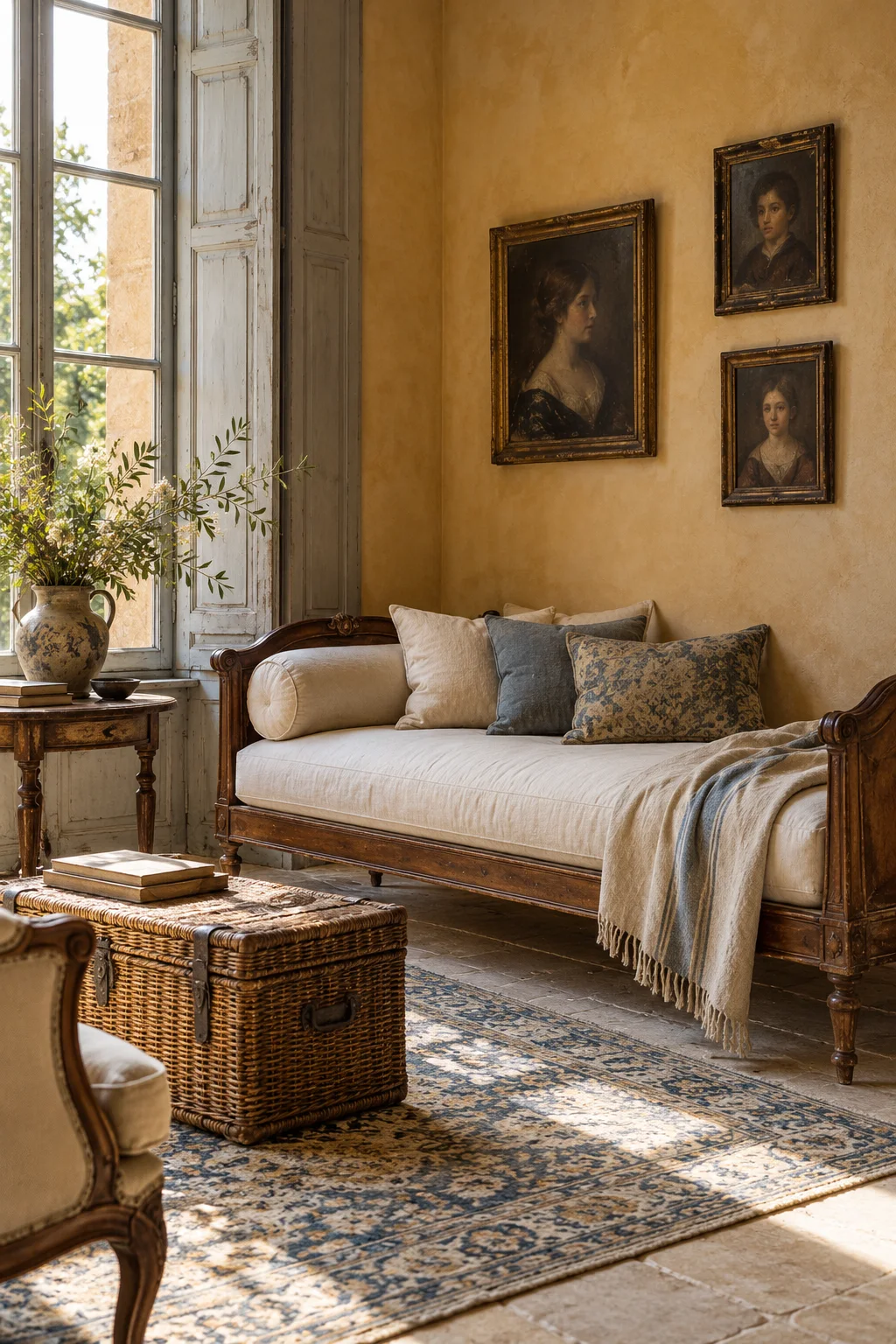 AI-created styling idea
Furniture
Match the top to the armrest height; a drum table saves corners in a small room.
Explore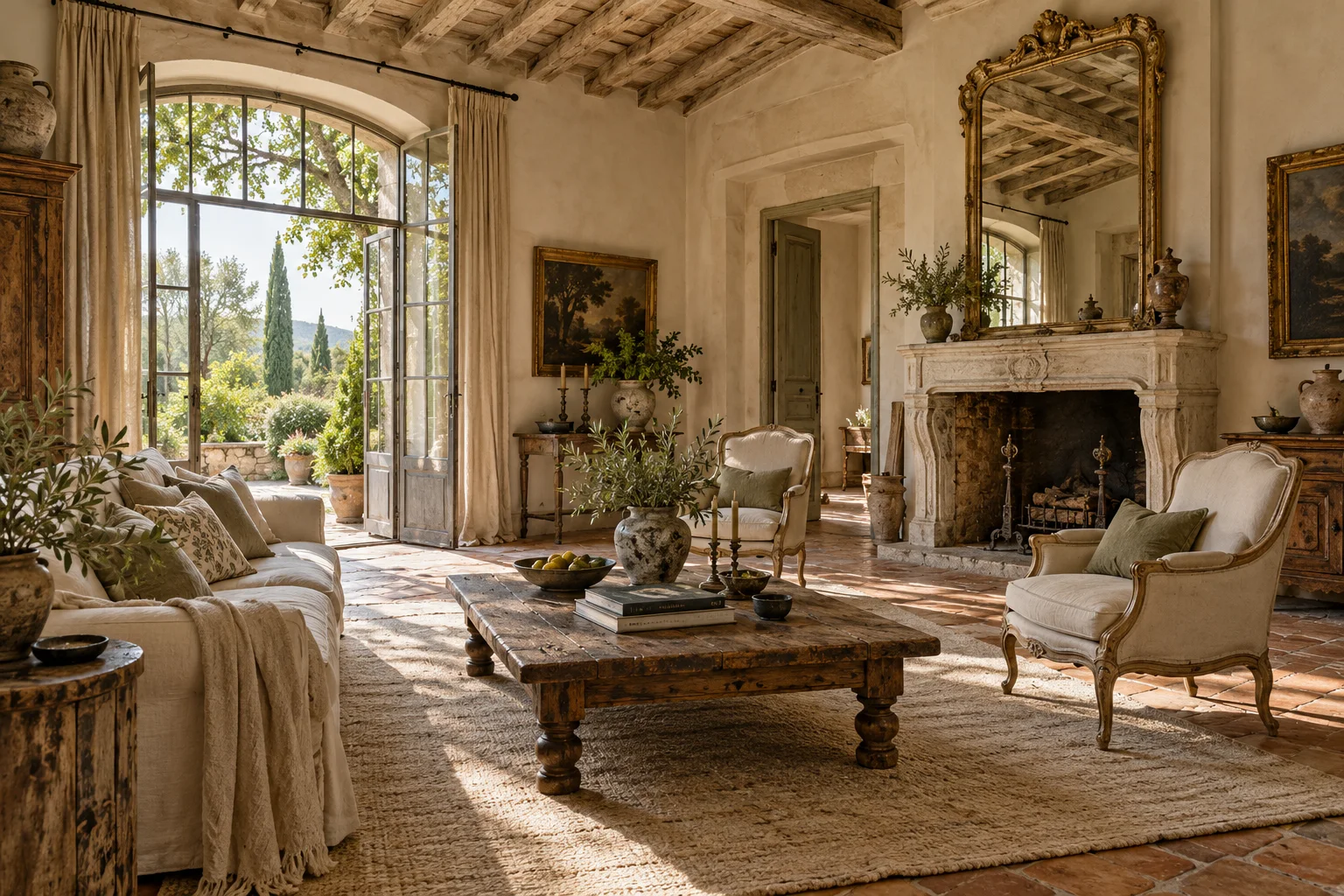 AI-created styling idea
Architectural antiques
Weigh the surround, plan the fixing and the clearances before the mantel arrives.
Explore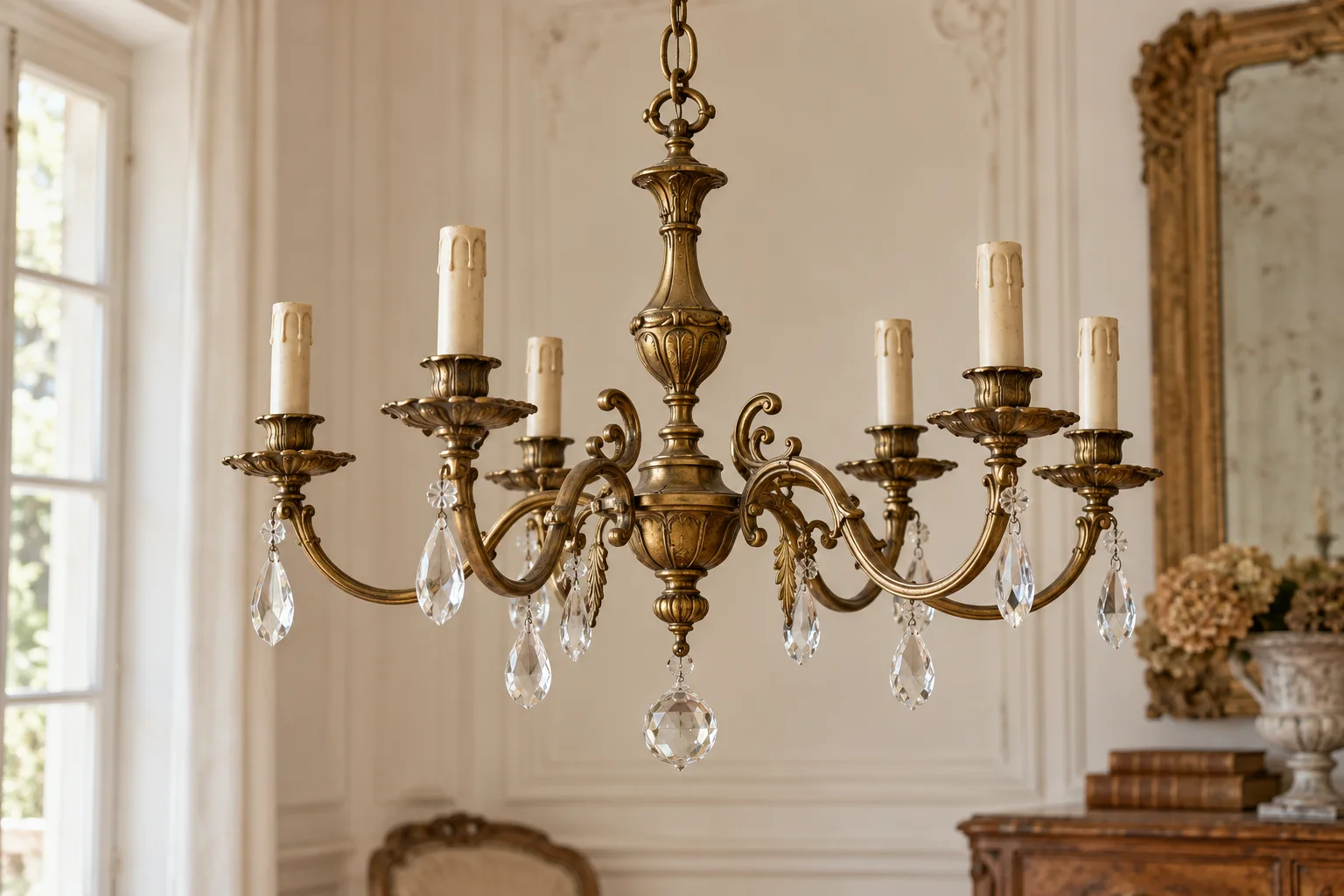 AI-created styling idea
Lighting
Size the chandelier to the room, then check arms, wiring and missing drops.
ExploreEvery piece for the living room in one place, grouped by category. Each subcategory page explains what to check before you buy and links to the detailed guides.
Place the main sofa facing the fireplace or the view, add a second seat at a right angle 7 to 10 ft away, and keep 16 to 18 in between the sofa and the coffee table. Give every seat a surface within reach, light each corner separately, and leave one wall with a single strong piece rather than several small ones.
Choose a table about two thirds of the settee's length and with a top within 1 to 2 in of the seat cushion height, usually 16 to 18 in. A French settee is often shallower than a modern sofa, so a narrower table of 18 to 22 in deep keeps the passage clear. A round or oval top avoids corners in a small room.
Yes, and it is often the best choice for daily comfort. Keep the sofa plain, in linen or a quiet wool, and let the antiques carry the character: a carved armchair, an aged low table, a gilt mirror. Repeat one material from the antiques in a lamp or a frame near the sofa so the new piece reads as part of the room.
One large piece above, a mirror or a painting slightly narrower than the shelf, and no more than three objects on the shelf itself, such as a pair of candlesticks and one ceramic. Leave breathing space on both sides, keep anything combustible at the clearance your code requires, and change the small objects with the seasons rather than adding to them.
Modern French country keeps the materials of the style, oak, linen, stone, iron and lime, and removes most of the small objects. A plain contemporary sofa sits with one or two antique chairs, a commode or a mirror, the walls stay pale and the floor carries a single rug. The result is lighter than a traditional room but still built on old wood and natural textiles.
Bergère chairs with closed upholstered sides, open-armed fauteuils, a carved settee and, for daily comfort, a pair of leather club chairs all suit the style. Choose at least one deep seat for evenings and let the carved pieces provide the curved lines. Check frame joints and springing before buying, and keep seat heights within about 2 in (5 cm) of one another.
Nov 6, 2026 · Antique guide
An antique fireplace mantel sets the scale of a living room before any furniture arrives.
Nov 6, 2026 · Antique guide
Choose the shape and distinguish the condition of the frame from that of the fabric.
Nov 5, 2026 · Antique guide
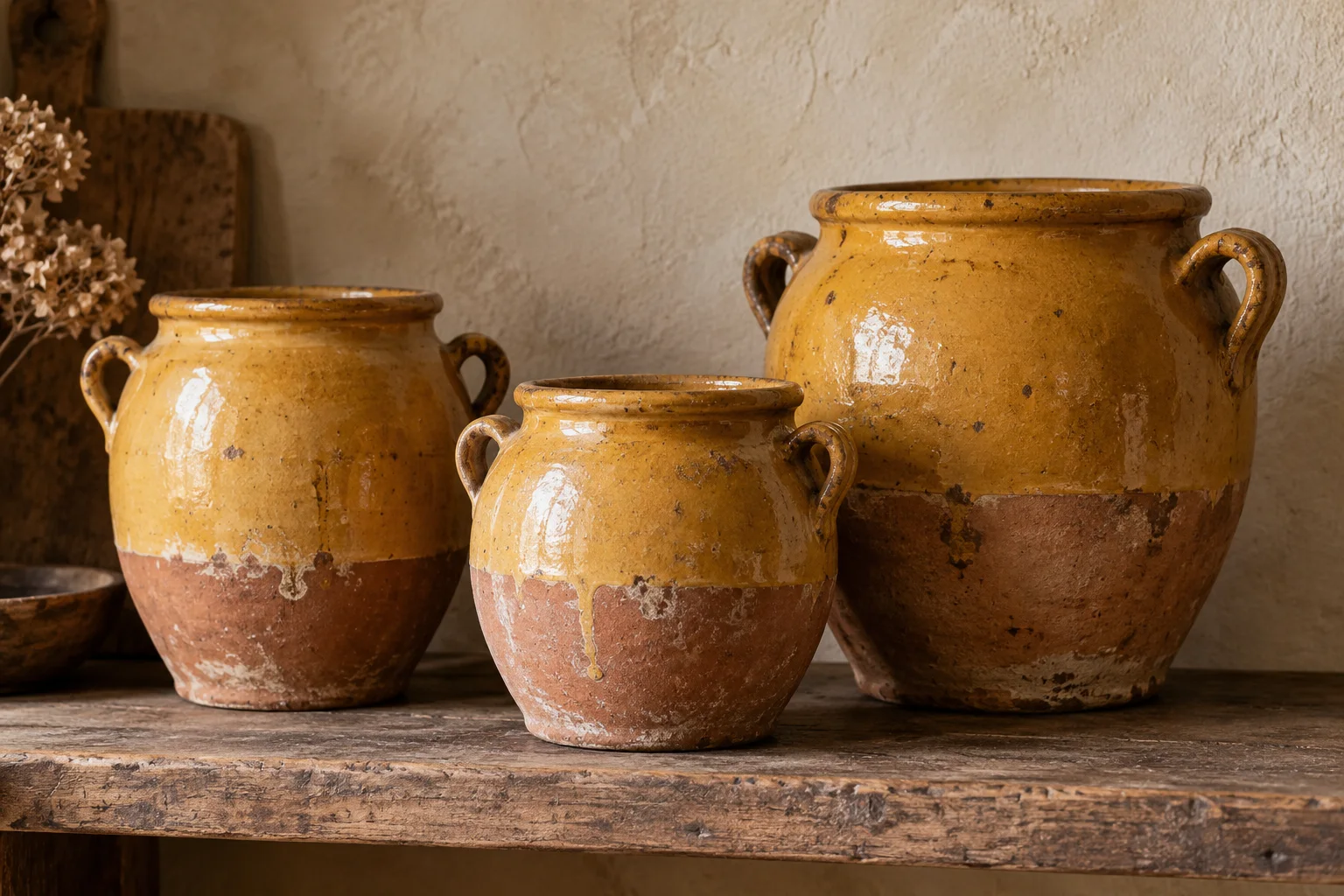
Vintage pottery from French kitchens and workshops falls into two bodies and three glazes.
Nov 5, 2026 · Antique guide
An antique magazine rack is one of the few small antiques that still does its original job and several new ones.
Nov 5, 2026 · Antique guide
An antique French oil painting is easiest to judge from the back.
Nov 5, 2026 · Antique guide
An antique French bronze is three things at once: a model by a sculptor, a cast made by a foundry, and a surface finished by hand.