Commode: The Chest of Drawers
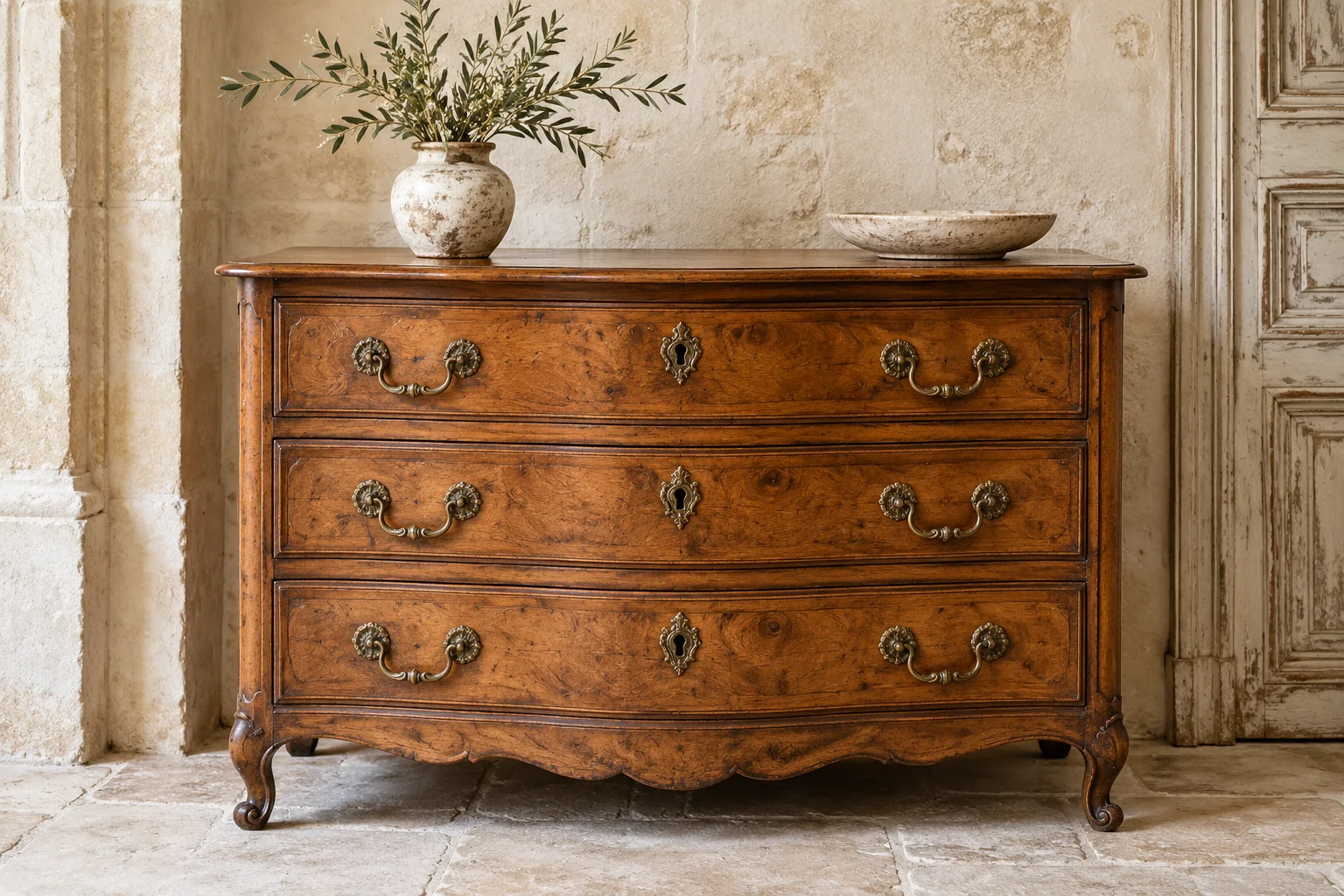
In French furniture a commode is a chest of drawers, from the bombé Paris commodes of the 18th century to the three-drawer walnut or cherry commodes of provincial workshops and the mahogany commodes of the Louis-Philippe period with a marble top. Typical sizes are 34–36 in (86–91 cm) high and 45–52 in (114–132 cm) wide. Two relatives share the drawers: the chiffonnier, a tall narrow chest of five to seven drawers, and the semainier, which has exactly seven, one for each day of the week. The dressers and chests of drawers category groups all three, and the guide to antique dressers and tall chests covers how to check them.
The false friend runs the other way. In American English a commode can mean a toilet, so a French seller writing “commode Louis-Philippe” and an American buyer reading it are not picturing the same object until a photograph settles it.
Vaisselier and Buffet: Kitchen and Dining Storage
A vaisselier is a two-part piece: a low cupboard, usually with two doors and a drawer or two, carrying an open rack with rails or plate guards where dishes stand on display. Regional versions from Brittany, Alsace and the Southwest differ in carving and proportion. A buffet is the low cupboard alone, 38–42 in (97–107 cm) high; a buffet deux-corps stacks a second cupboard with doors on top; an enfilade is a long buffet with three or four doors. The buffets and sideboards category shows the family side by side, and our guide to French country sideboards and buffets explains which one suits a dining room, a kitchen or a hall.
When buying a vaisselier, ask whether the upper rack and the lower buffet have always been together. Marriages of two pieces are common and legitimate when disclosed; matching wood, wear and construction on both parts is the check.
Coiffeuse, Chevet and the Other Names Worth Knowing
A coiffeuse is a dressing table with a mirror, often kidney-shaped in the 1920s–1950s; the dressing tables category covers it. A chevet or table de nuit is a bedside cabinet. An armoire is a wardrobe with shelves; a penderie has a hanging rail. A bonnetière is a narrow single-door cupboard. None of these is a dresser in English, yet all of them appear in listings that English buyers reach by searching for one.
For searching French sites, type the French word for the piece you mean: commode for drawers, vaisselier for a plate rack, buffet for a sideboard, coiffeuse for a mirror. For any two-part piece, ask for photographs of the inside and the back. Our French country furniture guide and the bedroom page show where each piece lives in a house.
What to compare
| Form | Suggested Use | Decisive Check |
|---|---|---|
| Commode | Bedroom storage for clothing | Drawer runners and locks |
| Vaisselier | Kitchen or dining display of plates | The two parts match in wood, wear and construction |
| Buffet or enfilade | Dining room serving and storage | Doors close and shelves are original |
| Coiffeuse | Bedroom or dressing room | Mirror glass and hinges |
Your buying checklist
Continue planning your room
Frequently asked questions
What is a commode in French furniture?
A commode is a chest of drawers, usually two to four drawers wide, from the 18th-century bombé forms to the provincial three-drawer commodes in walnut or cherry and the marble-topped mahogany commodes of the 19th century. It is the closest French equivalent of the American bedroom dresser, without the attached mirror.
What is the difference between a vaisselier and a buffet?
A buffet is a low cupboard with doors, about 38–42 in (97–107 cm) high, used in dining rooms and kitchens. A vaisselier is a buffet with an open rack above it for displaying plates. If the upper part has doors instead of an open rack, the piece is a buffet deux-corps, not a vaisselier.
Why do French listings say commode for a chest of drawers?
Because that is the French word for it, in use since the 18th century. The English word commode, meaning a washstand or a toilet, borrowed the French term and drifted. A French seller writing commode means drawers. Rely on the photographs and the dimensions rather than on the word.
What is a chiffonnier?
In French furniture a chiffonnier is a tall, narrow chest of five to seven drawers, often 50–60 in (127–152 cm) high and 24–32 in (61–81 cm) wide. In English the same word can mean a small sideboard, so again the photograph decides. A semainier is the seven-drawer version, one drawer per day of the week.
Sources & further reading
- The Metropolitan Museum of Art — French Furniture in the Eighteenth Century: Case Furniture — Describes the commode and other French case furniture forms by name and construction.
- Getty — Pair of commodes (documented example with replaced tops) — A documented pair of commodes, useful for seeing how museum catalogues name and describe the form.