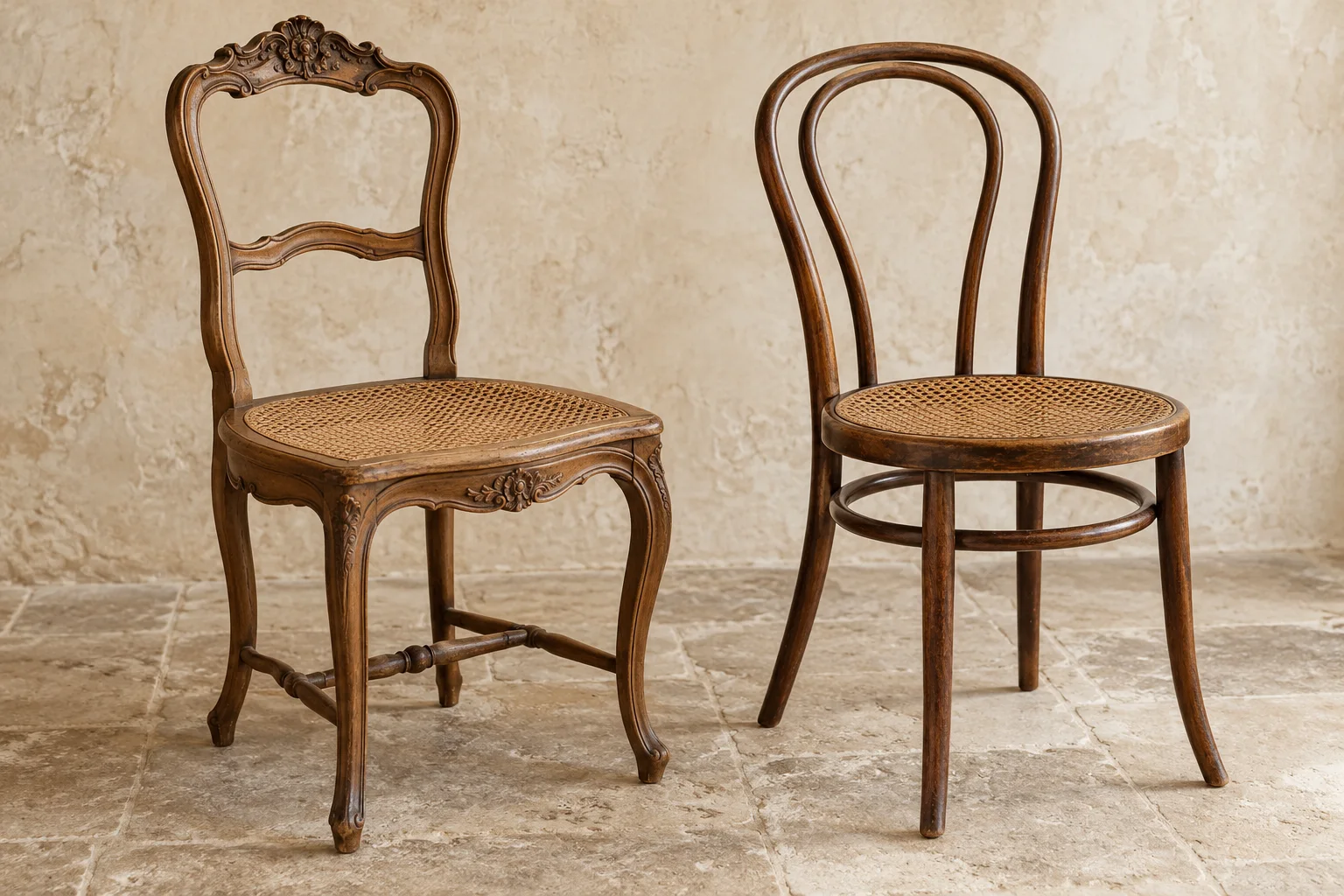
How steam-bent beech chairs are made
Beech was chosen because it bends well when hot and wet and holds its new shape once dried. Rods were turned, steamed, clamped into iron forms and left to dry before assembly. The result is a chair with few joints and no glued mortises: the back and rear legs are often one continuous bent piece, the seat is a bent ring, and a smaller ring braces the legs below. A chair of the No. 14 type weighs about 7 lb (3 kg), a fraction of a carved dining chair.
Because the parts are screwed and bolted rather than glued, a bentwood chair could be shipped in pieces and assembled at its destination, which is why so many were made for cafés. The same construction means the chair can be tightened and repaired today. The frame flexes slightly in use, which is normal; the bends themselves should be sound.
Thonet style chairs and later makers: labels and stamps
Thonet-type describes a form, not a maker. Chairs of the same patterns were produced by Thonet and by later firms, among them J. and J. Kohn, Fischel and Mundus, and in France Baumann. Attribute a bentwood chair only by its label or stamp: a paper label under the seat ring, a brand burned or impressed into the underside of the ring or a leg, or a factory mark on the seat. Many chairs carry none, and a missing label is not a fault.
Labels wear off and stamps can be imitated, so read the chair as a whole: rods with slight hand-finished variation, old slotted screws, wear on the leg ring where feet rested, and a finish darkened evenly by age. Later production often shows cross-head screws, stapled seats and a uniform sprayed lacquer. A matching set of six or eight with the same stamp is less common than a group gathered over time.
Cane, pressed and wood seats on vintage bentwood chairs
Three seat types are common. Woven cane, hand-caned through holes in the ring or as machine sheet pressed into a groove, is the lightest and most comfortable, and the first part to fail. Pressed plywood seats, often embossed with a pattern, are tough and easy to wipe, which made them a café standard. Solid or perforated wood seats sit between the two. A torn cane seat is a routine repair and no reason to reject a sound frame.
For a kitchen or dining room in daily use, a plywood or perforated seat with a loose cushion copes best; keep cane for chairs that see lighter wear. Seat height runs about 17 to 18 in (43 to 46 cm), suited to a table of 29 to 30 in (74 to 76 cm). Our page on bistro and dining chairs shows the seat types side by side.
Bentwood bistro chairs from café to dining room: checks and mixing
Turn the chair over. Look along each bend for cracks that run with the grain on the outside of the curve, and for old repairs with dowels or metal plates. Check every screw and bolt at the seat ring and the leg ring: loose fixings are normal and easy to tighten, but stripped holes need plugging with new wood. Rock the chair on a flat floor; a frame that twists has a loose joint or a cracked part. A missing leg ring weakens the legs and should be replaced.
Around a round bistro table of 24 to 30 in (60 to 76 cm), two or three chairs fit. At a farm table, a mixed set of four to eight works if the seat heights match within 1 in (2.5 cm) and the wood tones are close. For other seating forms, see our guide to French country chairs.
What to compare
| Form | Suggested Use | Decisive Check |
|---|---|---|
| Side chair, cane seat | Dining room, lighter daily use | Cane intact; no crack at the back bend |
| Side chair, pressed plywood seat | Kitchen and café table, everyday | Tight screws at seat ring and leg ring |
| Bentwood armchair | Head of the table or a desk | Arm joints and the long bend of the back |
| Mixed set of four to eight | Farm table | Seat heights within 1 in (2.5 cm) |
Your buying checklist
Continue planning your room
Frequently asked questions
How can you tell if a bentwood chair is a Thonet?
Only a label or stamp can tell you. Look under the seat ring and on the legs for a paper label, a burned or impressed brand, or a factory mark on the seat. Without one, describe the chair as Thonet-type, since many firms made the same patterns after the original patents expired.
Are bentwood chairs strong enough for everyday dining?
Yes, when the frame is sound. Bentwood chairs were made for cafés and take heavy daily use. Check that no bend is cracked along the grain, that the leg ring is present and that every screw holds. A plywood or perforated seat copes with daily use better than cane.
How do you repair a loose bentwood chair?
Tighten each screw and bolt at the seat ring and the leg ring with the right screwdriver, without forcing. If a screw turns without biting, plug the hole with a glued hardwood dowel, let it set and drill a new pilot hole. Cracked bends and broken rings are work for a furniture restorer.
Can bentwood chairs be mixed with other dining chairs?
Yes. Bentwood chairs mix well with rush-seat or upholstered chairs, provided seat heights match within 1 in (2.5 cm) and the wood tones are close. Use two bentwood armchairs at the ends of a farm table, or mix different bentwood models around a round bistro table.
Sources & further reading
- USDA Forest Products Laboratory — Wood Handbook: Wood as an Engineering Material — Properties of beech and the principles of steam bending solid wood.
- Canadian Conservation Institute — Basic care: furniture and objects made of wood — Basic care of wooden furniture: cleaning, stable humidity and when to call a restorer.