What is an old scale with weights? A mechanical balance that weighs by comparison: the object goes on one pan and known weights on the other until the beam levels. The French domestic and shop standard was the balance Roberval, with two open pans mounted above the beam, supplied with a graded set of brass or cast-iron weights.
The old-fashioned weight scale, explained
Two principles compete in old scales. The balance compares: an unknown weight on one side against known weights on the other, and the beam tells the truth only if the arms are equal. The spring scale measures: a dial connected to a spring, popular from the twentieth century onward, easier to read but prone to drift with age.
The balance that ruled French kitchens and village shops is the Roberval balance, named for Gilles Personne de Roberval, the seventeenth-century French mathematician whose parallel-arm linkage, described in 1669, lets both pans sit on top of the beam instead of hanging from it. That single trick made the flat platform scale possible — the grocer’s scale with two plates at waist height.
The linkage does something more useful still. A second beam concealed inside the base is tied to the visible one by two vertical rods, forming an articulated parallelogram, so the pans stay level and — the part that mattered to a grocer with a queue — the reading does not change depending on where on the pan you set the object. On a classical beam balance with hanging pans, position matters. On a Roberval it does not, which is why a shopkeeper could work fast and one-handed. Typical shop models weigh up to about 20 or 30 kg.
The forms to know
The Roberval form dominates French kitchen finds: enameled or polished plates, a steel beam, a simple pointer. Hanging scales read vertically and are rarer in kitchens — they belonged to the market and the farm. Brass balances are small, precise and almost always complete with fitted cases, which makes them the easiest form to collect well. The vintage kitchen scales index shows the pieces, and our antique scale encyclopedia entry adds the instrument forms.
The Béranger balance
A refinement of the Roberval in which the vertical force rods are replaced by small secondary beams, reducing lateral strain and friction. Visually very close to a Roberval, and mechanically more accurate and more sensitive. If a scale looks like a Roberval but has extra pivoting arms visible at the base, it is probably a Béranger — and it is the better instrument of the two.
The balance romaine, or steelyard
This is the form that works by moving a weight rather than adding weights: a single arm with a short load end and a long graduated end, and a sliding counterpoise that you move along the graduations until the arm levels. There are no pans and no weight set — the counterpoise is the weight and the arm itself is the gauge, which is why the graduations matter as much as anything loose. Used for sacks, cheeses, hams and livestock, hung from a beam or a hook. These are the oldest form in the room; Roman steelyards survive, and the French name records it.
The dial or spring scale
Late nineteenth and twentieth century, with an enamelled face, a single pan or scoop and a needle reading against a printed scale. No weights, a spring inside, and the one type that genuinely goes out of calibration with age as the spring relaxes. Charming, and almost always inaccurate.
The pharmacy and letter balance
Small precision balances with suspended pans, often in a glazed case, supplied with gram and sub-gram weights lifted by tweezers. Letter scales are the miniature version, made for postal rates. The weights in these sets are the ones most often missing, and the hardest to replace convincingly.
Reading the weights
A balance scale is only as good as its weights. French kitchen and shop scales use brass weights stamped in grams and kilograms, often slotted, stacked or fanned out of a fitted box; some grocery sets add iron weights for the heavy end. Read three things: the unit (metric in France — pounds on English or American sets), the stamping (clean, regular letters on honest weights; fuzzy casting on poor reproductions), and completeness — a scale without its weights is a sculpture.
Three families of French weight
Bell weights (poids bouteille) — turned brass or bronze weights with a domed, bottle-like profile and a knop on top, graduated so they nest inside one another. The most desirable, the most often split up, and the most often topped up with later castings.
Cast-iron block and cylinder weights — plain, with the value cast into the body and often a ring or handle on the larger ones. These are the farm and grocery weights: 1, 2, 5, 10, 20 kg.
Flat disc and gram weights — thin brass discs and squares in a fitted wooden case, for pharmacy and precision balances.
Does the set belong to the scale?
Four tests. The weights should share a single style and patina — one bright weight in a dull row has been added. They should form a complete logical sequence: a French metric set runs 1, 2, 5, 10, 20, 50, 100, 200, 500 g and then 1, 2, 5, 10 kg, and a gap in the middle means the set has been broken up. Bell weights should nest within each other and sit sensibly on the pan. And the verification stamps should be consistent across the set — see below.
One historical note explains the odd ones out. France adopted the metric system in the 1790s; before that the unit of mass was the marc, divided into eight onces. Pre-metric weights marked in livres and onces turn up regularly, and they will never make a coherent set with metric weights. They are interesting objects in their own right; they are not a working set.
Stamps, marks and what they mean
Weights and scales in commercial use were inspected, and the inspection left marks. French weights were periodically stamped — poinçonnés — by the verification service, and the punch marks accumulate on the top or the shoulder of each weight as the years pass. Under the Second Empire the mark was an imperial crown; later marks are letters, numerals and small devices, often with a date figure. A weight carrying several stamps was in lawful trade use over a long period, which is a point in its favour and a clue to its working life.
You may also find the maker’s or retailer’s name cast or embossed on the base of the scale, or painted on the enamel face. These are usually local — a scale-maker in Lyon, an ironmonger in Bordeaux — and they are the most reliable evidence of where a scale actually worked.
What the marks do not do is date the scale precisely. The Roberval design was made essentially unchanged for a century and a half. Describe a scale by its type, its material and its condition before assigning it a date: a style name describes an inspiration, it does not date or attribute a particular piece.
Checking that it weighs true
Two minutes on a market stall, and no tools required.
Empty-pan balance. Clear both pans. The needle should settle on zero and the beam should rest level. If it sits off-centre, look for an adjusting nut under the pan or at the end of the beam — most Robervals have one, and a small offset is normally adjustable.
The swap test. Put the same object on the left pan, note the reading, then move it to the right pan. A true balance reads the same both ways. A difference means the arms are unequal or a knife-edge is worn, which is a workshop repair rather than an adjustment.
The position test. This is the Roberval test, and the one most buyers never think to do. Put a weight at the centre of a pan, then slide it to the edge. The reading must not change. If it does, the internal parallelogram is bent or a rod has come loose — and that is the one fault not worth buying.
Listen and feel. Lift one pan slightly and let it go. A sound balance swings freely and settles; a gritty, hesitant or sticking movement means dirt or damage at the pivots.
Carry a known weight. A 500 g bag of coffee or a 1 kg bag of flour in your bag settles the question against the weights the scale is sold with.
What to check before you buy
First, the arms and knife-edges: the balance should level and settle when the pans are empty, and the beam should swing freely and slowly stop — grit or rust at the pivots kills the measurement. Second, the plates: enameled plates crack and chip, steel plates rust at the rim; both are normal, but through-rust on the underside of a plate is structural. Third, the base: check wood for worm damage and cast iron for cracks at the feet. Fourth, completeness: weights, box, tray, any shop label.
| Check | What you want | What it means if not |
|---|---|---|
| Needle at rest, pans empty | Settles on zero, beam level | Usually adjustable; sometimes a worn pivot |
| Swap test | Same reading on both pans | Unequal arms or worn knife-edge — a workshop job |
| Position test | Reading unchanged across the pan | Bent parallelogram; the one fault not worth buying |
| Pans or plates | Both present, same metal, same wear | Replaced plates change the tare and the look |
| Weight set | Complete sequence, matched patina, consistent stamps | A broken set is expensive to complete |
| Verification stamps | Several, consistent across the set | Mismatched stamps mean mixed sets |
| Enamel face (dial scales) | Sound enamel, chips only at mounting holes | Enamel cannot be repaired invisibly |
| Base and marble | No hairline cracks in a marble top | Marble tops crack across the middle and rarely survive moving |
| Rust | Surface only, on cast iron | Flaking through means the casting is compromised |
Two practical warnings. Weigh the whole thing before you commit to carrying it: a cast-iron shop Roberval with its weight set can exceed 40 lb / 18 kg, and a marble-topped one more. And if you intend to use the scale for food, scrub the plates and keep the weights off the work surface — old cast iron and old brass both pick up grime, and brass weights may have been polished with leaded compounds over the years. Our page on French pewter marks, lead and care covers the same caution for the softer metals.
An honest caveat: a century-old scale that reads perfectly is rare; most buyers choose a display piece that still moves, not a certified instrument. It belongs beside the other pieces in our French kitchenware essentials and fits the counter plan in the kitchen cabinets guide.
Displaying and using one
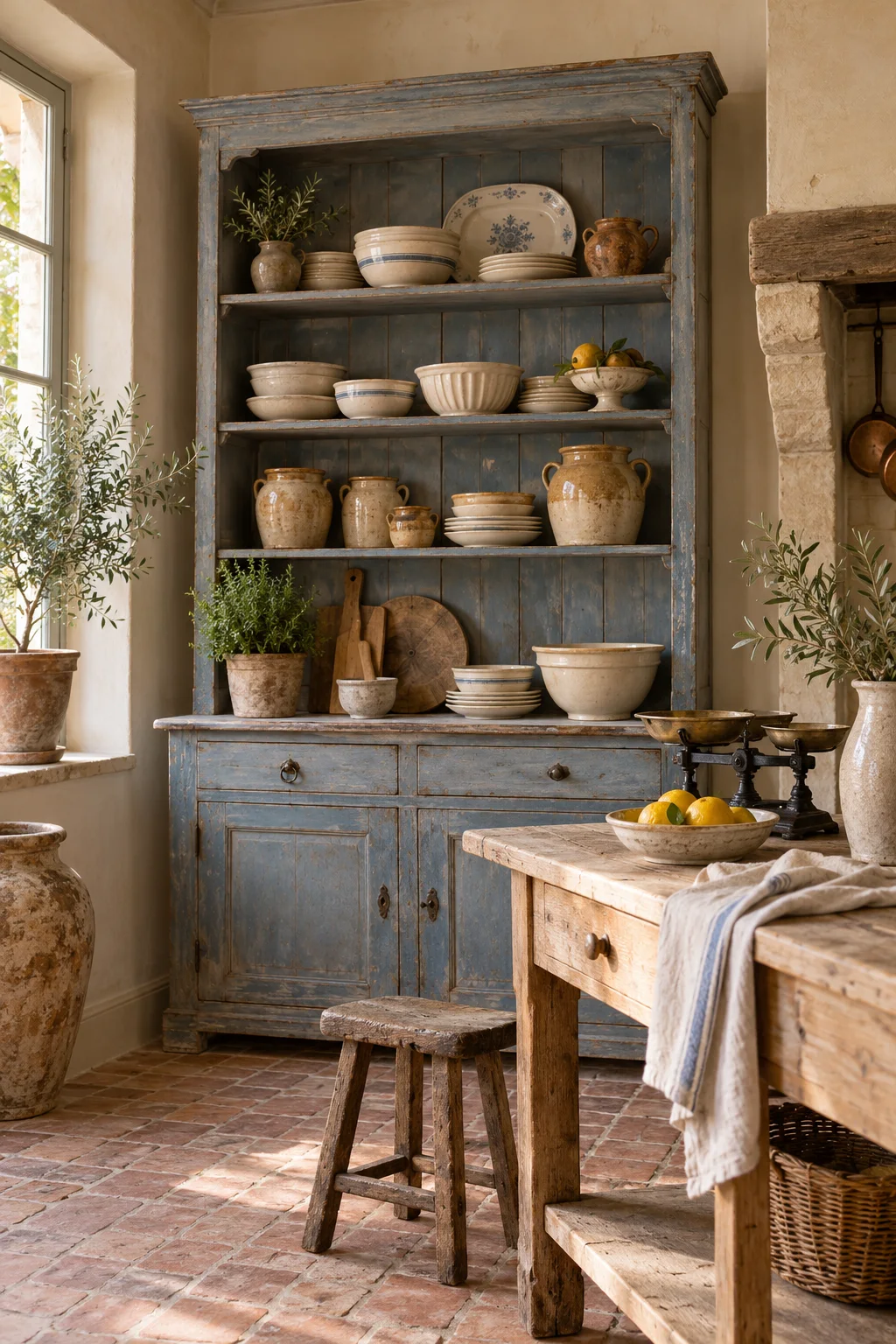
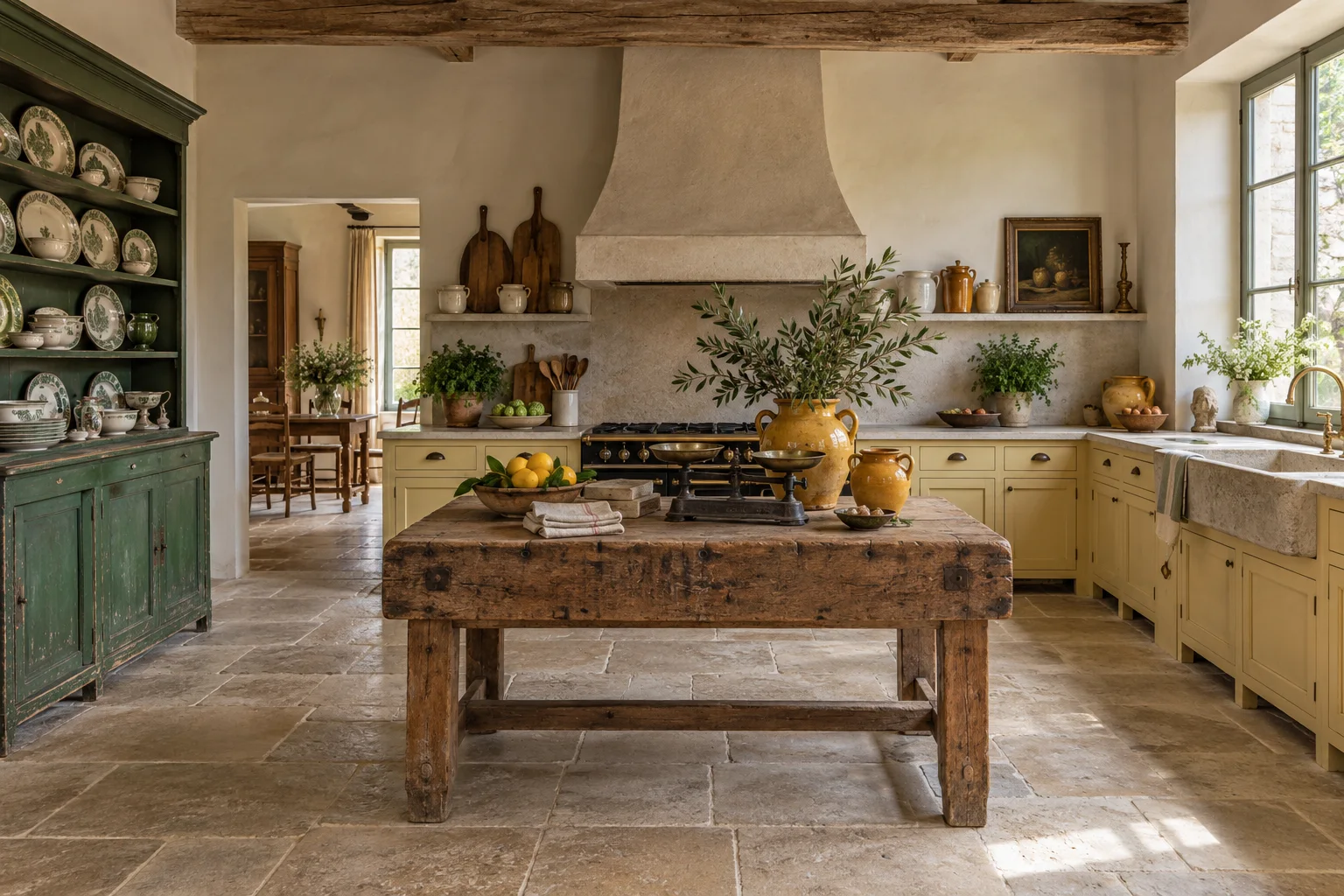
The Roberval balance asks for a counter corner with light behind it: brass weights fanned to one side, a flour sack, a bowl of eggs. Hanging scales want a wall stud and a basket of onions hooked on. Small brass balances live in the study with their cases open. In French country kitchens the scale usually shares the counter with the coffee grinder and the mortar — the three pieces that say “this kitchen was worked in”. Keep the beam free so the pointer still swings; a scale that visibly balances is the display.
Three rules keep it from tipping into museum display.
Keep the weights with the scale, in descending order along the front edge. Graded objects in a row are the whole effect; a scale whose weights live in a drawer is half an object.
Hang the steelyard rather than standing it. The balance romaine is the one form that belongs on a wall or a beam. Suspended from an old hook beside a doorway it reads as part of the building rather than as an ornament.
Do not group three scales. One scale is a tool; three are a collection, and the room becomes a museum. Pair a scale with unlike things — a bread board, a confit pot, a row of corks — rather than with its own kind, and alongside the pieces in French farmhouse antiques.
On colour: cast-iron scales were usually painted, often in the same greens and greys as the rest of French shop furniture, and chipped original paint should stay chipped. Stabilise surface rust with a light oil or wax and leave sound old paint alone — a scale repainted glossy black has lost most of its interest, which is the distinction drawn in real wear versus decorative distressing.
What to compare
| Form | Typical use | Display spot |
|---|---|---|
| Roberval balance, two platforms | Grocer, kitchen, tobacco shop | Kitchen counter, open shelf |
| Béranger balance | The more sensitive shop scale | Kitchen counter, where it will be used |
| Balance romaine (steelyard) | Sacks, hams, cheeses, livestock | Wall or beam, hung from a hook |
| Hanging scale (hook and dial) | Poultry, butter, harvest at market | Wall or pot rack, mudroom |
| Spring dial scale | Kitchen, post office, nursery | Counter, bathroom shelf |
| Small brass balance | Pharmacy, notary, jewelry | Desk, curio cabinet |
Frequently asked questions
What is a Roberval balance?
A balance whose two pans sit on top of the beam through a parallel-arm linkage described by French mathematician Gilles Personne de Roberval in 1669. The pans stay level however they are loaded, and the reading does not change depending on where the object sits on the pan — which is why the flat-platform grocer’s scale ruled shops and kitchens for two centuries.
Why do old scales have two pans?
Two pans mean comparison weighing: the goods on one side, known weights on the other. The beam reads the difference, so the scale stays honest — there is no spring to drift, unlike a dial scale.
What is a balance romaine?
A steelyard: a single graduated arm with a sliding counterpoise, hung from a hook. It needs no weight set, because the counterpoise is the weight and the arm is the scale. Used for sacks, hams and cheeses, and the easiest form to display because it hangs.
How do I know if my old scale is accurate?
Three tests. With empty pans the beam should settle level. Put one object on the left pan, then the right — a true balance reads the same both ways. Then slide a weight from the centre of a pan to its edge: on a sound Roberval the reading must not change. For real weighing, test against a modern weight; for display, a scale that balances visibly is enough.
How do I know if the weights belong to the scale?
Check four things: that all the weights share one style and one patina, that they form a complete sequence with no gaps, that bell weights nest within each other, and that the verification stamps are consistent across the set. One bright weight in a dull row, or a missing 200 g, means the set has been made up.
What are the old scale weights made of?
French sets are brass, stamped in grams and kilograms, with iron weights added for the heavier loads; fitted wooden or velvet-lined boxes hold the smaller sets. Clean stamping and correct metric units distinguish honest weights from cast reproductions.
What are the stamps on antique weights?
Verification marks. Weights in lawful commercial use in France were periodically stamped by the inspection service, so the punches accumulate over a weight’s working life — an imperial crown under the Second Empire, letters and numerals later. Several consistent stamps are a good sign; mismatched stamps mean mixed sets.
Can I use an antique scale for cooking?
Yes, and a Roberval is well suited to it. Scrub the plates, keep the weights off food surfaces, and check the balance against a known 1 kg weight first. Avoid the pharmacy balances for kitchen use — they are made for grams, not for flour.
Should I repaint a rusty cast-iron scale?
No. Stabilise the surface rust with a light oil or wax and leave the original paint where it is sound. Chipped shop paint is the patina that distinguishes a working scale from a reproduction, and a glossy repaint removes it permanently.
What is an old fashioned scale worth?
It depends on form, completeness and condition: a Roberval balance with its full weight set and box prices well above an incomplete one, hanging scales vary widely by maker, and small brass balances trade on precision and case condition. Completeness moves the price more than age.