The Forms: Table de Salon, Gueridon, Chevet and More
The provincial side table in the Louis XV manner has cabriole legs, a shaped apron and one drawer, in walnut, cherry or fruitwood. The gueridon is a round top on a tripod or a turned column. The table à ouvrage is a work table with a lift lid and a well for sewing. A chevet with a door serves as an end table with closed storage. From about 1900 the furniture industry produced marble-topped tables with cabriole legs by the thousand; they are style pieces, useful and plentiful. The side and nesting tables category and the French Provincial style page show the range.
Scale is modest: tops of 16–20 in (41–51 cm) across and heights of 22–28 in (56–71 cm). The French country living room guide places the small table among the sofa, the low table and the lamps.
Legs, Drawers and Tops: What to Look At
A cabriole leg breaks at the ankle, its thinnest point, and the repair is a dowel through the break; run a finger along the inside of each leg to feel the join. The knee is pegged or glued to the apron; rock the table to find play there. Pull the drawer out fully: hand-cut dovetails are uneven, machine-cut ones identical, and the runners show the wear. Solid tops split across the grain with shrinkage; marble tops chip at the edges and stain with iron; parquetry veneer lifts at the corners. The Getty’s catalogue of a documented pair of commodes with later marble tops shows why a replaced top should be recorded, not hidden.
The guide to antique tables and their shapes covers the same checks on larger tables. Wax a wood top lightly and keep a coaster on marble, which etches under wine and citrus.
Heights, Pairs and Placement in a Country Living Room
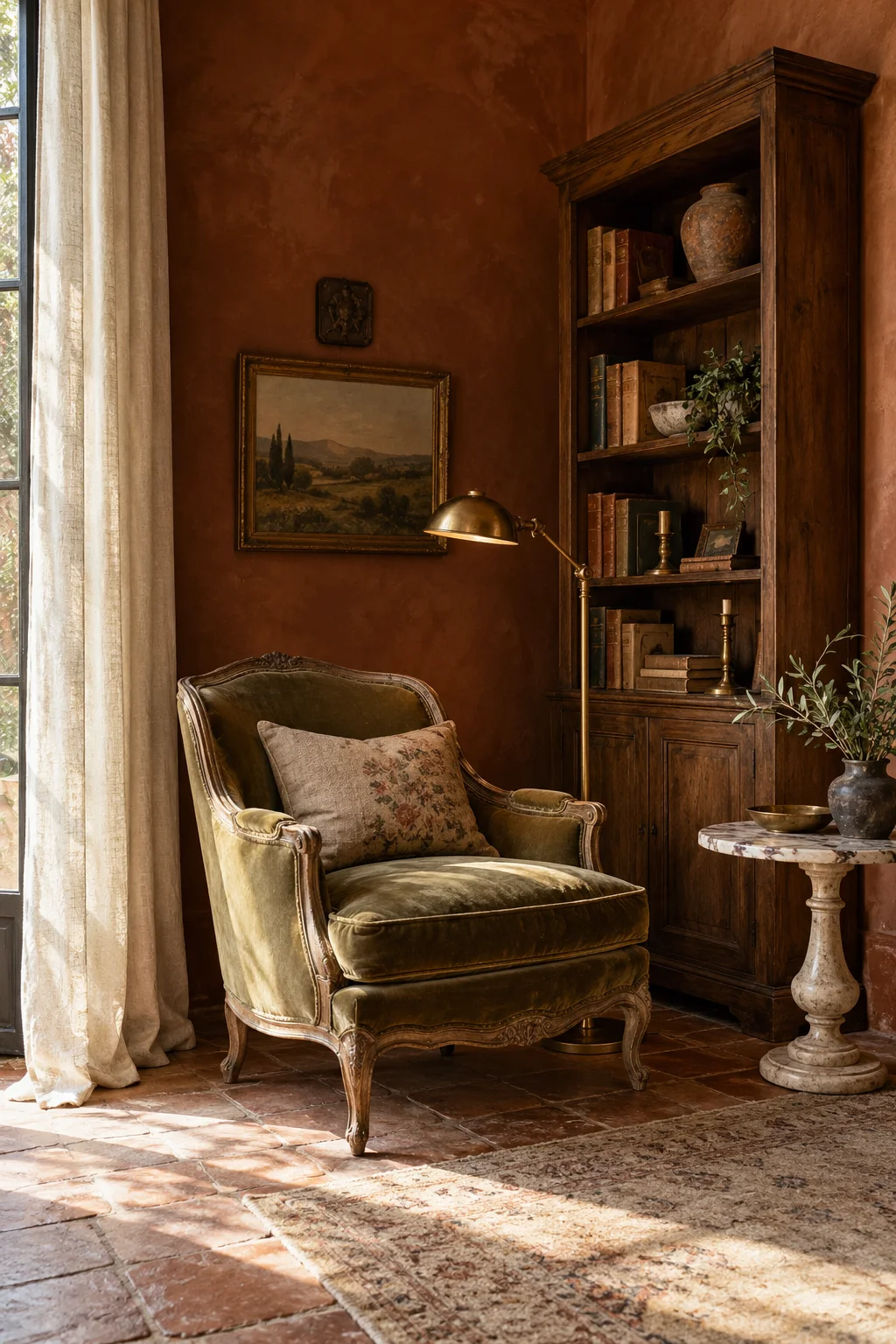
Sofa and chair arms vary from 24 to 30 in (61–76 cm), so measure the seat you own before shopping and aim for a table top within 2 in (5 cm) of the arm. A lamp on the table should bring the bottom of its shade to about 40 in (102 cm) from the floor, eye level when seated. A pair of matching tables flanking a sofa reads as formal; two different tables of equal height read as collected. A round gueridon between two armchairs, as in the guide to two antique armchairs around a round table, serves both seats.
Leave a walkway of 30 in (76 cm) past the table, and keep the depth at 16–20 in (41–51 cm) so the table does not push the chair away from the conversation. The living room page shows the arrangement with linen seating and a stone fireplace.
What to compare
| Form | Suggested Use | Decisive Check |
|---|---|---|
| Cabriole-leg side table with drawer | Beside an armchair, for a lamp and a book | Knee joints and drawer runners |
| Gueridon on a column | Between two chairs | Column stability and top fixing |
| Marble-top table, c. 1900 | Sofa end, drinks | Marble chips and stains |
Your buying checklist
Continue planning your room
Frequently asked questions
How tall should an end table be next to a sofa?
Within about 2 in (5 cm) of the sofa arm, which puts most end tables at 22–26 in (56–66 cm). A table well below the arm forces you to reach down; one above it blocks the arm. Measure your own sofa, since arm heights range from 24 to 30 in (61–76 cm) between models.
What is a gueridon?
A gueridon is a small round table on a central column or a tripod, used since the 18th century to carry a candlestick, a lamp or a tray. Provincial versions are in walnut or fruitwood with a turned column; later ones have marble tops. It works between two armchairs because both seats can reach it.
Do end tables have to match?
No. A matching pair flanking a sofa looks formal and suits a symmetrical room. Two different tables of the same height, for example a cabriole-leg table with a drawer on one side and a gueridon on the other, look collected over time, which is closer to the French country spirit. Keep the heights within an inch.
Are cabriole legs fragile?
They are vulnerable at the ankle, the thinnest section, where a break is repaired with a dowel. Check the inside of each leg for a repair line and rock the table to test the knee joint. A sound cabriole leg carries a lamp and books for decades; the risk comes from dragging the table rather than lifting it.
Sources & further reading
- Getty — Pair of commodes (documented example with replaced tops) — A documented example of replaced marble tops on period furniture.
- Canadian Conservation Institute — Basic care: furniture and objects made of wood — Guidance on waxing and cleaning old wooden furniture.