Recognising a pressed-back chair
Run a finger over the crest rail. A pressed design is shallow and uniform, with soft edges and a flattened, slightly glossy background where the die compressed the oak; the same motif repeats exactly on every chair of a set. Hand carving is deeper, with crisp tool edges and small differences between chairs. Common motifs are scrolls, leaves, a lion's head or a sunburst, sometimes repeated on a second rail, which sellers call double-pressed.
The wood is almost always oak, quarter-sawn on better chairs, with the ray figure visible on the seat and the posts. Spindles between the crest and the seat are turned, and the legs are joined by turned stretchers. Seat heights run 17–18 in (43–46 cm), back heights 40–44 in (102–112 cm), a little taller than French country chairs.
The form is largely an American one, sold through catalogues and department stores; European factories produced similar chairs in beech. Attribute an origin only from a label or a documented history. The bistro and dining chairs catalogue lists pressed-backs with other factory-era seating.
Seats: machine cane, solid wood and later replacements
Most pressed-back chairs have a seat of machine-woven sheet cane pressed into a groove around the seat frame and held by a spline; look under the seat for the groove, with no ring of drilled holes. A broken cane seat is replaced as a sheet, a routine job. Solid wood seats, often shaped in a shallow saddle, are the sturdier alternative and were offered on cheaper models.
Replacement seats are common: new cane that is paler than the frame, a plywood panel screwed under the rails, or an upholstered pad added later. None of these ends the chair's usefulness, but each should be disclosed and each lowers the value relative to an original seat. Check the spline for lifting and the groove for cracks before paying for a re-caning.
At a table, pressed-backs need 24 in (61 cm) of edge each and a table height near 30 in (76 cm) to keep 12 in (30 cm) of leg room under the apron. Our guide to French country dining tables gives the matching table dimensions, and our guide to choosing antique chairs covers the structural checks.
Value factors and how they sit in a French country room
Five details move the value of antique pressed back chairs: the depth and sharpness of the pressing, a matched set of four or six rather than singles, an original finish rather than a stripped and varnished one, an original cane or wood seat, and the rarer forms, such as a pressed-back rocking chair or an armchair with pressed arms. A chair with a crisp double pressing, old finish and intact seat is the one to keep.
Lowering factors are a stripped finish that has lost the colour of the oak, loose spindles, a cut-down height, and a crest rail with a split through the pressing, which cannot be refilled invisibly. Regluing loose spindles is routine; replacing a pressed crest rail is not, since the die no longer exists.
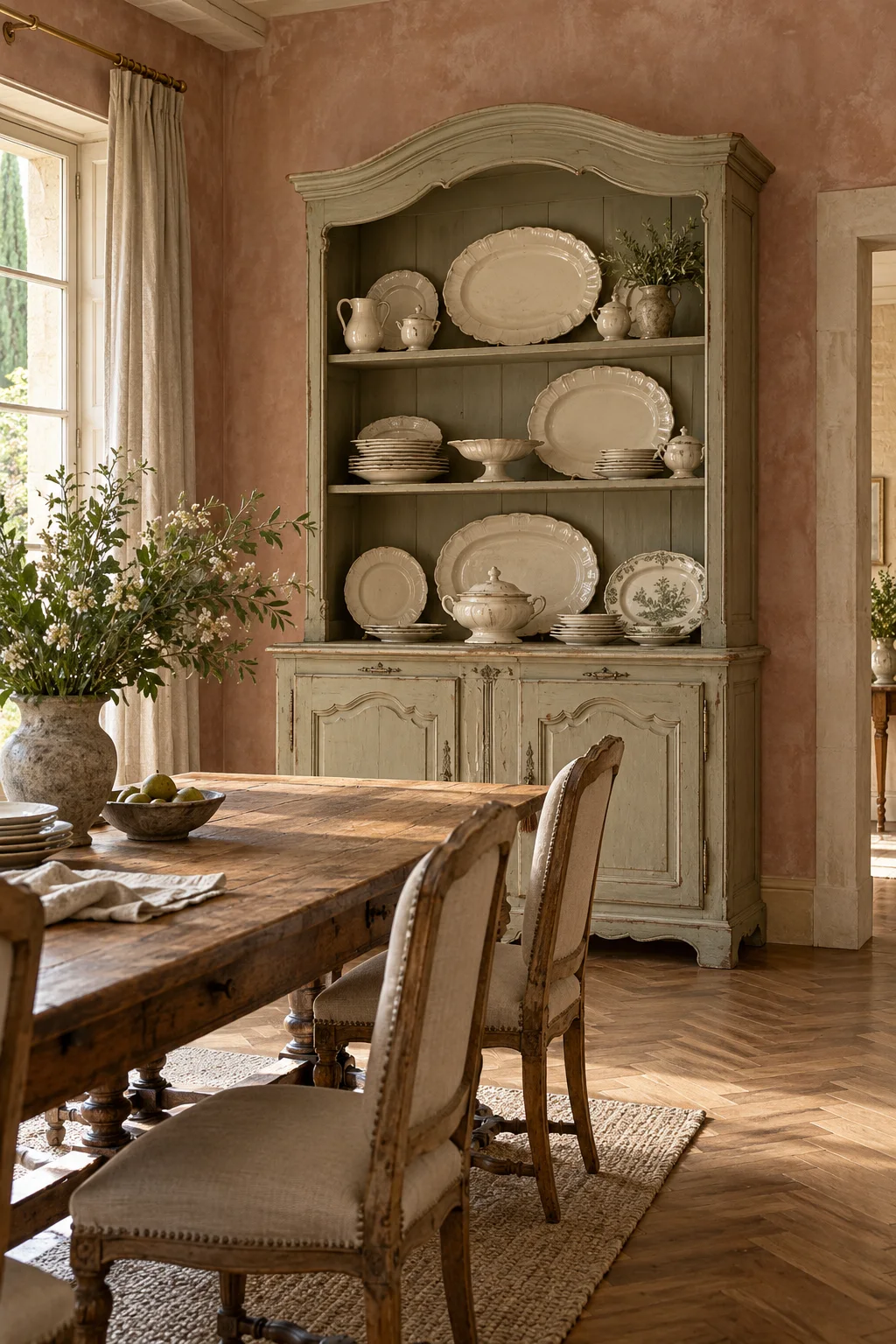
In a French country dining room, pressed-backs read as rustic cousins of the ladder-back: pair them with a scrubbed farmhouse table and keep the ornament from competing with a carved buffet. See the overview of French country chairs for how factory-era chairs mix with rush and bentwood.
What to compare
| Form | Suggested Use | Decisive Check |
|---|---|---|
| Single-pressed oak side chair | Kitchen, extra seating | Pressing crisp, spindles tight |
| Double-pressed set of four | Dining table | Matched motifs, original finish and seats |
| Pressed-back rocker | Porch, bedroom corner | Rockers original, crest rail unsplit |
Your buying checklist
Continue planning your room
Frequently asked questions
How can I tell a pressed back from a carved back?
A pressed design is shallow, uniform and soft-edged, with a flattened, slightly glossy background where the die compressed the oak, and it repeats exactly across a set. Hand carving is deeper, with crisp tool marks and small differences from chair to chair. Running a finger over the rail usually settles it.
Are antique pressed-back chairs valuable?
Value depends on five details: the depth of the pressing, a matched set rather than singles, an original finish, an original cane or wood seat, and rarer forms such as rockers or armchairs. Stripped finishes, replaced seats, loose spindles and split crest rails lower the value. Ask for comparable sales rather than relying on a general figure.
Can the cane seat on a pressed-back chair be replaced?
Yes. Most have machine-woven sheet cane held in a groove by a spline, which a caner replaces as a sheet in a routine job. Check that the groove is not cracked and that the spline is not lifting before paying. Hand-caned seats with drilled holes are rarer on these chairs and cost more to redo.
Do pressed-back chairs fit a French country dining room?
Yes, as rustic cousins of the ladder-back. Pair them with a scrubbed farmhouse table, keep the pressed ornament from competing with a carved buffet, and check the seat height of 17–18 in (43–46 cm) against the table. Mixing four pressed-backs with two rush chairs at the ends reads as intended.
Sources & further reading
- Canadian Conservation Institute — Basic care: furniture and objects made of wood — Preserving original finishes on oak furniture and checking joints before daily use.
- USDA Forest Products Laboratory — Wood Handbook: Wood as an Engineering Material — Reference on oak and other hardwoods, including the ray figure of quarter-sawn oak.