Nov 20, 2026 · Antique guide
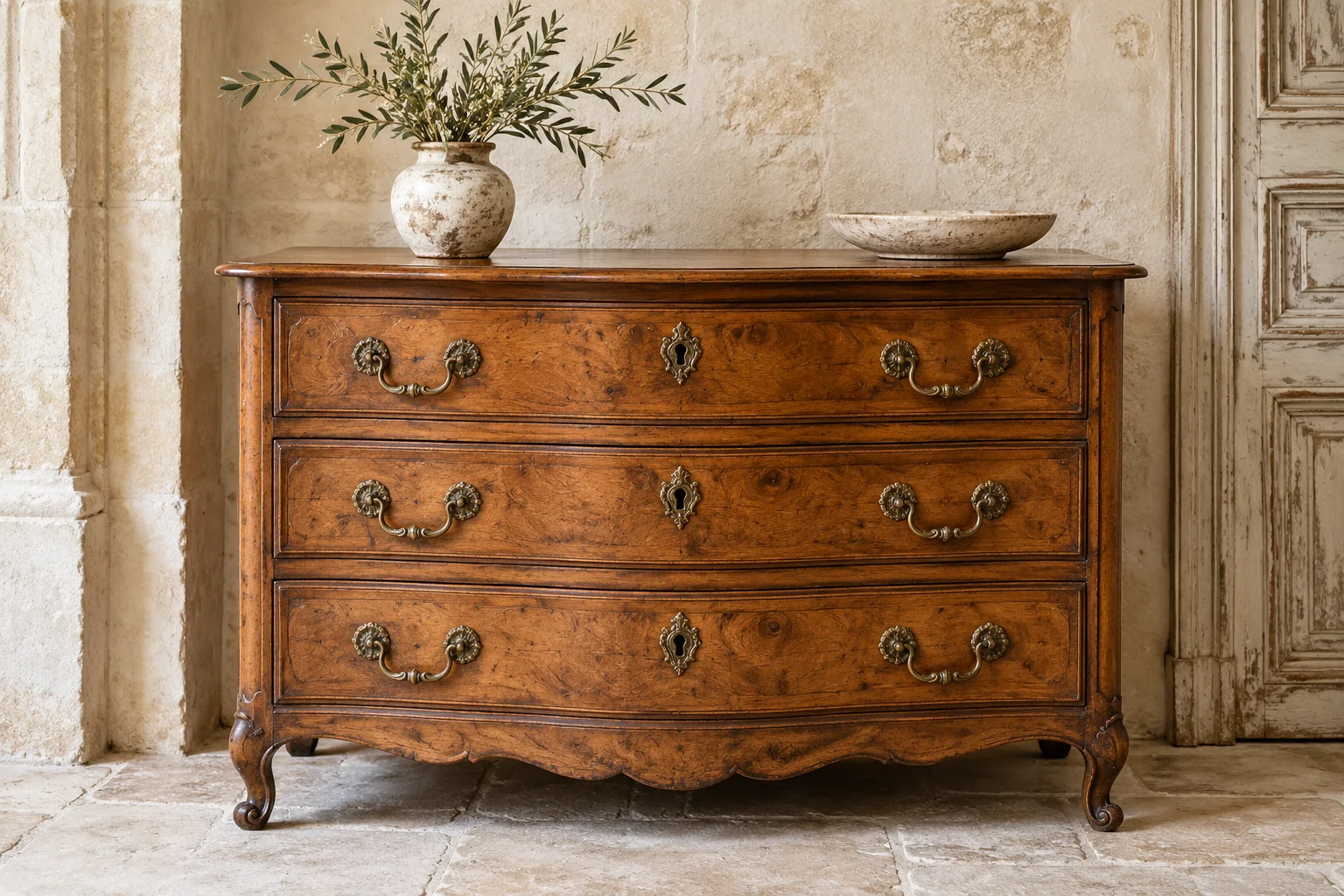
French for Dresser: Commode, Vaisselier, Buffet or Coiffeuse?
French for dresser is not one word, because English uses dresser for several different pieces.
In the Gascon countryside described by Pesquidoux, the "first neighbour" was a formal role with duties at every turning point of family life. At a wedding, the first neighbour went out to cut evergreen trees to line the approach to the house, decorated the doorway and the barn where the banquet would be held with crowns of boxwood studded with flowers, and supplied benches, chairs and tables. He acted as sommelier and controlled the wine, so that his friend would not have to. His wife helped the mistress of the house to cook and serve.
It was the first neighbour's wife who led the most striking part of the ceremony: fetching the bride's furniture.
The bed and the armoire were made by the local joiner, the menuisier. On the appointed day, the first neighbour's wife, the bride's mother and a group of women went to the joiner's workshop to collect them and take them to the new home, the house of the groom. The bride's father's cart carried the furniture; the neighbour's cart carried the women. The procession across the country was called the passade du lit, the passing of the bed.
As soon as the carts were loaded, the first neighbour's wife began the nobi, the song of the bed, a slow chant with even inflections that Pesquidoux found almost primitive. People gathered along the road and took up the refrain, which everyone knew.
At the house, the armoire and the bed were taken down from the cart by women alone. No man's hand could touch them before the groom's, and he could only touch them the next day, after the marriage had been blessed. The women set up and made the bed, all in white, and filled the armoire with the bride's linen, scented with lavender. Then they withdrew.
The custom explains why the armoire mattered so much. It was the visible measure of what the bride brought into her husband's family, and it arrived publicly, in procession, for the whole parish to see.
Pesquidoux mentions only "the bride's linen". A detailed monograph of a sharecropping family in the Orthe district, by the Adour, reproduced in Archives de Gascogne, shows how much linen a solid farm household could hold around the turn of the twentieth century. Its household linen alone was valued at 960 francs, and included:
The same account notes that each member of the family, children included, had their own store of linen and clothes. In the Landes, Alfred Cayla notes, every farm grew hemp for the family linen, retted it in water, then broke and scutched it; the thread was spun at home and woven in the village. A stack of sheets represented years of work. For the textiles themselves, see our guide to French linen and antique textiles.
The armoire was not the only wedding piece. Pesquidoux records that the bride's godfather gave her plates and dishes of Samadet faience to decorate her room, a gift that was much envied. Elsewhere in France, other objects carried the same meaning: our encyclopedia describes the wedding trammel hung in the hearth and the wedding handkerchief.
Many regions of France had wedding armoires, and some carry explicit symbols carved on the cornice or doors: paired doves, hearts, baskets of flowers, initials or a date. The Gascon sources we rely on describe the ritual, not a particular carving, so a plain, well-made Gascon armoire may well have arrived by passade too. Signs worth looking for:
Be cautious with "wedding armoire" used as a sales label. Without initials, a date or a documented provenance, it is a description of a type, not of a particular history.
For the forms and woods of Gascon country armoires, read Louis XV de campagne.
The Gascon armoire was built to be carried on a cart and set up in a new house, and most can still be taken apart:
Allow a few weeks for the wood to settle after a move from a damp barn to a heated house. Doors that bind at first often ease once the humidity stabilises.
An armoire still makes the best linen press. Fold sheets and tablecloths flat, interleave the oldest pieces with acid-free tissue, and refold them along new lines once or twice a year so that the creases do not wear through. Lavender sachets keep the traditional scent; avoid mothballs, whose smell gets into the wood for good. Leave a little space between stacks so air can circulate, and never store linen that is not completely dry.
Fitted with a hanging rail, an armoire works as a wardrobe in a bedroom without built-in closets, as an entry cupboard for coats or, with shelves and a power cut-out at the back, as a media or bar cabinet. If you modify one, keep the original shelves and hardware so the change can be reversed. Our article on antique armoires covers the other uses.
| Feature | What it can tell you | How to check |
|---|---|---|
| Initials or date | A commissioned piece, often for a marriage | Same wear and colour as surrounding wood; tool marks consistent with hand carving |
| Matching bed | Joiner's pair made for one couple | Same wood, mouldings and construction on both |
| Linen shelves | Original use as a linen press | Shelf supports original to the carcass, no fresh screws |
| Knock-down carcass | Built to travel and be reassembled | Removable pegs or wedges at the corners |
It is an armoire commissioned for a marriage, usually to hold the bride's linen. In Gascony, the bride's bed and armoire were made by the village joiner and carried in procession to the groom's house, a custom called the passade du lit.
Carved initials or a date, quality above the rest of the household furniture, a matching bed and a documented provenance are the strongest signs. Without them, "wedding armoire" describes a type rather than a proven history.
A well-off sharecropping household in Gascony around 1900 owned 45 pairs of sheets, nine blankets, dozens of napkins, tablecloths and tea towels, handkerchiefs, cloth for shirts and thread ready to be woven, and each family member had their own store.
Most can. The doors lift off their hinge pins, the cornice lifts away, and many carcasses are held with removable pegs or wedges. Check this before delivery and mark each part.
Nov 20, 2026 · Antique guide
French for dresser is not one word, because English uses dresser for several different pieces.
Nov 20, 2026 · Antique guide
An antique sofa table is a long, narrow table, usually 48–60 in (122–152 cm) long and only 18–24 in (46–61 cm) deep, often with a drop leaf at each end and a drawer…
Nov 20, 2026 · Antique guide
French farmhouse interior design starts with the building and the work that was done in it: lime walls, stone or terracotta floors, a long table, open shelves of…