Nov 4, 2026 · Antique guide
French Country Fabrics: Toile, Gingham and Provençal Prints
French country fabrics rest on a few patterns: toile de Jouy, gingham, ticking stripes, Provençal printed florals and plain linen.
Joseph de Pesquidoux traces the Gascon bed through four stages, each warmer and more enclosed than the last.
The canopy was not a matter of romance. In a farmhouse with no ceilings in the bedrooms, a high, unheated room and a tiled floor, the enclosed bed was the only warm place at night.
Pesquidoux names the textiles of the eighteenth-century bed precisely: toiles de Jouy, or strips of cloth in red and blue checks, or white and blue checks, nailed onto the panels of the headboards and stretched to form the canopy.
Toile de Jouy is printed cotton, named after the manufacture founded by Christophe-Philippe Oberkampf at Jouy-en-Josas, near Versailles, in 1760, which operated until the 1840s. Its best-known designs are pastoral or historical scenes printed in a single colour, red, blue, sepia or purple, on a natural ground, first from wooden blocks and then from engraved copper plates and rollers. The name has since become a generic term for scenic monochrome prints of the same kind. Our toile de Jouy entry explains how to tell eighteenth-century prints from later ones.
For a Gascon bed, toile was a fashionable, bought fabric, a sign that the household followed the taste of the towns.
The checks were the local alternative, woven by village weavers. Pesquidoux notes that the weavers, like the joiners, made their tour of the provinces and brought back new techniques. Red and blue, or blue and white, are the colours he records. Woven checks hold up far better than prints to sun and washing, which is why checked bed curtains and covers survive more often than eighteenth-century toile.
The same weavers produced the striped woollen cloth that Pesquidoux describes as the type of Gascon dress fabric: fine red and blue stripes, stiff, shiny and practically indestructible, used for women's skirts and bodices and for the long capes everyone wore.
A detailed inventory of a sharecropping family's farm in the Orthe district of Gascony, reproduced in Archives de Gascogne, lists what went with each of the household's four turned-column beds in the Louis XIII style:
A cover for the washstand in red "Van Dyck" cretonne completed the set. The four beds with their textiles were valued at 682 francs, more than half of all the household's furniture. The same household owned 45 pairs of sheets and nine blankets. For the full inventory and what it reveals, read What a Gascon farmhouse owned.
On the wedding night, Pesquidoux adds, the bride's new bed was dressed entirely in white by the women of the neighbourhood: see The wedding armoire and the passade du lit.
Old French farmhouse sheets in hemp or linen are the textiles you are most likely to find. The Landes farms, Alfred Cayla notes, grew hemp for all the family linen. Signs of hand-weaving:
Our guide to French linen and antique textiles covers hemp, linen and cotton in more detail.
Old checked bed textiles are usually linen, hemp, cotton or mixtures, hand-woven, with dyes that have faded unevenly. Look for hand-stitched hems, old ring tapes, nail holes along the edges where the cloth was tacked to a headboard, and fold lines darkened by years in an armoire.
Old toile shows fine engraved detail with hatching rather than solid areas of colour, a soft, matt handle and fading on the side that faced the light. Modern reproductions are often brighter, with a crisper, flatter print and a smoother cotton.
You do not need a period bed to borrow the look. Some practical steps:
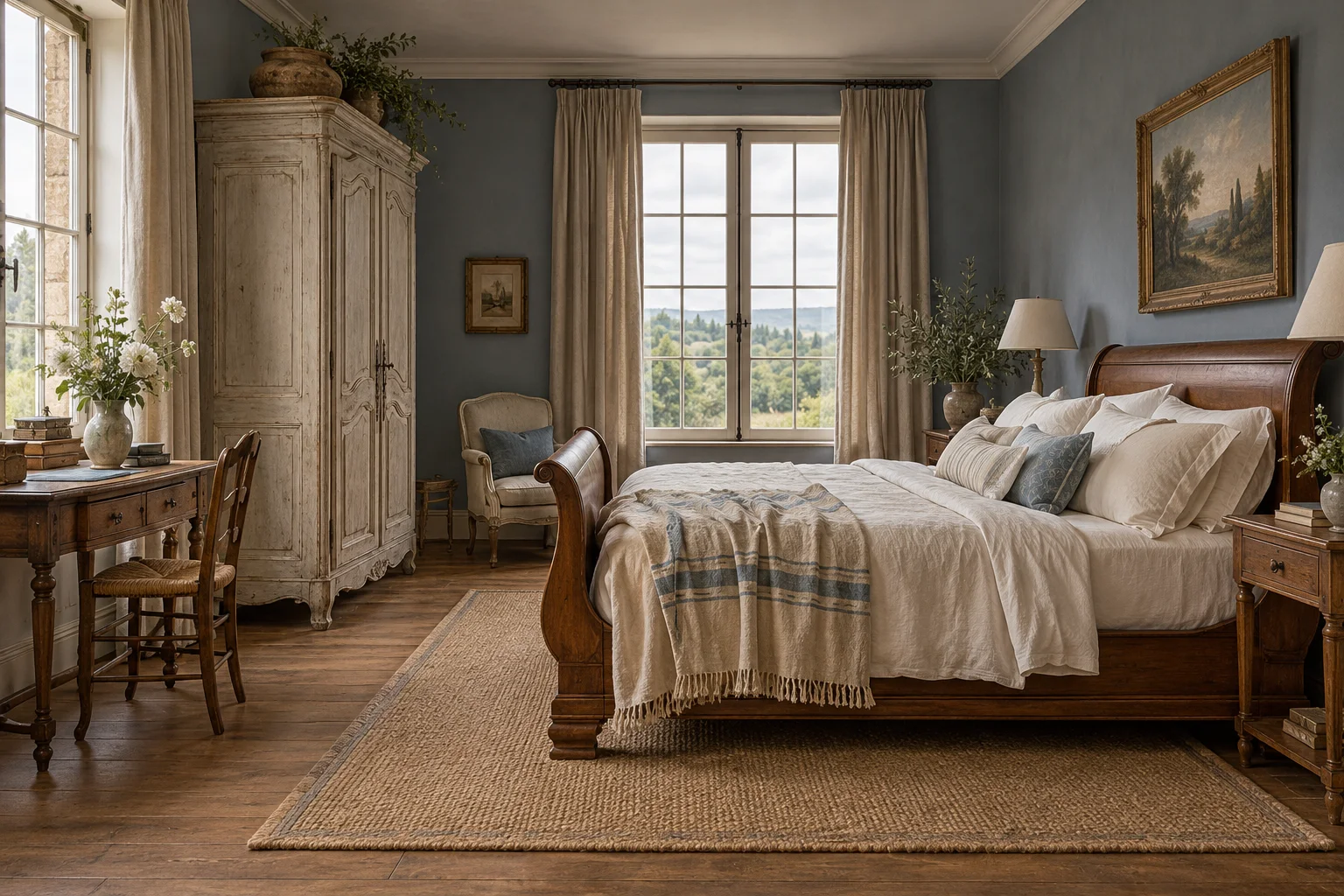
Modern mattresses are a different size from old beds. Measure the inside of the rails, and expect to have a mattress made to size or to fit the frame with adapted slats. Our French country bedroom page shows complete room schemes, and French country fabrics compares toile, gingham and Provençal prints.
| Textile | Where it went | Decisive check |
|---|---|---|
| Toile de Jouy | Headboard panels, canopy, curtains | Fine engraved hatching, matt handle, uneven fading |
| Woven checks (red-blue, blue-white) | Headboard panels, curtains, covers | Hand-woven irregularity, hand-stitched hems, nail holes |
| Hemp or linen sheets | Bedding, often embroidered with initials | Central seam, selvedges, slubs |
| Valances (pantes) | Around the canopy and the bed base | Old ring tapes or tack lines along the top edge |
In Gascony, the bed had a canopy carried on four iron rods fixed to the posts, curtains on rings, and toile de Jouy or red-and-blue or blue-and-white checked cloth nailed to the headboard panels and stretched over the canopy. Inside were a straw mattress, two mattresses, a feather bed, a bolster, a pillow and several blankets.
Farmhouse bedrooms often had no ceiling, high cold rooms and tiled floors. The canopy and curtains kept out the cold air from the roof and made the bed the only warm place at night.
Look for a central seam joining two narrow widths, original selvedges on the long edges, irregular thick threads called slubs, and often embroidered initials. Machine-woven sheets are wide, even and usually seamless.
Toile de Jouy is a printed cotton, usually with pastoral or historical scenes in one colour on a natural ground, named after the manufacture founded by Oberkampf at Jouy-en-Josas in 1760. The name is now used generically for prints of this kind.
Nov 4, 2026 · Antique guide
French country fabrics rest on a few patterns: toile de Jouy, gingham, ticking stripes, Provençal printed florals and plain linen.
Oct 30, 2026 · Antique guide
French country decor ideas work best when each one is concrete: a measurement, a material, a place in the room.