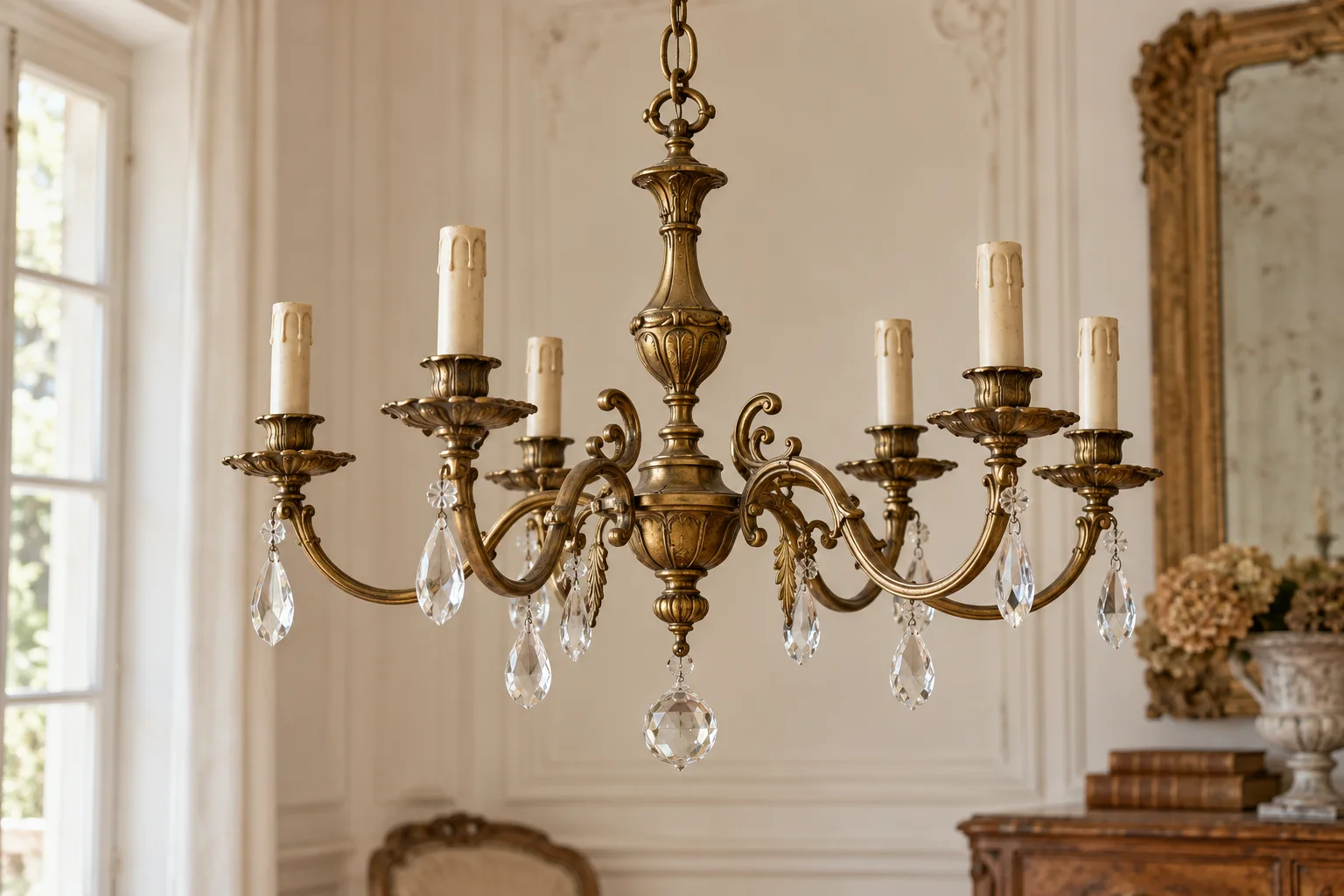
 AI-created styling idea
French Country · An inspiration catalogue
Antique French Lamps & Lighting: The Complete Guide
Antique French lighting covers chandeliers, wall lights, lamps, lanterns and candlesticks made over three centuries, and this guide explains how to recognize each form and material, size it for your room, care for it and make it safe for a US home.
In this guide
The short answers on antique French lighting come first. Name a French light by its form and material, and give it a period only when its construction, a mark or a document supports the date. Expect to rewire: almost every antique lamp or fixture needs its cord, sockets and plug checked, and usually replaced, before daily use in the United States. Size from the room, not from the photograph.
- Bronze, brass and spelter can look alike under gilding; weight, wear and casting tell them apart.
- Have every piece checked, and rewired where needed, by a qualified electrician using UL-listed parts; never plug in a frayed cloth cord.
- Chandelier diameter in inches is roughly the room's length plus width in feet; hang it 30–36 in / 76–91 cm above the table.
Lighting a French country home in layers
Ceiling, wall, lamp and flame
A French country room is rarely lit from a single point. The ceiling layer is a chandelier, a pendant or a lantern on a dimmer. The wall layer is a pair of sconces beside a mirror, a mantel or a bed. The lamp layer sits at seated eye level, where reading and conversation happen. The flame layer is candles on the table and the mantel. Our overview of choosing French country lighting shows the layers in each room.
Warm light at low levels
Old gilding, waxed wood and limewash look best under warm light: bulbs of 2200–2700 K come close to lamp and candle light, and 3000 K suits a kitchen work surface. A living room usually needs three to five sources at different heights. A dimmer on every ceiling fixture lets the evening move from the chandelier to lamps and candles.
Old fixtures, new wiring
Most antique French lamps and chandeliers can be used every day once the electrical parts have been checked or replaced. The metal, glass and paint are what you buy; the cord, sockets and plug are consumables. The same principle runs through French country decor, room by room: old surfaces, current safety.
Antique French chandeliers, form by form
In French, a chandelier is a lustre; a French chandelier is a candlestick, a frequent slip in translated listings. Name a lustre by its form and material first. For the stylistic sequence, read French chandelier styles from Louis XV to Art Deco.
Crystal chandeliers and cage forms
The French crystal chandelier began as a metal frame, or cage, hung with drops (pampilles) and chains of faceted buttons. Eighteenth-century examples are rare outside museums; most on the market were made in the nineteenth or twentieth century in the Louis XV or Louis XVI manner. Count drops against empty hooks and ask whether replacements are disclosed. Our list of checks before buying a crystal and brass chandelier covers frames, arms and missing pieces.
Gilt bronze and brass chandeliers
Cast bronze or brass arms on a central baluster, gilded or bright, carry the formal French chandelier. Cast arms are heavy and crisp in the hollows; stamped sheet brass is light. Gilt bronze (bronze doré) should be dusted, not polished, because the gold layer is thin. The page on antique brass and bronze explains how to tell the metals apart.
Empire chandeliers
The Empire form is a gilt-bronze ring hung from chains, carrying candle arms, with a bowl or a fringe of drops below. Pieces made during the Empire itself (1804–1815) and just after are far rarer than the twentieth-century Empire style. Read the casting, chains and arm fixings before trusting a label; reading an Empire chandelier's ring, chains and crystal takes each part in turn.
Basket and Montgolfier chandeliers
In a basket, or bag, chandelier, strands of drops hang from a ring and gather below into a bowl. The Montgolfier form, named after the hot-air balloons of the 1780s, swells into a balloon of crystal. Both depend on complete strands: re-stringing is normal maintenance, but a strand of new pressed glass among old crystal shows in daylight. See how the crystal basket form is built.
Tole chandeliers
Tole (tôle peinte, painted sheet metal) chandeliers carry painted leaves and flowers in cream, green or several colors around a central stem. Check for rust lifting the paint, fresh paint over old damage and arms re-soldered at odd angles. Our guide to painted tole lamps and chandeliers lists the condition points.
Wrought iron and wood country chandeliers
Forged iron, sometimes with a turned wooden body or glass beads, is the everyday country chandelier: lighter in look, often shallower, and suited to ceilings of 8–9 ft / 2.4–2.7 m. Hand forging shows slight irregularity and riveted or collared joints; smooth weld beads point to recent work. See iron, wood and tole chandeliers for lower ceilings, then browse chandeliers by form.
Wall sconces and French appliques
Bronze, brass and crystal appliques
An applique is a wall light: a back plate with one to five arms, cast in bronze or brass, often gilt and sometimes hung with crystal drops. Pairs are the norm in French rooms, and a matched pair is worth more than two singles because pairs separated over the years are hard to reunite. Our guide to antique French wall lights in bronze, tole, iron and crystal covers each family.
Tole and iron sconces
Tole and iron sconces are the country version: painted leaves, one or two candle cups, sometimes a tin reflector. Many were made for candles and electrified later, so a hole through the back plate and a socket in the candle cup are normal. Check that fresh paint has not been laid over rust.
Back plates, heights and junction boxes
Mount the center of a sconce 60–66 in / 152–168 cm from the floor, and 54–58 in / 137–147 cm beside a bed or a reading chair. Antique back plates are often smaller than a US junction box; an electrician can fit an adapter plate or a new canopy so the box is fully covered. Compare pairs of wall sconces by back plate size.
French table lamps: bouillotte, converted, ceramic, opaline and brass
The bouillotte lamp
The bouillotte lamp, pronounced roughly "boo-YOT", takes its name from a card game played in France in the late eighteenth century, and the form is usually associated with the Louis XVI and Empire years. A brass or bronze stem carries two or three candle arms with drip pans and a tole shade that slides on the stem to shield the eyes. Most pieces sold today are later electrified versions or reproductions, which is acceptable when declared. Read the history and buying points of the bouillotte lamp before choosing a pair.
Candlestick, candelabra and oil-lamp conversions
Many French table lamps began as candlesticks, candelabra or oil lamps. A sympathetic conversion is visible and reversible: the cord leaves through an existing opening or a small discreet hole, the socket sits in the candle cup or burner collar, and nothing original has been cut away. See candelabras converted to lamps and converted oil lamps, bouillottes and student lamps in brass.
Ceramic and faience bases
Glazed earthenware and faience bases, from nineteenth-century vases made into lamps to studio forms of the 1950s and 1960s, bring color to a side table. Attribute a ceramic base to a maker or a town only by a mark: "Vallauris" without a mark describes a look, not an origin. Check for drilled holes, hairline cracks and retouched glaze under raking light. Vintage French lamps, from the bouillotte to the 1950s ceramic base, covers these forms in more depth.
Opaline and glass lamps
French opaline, a semi-opaque glass in white, blue, pink or green, appears as lamp bases, globes and shades. Nineteenth-century pieces are usually blown and finished by hand, with a ground scar under the foot; later opaline tends to be more even in color and wall thickness. See opaline and glass globe lamps and the catalogue of French opaline glass.
Brass, bronze and wooden bases
Brass columns and balusters, bronze figures and turned or gilded wood make up most other French lamps. Weight is the first test for metal: cast brass and bronze are heavy, while spelter is lighter and gray where worn. Wooden bases crack along the grain as they dry; a stable crack is not a defect, a moving one is. Read turned wooden lamp bases and their finishes, or browse the antique lamp catalogue.
Floor lamps and reading lights
Wrought iron and brass floor lamps
The French floor lamp (lampadaire) is usually a wrought-iron stem on a tripod or a weighted foot, or a brass column on a heavy base, most often from the 1920s to the 1960s. A liseuse is a reading lamp with an adjustable arm or shade. For a seated reader, the bottom of the shade sits 58–64 in / 147–163 cm from the floor, just below eye level so the bulb stays hidden. Our guide to wrought iron, brass and reading floor lamps covers the forms; standing lamps in the catalogue show them in rooms.
Stability and the cord
Push the stem gently at shoulder height: a floor lamp that rocks needs a heavier base or a leveled foot. Run the cord behind furniture, never under a rug, where wear goes unseen. Our piece on a window reading corner shows chair, table and lamp together.
Lanterns and pendants: hall, market and garden
Hall lanterns
The hall lantern (lanterne de vestibule) hangs in an entry or a stairwell: a glazed cage of bronze, brass or iron with candle arms or a single socket. Old glass is thin and slightly wavy; a panel replaced with modern glass is acceptable when it is declared. Keep at least 7 ft / 2.1 m of headroom wherever people walk underneath.
Market, stable and carriage lanterns
Portable lanterns with a carrying ring, made for barns, markets and carts, survive in tin, iron and copper with glass or horn windows. Carriage lanterns have a bracket and a reflector. Many now serve as candle lanterns; an electrified one needs the same check as any other fixture. Our guide to hall, market and garden lanterns gives sizes by door.
Garden and outdoor lanterns
A lantern moved outdoors needs a conversion rated for damp or wet locations, or a sheltered place under a porch; otherwise, use it with a candle. Beside a door, a wall lantern of about one quarter to one third of the door's height usually looks in scale. Browse antique lanterns, and see the French country garden for the furniture around them.
Pendants over islands and tables
Enamel factory shades, opaline bowls and small tole pendants suit a kitchen. Hang them 30–36 in / 76–91 cm above the work surface and 24–30 in / 61–76 cm apart in a row. Read kitchen pendants, lanterns and their spacing, browse hanging pendant lights, and see how they fit the whole French country kitchen.
Candlesticks and candelabra: the layer before electricity
Candlesticks
A bougeoir is a candlestick, a flambeau a taller, more formal one, and the bobèche the removable drip pan. Brass, bronze, silver plate and pewter are the usual materials; weighted bases and screw-together sections are normal construction. Date a candlestick by construction and marks, not by style. See antique French candlesticks in brass, bronze and silver plate and Lo Cantou's brass candlesticks and candle holders.
Candelabra
A candélabre carries several arms, often removable, on one stem. Check that the arms belong to the stem (same alloy, same wear, same thread) and that the piece stands level when loaded. The arms, weight and surface of a brass candelabra covers the details, and candle holders for the table shows pairs in use.
Burning candles safely
Use candles that fit the cup without wedging, keep flames at least 12 in / 30 cm from curtains, greenery and shades, and never leave candles burning in an empty room. Let dripped wax harden and lift it with a wooden or plastic tool; metal blades and hot water damage gilding.
French industrial lamps: Jieldé, Gras and enamel shades
The Jieldé lamp
The Jieldé is an articulated steel work lamp usually dated to 1950 and credited to Jean-Louis Domecq in Lyon; the name sounds out his initials. It is known for joints that carry current without loose wire at the hinges, so the arms can turn again and again. Production has continued in France, so a Jieldé can be vintage or recent; labels, paint and wear tell the age better than the form.
The Lampe Gras
The Lampe Gras is credited to Bernard-Albin Gras and usually dated to the early 1920s. It is known for a plain steel arm on a round foot, a desk clamp or a wall bracket, used in offices, workshops and studios. The design has been reissued under license in recent years, so ask for maker's stamps and compare them with documented originals before paying a vintage premium.
Enamel workshop shades
Enameled steel shades, white inside and green, gray or blue outside, came from workshops, schools and stations. Chipped enamel is normal; rust spreading under the enamel is not. Read Jieldé and Gras lamps in detail for originals versus reissues, and look through vintage and industrial lighting.
Art Nouveau and Art Deco glass lamps
Art Nouveau: cameo glass and plant forms
French Art Nouveau lamps, from roughly 1890 to 1910, use acid-etched cameo glass in layered colors, plant and insect motifs, and bronze or spelter bases in organic shapes. The glasshouses of Nancy are central to the story: Gallé is known for cameo glass, Daum for etched and enameled glass. The style page on Art Nouveau at home gives the wider context.
Art Deco: pressed glass, pâte de verre and mushroom lamps
Art Deco lamps of the 1920s and 1930s favor geometric bronze or chrome mounts, thick pressed or frosted glass, bowls hung from three chains (vasques) and the domed mushroom lamp (lampe champignon). Muller Frères is known for ceiling bowls and shades, Daum for heavy etched glass and pâte de verre. See the Art Deco style and Art Nouveau and Art Deco lamps in glass and bronze.
Signatures and attribution
Attribute a glass lamp only by its signature, and treat the signature as the start of the check, not the end: engraved and etched signatures have been added to unsigned or later glass. Compare the mark, the glass and the mount with documented examples, and ask whether shade and base were made together. A "Gallé-style" lamp describes an inspiration, not a maker.
Materials: bronze, brass, spelter, crystal, tole, iron and opaline
Bronze, brass or spelter
Brass, an alloy of copper and zinc, shows yellow where worn; bronze, copper and tin, shows a warmer brown. Both are heavy and non-magnetic. Spelter (régule), a cast zinc alloy, was bronzed or gilded to imitate them; it is lighter, silvery gray where the finish has worn, and it snaps rather than bends. Spelter is not a fake, but a listing should name it. Older gilt bronze was fire-gilded with mercury and shows crisp chasing with matt and burnished contrast.
Crystal or glass
Lead crystal is heavier, clearer and more refractive than ordinary glass, and cut drops have flat facets with sharp edges. Pressed glass drops have softer edges and sometimes faint mold seams. Natural rock crystal (cristal de roche) appears on rare early chandeliers; it feels cold, often holds tiny inclusions, and should be attributed by testing, not by description.
Tole and wrought iron
Tole is sheet iron, often tin-plated, then painted or lacquered; it is magnetic and rusts wherever the paint breaks. Wrought iron was hammered by hand and shows uneven sections, scrolls, collars and rivets. Cast iron is grainy and brittle, and modern steel shows machine-even bars and welds.
Opaline
Opaline is glass made semi-opaque, then blown or molded. Held to the light, some nineteenth-century opaline shows an amber or pinkish glow at the edges. Rim chips and drilled holes are the main condition points.
| Material | How it reads | Common issue | Care |
|---|---|---|---|
| Gilt bronze | Heavy, crisp chasing, warm gold | Worn gilding on high points | Dust only, never polish |
| Brass | Heavy, yellow at wear points | Old lacquer gone patchy | Dust; polish bare brass rarely |
| Spelter | Lighter, gray where worn | Snapped arms, soldered repairs | Dust; avoid bending |
| Crystal | Heavy, sharp facets, strong rainbows | Missing or replaced drops | Wash drops off the frame |
| Tole | Thin painted metal, magnetic | Rust lifting paint, repainting | Dry brush, no water |
| Wrought iron | Hand-hammered, riveted joins | Surface rust, recent welds | Dry dusting, thin wax |
| Opaline | Semi-opaque, soft color | Rim chips, drilled holes | Lukewarm water, no dishwasher |
Periods and styles: dating antique French lamps
The dates below are approximate and describe when a style was current. Period means made at the time; style means made in that manner later, sometimes a century later. Construction tells them apart: casting, threads, wiring routes and wear. The French country antiques guide applies the same distinction to furniture.
| Period (approx.) | Lighting you will meet | What to look for |
|---|---|---|
| Louis XIV and Régence, c. 1650–1725 | Candle chandeliers with cage frames, bronze candlesticks | Rare; most pieces are later style |
| Louis XV, c. 1725–1775 | Rococo gilt-bronze sconces, scrolling arms | Asymmetry and shells; many revivals |
| Louis XVI and Directoire, c. 1775–1800 | Neoclassical sconces, early bouillotte lamps | Straight lines, ribbons, laurel, urns |
| Empire and Restauration, c. 1800–1830 | Ring and basket chandeliers, oil lamps | Gilt and dark bronze together, palmettes |
| Louis-Philippe to Napoleon III, c. 1830–1870 | Mechanical oil lamps, opaline, gas fittings | Revival mixtures, oil burners |
| Belle Époque and Art Nouveau, c. 1880–1914 | Early electric fixtures, cameo-glass lamps | Sockets set in candle cups |
| Art Deco, c. 1920–1940 | Ceiling bowls, mushroom lamps, chrome | Geometry, frosted and pressed glass |
| Mid-century, c. 1945–1975 | Ceramic bases, opaline globes, work lamps | Labels, original plugs and sockets |
Candle, oil, gas and electricity
Until the late eighteenth century, French rooms were lit by candles. Improved oil burners from the 1780s, and the pump and spring-driven oil lamps of the nineteenth century, made lamps far brighter. Gas reached city streets and some interiors during the nineteenth century, and electric light spread through French towns from the 1880s but reached many country houses only decades later. Many fixtures were therefore made for candles or oil and converted, sometimes twice.
French provincial lighting
Provincial makers adapted court forms in simpler materials: iron for bronze, tole for gilding, turned wood for cast baluster stems. A provincial piece is not a lesser version but a different object, judged on its own construction. The French Provincial style page covers the furniture that goes with it.
Vintage French lamps in a US home: voltage, sockets and plugs
This section explains what to check and what to ask for. It is not a wiring guide: have every antique lamp or fixture checked, and rewired where needed, by a qualified electrician or lighting restorer using UL-listed parts.
230 V in France, 120 V in the US
France supplies 230 V at 50 Hz; a US home supplies 120 V at 60 Hz. A simple lamp of cord, switch and socket has no voltage-specific part except the bulb, so the real problems are age and format: perished insulation, European sockets and plugs that do not fit. Lamps with built-in transformers, dimmers or ballasts are different and need an electrician's assessment.
Sockets: E14, E27 and bayonet versus E12 and E26
French lamps usually carry E14 (small) or E27 (standard) screw sockets, or bayonet sockets (B15, B22) on many older pieces. US lighting uses E12 candelabra and E26 medium screw sockets. The sizes are close but not identical, and forcing a US bulb into a European socket, or the reverse, is not a safe fix. The usual answer is a UL-listed E12 or E26 socket of similar size, fitted by the electrician, with the original part kept with the lamp.
Plugs, adapters and cord
A travel adapter changes the shape of a French plug, not the condition of the cord behind it. Ask for a polarized US plug and new UL-listed cord. Old cloth-covered cord often hides rubber insulation that has gone brittle: never use a lamp with frayed, cracked or taped cord, even for a quick test. A listed cloth-covered cord keeps the look if you prefer it.
Chandeliers, sconces and weight
Hard-wired fixtures are installed by a licensed electrician. A standard US ceiling box is generally rated for fixtures up to about 50 lb / 23 kg unless it is marked otherwise; a large crystal or bronze chandelier can exceed that and then needs a box rated for the weight or separate support. Ask for the chain, hook and top loop to be checked along with the wiring. Our guide to voltage and rewiring for a French lamp in the US explains when an electrician is needed and what the work includes.
Sizing and placement rules, in inches and centimeters
Chandelier diameter and height
Add the room's length and width in feet and read the sum as inches: a 12 × 14 ft (3.7 × 4.3 m) room suits a chandelier about 26 in / 66 cm across. Over a table, aim for one half to two thirds of the table's width. For the body's height, allow about 2.5–3 in per foot of ceiling (21–25 cm per meter), so a 9 ft ceiling suits a fixture about 22–27 in / 57–69 cm tall.
Hanging heights
Over a dining table, hang the lowest point 30–36 in / 76–91 cm above the top with an 8 ft / 2.4 m ceiling, adding about 3 in / 8 cm for each extra foot of ceiling. Center the chandelier on the table, not the room. The French country dining tables page gives the table widths to size against.
Lamp and shade proportions
Beside a sofa, the bottom of a lamp shade looks right near seated eye level, roughly 38–42 in / 97–107 cm from the floor. On a nightstand close to mattress height, a lamp of 24–28 in / 61–71 cm usually brings the shade to chin level when you sit up in bed. As a starting point, the shade's bottom diameter roughly equals the base height from foot to socket, and the shade's height is about two thirds of that. Sizing French country table lamps works through bedside and living room examples.
| Fixture | Rule | Inches | Centimetres |
|---|---|---|---|
| Chandelier over a table | Lowest point above the top, 8 ft ceiling | 30–36 in | 76–91 cm |
| Fixture in a walkway | Minimum headroom | 84 in (7 ft) | 213 cm |
| Wall sconce | Center from the floor | 60–66 in | 152–168 cm |
| Sconce by a bed or chair | Center from the floor | 54–58 in | 137–147 cm |
| Pendants over an island | Above the surface / apart | 30–36 / 24–30 in | 76–91 / 61–76 cm |
| Reading floor lamp | Shade bottom from the floor | 58–64 in | 147–163 cm |
| Table lamp by a sofa | Shade bottom from the floor | 38–42 in | 97–107 cm |
| Candle flame | Distance from curtains or greenery | 12 in minimum | 30 cm minimum |
Lamp shades for French lamps
Shapes
The Empire shade, narrow at the top and flared at the bottom, suits baluster and candlestick bases. The drum suits columns and ceramic forms; bell and pleated shades suit Louis XV and figural bases; small clip shades dress candelabra lamps and sconces. The bouillotte keeps its own flat tole shade, often dark green, black or red outside and pale inside.
Materials and linings
Pleated silk and linen soften light; card and paper shades throw a directed pool; parchment and tole cut glare almost entirely, so pair them with a second source. The lining shapes the light: white reflects more, gold or pink warms it.
Fitters after rewiring
European lamps often hold the shade with a ring that screws onto the socket. After rewiring with a US socket, the shade needs a matching fitting: a harp and finial, an uno fitter that sits on the socket, or a clip that grips the bulb. Choose the shade with the electrician, because the socket decides the fitter. See shade shapes, fabrics and fitters.
French country lighting, room by room
Living room
A chandelier or none at all, a pair of sconces at the mantel or mirror, two or three table lamps and a floor lamp by the reading chair. In the French country living room, lamps do most of the evening work; the center light is for cleaning and parties.
Dining room and kitchen
Over the dining table, a chandelier on a dimmer with candles on the table and a candelabra lamp on the buffet. In the kitchen, pendants or a lantern over the island, a small chandelier over the eating table and sconces near open shelves. Enamel, glass and iron clean easily where there is steam and grease.
Bedroom
A pair of bedside lamps or swing-arm sconces, a small crystal or tole chandelier and warm bulbs. Painted bases and crystal drops belong here; see shabby chic lamps with painted bases and crystal drops and the French country bedroom.
Entry, hall, study and bathroom
A hall lantern or a pair of sconces at the mirror, with a lamp on the console, sets the entry. A study takes a brass desk lamp or an industrial lamp and a floor lamp by the armchair. In a bathroom, use only fixtures converted and rated for damp locations, placed where code allows; the electrician decides.
How to choose antique French lighting: value and the buyer's checklist
What affects value
Completeness, originality and quality matter more than age alone: every arm, drop, shade and finial present, crisp casting, original paint or gilding, and a matched pair when the piece was made as one. A documented maker adds value only when the mark checks out. Proper rewiring does not lower value; a conversion that cut into the piece does. We do not quote prices, which vary with each piece and the market.
Questions to ask the seller
Ask for every dimension in inches and centimeters, the weight, the wiring status and photographs of the back plate, top loop, sockets and every repair. A seller who documents each flaw makes the decision easier.
Your buying checklist
Caring for antique lamps and chandeliers
Crystal and glass
Switch off the circuit and let the bulbs cool, then dust the drops with a soft brush. For a deeper clean, wash the drops off the frame, as described in the questions below.
Brass and bronze
Dust regularly. Every polish removes a little metal and patina, so polish bare brass rarely, never polish a lacquered surface and never polish gilt bronze. The conservation notes on brass listed below describe gentler methods.
Tole, iron and paint
Dust with a soft, dry brush; water lifts flaking paint and starts rust. A thin coat of microcrystalline wax protects bare iron indoors. Keep painted tole away from hot bulbs; LED bulbs run cooler.
Shades
Vacuum fabric shades through a soft brush and spot-clean only. Replace a shade that has split or browned, and keep the old frame if it fits.
Buying antique French lighting in France: shipping and import
Age documents and customs
Antiques documented as more than 100 years old fall under heading 9706 of the US tariff schedule, which carries a zero general duty rate, subject to classification confirmed for each piece. Younger lighting is classified as lighting fittings, with its own rate. Customs decides the classification, so ask for written age documentation and an invoice that describes the piece; a licensed broker confirms the duty for each shipment.
Packing chandeliers and glass
Chandeliers travel dismantled: arms and drops are removed, numbered and photographed so the piece can be rebuilt. Export crates are made of heat-treated wood stamped to the ISPM 15 standard. Ask how the drops will be packed apart from the frame.
Rewired before or after shipping
Rewiring in France with UL-listed parts, described in the condition report, saves a step on arrival; rewiring by a local electrician after delivery works equally well. Either way, the work should be written down and the removed parts kept.
Where to look
Homeowners can start with Lo Cantou's current listings, which give condition details for each piece. Designers can send a brief to Antiques 360 for three documented pieces within 72 hours from established dealers in Occitanie and southwest France, rewired to US standards and crated to ISPM 15, with the landed cost known upfront.
Glossary of French lighting terms
| French term | Meaning |
|---|---|
| abat-jour | Lamp shade |
| applique | Wall light, sconce |
| bobèche | Drip pan below a candle |
| bougeoir | Candlestick |
| bouillotte | Table lamp with candle arms and an adjustable tole shade |
| bronze doré | Gilt bronze, often called ormolu in English |
| candélabre | Candelabra, several arms on one stem |
| chandelier | Candlestick, not a ceiling fixture |
| douille | Socket, lamp holder |
| fer forgé | Wrought iron |
| flambeau | Tall, formal candlestick |
| lampadaire | Floor lamp |
| lampe champignon | Mushroom lamp |
| liseuse | Reading lamp |
| lustre | Chandelier |
| pampille | Glass or crystal drop |
| plafonnier | Ceiling light fixed close to the ceiling |
| régule | Spelter, a cast zinc alloy |
| suspension | Pendant light |
| tôle peinte | Painted sheet metal, tole |
| vasque | Glass bowl ceiling light hung on chains |
Explore antique French lighting by object
AI-created styling idea AI-created styling idea
 AI-created styling idea
Lighting
Antique lamps
Look for reversible conversions, original shades and a stated wiring status.
Explore AI-created styling idea
 AI-created styling idea
 AI-created styling idea
Lighting
Candlesticks & candelabras
Arms that belong to the stem, level bases and drip pans present.
Explore AI-created styling idea
 AI-created styling idea
Lighting
Vintage lighting
Work lamps and mid-century pieces: labels, sockets and enamel condition.
Explore AI-created styling idea
Glass
French opaline glass
Check rims for chips, bases for drilled holes and color for evenness.
ExploreFrequently asked questions
What is a bouillotte lamp?
A bouillotte lamp is a French table lamp with a central brass or bronze stem, two or three candle arms and an adjustable tole shade that slides on the stem. The name, pronounced roughly "boo-YOT", comes from a card game played in France in the late eighteenth century. Most pieces sold today are later electrified versions or reproductions, acceptable when declared.
Can I use a lamp bought in France in the US?
Yes, once it has been checked and, usually, rewired. France supplies 230 V and the US 120 V, but for a simple lamp the real issues are old cord, European sockets such as E14, E27 or bayonet, and a French plug. Have a qualified electrician fit UL-listed sockets, cord and a polarized plug, and do not rely on a travel adapter.
Does an antique chandelier need special installation?
Yes. A chandelier or sconce is hard-wired, so a licensed electrician installs it. A standard US ceiling box is generally rated for fixtures up to about 50 lb / 23 kg unless marked otherwise, and heavier crystal or bronze pieces need a box rated for the weight or separate support. Ask for the chain, hook and top loop to be checked as well as the wiring.
How can I tell if an antique French lamp is valuable?
Look at completeness, originality and quality before age: every arm, drop, shade and finial present, crisp casting, original paint or gilding, and a matched pair when the lamp was made as one. A maker's mark adds value only when it checks out against documented examples. For insurance or a sale, ask a qualified appraiser.
How high should a chandelier hang over a dining table?
With an 8 ft / 2.4 m ceiling, the lowest point of the chandelier should sit 30 to 36 in / 76 to 91 cm above the tabletop; add about 3 in / 8 cm for each extra foot of ceiling. Center the fixture on the table rather than the room, and keep it well inside the table's edges.
What size shade does an antique table lamp need?
Start with a shade whose bottom diameter is about the height of the base from foot to socket, and whose height is about two thirds of that base height. The lower rim should hide the socket from a seated position. Empire shades suit baluster and candlestick bases, drums suit columns, and the fitter must match the socket fitted during rewiring.
How can you tell bronze from brass or spelter?
Start with weight and wear. Bronze and brass are heavy and non-magnetic; brass shows yellow where worn, bronze a warmer brown. Spelter, a cast zinc alloy, is lighter, shows silvery gray where the finish has worn and tends to snap rather than bend. Gilding can hide all three, so look at worn edges, the underside and the screw holes.
How do you clean an antique crystal chandelier?
Switch off the circuit and let the bulbs cool first. For a full clean, photograph the fixture, remove the drops section by section, wash them in lukewarm water with a little neutral detergent, then rinse and dry them before rehanging. Never spray cleaner onto a hanging fixture, because liquid runs into the sockets and onto the metal.
Sources & further reading
- Canadian Conservation Institute — CCI Notes 9/3: The Cleaning, Polishing and Protective Waxing of Brass and Copper — cleaning, polishing limits and waxing for brass.
- Canadian Conservation Institute — Care of metal objects — dusting and corrosion prevention for bronze, iron and tole.
- Canadian Conservation Institute — Caring for ceramic and glass objects — handling and cleaning glass drops, opaline and ceramic bases.
The guides
Nov 6, 2026 · Antique guide
French Country Thanksgiving Table: Setting It with Antiques
A French country Thanksgiving table takes its look from the farmhouse: a linen cloth, white ironstone or faience plates, mixed silverplate, short bistro glasses,…
Nov 5, 2026 · Antique guide
French Country Christmas Decor with Antiques and Candlelight
French country Christmas decor works best when it borrows from the house rather than from a store: brass candlesticks taken down from the mantel, greenery cut from…
Nov 5, 2026 · Antique guide
Mid-Century French Table Lamps 1950–1975: A Buyer's Guide
Mid-century French table lamps, made between about 1950 and 1975, fall into three families: glazed ceramic bases, articulated lamps and space-age designs.
Nov 2, 2026 · Antique guide
French Country Gifts: 15 Antique and Vintage Ideas
French country gifts that travel well are small, sturdy and useful: a linen tea towel, a brass candlestick, a confit pot, a set of silver-plated spoons.
Nov 1, 2026 · Antique guide
French Country Chandelier Styles: Iron, Wood, Tole and Beads
A French country chandelier is lighter in spirit than its crystal cousins: forged iron, turned wood with tole leaves, painted sheet metal with flowers, or wooden…
Nov 1, 2026 · Antique guide
Vintage Globe Lamp Guide: Opaline Globes, Fitters and Bulbs
A vintage globe lamp is a glass sphere on a metal fitting: opaline or milk glass, clear or smoked, on brass, chrome or lacquered steel from the 1950s to the 1970s.