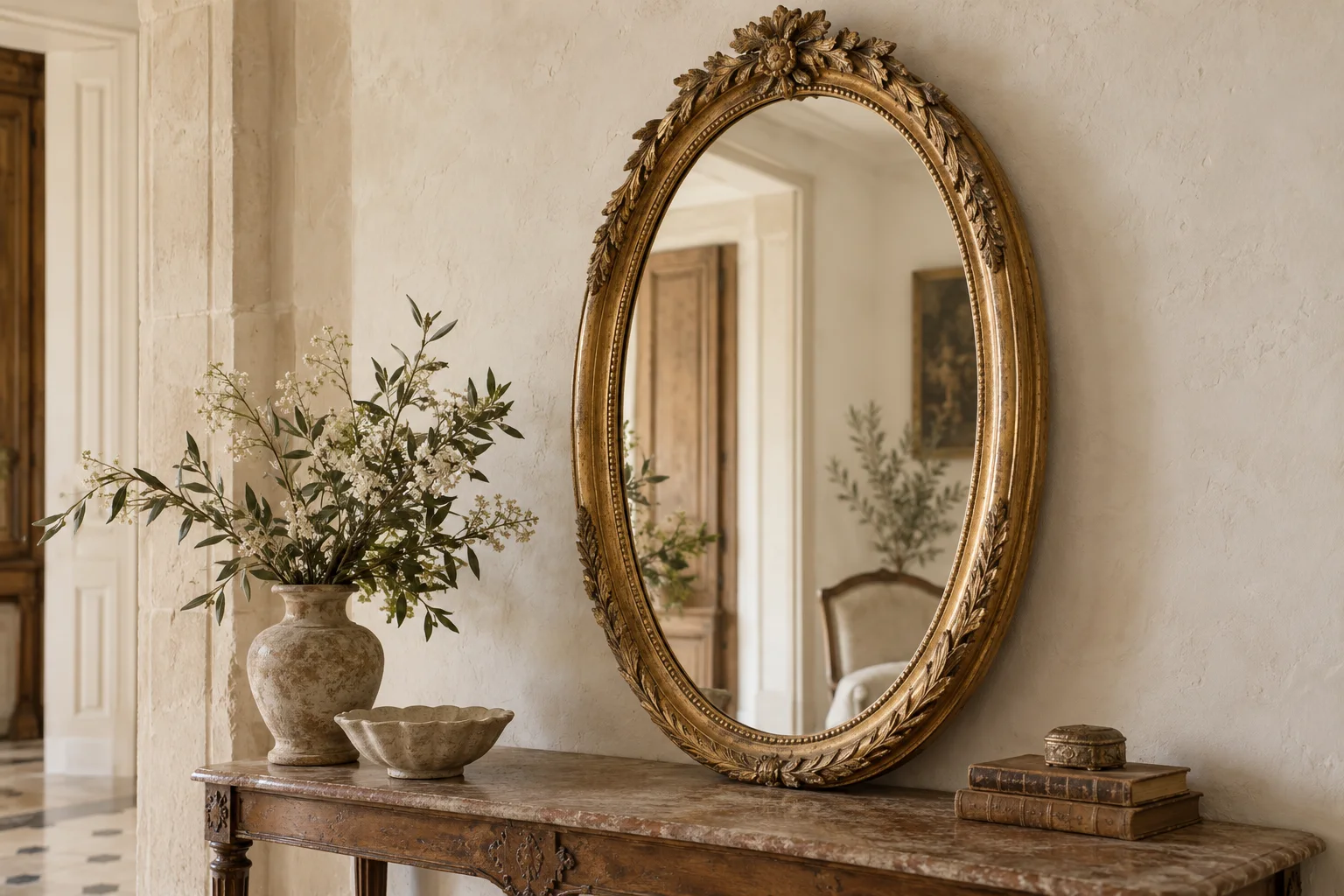
 AI-created styling idea
Mirrors
Antique mirrors
Read the frame, the plate and the back separately before choosing a form.
ExploreFrench Country · An inspiration catalogue
Antique French mirrors are read in three parts, the frame, the glass and the back, and this guide shows how to judge each one, period by period, before you buy, hang or restore a mirror.
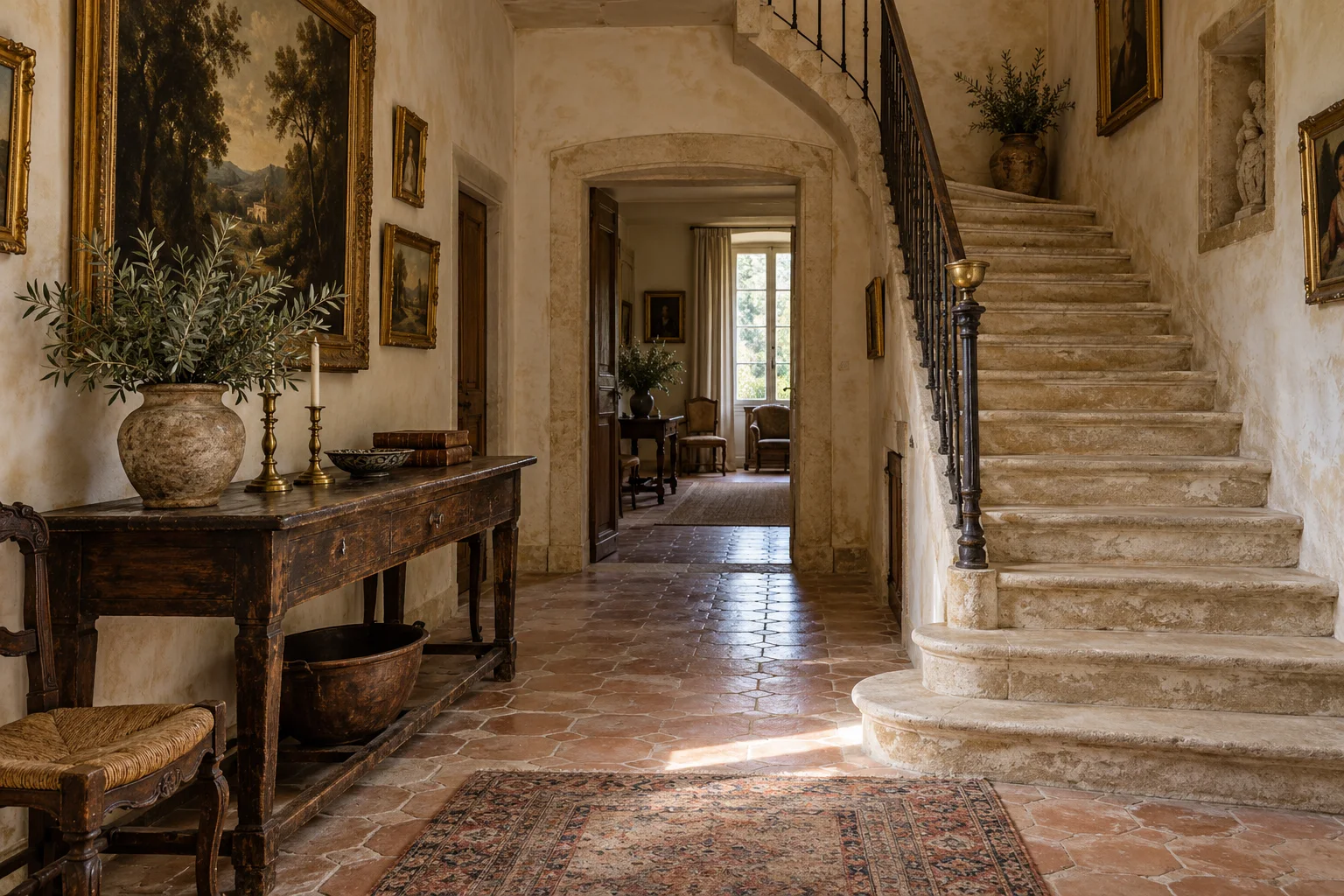
The short answer: antique French mirrors are identified by their proportions and ornament, dated by their construction, and judged by how much original gilding and glass survives. A style name describes an inspiration; only a mark, a label or a document supports a date or a maker. This page extends our hub on French country mirrors and wall decor, part of French country decor, room by room.
French mirrors tend to be tall rather than wide, with the ornament gathered at the top. Many 18th-century and revival frames carry a crest, the fronton, above the glass; the Louis-Philippe frame replaces it with rounded upper corners. An antique French mirror was planned with the paneling, so it looks right when centered on something.
French carvers shared a pattern language that changed with each reign: shells and C-scrolls for the rocaille of the mid-18th century, pearl beading and ribbon-tied crests for Louis XVI, palmettes and wreaths for the Empire. Every motif was revived in the 19th century, so ornament gives the style. Our guide to carved wood mirrors with garlands and quatrefoils follows the floral motifs.
Paris frames are usually carved oak or softwood under gesso and gilding; provincial frames use walnut, oak, pine and fruitwood, often painted or waxed. On an old frame, the plate rests in a rabbet, held by small wooden blocks or wedges and closed by a backboard of planks. That construction separates old from new better than the front does. Regional work is covered in French Provincial mirrors, carved, painted and gilt.
"Louis XV period" claims that a mirror was made during the reign; "Louis XV style" says only that it follows the form. Attribute a maker or a workshop only by mark, label or document. The French country antiques guide explains what a documented listing should contain.
For much of the 16th and 17th centuries, the finest mirror plates came from Venetian glassmakers on Murano. In 1665, under Colbert, a royal manufactory for mirror glass was founded in France with craftsmen recruited from Venice; Saint-Gobain descends from it. French plate is usually credited with supplying the mirrored arcades of the Hall of Mirrors at Versailles, completed in the mid-1680s.
Blown glass limited the size of a plate. Casting molten glass on a flat metal table, developed in France in the late 1680s, allowed larger and flatter plates, each still ground and polished by hand. Large plates stayed expensive through the 18th century, which is why many tall mirrors of the period use two or more pieces of glass, the joins covered by a molding or simply butted.
Until the mid-19th century, mirror plates were backed with tin foil amalgamated with mercury. Depositing metallic silver from a silver nitrate solution was described in the 1830s and developed into commercial processes in the 1840s and 1850s. The change was gradual, so the back of a plate supports a date range, never a year.
Cheaper plate, molded ornament and the railways brought the gilt mirror into ordinary houses after about 1830. Overmantel mirrors became a standard fitting in many Paris apartments of the Second Empire and after, and provincial homes bought Louis-Philippe frames in large numbers. That is why so many vintage French mirrors on the market are 19th-century work.
Reign dates are fixed; style dates are not. Every style began before its king, outlived him and was revived later, so the ranges below are approximate.
Heavy, symmetrical and architectural: rectangular frames with wide carved moldings, often a pierced crest of acanthus, masks or a radiating sun, gilded over oak. Many use several plates held by narrow molded strips, the parcloses, because large single plates were rare. Look for a deep frame section and a crest that belongs to the structure.
The regency of Philippe d'Orléans lasted only from 1715 to 1723, but the style it names covers roughly three decades. Outlines soften: the top of the frame arches, the crest lightens, and lattice grounds, shells and female masks appear within a layout that stays symmetrical. Régence mirrors bridge the gravity of Louis XIV and the movement of rocaille.
Asymmetry is the signal: C-scrolls, S-scrolls, shells, rockwork and flowers break the outline, and the crest becomes a pierced cartouche. Louis XV reigned from 1715 to 1774, but full rocaille is a mid-century fashion, translated in the provinces into walnut or painted pine. The same taste for the exotic produced the pagoda crests in our look at chinoiserie mirrors in lacquer and gilt.
The line straightens. Rectangular or oval frames are edged with pearl beading, twisted ribbon or laurel and crowned by a ribbon bow, a flower basket, an urn or crossed torches and quivers; many are painted gray or off-white with gilt highlights. The style was forming in the 1760s, before the reign of 1774–1792, and was widely revived in the late 19th century, so many "Louis XVI" mirrors on the market are later.
After the Revolution, ornament turned Greek and Roman: palmettes, laurel wreaths, stars, swans and winged figures. Empire mirrors are rectangular, in mahogany with gilt-bronze mounts or in giltwood with crisp molded ornament, and the full-length swinging mirror, the psyché, became fashionable around 1800.
Under Louis XVIII and Charles X, Empire forms soften. Pale woods such as elm burl, maple and ash, sometimes inlaid with darker wood, appear on dressing mirrors and small frames, while gilt frames carry lighter palmettes and rounded corners. These smaller, more domestic mirrors lead straight to the Louis-Philippe frame.
The July Monarchy gave its name to the most familiar antique French mirror: a rectangular plate under rounded upper corners and a plain or lightly decorated gilt molding, often with palmettes or shells at the corners, usually molded rather than carved. The form stayed in production long after 1848. Our article on recognizing a Louis-Philippe mirror by its corners and plain gilt covers real sizes and period evidence.
Second Empire taste is eclectic: Louis XIV, Louis XV and Louis XVI revivals side by side, heavy crests in molded composition, black-and-gilt frames with brass inlay, and very large overmantel mirrors built into chimney breasts. The guide to choosing and hanging a large ornate mirror deals with the scale and weight they bring.
The decades before the First World War produced revival frames in large numbers, café and bistro mirrors with painted or gilded lettering, beveled plates as standard and chemically silvered glass. These vintage French mirrors are often the most practical choice for daily use, provided they are described as what they are. Our piece on etched mirror patterns, glass and safe care explains the decoration.
Art Nouveau mirrors follow plants rather than architecture: whiplash curves, irises, water lilies and branches carved in walnut, mahogany or oak, sometimes with bronze or copper mounts. The École de Nancy produced the best-known carved examples; attribute one to a named workshop only by mark or document. Our Art Nouveau style page shows the furniture that shares the vocabulary.
Art Deco takes its name from the 1925 Paris exhibition of decorative arts. Mirrors turn geometric: stepped and sunburst frames, deep bevels, etched borders, cushion mirrors with glass framed in glass, and frameless plates with clipped corners; mirrored furniture followed in the 1930s and 1940s, and brass-framed and arched mirrors spread later in the century, as our piece on arched brass mirrors and bronze frames shows, with a magnet test for solid brass in our antique brass and bronze guide. See also our guide to beveled, etched and sunburst Art Deco wall mirrors and the Art Deco style overview.
A trumeau combines a mirror plate with a painted canvas, a carved panel or a second plate above it, in one tall frame. The word first meant the stretch of wall between two windows. Heights of 60–80 in (150–200 cm) are usual. Judge painting, frame and glass separately. Read our trumeau history and identification guide before buying one.
A pier glass hangs on the narrow wall between two windows, often above a matching console, and catches the light from both. An overmantel mirror, the trumeau de cheminée or miroir de cheminée, rests on or above the mantel shelf; widths of 50–70 in (127–178 cm) are common. Low mantels suit long horizontal plates, as our piece on oblong mirror proportions for mantels and halls explains.
The psyché tilts between two uprights on a base, the French cousin of the English cheval glass; Empire and Restauration examples are in mahogany or pale wood with gilt-bronze or brass fittings. See the guide to psyché, cheval and leaning floor mirrors.
The miroir de sorcière, or witch's mirror, is a small convex glass in a round frame, a name with folklore attached; in practice it shows a whole room from one point. The English girandole or bull's-eye mirror adds balls around the frame and often an eagle crest. See convex mirrors, from sorcière to bull's-eye.
Oval frames suit narrow walls, powder rooms and small consoles, and they sit with paintings more easily than rectangles do; the Louis XVI oval with a ribbon crest is the classic French version. Two journal pieces cover them: choosing a vintage oval mirror by frame and glass, and where a small oval mirror earns its place.
Venetian-type mirrors have frames made of glass: shaped mirror segments, etched flowers and applied glass rosettes, sometimes over a wooden core. Many sold in France were made in Venice or in the Venetian manner in the late 19th and 20th centuries,. Read placing a Venetian glass mirror in a country room for inspection and care.
Rocaille literally means rockwork, the shells and stones of garden grottoes, and carved shells run through French frames from the Régence onward. Frames encrusted with real shells form a separate, later family, many of them from the 20th century; check for missing shells, modern glue and loose fragments. Our guide to rocaille, grotto and seashell frames separates carved motifs from encrusted ones.
Small tilting mirrors on a stand or box, the miroir de toilette, stood on dressing tables from the 18th century; hinged triple mirrors belong more to the late 19th and 20th centuries, and a coiffeuse is a dressing table with its own mirror. See toilet, vanity and triple mirrors explained and the dressing tables category.
The armoire à glace, a wardrobe with a mirrored door, became a fixture of 19th-century French bedrooms, and in the 1930s and 1940s whole chests were faced in mirror. Check the plates, the clips and the carcass beneath, as our checks for mirrored chests and furniture set out. For a chest of drawers with its own mirror, see pairing and fixing a French Provincial dresser with mirror.
A French gold mirror frame is built in layers. Carved wood is coated with many thin layers of gesso, chalk bound in animal glue, then smoothed and often recut so the detail stays crisp; French workshops called this recutting reparure. A clay layer, the bole, usually red, ochre or gray, goes on next, and gold leaf is laid over it. Where the gold wears, the bole shows through, and that warm tone on high points is expected on an old frame.
Water gilding lays leaf on wetted bole and can be burnished with an agate stone to a bright shine; the contrast between burnished and matte areas marks good work. It is also soluble in water, which is why a damp cloth can remove it. Oil gilding lays leaf on a tacky oil size; it cannot be burnished, looks flatter and resists moisture better. Our article on reading gilt, gesso and honest wear on a gilded mirror shows how to tell them apart.
Fine 18th-century frames are carved throughout, and the gesso follows the carving. From the late 18th century, and widely in the 19th, ornament was pressed in molds from composition, a putty of chalk, glue, resin and oil, and applied to a plain molding. Composition is not a fault: most Louis-Philippe and Napoléon III frames were made this way. It breaks in clean, granular chips, while carved wood splinters along the grain. Our antique wood furniture guide explains the woods underneath.
Outside Paris, many frames were painted, waxed or left in natural walnut. Louis XVI frames painted gray, off-white or green, with the moldings picked out in a second color or in gilt, are described as réchampi. Fresh, thick paint over old gilding usually hides damage. These regional versions belong to French Provincial style, which adapted court forms for family houses.
On a mercury plate, the reflecting layer is tin foil bonded with mercury, and the back is bare: a gray, metallic, slightly granular surface with no paint over it. The reflection is soft and a little gray. Decay appears as crystalline gray or white patches, often worst at the edges and the bottom. Mercury can remain in the coating, so never sand, scrape, heat or resilver such a plate yourself; handle it with gloves and keep the backboard on.
Chemical silvering deposits a thin layer of metallic silver on the glass and protects it with paint, often red-brown, gray or black; more recent production adds a copper layer. A silvered plate gives a brighter, whiter reflection than a mercury plate. Its failures look different: black spots, dark edges and lines where the protective paint has broken. A painted back on a mirror sold with an 18th-century date is a reason to ask whether the plate was replaced.
Foxing, the French piqûres, is the general name for spots and clouding where the reflective layer has failed. A little foxing confirms age and softens the reflection; heavy foxing in the middle of the plate makes a mirror hard to use. Damp walls, bathrooms and cleaning fluid running behind the frame speed it up. Our guide to antique mirror glass, foxing and resilvering goes through the options plate by plate.
Old plates are rarely perfectly flat: sight along the surface and the reflection of a straight line waves slightly. Old bevels were ground and polished by hand; they are usually shallow and wide, and their width varies along the edge. A sharp, even, narrow bevel suggests a modern or replaced plate.
Search for antique mirror glass and most of what appears is new float glass (the flat-glass process introduced in the late 1950s), chemically distressed to look old. It is an honest replacement when sold as such, and it shows a perfectly flat reflection, repeated mottling and a crisp machine edge.
When a plate is too foxed to use, three options exist. Keep it and accept the reflection, which usually matters most to collectors of period pieces. Replace it with new or antiqued glass and keep the original, labeled, with the mirror. Or have it resilvered, which strips the original coating for good and, on a mercury plate, is specialist, hazardous work. Whichever you choose, disclose it when the mirror is sold.
The back tells more than the front. An old backboard is made of oak or pine planks, often hand-planed, shrunk and darkened by oxidation, and fixed with nails or wedges; paper labels, inventory numbers or chalk marks may survive. Plywood, hardboard or MDF means a later back, which does not prove that the frame is new. Ask for a photograph of the back with every listing, as the journal's mirror placement, frames and condition guide also advises.
Broadly, hand-forged nails have irregular hammered heads and taper on all four sides; machine-cut nails, common through much of the 19th century, taper on two; round wire nails spread in the later 19th century. Slotted screws with uneven threads are older than machine-made ones, while cross-head screws, staples and plastic hangers are modern. Fixings date the last repair, not necessarily the frame.
Genuine wear follows handling: gold rubbed from high points and outer edges, losses on the lower rail and corners, dirt in recesses, and fine gesso cracks that follow the grain of the wood beneath. Artificial distressing is even, appears where nothing would touch, and often repeats the same pattern on both sides.
Many old frames were regilt in the 19th or 20th century, some more than once. A full regild looks uniformly bright and may sit over filled losses. Gold paint made from bronze powder darkens to a brown or greenish tone and lacks the flat sheen of leaf. A regild is not a fake, but the listing should say so.
A married mirror combines parts of different objects: a crest from one frame on another, a later painting in an older trumeau, a new plate in an old frame. Reproductions from the late 19th century onward copy every period; recent ones often use resin ornament that sounds hollow when tapped, stapled corners and sprayed finishes. A change in carving quality between crest and frame is the usual clue.
On an open wall, set the center of the mirror at 57–60 in (145–152 cm) from the floor. Above a console, a sideboard or a mantel, leave 4–8 in (10–20 cm) between furniture and frame, and keep the frame at about 60–75 percent of the width of the piece below. A flat mirror only needs to be about half your height to show you head to foot, if its top edge sits a little above eye level. Our French country mirror ideas, room by room apply these rules to real walls.
Over a fireplace, an overmantel or trumeau mirror is the classic French choice, but check the arithmetic. In an 8 ft (244 cm) room with a mantel shelf at 50 in (127 cm), a gap above the shelf and below the ceiling leaves room for a mirror about 36–40 in (91–102 cm) high. A trumeau of 60–80 in needs a ceiling of 10 ft (3 m) or more. Our French country living room guide plans the whole fireplace wall.
A mirror above a console by the door is the simplest French arrangement, and it brings light into a dark hall. Choose a frame narrower than the console and keep the 4–8 in gap. In a corridor under 40 in (100 cm) wide, prefer a flat frame without a projecting crest. See the entryway scenes and the hallway and staircase ideas.
Above a sideboard, a mirror doubles the candlelight and the chandelier. Hang it so that seated diners see the room and the windows rather than themselves; a lower edge 4–8 in above the sideboard top usually achieves that. Our pages on French country dining tables and sideboards and buffets give the furniture sizes to plan around.
Above a chest of drawers, use the same width rule. Above a bed, keep the frame narrower than the headboard, its bottom edge 6–10 in (15–25 cm) above it, and fix it firmly. The French country bedroom guide places these pieces, with the dressing table in the same plan.
Steam and splashes are hard on silvering and on water gilding, so keep a valued antique mirror out of a shower room. A powder room without a bath or shower is different: a small oval or etched mirror suits it well. Ventilate, wipe condensation promptly and leave a small air gap behind the frame. See the bathroom and powder room scenes.
| Room and wall | Forms that suit | Size rule | Watch for |
|---|---|---|---|
| Living room, over the mantel | Overmantel, trumeau, Louis-Philippe | Two-thirds to the full width of the mantel shelf | Ceiling height; weight resting on the shelf |
| Entryway, over a console | Louis-Philippe, oval, carved provincial | Narrower than the console; 4–8 in (10–20 cm) gap | Projecting crests in narrow halls |
| Dining room, over a sideboard | Oblong, pier glass pair | 60–75 percent of the sideboard width | Diners facing their own reflection |
| Bedroom, over a bed or chest | Oval, painted provincial, psyché | Narrower than the headboard; 6–10 in (15–25 cm) above it | Secure fixing above a bed |
| Powder room | Small oval, etched, Venetian | No wider than the basin or vanity | Humidity and splashes |
| Hallway | Horizontal oblong, small groups | Eye level; 2–3 in (5–8 cm) spacing in groups | Frame depth in a tight passage |
Stand on a bathroom scale and note your weight, then lift the mirror with a helper and read the scale again; the difference is the mirror. As a rule of thumb, a 1/4 in (6 mm) plate alone weighs about 3 lb per square foot (15 kg per square meter), and a 40 × 50 in gilt mirror often weighs 30–60 lb. Our step-by-step guide to hanging a heavy antique mirror continues from here.
Use hardware rated for at least twice the weight, a common safety margin. For most large frames, a French cleat, two beveled strips that lock together, spreads the load and keeps the mirror flat to the wall. Otherwise, fix two D-rings into the structural sides of the frame about a third of the way down, never into the gesso, the crest or the backboard, and hang them on two separate hooks. Replace old wire, cord and rings.
In US frame houses, studs usually stand 16 in (40.6 cm) apart, center to center, sometimes 24 in (61 cm). Drive screws into studs where you can and use heavy-duty anchors rated for the load elsewhere. Plaster and masonry need suitable plugs and long screws. In earthquake zones, closed hooks and a fixing at the bottom of the frame stop a mirror from jumping off the wall.
A leaning mirror is safe only when it cannot slide or tip. Set the base on non-slip pads, keep the lean shallow, and tie the top to a stud with a discreet strap, especially with children or pets in the house. A mirror resting on a mantel shelf needs the same top fixing, however stable it looks.
Spray nothing directly on an antique mirror. Dampen a microfiber cloth lightly with water, wring it until it is almost dry, and wipe the center of the plate, staying away from the edges so moisture cannot creep behind the glass and attack the silvering. Keep ammonia and vinegar away. Our guide to cleaning the glass and the gilt frame covers stains and old residues.
Dust gilding with a soft, dry brush, letting the dust fall into a vacuum nozzle held at a distance. Never use water, polish, spray cleaners or gold paint on water gilding, and have flaking gesso secured by a conservator before it falls. Keep frames away from radiators, vents and direct sun, and check the gesso each season above a fireplace that is lit often. The Canadian Conservation Institute's basic guidance for wooden objects, listed in the sources below, applies to frames.
Conservators follow a simple principle: do only what is needed to stabilize the object, with methods that can be reversed. For a mirror, that means consolidating loose gesso, re-securing a loose plate with blocks rather than glue, and filling losses only where they weaken the frame. Gluing a plate to its backboard pulls on the silvering and makes every later repair harder.
Small losses on an original gilt surface can be toned in or locally gilded, keeping the old surface around them. A full regild removes the evidence of age and can reduce a collector's interest in a period frame, even when it improves the look. Stripping paint to reveal gilding, or gilding a frame that was always painted, rewrites the object's history. When in doubt, leave the surface alone, and record and disclose any work when you sell.
Call a conservator for flaking gilding, a cracked or loose plate in a heavy frame, a mercury plate that needs work, active woodworm, or a painted trumeau panel with lifting paint. A framer or general restorer can handle new hanging hardware, a new backboard or a replacement plate in a frame of modest interest.
Mirrors travel in wooden crates, with the plate protected by foam and corner blocks and the frame floated so nothing presses on the crest. Wood packaging that crosses borders must meet the ISPM 15 standard: treated, usually by heat, and stamped. Insure for replacement value, and photograph the crate and the mirror on arrival before signing for delivery.
Antiques over 100 years old may be classified under heading 9706 of the US Harmonized Tariff Schedule, which carries a zero general rate when the age is documented. Customs decides the classification at entry, so nobody can promise it in advance: ask the seller for written evidence of age and work with a customs broker. Younger mirrors are classified with other goods, and duty may apply. Know the landed cost, freight, insurance, duty and fees, before you commit.
Homeowners can browse antique mirrors at Lo Cantou, where listings show dimensions and condition views; the antique mirrors category shows the forms in room settings. Interior designers sourcing for a client can send a brief to Antiques 360 and receive three documented pieces within 72 hours from dealers in Occitanie and southwest France, with every flaw photographed, ISPM 15 crating arranged and the landed cost known upfront.
| French term | What it means |
|---|---|
| Tain | The reflective backing; originally the tin-mercury amalgam, from étain, tin. |
| Piqûres | Foxing: spots and clouds where the backing has failed. |
| Parclose | A narrow molding that holds a secondary piece of glass; a miroir à parcloses has a border of separate plates. |
| Fronton | The crest or pediment above the frame. |
| Trumeau | A mirror with a painting or panel above the glass; first, the wall between two windows. |
| Psyché | Full-length tilting mirror between two uprights (cheval mirror). |
| Miroir de sorcière | Witch's mirror: a small, round convex mirror. |
| Bois doré | Giltwood: carved wood, gessoed and gilded. |
| Bois et stuc doré | Gilded wood with molded composition ornament. |
| Dorure à l'eau | Water gilding: burnishable, and soluble in water. |
| Dorure à la mixtion | Oil gilding, laid on an oil size; matte and more moisture-resistant. |
| Apprêt | The gesso ground under the gilding. |
| Assiette | The bole, the clay layer under the leaf. |
| Réchampi | Moldings picked out in a second color or in gilt on a painted frame. |
| Rocaille | Rockwork and shell ornament, the language of the Louis XV style. |
| Verre églomisé | Glass decorated on the back with gilding or paint. |
AI-created styling ideaMirrors
Read the frame, the plate and the back separately before choosing a form.
Explore AI-created styling idea
Art & decorative objects
Measure the rabbet, and check corners and the lower rail for gesso losses.
Explore AI-created styling idea
Tables
Choose a console wider than the mirror above it and deep enough for a lamp.
Explore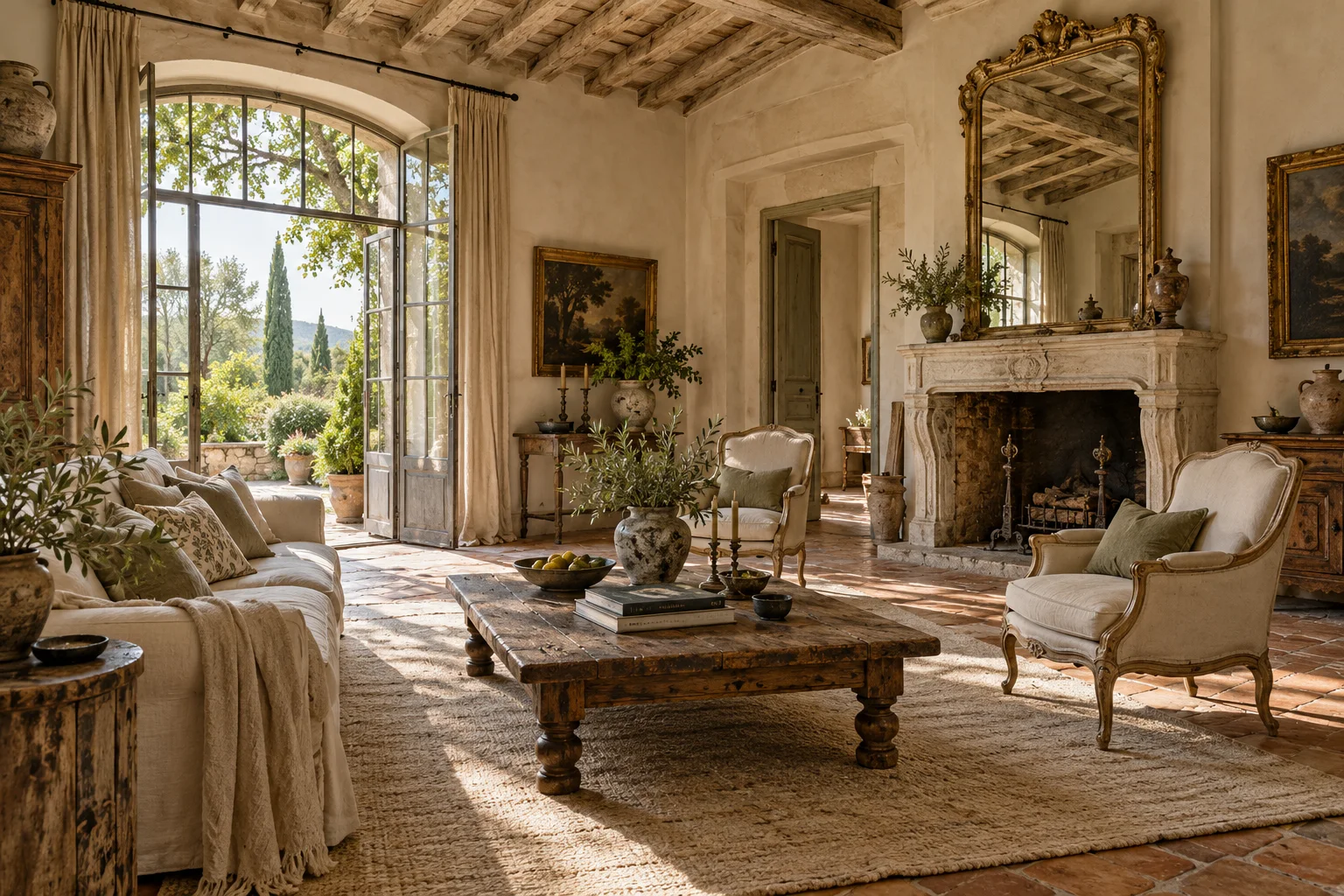 AI-created styling idea
Architectural antiques
Measure the chimney breast and the ceiling before choosing an overmantel mirror.
Explore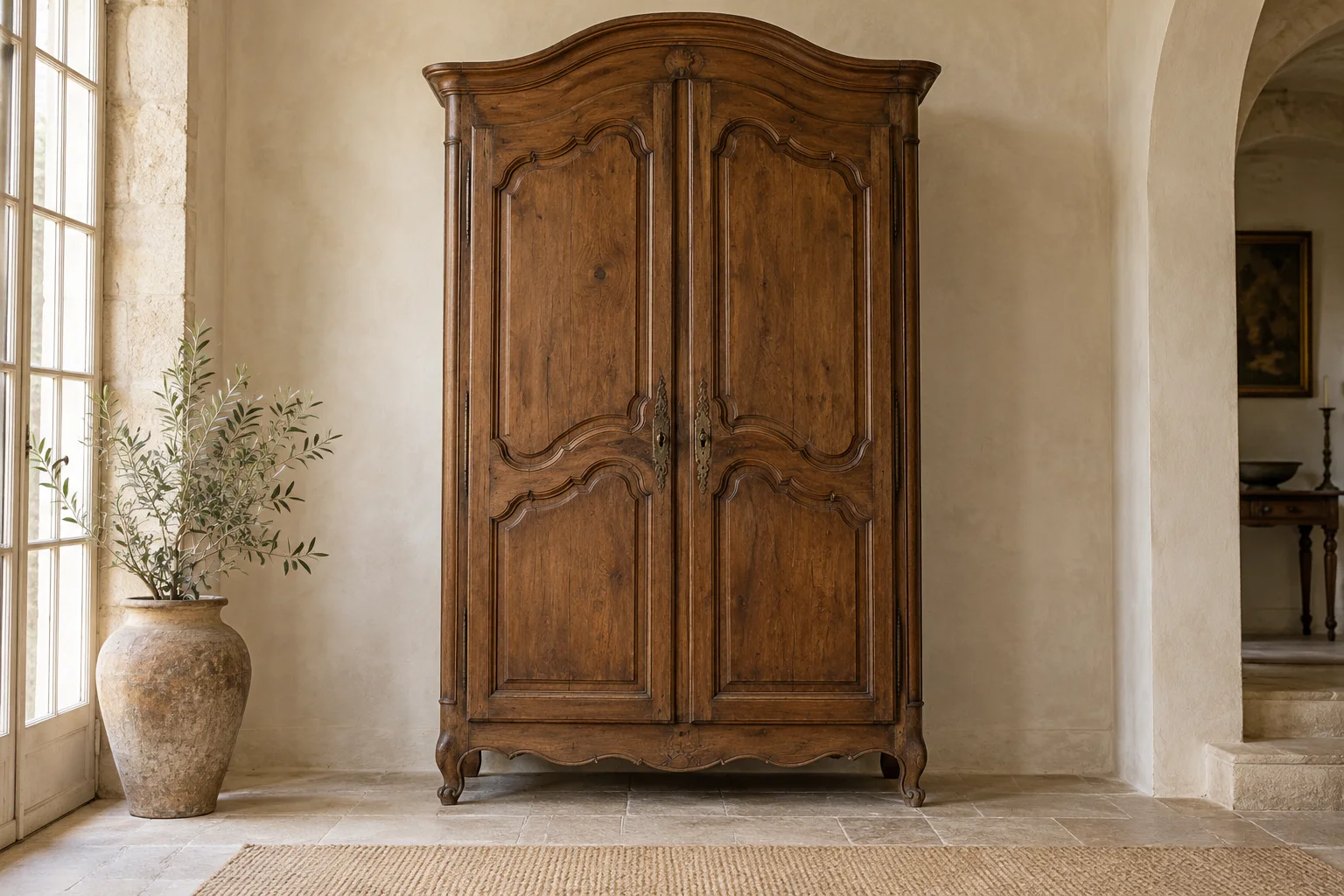 AI-created styling idea
Furniture
On a mirrored armoire, check the door hinges and how the plate is fixed.
ExploreTurn it over first. An old mirror usually has a backboard of aged planks, old nails or wedges, a slightly uneven plate with a hand-ground bevel, and gilding worn on the high points with bole showing through. A plywood back, staples, a perfectly flat plate or uniformly bright gold point to later work. Any period date should rest on a mark, a label or a document, not on style alone.
A pier glass is any tall mirror made for the wall between two windows, often hung above a console. A trumeau is a French mirror with a painting, a carved panel or a second plate above the glass, made for that same wall or for the chimney breast. Many trumeaux served as pier glasses, but not every pier glass has the panel that makes it a trumeau.
An intact mercury plate left in its frame is generally considered a low risk in normal display, but the coating can release mercury if it is sanded, scraped, heated or broken. Never resilver or strip such a plate yourself, handle it with gloves and keep the backboard on. Ask a conservator for help if beads of liquid metal appear in the bottom of the frame or the plate breaks.
Usually not, if the mirror is a period piece. Resilvering removes the original coating for good, and on a mercury plate it is hazardous specialist work. If the reflection is too poor to use, a reversible option is to fit new or antiqued glass and keep the original plate, labeled, with the mirror. For a later decorative mirror, resilvering is a reasonable choice when it is disclosed.
Evidence of period, the survival of the original gilding and glass, the quality of the carving, the size and any documented provenance matter most; a style name alone adds little. Regilding, a replaced plate or a married crest each change the description. Compare documented pieces in similar condition, and ask an independent appraiser for a written valuation rather than relying on asking prices.
Clean the glass with a microfiber cloth that is barely damp with water, wiping the center and staying clear of the edges so no moisture reaches the silvering. Dust the frame with a soft, dry brush. Never use water, sprays, polish or gold paint on the gilding, because water gilding dissolves in water. Leave flaking gesso and loose ornament to a conservator.
Weights vary widely: a 40 by 50 in gilt mirror often weighs 30 to 60 lb (14 to 27 kg), and a large trumeau can weigh far more. Weigh it on a bathroom scale, then hang it on a French cleat or on two D-rings fixed into the sides of the frame, with screws into studs and hardware rated for at least twice the weight.
Antiques over 100 years old may be classified under heading 9706 of the Harmonized Tariff Schedule, which has a zero general rate, but only when the age is documented and customs accepts the classification at entry. Nobody can guarantee it in advance. Ask for written evidence of age, work with a customs broker, and confirm the landed cost, including freight, insurance and fees, before you buy.
Oct 30, 2026 · Antique guide
French country decor ideas work best when each one is concrete: a measurement, a material, a place in the room.
Oct 29, 2026 · Antique guide
A small oval mirror, 10 to 20 in (25 to 51 cm) tall, is the easiest antique to place and the easiest to waste.
Oct 29, 2026 · Antique guide
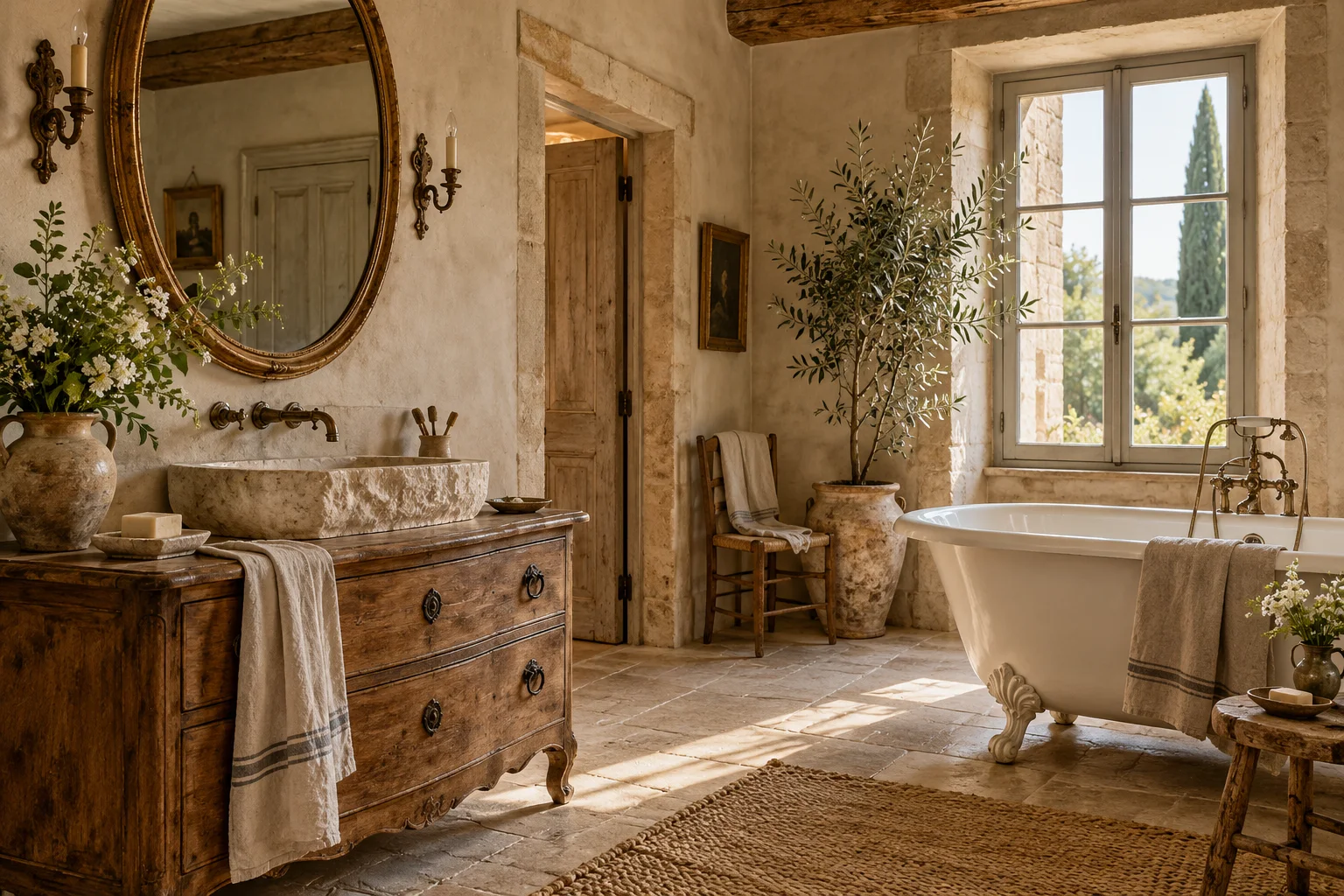
Etched mirrors antique dealers describe as 'frosted' or 'engraved' share one technique: the design is cut into the glass surface so it reads matte against the bright…
Oct 29, 2026 · Antique guide
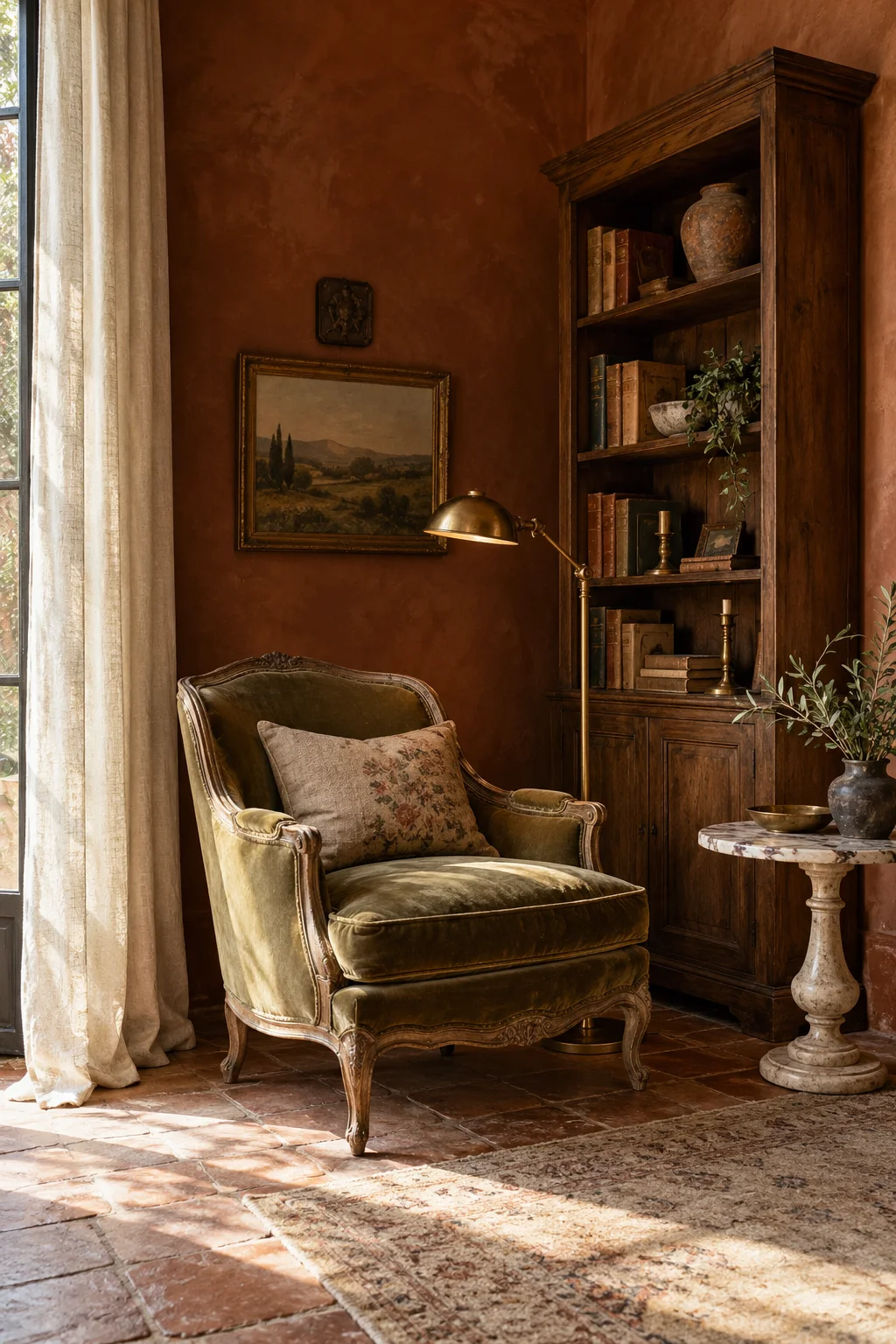
A large ornate mirror changes a room more than any other single antique: it doubles the light, adds a second window and brings carved or composition ornament to walls…
Oct 29, 2026 · Antique guide
A vintage oblong mirror is the workhorse of a country house: a long rectangle, horizontal over a mantel or sideboard, vertical in a hallway or beside a basin.
Oct 28, 2026 · Antique guide
A Venetian glass mirror is a mirror framed in glass: etched or engraved glass panels, rosettes and ribbons are fixed over a wooden carcass with small brass screws and…